Nelumbo nucifera Pink Lady - Sacred lotus
Nelumbo nucifera Pink Lady - Sacred lotus
Nelumbo nucifera Pink Lady
Sacred Lotus, Indian Lotus, Lotus
Back-to-school special offer!
Get €10 off for every €50 you spend! And get up to €40 off on a single order.
How does it work?
1. Shop your favourites
Add your favourite plants to your basket. For every €50 you spend (excluding delivery charges, store credit and the plastic-free option), you’ll receive a €10 voucher.
€50 spent = €10 voucher
€100 spent = €20 voucher
€150 spent = €30 voucher
€200 spent = €40 voucher
2. Place your order
Once your basket reaches one of the spending thresholds, place your order. You can even choose your delivery date!
3. Receive your voucher
As soon as your order has been shipped, you’ll receive an email containing your personal voucher code and its value.
4. Use it on your next order
Your voucher is valid for 90 days from the date you receive it. It can be used once only, on a new order worth at least the value of the voucher, excluding delivery charges.
Please note: Vouchers can be combined with other offers, but cannot be split or refunded.
Why not try an alternative variety in stock?
View all →
Available in 1 sizes
Available in 1 sizes
Available in 1 sizes
Available in 1 sizes

Available in 1 sizes
This plant carries a 6 months recovery warranty
More information
We guarantee the quality of our plants for a full growing cycle, and will replace at our expense any plant that fails to recover under normal climatic and planting conditions.
Description
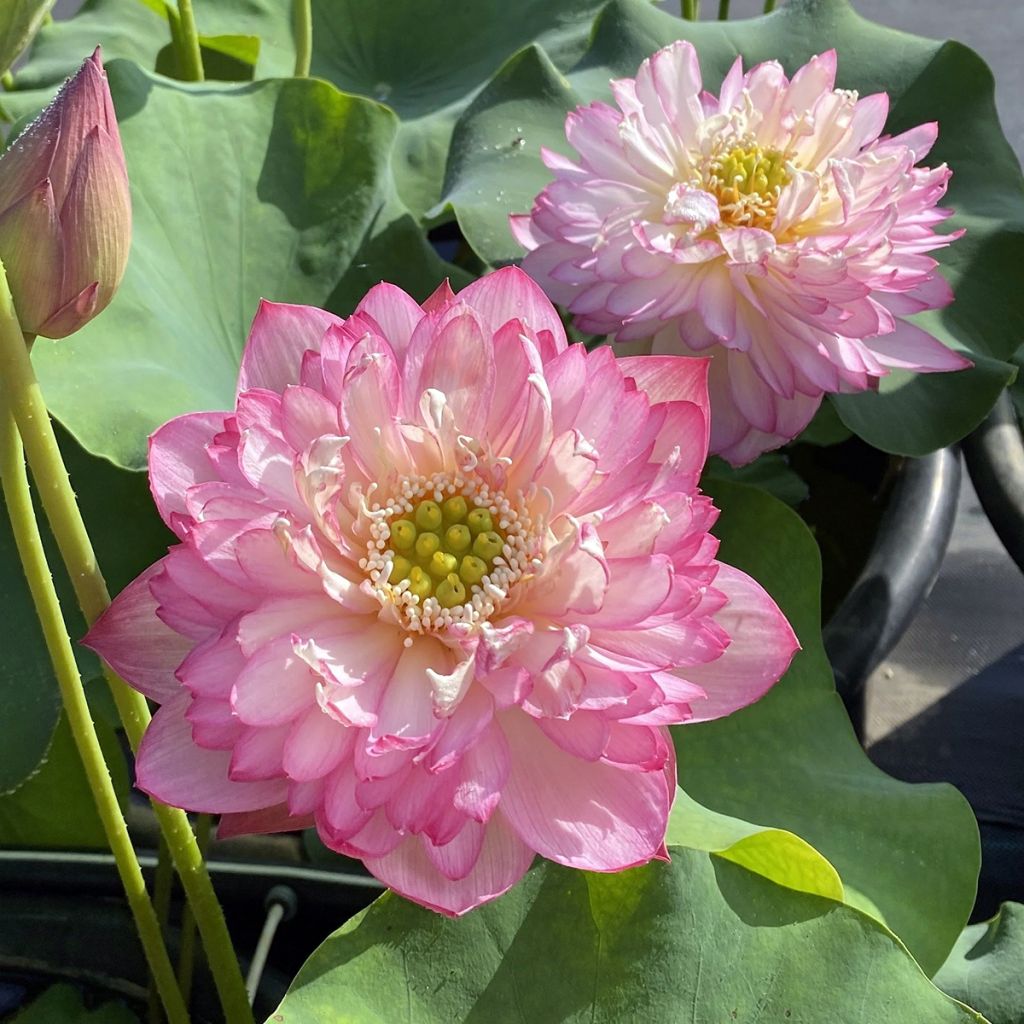
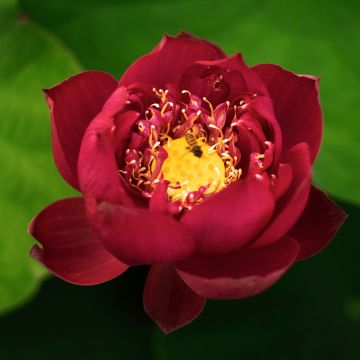
Nelumbo nucifera ‘Pink Lady’ is a large-growing Indian lotus, endowed with a bright pink, very double flowering and luxuriant vegetation, which does not go unnoticed in a pond. This variety produces large flowers in summer, held well above the water by sturdy stems. It is suitable for large ponds, pools, and vast bodies of water. It can also be accommodated in a large-volume aquatic container.
The sacred lotus belongs to the Nelumbonaceae family. The species Nelumbo nucifera is a rhizomatous aquatic perennial that grows in a vast area ranging from Asia to northern and northeastern Australia. It roots in mud or a silty and clayey substrate. In the lotus, the leaves and flowers emerge well above the surface, while water lilies most often have floating foliage. The leaf blades are peltate, almost circular, borne on long petioles and covered with a waxy surface on which water forms beads.
'Pink Lady’ is a horticultural cultivar classified among the large lotuses, with a height of about 1.20 m, or even more. Some American nurseries relate this variety to Thai strains, particularly due to its somewhat oval receptacle. The plant develops ample, bright green aerial foliage. Flowering spreads from July to September. The flowers measure 20 to 30 cm in diameter and have more than 50 petals, placing them among the very double forms. Their colour is a fresh and bright pink that contrasts with the chartreuse green receptacle, clearly visible at the centre of the flower. This cultivar is particularly floriferous. In autumn, the foliage yellows and then disappears, while the rhizome enters dormancy for the winter.
Due to its vigour, ‘Pink Lady’ is not intended for mini-ponds. It should be planted in a large, watertight container, wider than deep, at least 50 cm in diameter, to give the rhizome the necessary space without letting it invade the entire pond. The latter should be covered with 30 to 45 cm of water. This lotus should be grown alone in its container while companion plants are placed at a distance, on the bank, in shallow water, or in another basket. Pontederia cordata ‘White Pike’, Pontederia cordata ‘Pink Pons’, or water lily ‘Gonnère’ can accompany it in an aquatic scene.
This large and beautiful lotus naturally finds its place in a large, very sunny body of water. It will be a main feature and should be given enough space so that its foliage and flowers are clearly visible. Like other lotuses, it partially shades the water and helps provide shelter for small aquatic wildlife. In winter, if the pot is already submerged quite low, it can remain in place; if the pot is exposed to frost, it will need to be lowered deeper once the plant is dormant or sheltered from frost.
Report an error about the product description
Flowering
Foliage
Plant habit
Botanical data
Nelumbo
nucifera
Pink Lady
Nelumbonaceae
Sacred Lotus, Indian Lotus, Lotus
Nymphaea nelumbo, Nelumbo caspica, Nelumbo speciosum, Nelumbo nelumbo, Nelumbo komarovii
Cultivar or hybrid
Planting and care
Aside from a few requirements, cultivating the 'Pink Lady' lotus does not require any special arrangements. Lotus requires a sunny location and enjoys warmth. It can withstand temperatures as low as -12°C, provided it is submerged at a water depth that protects it from frost. Plant the rhizome without breaking it, horizontally, in late spring, in a pot or directly in the mud, under 20 to 45 cm of water. Place the rhizome on a thick layer of rich silt or clay (never use horticultural compost, as it would float to the surface and encourage algae growth).
For shallow ponds, planting in a container is possible, but it will be essential to overwinter the rhizomes in damp sand, protected from frost. The rhizomes can be planted in a wicker basket or a fine mesh wire basket, 50 cm in diameter (wider than it is tall), which is sunk in the required spot. Give them the sunniest spot in the water feature. Space each rhizome at least 2 m apart.
In regions with severe winters, you can keep the rhizome in a damp pot, protected from frost, from October to May.
Never leave Nelumbo rhizomes exposed to sun or air to prevent them from drying out; plant them immediately upon receipt or purchase. If you have fish in your pond, it is preferable to spread a good layer of coarse gravel on the surface of the planted pot to deter them from digging in the soil and thus fouling the water. The development of nelumbos will be optimal if they are planted in containers suited to their growth. Lotuses are greedy plants: apply a balanced, controlled-release fertiliser at planting, and then each year at the start of the growing season, with a duration matching the growing period (for example: Osmocote 10-11-18-2 with a 5-6 month duration). During summer, remove excess leaves that emerge in the centre of the clump, keeping only the most vigorous ones. Also remove those that are yellowed or spotted, as well as any aquatic weeds emerging from the surface. Caution: contact with lotus foliage can cause an allergic reaction on the skin!
Monitor for aphid infestations on the foliage. Introduce ladybird larvae or spray black soap onto the foliage. Remove yellowed leaves at the end of summer.
Planting period
Intended location
Care
Planting & care advice
-
-
-
-
-

-
-
-
This item has not been reviewed yet - be the first to leave a review about it.
Recently viewed products
Haven't found what you were looking for?
Hardiness is the lowest winter temperature a plant can endure without suffering serious damage or even dying. However, hardiness is affected by location (a sheltered area, such as a patio), protection (winter cover) and soil type (hardiness is improved by well-drained soil).
In temperate climates, pruning of spring-flowering shrubs (forsythia, spireas, etc.) should be done just after flowering.
Pruning of summer-flowering shrubs (Indian Lilac, Perovskia, etc.) can be done in winter or spring.
In cold regions as well as with frost-sensitive plants, avoid pruning too early when severe frosts may still occur.
The harvesting period indicated on our website applies to countries and regions in USDA zone 8 (France, England, Ireland, the Netherlands).
In colder areas (Scandinavia, Poland, Austria...) fruit and vegetable harvests are likely to be delayed by 3-4 weeks.
In warmer areas (Italy, Spain, Greece, etc.), harvesting will probably take place earlier, depending on weather conditions.
The sowing periods indicated on our website apply to countries and regions within USDA Zone 8 (France, UK, Ireland, Netherlands).
In colder areas (Scandinavia, Poland, Austria...), delay any outdoor sowing by 3-4 weeks, or sow under glass.
In warmer climes (Italy, Spain, Greece, etc.), bring outdoor sowing forward by a few weeks.
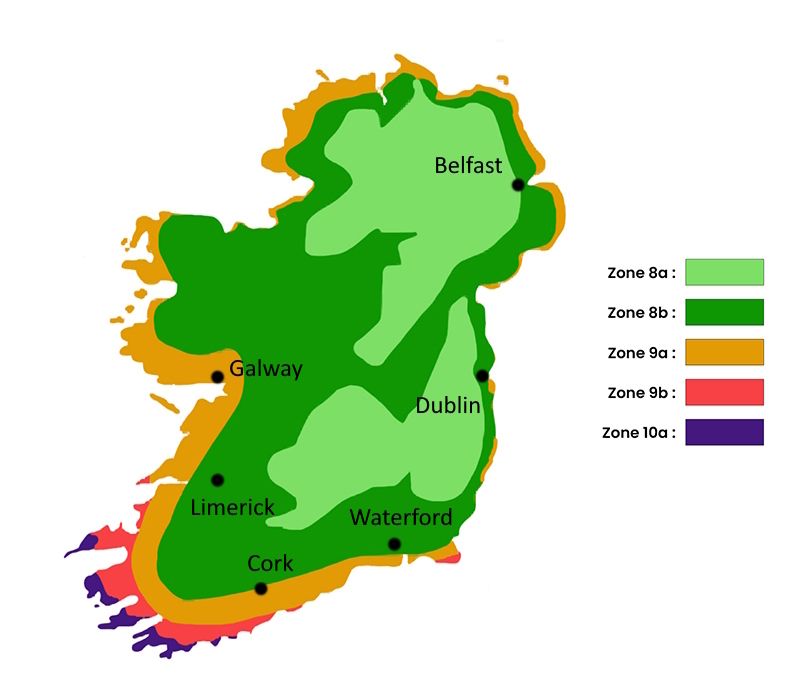
The planting period indicated on our website applies to regions in USDA Zone 9a (East Coast and Midlands: Dublin, Wexford, Waterford, Kilkenny, Portlaoise). It will vary depending on where you live:
- On the west coast and in the north-west (Galway, Limerick, Sligo, Donegal, Westport), delay planting by 1 to 2 weeks in spring and bring it forward by 1 to 2 weeks in autumn compared to the dates given, preferably choosing periods without strong winds.
- In the inland hills and plateaus (Wicklow Mountains, Macgillycuddy’s Reeks, Connemara, Killarney), it is best to plant in spring (April–May) or autumn (September–October), avoiding periods of waterlogged soil in winter and strong winds, which pose the main risk to newly planted trees in these areas.
The flowering period indicated on our website applies to regions in USDA Zone 9a, such as the East Coast and Midlands, including Dublin, Wexford, Waterford, Kilkenny and Portlaoise.
This will vary depending on where you live:
- On the west coast and in the northwest (Galway, Limerick, Sligo, Donegal and Westport), it will be delayed by one to two weeks compared to the given dates, due to stronger Atlantic winds and less spring sunshine.
- In the inland hills and plateaus (the Wicklow Mountains, the Macgillycuddy's Reeks, Connemara and Killarney), flowering will be delayed by two to three weeks. Flowering mainly occurs between May and July, with the limiting factors being less frost and more of the excessive humidity, strong winds and lack of sunshine that are characteristic of these areas.
Shipping country and language
Your country of residence may be:
Your country of residence is:
For a better user experience on our website, you can select:
Your shipping country:
-
 Austria
-
 Belgium
-
 Bosnia & Herzegovina
-
 Bulgaria
-
 Croatia
-
 Cyprus
-
 Czechia
-
 Denmark
-
 Estonia
-
 Finland
-
 France
-
 Germany
-
 Greece
-
 Hungary
-
 Iceland
-
 Ireland
-
 Italy
Italy
-
 Latvia
-
 Liechtenstein
-
 Lithuania
-
 Luxembourg
-
 Malta
Malta
-
 Netherlands
-
 Poland
-
 Portugal
-
 Romania
-
 Serbia
-
 Slovakia
-
 Slovenia
-
 Spain
Spain
-
 Sweden
-
 Switzerland
Language:
-
French
-
 English
-
Spanish
-
Italian
-
German
-
Portuguese
-
Dutch
-
Finnish
My Account
Hello
My wish lists
My cart
Log in / Register
Existing customer?
This form is protected by reCAPTCHA - the Google Privacy Policy and Terms of Service apply.
New customer?
Create an account to track your orders, access our customer service and, if you wish, make the most of our upcoming offers.