





























Choosing a witch hazel
and plant this beautiful bush with winter flowering in the garden
Contents
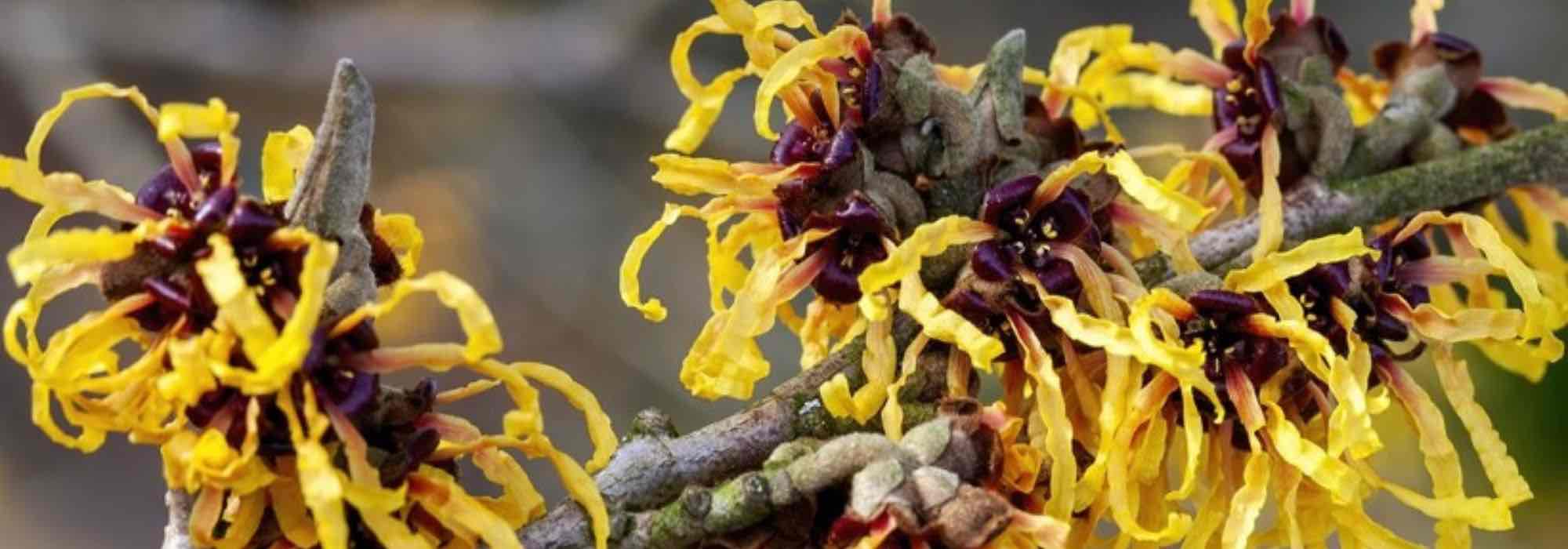
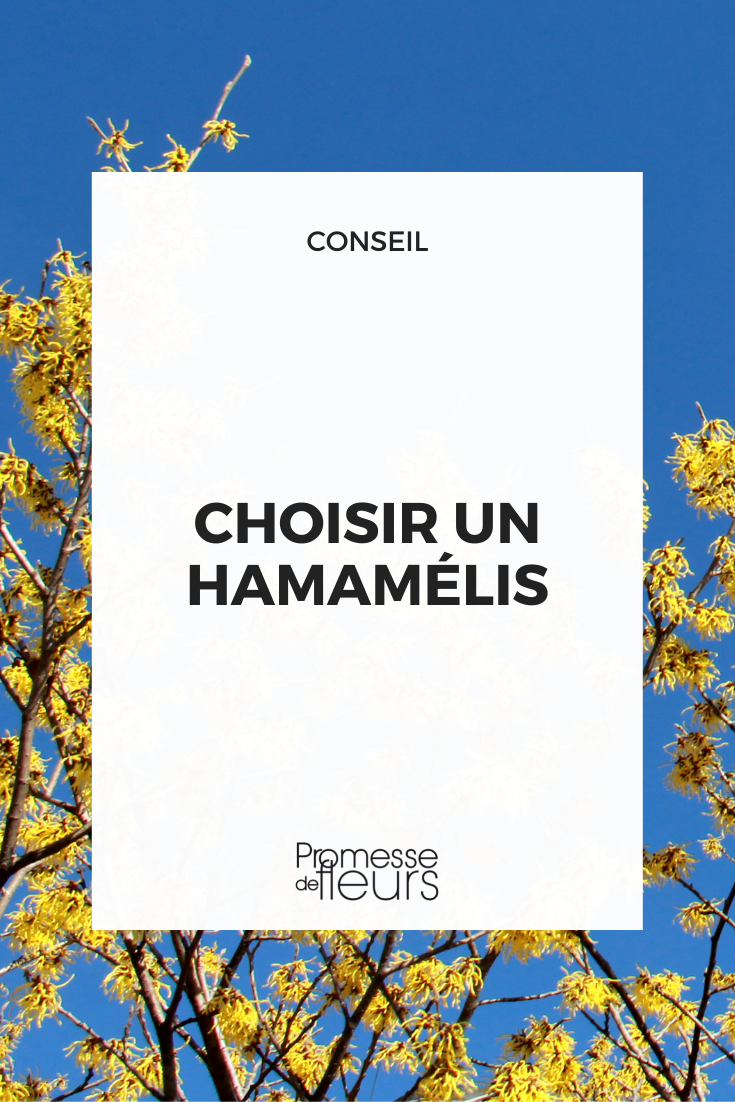
Witch hazels or Hamamelis are beautiful bushes that are not seen often enough. However, their modest size allows them to be planted in the smallest gardens or in pots on a terrace. Deciduous, they lose their foliage after setting autumn ablaze with a thousand golden, orange, coppery, and glowing hues. This is only to make us appreciate their beautiful and astonishing flowering in winter, on their naked branches. They bloom in frizzy, clustered filaments, with a spicy colour and a scent of lemon tea and honey. What could be better in winter?
They enjoy winter sun to bloom and prefer to be sheltered in summer when it is hotter. Known as heather soil shrubs, they thrive in acid to neutral, well-drained, and cool soil. Discover our different species and varieties of witch hazels and how to distinguish them.

Choose by size
Witch hazels are generally homogeneous in terms of their size. Depending on the species and varieties, they measure between 2 m and 4 m in height at ripeness and are as wide as they are tall. If you have a small garden, be aware that the smallest are those of the American species Hamamelis vernalis, such as the selections ‘Amethyst’ and ‘Washington Park’, which reach 2.5 m in height with an equivalent width. This is also true for Hamamelis japonica ‘Pendula’, with its weeping and compact habit.
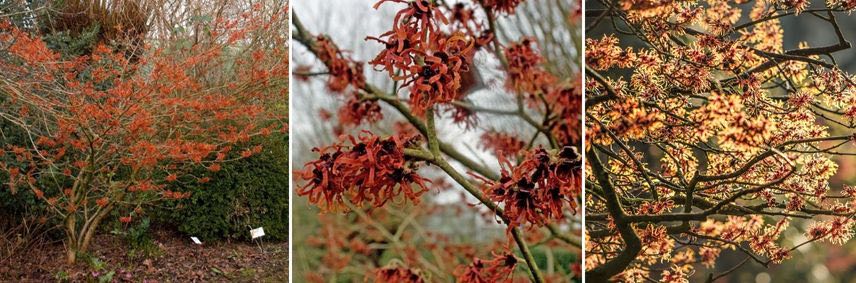
The habit of witch hazel and its filamentous flowering
According to the colour of the flowers
Witch hazels, formerly known as witch hazel, display their quirky flowering made up of frizzy filaments in warm, spicy colours (saffron, copper, brick), ranging from yellow, orange, red to purple. The Hamamelis x intermedia, commonly cultivated, are the result of a cross-breeding between two Asian species: Hamamelis mollis and Hamamelis japonica. They bear larger flowers than their respective parents. Notably, the flowers are very frost-resistant.
Witch hazels with yellow flowers
The lighter varieties flood their bare branches with a winter flowering in pale yellow like the Hamamelis japonica ‘Pendula’, in golden yellow like the Hamamelis x intermedia ‘Arnold Promise’ with particularly frizzy flowers, and ‘Westerstede’. Others are in sulphur yellow, like ‘Aurora’, while the Hamamelis mollis ‘Pallida’ shines in bright yellow.
Witch hazels with orange flowers
The witch hazels with orange flowers are the spiciest, blending several shades. The flowers of the Hamamelis x intermedia ‘Feuerzauber’ have long petals of a coppery orange, suffused with red, and are tinged with purple at the base. Also among the Hamamelis x intermedia, ‘Jelena’ offers coppery orange and ochre yellow flowers with a garnet red calyx, while ‘Aphrodite’ presents a bold rust orange.
Witch hazels with red flowers
The beautiful witch hazels with red flowers include the Hamamelis x intermedia ‘Ruby Glow’, which adorns itself with a winter flowering of coppery red filaments on a crimson red calyx. In the case of the Hamamelis x intermedia ‘Diane’, the flowers are red-orange to dark red, on a brown-purple calyx, with slightly undulated petals.
Finally, witch hazels with purple flowers
The Hamamelis vernalis are native to North America. The Hamamelis vernalis ‘Washington Park’ offers purple-red flowers, just like the Hamamelis vernalis ‘Amethyst’, in old rose purple.
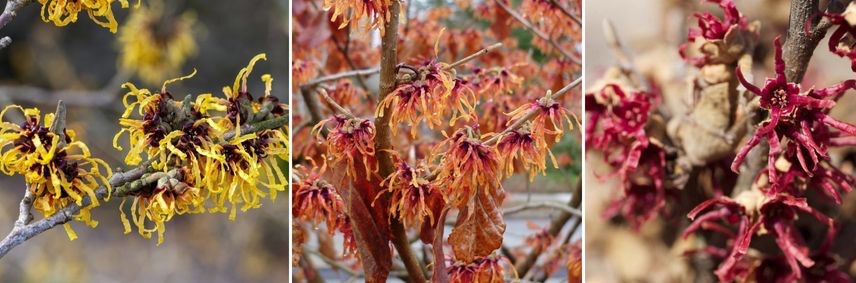
Different witch hazel flowers: Hamamelis x intermedia ‘Aurora’ and ‘Jelena’, Hamamelis vernalis ‘Amethyst’
Discover other Winter-flowering shrubs
View all →
Available in 1 sizes
Available in 1 sizes
Available in 1 sizes
Available in 1 sizes
Available in 1 sizes
Available in 1 sizes
Available in 1 sizes

Available in 1 sizes
Available in 1 sizes
Available in 1 sizes
Witch hazel with the most fragrant flowering
Witch hazels are kind enough to offer a delightful fragrance that features the tangy scents of citrus trees, as well as hints of tea and honey. In the winter sky, one is quickly drawn to such aromas. One witch hazel stands out for its fragrance, and that is the Hamamelis mollis ‘Pallida’, the most fragrant of all, exuding a powerful scent of honey.
According to the colour of the foliage
Among the trees and bushes whose foliage adorns itself with beautiful autumn colours, the witch hazels are certainly included. The Hamamelis x intermedia ‘Aphrodite’ changes little in colour after summer, while all the others don their finest attire.
Among their beautiful autumn foliage, there is the bright yellow leaf edged with red at the top of the leaf of Hamamelis x intermedia ‘Arnold Promise’ and Hamamelis mollis ‘Pallida’, after a summer of light green. ‘Aurora’ ignites in scarlet red after passing through yellow and orange. The other varieties of Hamamelis x intermedia play with a varied palette, always consisting of yellow and orange, but also brick, green, copper, and purplish hues for the more daring.
The Hamamelis vernalis display grey-green foliage in spring and summer. ‘Amethyst’ and ‘Washington Park’ produce their first bronze-coloured leaves, which then darken to grey-green in summer, before showcasing a lovely coppery orange hue, and ultimately a blazing red. With ‘Amethyst’, the leaves persist on the tree for a long time before falling.

The autumn foliage of Hamamelis x intermedia ‘Arnold Promise’, ‘Aurora’, and ‘Ruby Glow’
According to the flowering period
Apart from Hamamelis virginiana, which blooms as early as autumn, the other witch hazels finally decide to show us their wild little dishevelled flowers during a period from December to March. Most bloom in January and February. A few emerge early with their flowers as soon as December, such as Hamamelis x intermedia ‘Diane’ and Hamamelis mollis ‘Pallida’.
Others wait until February and March to delight us, such as Hamamelis x intermedia ‘Feuerzauber’, ‘Westerstede’, ‘Aphrodite’, ‘Aurora’, and Hamamelis japonica ‘Pendula’.
According to the uses
If there is a bush that can be planted in gardens of all sizes or even in pots on the terrace, it is certainly the witch hazel, with its modest, well-balanced, and rather spreading growth. It is a pleasure to create a winter scene around it, allowing you to enjoy the beauty of the garden during this season often deemed desolate. After its autumn flamboyance, its joyful flowering can be observed from the window, snug inside the house, and on sunny days, it is a delight to go and smell its sweet fragrance.
As a standalone or in a pot
Plant it as a standalone or in a pot on the terrace to highlight its features. Ensure it receives enough sunlight or very good light in winter, and that it is sheltered from the scorching sun in summer. It can be placed, for example, in front of a backdrop of hedges or dark conifers against which its vibrant colours stand out. In a thoroughfare, you can also enjoy its fragrance.
In a heather soil mass
Combine it with plants of similar needs in a carefully prepared soil. Camellia, Sarcococca, Daphne scented, Pieris, Loropetalum, all make good companions.
For a colourful winter scene
Enjoy other colourful shrubs in winter such as decorative Cornus and Edgeworthia, another delight of this season, to create a lovely winter scene with the presence of perennials and bulbs at their feet, such as Hellebores and the lovely Eranthis hyemalis. Add some evergreen plants with decorative fruits.
Also consider Japanese-style beds, to which its silhouette and atypical flowering lend themselves well, as well as more natural and rustic atmospheres.

In autumn, against a backdrop of asters. In winter, in front of a dark wall and a conifer, at the edge of a woodland
- Subscribe!
- Contents
Comments