





























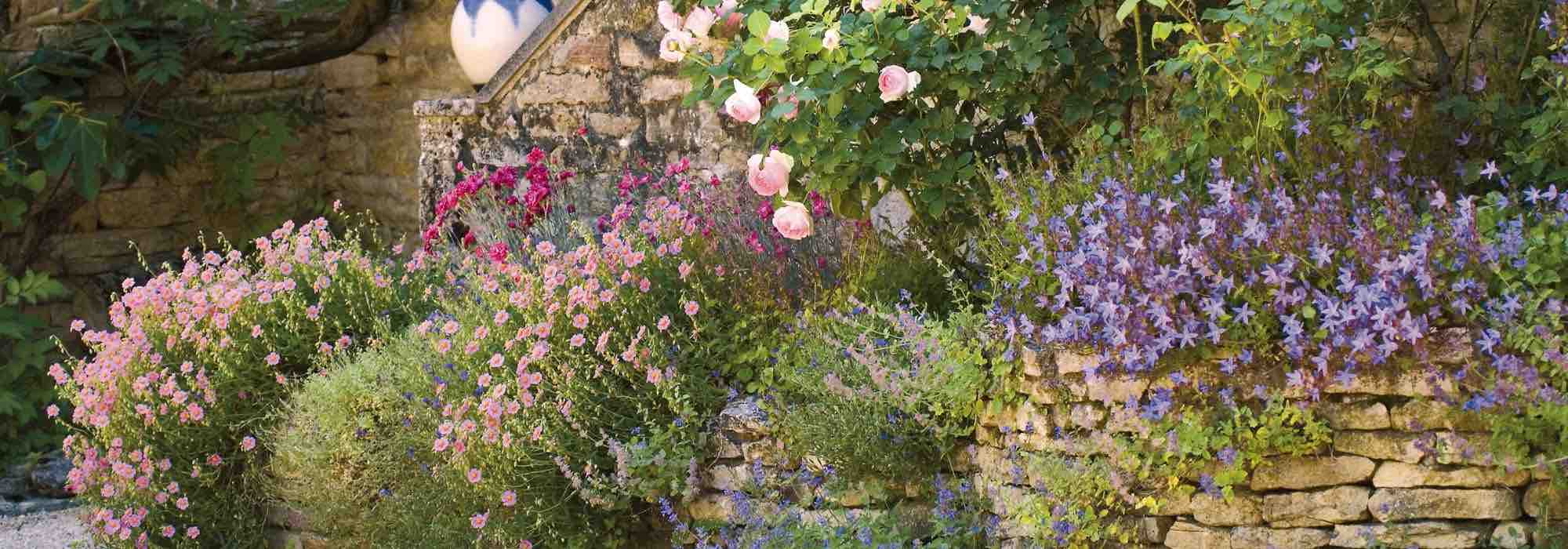
8 perennial plants that tolerate drought and heat for a romantic garden
A romantic garden in dry soil
Contents
The evolution of climate compels us to rethink our approach to gardening. We are noticing that our plants are suffering with increasingly dry and hot summers. For those who appreciate romantic atmospheres, one might wonder which perennial plants for full sun and romantic gardens can tolerate high temperatures and dry or unwatered soil for a while. We can also reverse the question and ask which drought-tolerant perennials can beautifully adapt to our desires for romance and softness.

Some hardy geraniums
Some hardy geraniums are particularly drought-resistant, such as the species sanguineum, cantabrigiense and cinereum, but overall, hardy geraniums are quite resilient. We should also mention erodiums, cousins of geraniums, which are of Mediterranean origin and thrive in dry conditions. Hardy geraniums are reliable and tolerant plants in many situations. A perfect romantic garden plant, position the geranium alongside all perennials, particularly those that follow, either in the foreground or in the middle of the border.
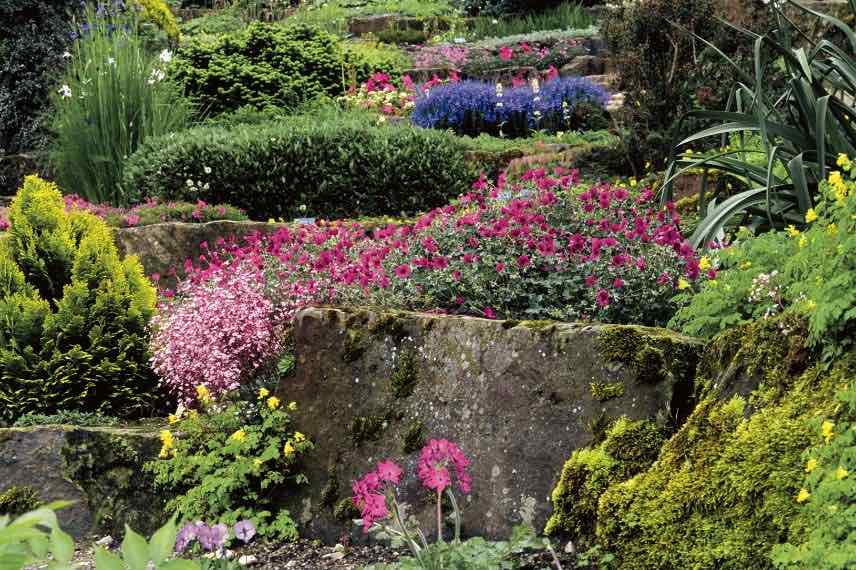
Here, a Geranium cinereum in a deep pink
Read also
Pairing ideas with ErodiumsDianthus or Carnations
Pink or Dianthus, with their charming lace-like flowers, are lovely perennial plants that are drought-resistant and thrive in well-drained soil. Consider particularly the dwarf varieties, which are well-suited for rockeries. Pinks display single or double flowers, in frilled pompons with undulating petals or flat single blooms, in shades of white, pink, and red, sometimes soft yellow. They brighten up the front of a border or a romantic edge. For example, pair Dianthus plumarius with double pompon flowers, such as ‘Scent First Iced Gem’, ‘Doris’, or ‘Cranmere Pool’ with Geranium sanguineum, Gypsophila repens or paniculata, and Phlox subulata, the dwarf species for rockeries.
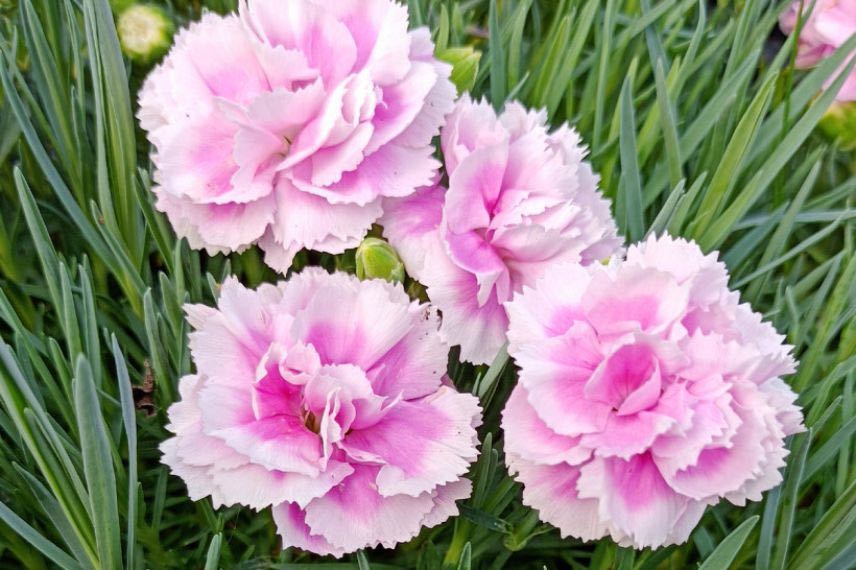
Dianthus ‘Scent First Iced Gem’
Discover other Drought-tolerant perennials
View all →
Available in 1 sizes
Available in 1 sizes
Available in 1 sizes
Available in 1 sizes
Available in 1 sizes
Available in 1 sizes
Available in 1 sizes
Available in 1 sizes
Available in 1 sizes
Available in 1 sizes
Penstemons
Sun perennial with delicate flowering, the Penstemon is generous, blooming from spring to autumn in violet, pink, red, and purple. It is quite drought-resistant, although it produces fewer flowers under such conditions. It requires well-drained soil and is sensitive to winter moisture. Charming and often contrasting with a light throat, its flower resembles that of the foxglove; it is a lovely perennial to lighten a bed of more opulent flowers. The hybrid Penstemon ‘Alice Hindley’ offers lovely lilac flowers, while ‘Apple Blossom’ features candy-pink blooms. Pair the Penstemon with a Rose and a Salvia nemerosa such as ‘Ostfriesland’.

Penstemon ‘Evelyn’ and Achillea ‘Lilac Beauty’, a soft pink colour scheme
Iris germanica
Much more opulent, the full sun outdoor plant, the Iris germanica or garden iris, loves sunlight and well-drained, dry soils, unlike other species of iris, which prefer some or a lot of moisture. It offers a very wide range of contrasting colours, from pure white to black purple, including splendid coppery hues and electric blues. These large crumpled and luminous flowers are stunning in a romantic border, for example, with a Hardy geranium ‘Rozanne’ and poppies.
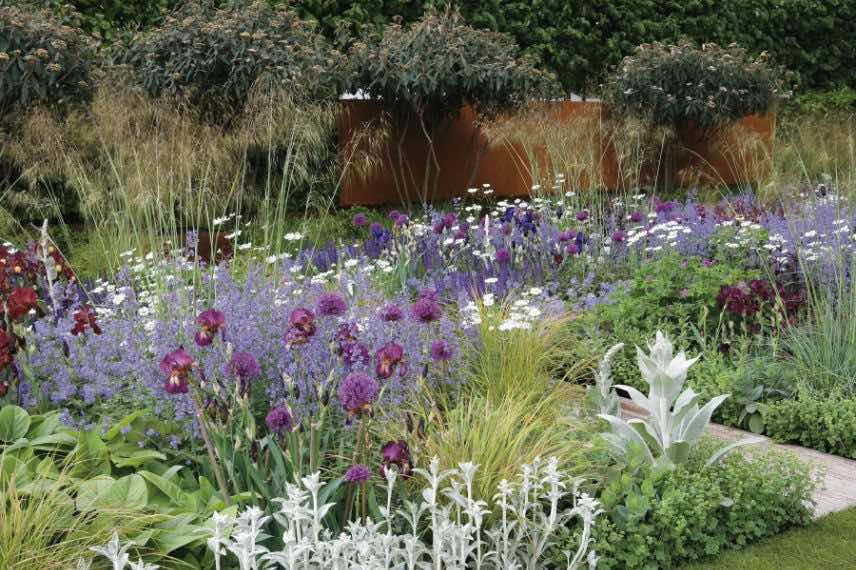
Iris germanica at the Chelsea Flower Show with Nepetas, Stachys, Allium, Stipa: all plants for dry soil. The blur of the Nepetas and the light from the Stachys can be a source of inspiration for a romantic border (photo Nicole and Patrick Mioulane – MAP)
Sedums
The Sedums or Autumn Stonecrops are medium-sized perennials, highly drought-resistant, that thrive in dry, well-drained soils and reward us with a much-anticipated late summer flowering, featuring more or less round or flat umbels of flowers in slightly cooked tones: purple, brown, as well as brighter raspberry shades. Their foliage is equally attractive, beautifully succulent, in soft green or olive, or greyish, bluish hues. These plants blend into all settings, particularly the lovely range of romantic colours. They highlight lighter flowers by contrast. Their foliage often takes on purple or bronze tones in autumn, and the flowers, once flowering is over, remain decorative in faded brown shades. For a romantic garden, you might prefer varieties with green foliage and pink flowers for the freshness of their colour. For example, Sedum ‘Mr Goodbud’, the Sedums spectabile: ‘Brilliant’, ‘Carl’, ‘Carmen’, ‘Meteor’.
Also consider the Achilleas, well-known for their drought resistance, with varieties in white (except for Achillea ptarmica, which prefers moist soils) in various shades of pink and bluish reds, which can complement many romantic-style plants.
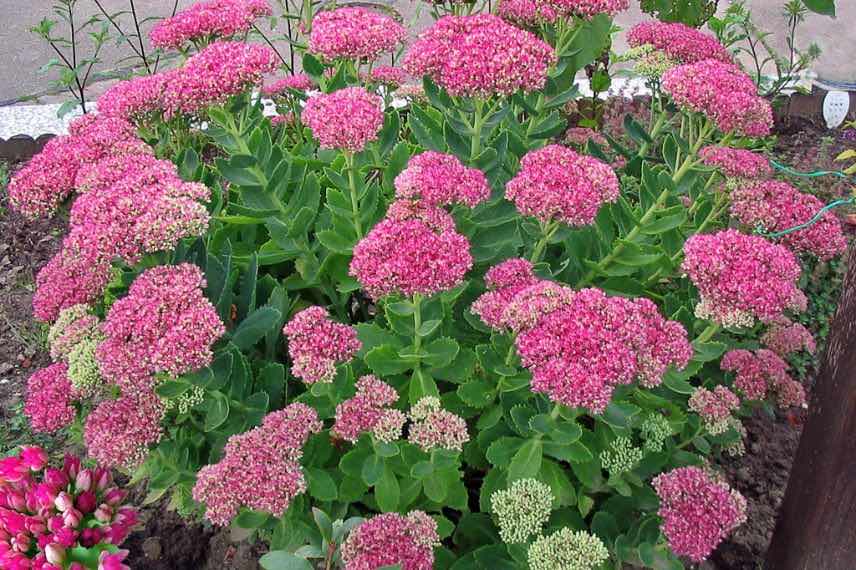
Sedum spectabile ‘Meteor’
Oriental poppies
Perennial Oriental poppies, with their beautiful, somewhat heavy flowers in shades of salmon, purple, pink, or white, are lovely plants for your romantic gardens. They prefer well-drained soils, as they are sensitive to stagnant moisture and can tolerate summer drought. With their crinkled petals and large flower on a single stem, they give an impression of fragility, but are actually robust plants that can thrive in poor, stony soil. A full sun plant, consider the varieties ‘Patty’s Plum’, ‘Perry’s White’, ‘Queen Alexandra’, or ‘Helen Elisabeth’.
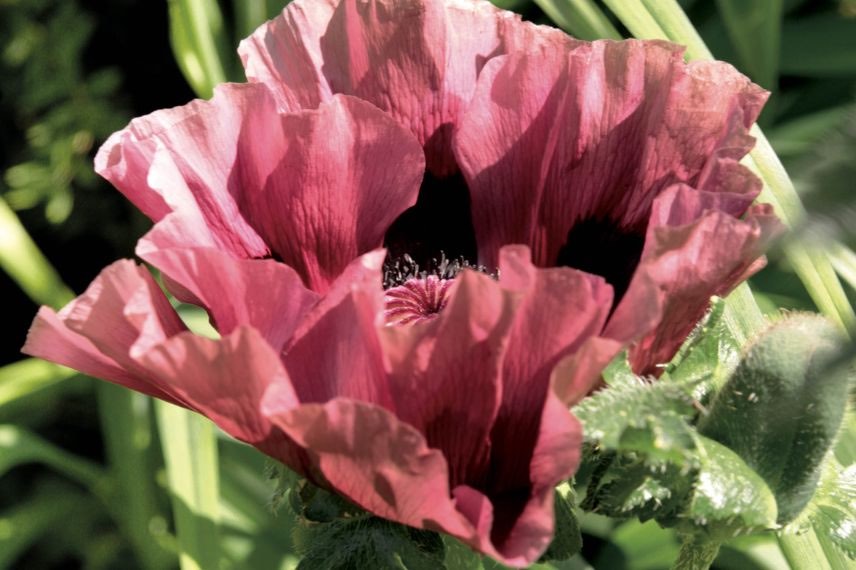
Papaver orientale ‘Patty’s Plum’
Lavateras
Lavateras, whose flowers resemble those of Hibiscus, are, however, easier to grow in dry, well-drained soil. They are generally hardy down to temperatures of around -10° to -12° C. Generous and floriferous, they produce fairly large single flowers in wide, flared corollas, in very soft shades of pink and white, or in a more vibrant pink. For example, try Lavatera Barnsley or Lavatera maritima alongside large Sedums or autumn Orpins, or Achilleas.

Lavatera, Achillea and Rose
Cenalophium naked
Let’s finish with a lesser-known plant that deserves more recognition: the Cenalophium denudatum, or Baltic Parsley, is an umbellifer with finely divided foliage and a very light, prolific flowering that lasts for many months. It readily establishes itself in any style and type of garden, accepting all soils and requiring no watering once established. Its inflorescences, about 10 cm wide, transition from pale green to white from June to October. It forms a bushy clump reaching 1 m in height and 60 cm in spread within a few years. Its charm beautifully complements plants in a romantic garden border, whether in full sun or partial shade.
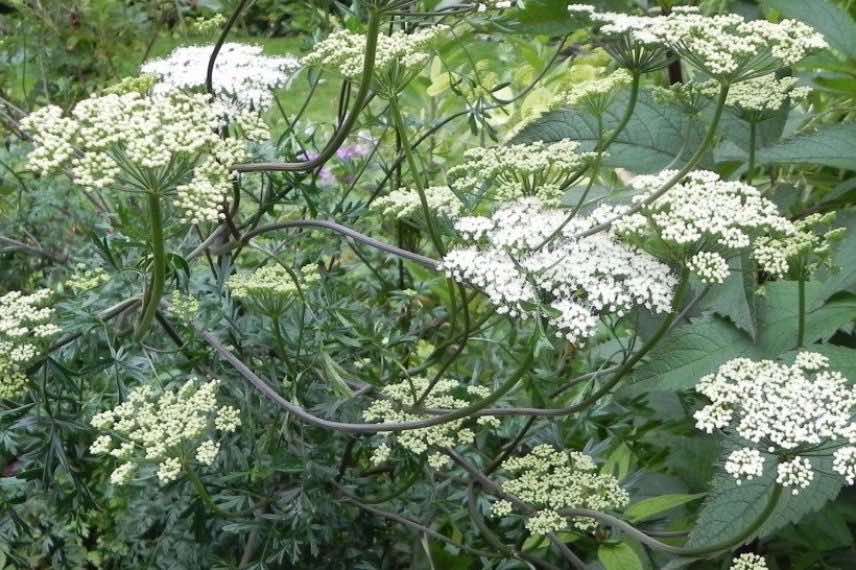
Cenalophium denudatum
- Subscribe!
- Contents
Comments