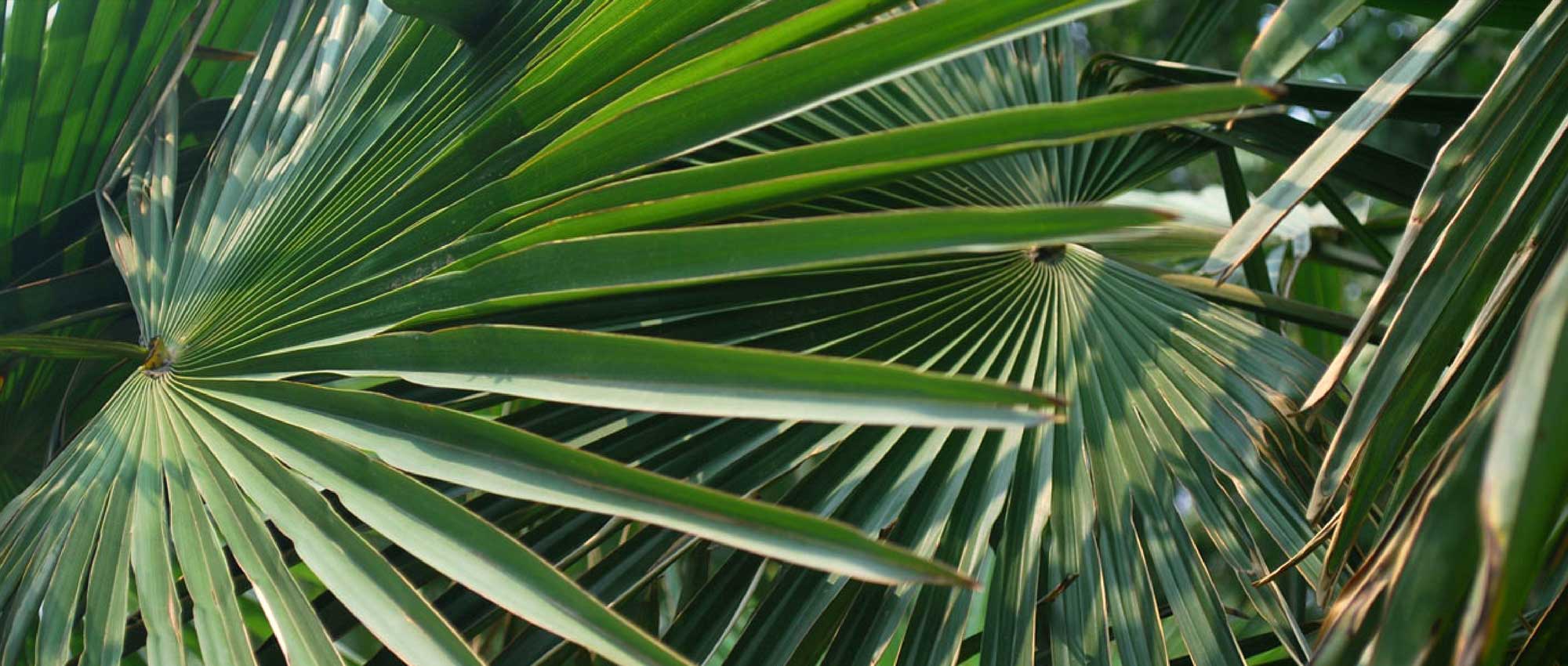
Palms: how to plant, grow and care for them
Contents
Palms in a nutshell
- Palms have a majestic silhouette that immediately adds a touch of the exotic!
- They have a very straight, imposing trunk topped with luxuriant foliage
- They bear very large leaves, which can be pinnate or palmate
- Palms are very striking plants
- They generally prefer sunny positions and well-drained soil
- It is the perfect plant to bring a touch of the exotic to the garden!
- Some species are very hardy and can easily be grown in open ground in northern France.
A word from our expert
Les palms are truly plants apart: they form a large plant group, the family Arecaceae, and are immediately recognisable – they do not resemble other plants. They impress with their majestic silhouette, made up of a very straight stipe, at the top of which a crown of leaves unfolds. These are always very large, taking the form of palms (palmate leaves) or feathers (pinnate leaves). Often green, they can also take beautiful bluish or grey hues.
There are many palm varieties: the superb Phoenix (including date palms and Canary Island palms), hemp palms (sometimes called Chinese palms), as well as Washingtonia, and dwarf palms Chamaerops humilis… There are also indoor palms, such as Areca, but here we will focus mainly on outdoor palms for the garden.
They will obviously be easier to grow if you live in the Mediterranean region; however some palms resist cold very well and are suited to outdoor cultivation even in northern France! They are planted in spring, in a sunny, wind-sheltered spot, and in a well-draining substrate. Small palms can be grown in a pot or container and placed on a terrace! In the ground they require little maintenance, but need more attention when grown in a pot. In that case, water occasionally, feed with a little fertiliser and repot on average every three years.
Palms are plants that impress and fascinate. They can lift us out of gloom and grey skies and transport us to sunshine. They make us dream by instantly bringing a touch of the exotic to the garden. The mere mention of palms is enough to evoke a postcard scene, a paradisiacal beach with its coconut palms and turquoise water… So, why not add a touch of exoticism to your garden?

Description and botany
Botanical data
- Latin name Trachycarpus sp., Chamaerops sp., Washingtonia sp. ...
- Family Arecaceae
- Common name Palm
- Flowering often in spring or summer
- Height very variable, often up to 15-20 metres
- Sun exposure full sun
- Soil type well-drained, rather sandy
- Hardiness very variable. Down to −20 °C for the hardiest
Palms are plants with an upright, imposing trunk called a stipe, topped by a crown of large, pinnate or palmate leaves. They are a distinct, ancient group, highly diverse. They make up the botanical family Arecaceae, comprising between 2,500 and 2,700 species across 185 different genera.
Palms have a wide global distribution: many species originate from Indonesia and Southeast Asia, others from Africa or the Americas. Only two palms grow wild in Europe, in the Mediterranean region: Chamaerops humilis and Phoenix theophrasti. Numerous species are also found on islands in the Indian Ocean. Their presence on islands and in mild-climate regions has made them a true symbol of holidays, leisure and exoticism.
In the wild, palms occupy very varied habitats. Some come from tropical forests, others grow in deserts, and others in mangroves (such as Nypa fruticans)… They can grow by the sea as well as at altitude (for example on the Andes).
Valued for the exotic touch they bring, palms have found a place in gardens, and are also cultivated for food or craft uses: rattan, raffia, coconuts, dates, palm oil, vegetable ivory… palms have many uses!
Palms are not trees: they are generally unbranched, do not have wood or branches, and rarely increase in diameter, growing mainly in height. Botanically, they are better considered giant herbs than trees. The palm trunk is called a stipe. It is actually made up of the bases of the petioles, which accumulate as the plant grows.
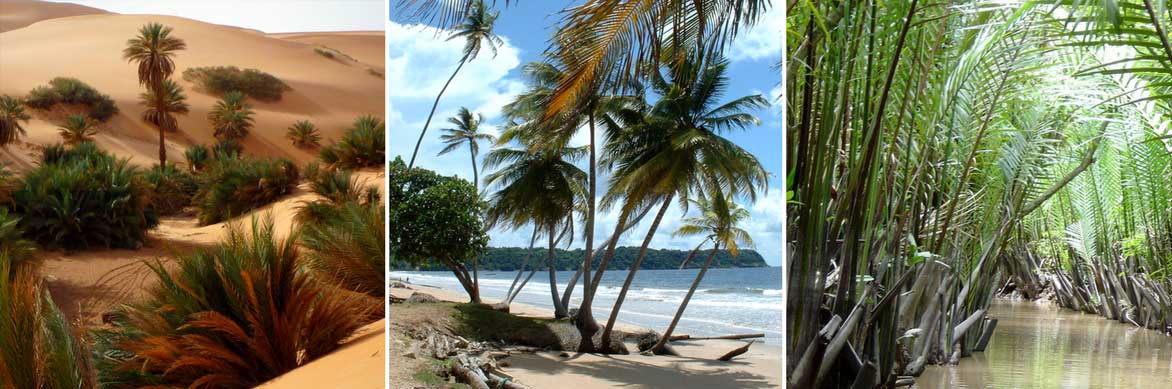
In the wild, palms grow in varied habitats. The date palm (Phoenix dactylifera) is found in desert regions (photo Franzfoto), the coconut palm (Cocos nucifera) on seashores (photo Kalamazadkhan), while Nypa fruticans grows in mangroves (photo Luis Argerich)
Palms have only an apical bud at the top of the stipe, which allows them to gain height. Once the stipe is formed, it can hardly increase in diameter (except in a few cases where cells swell with water, giving the trunk a little extra thickness…). If the terminal bud dies, the palm will be doomed, since it can no longer grow.
Palm shape is characteristic. Most have a long, very straight and imposing stipe topped by a tuft of leaves. It is rare for palms to be branched: usually there is a single stipe. However, some species form clumps and have a bushy habit, such as Chamaerops humilis. Nannorrhops ritchieana is also a cespitose palm that produces several stipes. There are even climbing palms, such as those in the genus Calamus! The stipes of climbing palms can reach 180–200 metres in length. They usually cling to other plants using their spines.
Palm height is very variable. The most commonly grown in gardens reach 15–20 metres, but there are also dwarf palms, such as Chamaerops humilis, which has a bushy habit. In nature there are no strict rules: the largest species reach 50–60 metres, while the smallest measure only a few dozen centimetres in height.
The stipe can be quite thin or very massive. It is often very straight, although coconut palms seen on beaches often have curved, sometimes strongly leaning stipes. The Chilean wine palm (Jubaea chilensis) has a particularly massive, very smooth stipe, which can measure four metres in circumference at the base!
In some species, such as Trachycarpus fortunei, the stipe is covered with brown fibres. Leaves may leave scars that remain visible on the trunk, creating patterns (horizontal marks, diamonds or other). Palms of the genus Hyophorbe have a swollen stipe, earning them the common name bottle palm. Some species have bright red trunks, such as those in the genus Cyrtostachys. The stipe can also be very spiny, as in Trithrinax campestris!
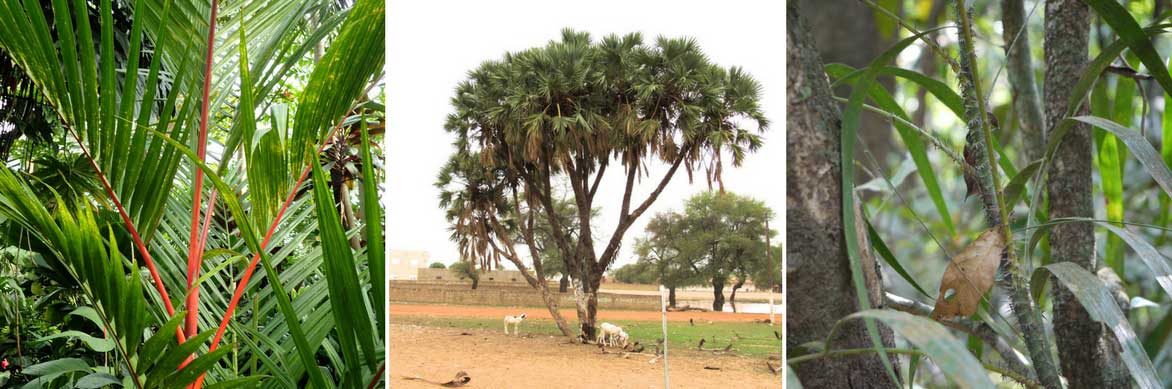
Palms form a large group, some individuals of which stand out for their originality. The bright red stipe of Cyrtostachys renda (Krzysztof Ziarnek, Kenraiz), the branching stipe of Hyphaene thebaica (photo Malcolm Manners), and the climbing palm Calamus thwaitesii (photo Dinesh Valke)
Most palms flower in spring or summer. Their flowers are grouped in more or less branched inflorescences, sometimes very impressive! They are generally located in the axils of the lowest leaves, but can also emerge from within the leaf crown or appear terminally.
The flowers are small, often white, cream or yellow. They consist of three sepals, three petals, generally six stamens, sometimes many more. Most of the time, flowers are unisexual. They are pollinated by insects or by wind.
Some palm species bear only male or only female flowers on the same plant: they are dioecious. This is the case for Trachycarpus fortunei. Male and female plants are required to obtain seeds. Other palms carry both male and female flowers on the same plant: they are monoecious. This is the case for Sabal palmetto.
Palms have very large, thick, leathery leaves. They are divided into segments that are narrow and elongated, sometimes pointed at the tip. Leaflets are often pleated. Leaves may also bear filaments, linear fibres, as in Washingtonia filifera. Leaves of Licuala grandis are barely divided and form true fans!
In general form, palms have two main leaf types: leaves are often palmate (fan-shaped), but they can also be pinnate (feather-like, with a central axis and segments on each side). When pinnate, leaves are often gracefully arched. Those of Trachycarpus and Chamaerops are palmate, while those of Phoenix or Butia are pinnate. Sometimes leaves take an intermediate form, called costapalmate: fan-shaped but with a central axis. Some are even more unusual, like those of Caryota mitis, the fishtail palm. Leaves are generally green but can take bluish or greyish tints, and sometimes green–yellow.
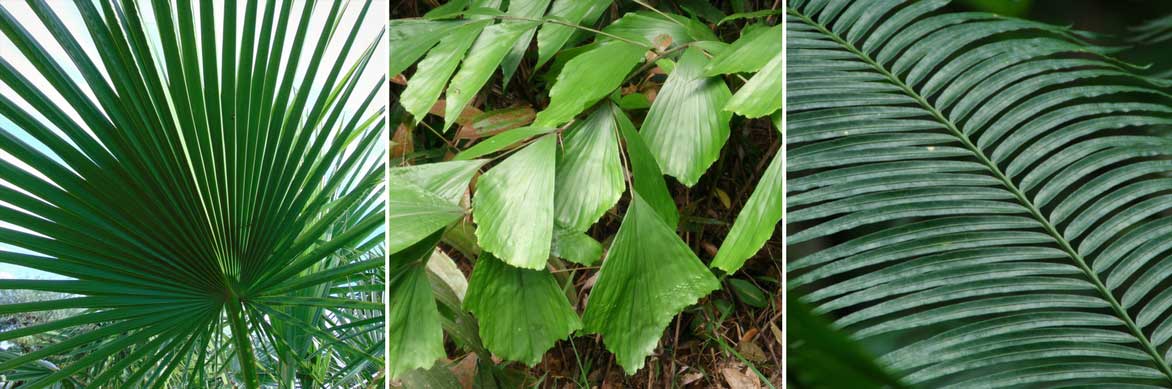
The palmate leaves of Washingtonia robusta, the distinctive fishtail foliage of Caryota mitis (photo Mokkie), and the pinnate leaves of a Phoenix (photo Wiethase Hendrik)
Leaves attach to the stipe via a thick petiole, which can be very spiny. Sometimes the base of the petiole remains on the trunk after the leaf falls. When leaves drop, they may leave scars and patterns on the trunk. It is also common for old, dry leaves to remain attached to the stipe. This is the case with the skirted palm, Washingtonia filifera. They form thick layers of dead leaves. For aesthetic reasons they are often removed, trimmed to give a “clean” look. However, these leaves insulate and protect the trunk. It is preferable to leave them in place.
Palms have numerous long, fasciculate roots. They are sparsely branched and do not increase in diameter, but they penetrate deeply into the soil. There is a palm with large aerial roots (stilt roots), Socratea exorrhiza.
Fruits and seeds of palms are extremely varied. Fruits are berries or drupes. They can be enormous, like the seeds of the double coconut (Lodoicea maldivica), or tiny. Some species produce edible fruits: dates (fruits of Phoenix dactylifera) or coconuts. The fruit of the genus Phytelephas yields vegetable ivory, which can be carved into jewellery, buttons or objects. Palm oil comes from the nut of Elaeis guineensis, now intensively cultivated. Coconuts are adapted to float and be dispersed by the sea, enabling the coconut palm to colonise new islands.
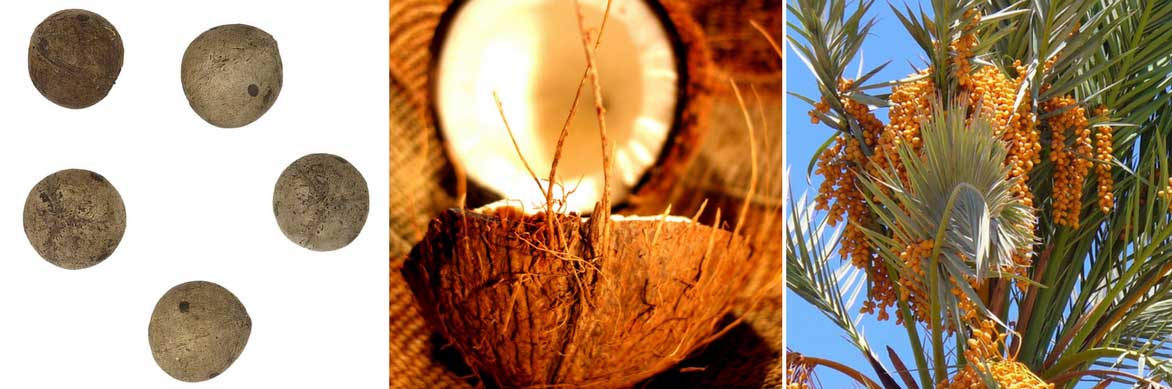
Seeds of Butia capitata (photo Roger Culos – Museum of Toulouse), a coconut (photo Nicolai Schäfer), and dates: fruits of Phoenix dactylifera (photo Bernadette Simpson)
Some species do not tolerate freezing temperatures, while others are quite hardy (Chamaerops humilis, Trachycarpus fortunei…). Rhapidophyllum hystrix can even withstand −20 to −25 °C! Discover our collection of cold-hardy palms!
Conversely, some palms can be grown indoors all year round, such as the kentia, Howea forsteriana, a common houseplant, as well as Chamaedorea elegans or some Dypsis species.
Main palm varieties
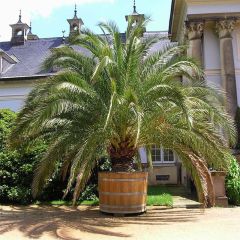
Phoenix canariensis - Canary Island Date Palm
- Flowering time August, September
- Height at maturity 15 m
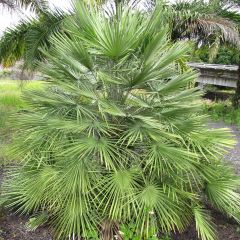
Chamaerops humilis - Dwarf Palm
- Flowering time July, August
- Height at maturity 3,50 m
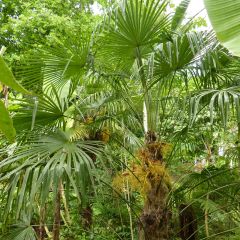
Trachycarpus fortunei - Chinese Windmill Palm
- Flowering time August to October
- Height at maturity 8 m
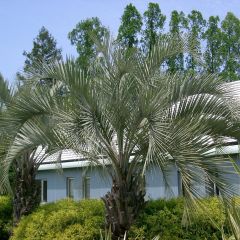
Butia capitata - Wine Palm
- Flowering time July, August
- Height at maturity 5 m
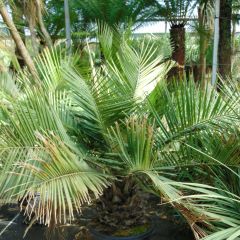
Jubaea chilensis - Chilean Wine Palm
- Flowering time July, August
- Height at maturity 13 m
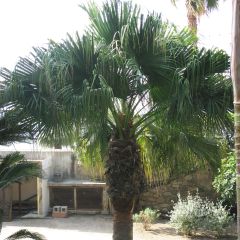
Washingtonia filifera - California Fan Palm
- Flowering time August, September
- Height at maturity 17 m
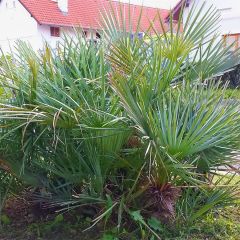
Chamaerops humilis var. cerifera - Dwarf Fan Palm
- Flowering time July, August
- Height at maturity 3 m
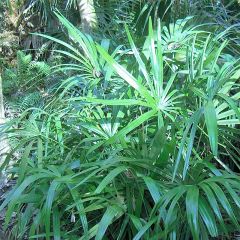
Rhapidophyllum hystrix - Needle Palm
- Flowering time July, August
- Height at maturity 3 m
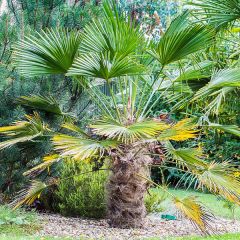
Trachycarpus wagnerianus - Dwarf Chusan Palm
- Flowering time July, August
- Height at maturity 6,50 m
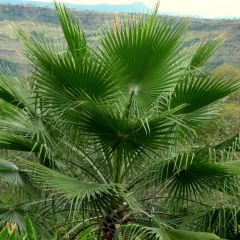
Washingtonia robusta - Mexican Fan Palm
- Flowering time August, September
- Height at maturity 24 m
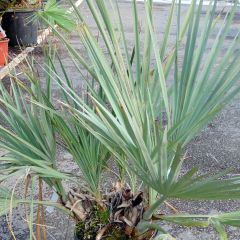
Nannorrhops ritchiana Silver
- Flowering time August, September
- Height at maturity 10 m
Discover other Palm trees
View all →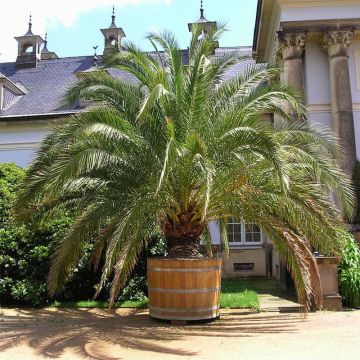
Available in 5 sizes
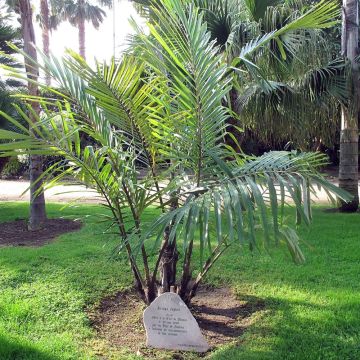
Available in 1 sizes
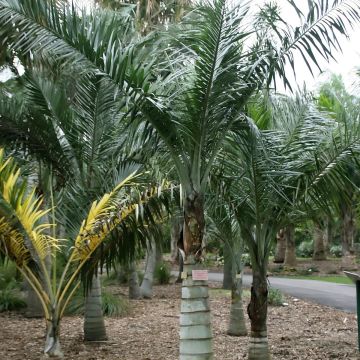
Available in 1 sizes
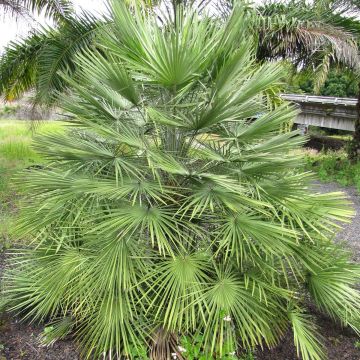
Available in 4 sizes
Available in 1 sizes
Available in 1 sizes
Available in 1 sizes
Available in 1 sizes
Available in 2 sizes
Available in 2 sizes
Planting a palm tree
Where to plant?
Palms represent a large, diverse group of plants. They do not all have the same needs. Some prefer rather arid conditions, others cool or humid environments. Most species enjoy full sun, but a few will prefer shade or partial shade. It is important to check the growing requirements of the species you want to plant. Also, once established, palms do not like to be moved.
Most palms prefer full sun, as they need plenty of light. Avoid exposing them to scorching situations. There are also species that can be planted in shade, such as Trachycarpus fortunei. Likewise, in southern France, Rhapidophyllum hystrix will appreciate being placed in shade or partial shade.
Palms need a very free-draining soil. They do not like stagnant moisture, and heavy, clay soils make them more susceptible to cold. They prefer rather sandy soils. Do not hesitate to improve drainage when planting by adding gravel or pumice, or plant on a mound to encourage water runoff.
Most palms prefer free-draining soils, but again this depends on the species you are growing (there are always exceptions!). For example, Nypa fruticans, which grows wild in mangroves, will appreciate having its roots in the water!
Palms favour soils relatively rich in mineral elements, although Chamaerops can grow in poor soil. They also like deep soils.
Choose, if possible, a position sheltered from wind, because wind can damage leaves and make palms more sensitive to cold and drought. Some species tolerate sea spray very well and can therefore be planted in a seaside garden. This is the case, for example, with Phoenix canariensis or Chamaerops humilis.
You can grow smaller palms in containers (such as Chamaerops humilis…), and place them, for example, on a terrace. This is a good solution if you live in a region with a harsh climate, or if your palm is not very hardy, because you can move it into a frost-free shelter for the winter. Place a drainage layer at the bottom of the pot, and choose a substrate that is both free-draining and fairly rich (potting compost, garden soil and sand).
Palms can sometimes make excellent houseplants, such as Howea forsteriana or Chamaedorea, which can easily be grown indoors all year round. With their upright, imposing and majestic silhouette, palms are also very good as lining plants. They set off the lines of an avenue beautifully.
Choose a suitable spot with enough room to allow the palm to develop properly. If you only have a small garden, avoid growing the largest palms, such as Jubaea chilensis.
When to plant?
We recommend planting your palm in spring, between April and June. You can plant a little earlier if you live in the Mediterranean region. Planting is still possible in summer, but avoid planting in autumn or winter, because palms need warmth to establish.
How to plant?
- Place the root ball in a tub of water for a few moments.
- Dig a planting hole two to three times the size of the root ball. You can add gravel or pumice to the bottom of the hole to improve drainage. Add a little compost to enrich the soil, or a slow-release fertiliser.
- Position the root ball, placing the base of the trunk at ground level or very slightly above (take care not to bury the collar).
- Backfill with soil around the palm, and firm down.
- Water thoroughly. You can form a watering basin.
Continue to water regularly during the first year.
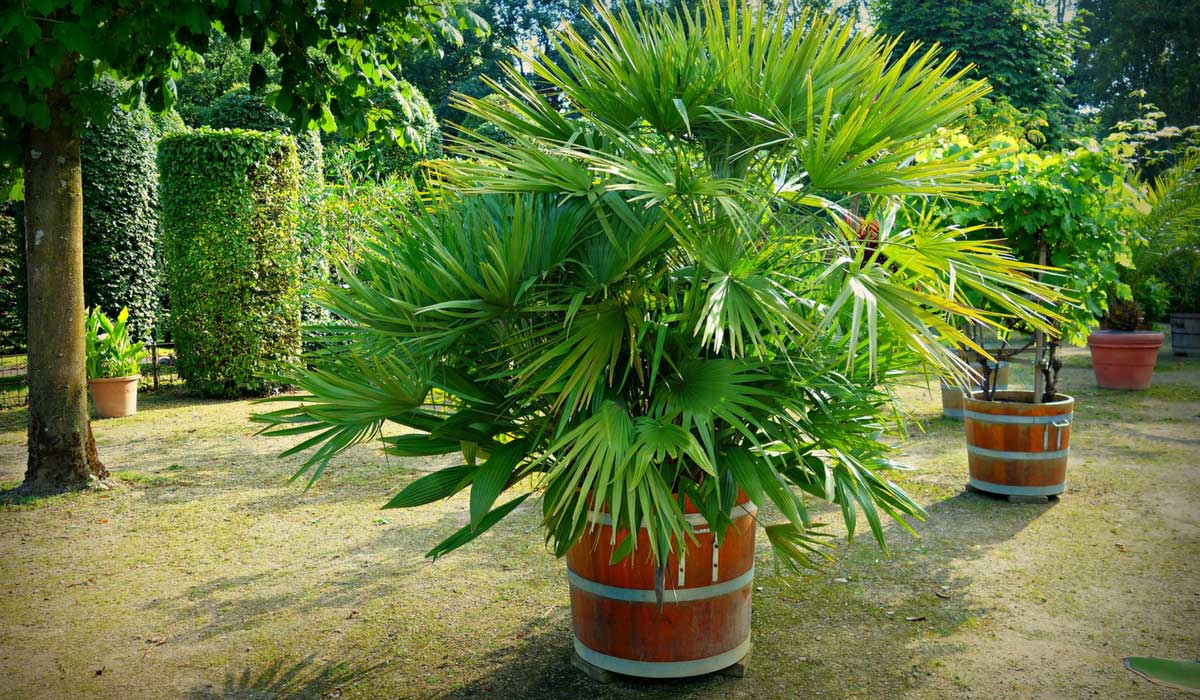
A Chamaerops humilis in a pot
Caring for palms
If you plant them in the ground and choose hardy species, palms are very easy to grow. When grown in pots, they require a little more attention than when grown in the ground. They are more fragile, more sensitive to cold and drought, and need more fertiliser, etc.
Water regularly during the year of planting. In subsequent years, water only occasionally during prolonged dry spells. Palms will need more frequent watering if grown in pots, because the potting mix dries out much faster. Ensure it stays moist without becoming waterlogged, and do not allow water to stagnate in the saucer. You can reduce watering in winter. Most palms appreciate fairly humid air: if conditions are particularly dry, you can mist the foliage. This is especially important for palms grown indoors, since the air in houses and flats is much drier than outdoor air.
Palms are quite hungry for nutrients. We recommend applying a fertiliser or well-rotted compost, especially for container-grown specimens. You can also feed your palm with horn meal, guano or blood meal.
Not all palms have the same cold tolerance. Some tolerate –15 °C, while others cope very poorly with freezing temperatures. Check the hardiness of the one you are growing! Some species need winter protection against the cold, especially during the first two or three years. Young palms are more sensitive to cold than mature plants. For example, you can wrap them in a fleece. For winter, bring into a greenhouse or indoors those palms grown in tubs if they are not very hardy or if you live in a cold area. Place them in a bright spot and mist the foliage if the air is dry. You can put them back out in spring, first in part shade before moving them into sun, to acclimatise them gradually and avoid scorching the foliage.
If you grow your palm in a tub, you will need to repot regularly, on average every three years to renew the potting mix and move the plant into a slightly larger pot each time. In years when you do not repot, consider top‑dressing to refresh the surface compost.
→ Gwenaëlle explains in detail, with photos, how to repot an indoor palm easily.
Pruning palms is mainly for aesthetic reasons and is not strictly necessary. We generally advise against it, as palms can do perfectly well without it, and pruning can attract pests. If you do need to prune, do so between November and March (outside the flight period of pests), make light cuts and apply a wound‑sealing paste. You can perform what is called a “pineapple cut”, trimming the petioles fairly far from the stipe. This leaves the bases of the petioles as protection against cold, and the plant retains the nutrient reserves stored in those tissues. If you cut the stipe of a palm, this is likely to be fatal, because at the top of the trunk there is a single terminal bud that allows the palm to grow. Removing this terminal bud may condemn the palm.
For aesthetic reasons, it is sometimes recommended to cut away dead leaves that remain attached to the stipe (visible for example on Washingtonia filifera). However, these leaves have their uses: they form an insulating layer that protects the palm from cold and pests. It is preferable to leave them in place.
Diseases and pests of palms
Palms are sometimes attacked by the palm moth Paysandisia archon. Native to South America, it has spread around the Mediterranean basin and is causing serious damage in southern France. Caterpillars tunnel into the stipe. Leaves become damaged, holed, turn yellow, dry out and deform. Palms have another enemy: the red palm weevil (Rhynchophorus ferrugineus), a beetle native to Asia. Again, larvae tunnel into the stipe or into palm leaves. Infected palms can die rapidly.
→ read: “Controlling red palm weevil”
You can spot these pests by a crown of leaves that sags, falling fronds, desiccation or perforation… As soon as you notice their presence, you must report it to your local council and take steps to eradicate the pest. Given the damage they cause, control of these pests is compulsory.
→ read: “Palm moth Paysandisia archon – control and treatment”
When grown indoors or under glass, palms are sometimes attacked by red spider mites and scale insects. For scale insects, spray with black soap. As for red spider mites, they favour dry atmospheres: we recommend misting the foliage. Finally, palms can be attacked by the palm leaf beetle, Pistosia dactyliferae, whose larvae attack the heart of the plant.
They are sometimes affected by the fungus Chalara paradoxa, which rots the terminal bud and can cause the palm to die. They can also be affected by other cryptogamic diseases such as Phytophtora palmivora or Fusariosis.
→ Also consult our advice sheet: Nematodes for palm pests: why and how to use them in the garden?
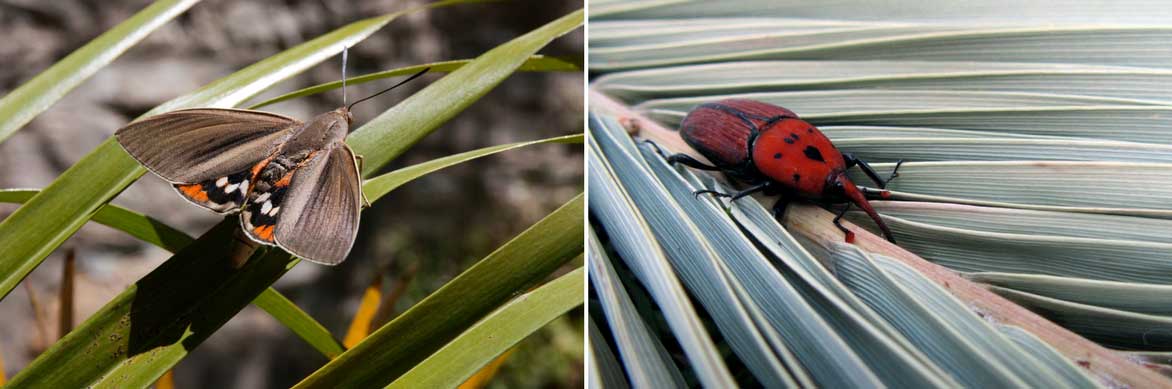
Palm moth Paysandisia archon (photo Daniel Villafruela) and red palm weevil Rhynchophorus ferrugineus (photo Katja Schulz)
Propagation: sowing palm seeds
Palms are mainly propagated by sowing, although some species (such as Chamaerops humilis) produce offshoots that can be removed to propagate the plant.
Sowing
Seeds vary greatly from one palm to another, both in size and in germination protocol or storage longevity. We recommend checking germination requirements specific to the species you wish to propagate. Some palms take a year to germinate, while others germinate within weeks. Some require a preliminary soak in lukewarm water, others need a period in the refrigerator before sowing (stratification). Others still require seeds to be brushed, cleaned or have their skin removed. Likewise, depending on species, humidity and temperature requirements differ. Palms form a very large and diverse group, so generalisations are difficult.
It is preferable to sow seeds in spring, and to do so if possible shortly after harvesting. Some seeds remain viable for several years, others quickly lose viability.
- Before sowing, place seeds in lukewarm water for at least 24 hours, or even two to three days, changing the water daily. This aids germination. For some species, a period in the refrigerator will favour germination.
- Prepare pots by filling them with a free-draining substrate, for example a mix of potting compost and sand. Choose fairly tall pots, as in some species the first radicles that appear grow deeply into the substrate.
- Remove seeds from the water, rinse them and sow.
- Cover them with a layer of substrate.
- Press down lightly.
- Water with a fine mist.
- Optionally place a lid or a plastic bag over the pot to maintain a humid atmosphere.
Place your seedlings in a bright spot but out of direct sun, at a temperature of at least 20 °C. Again, check species-specific growing conditions: some palms prefer temperatures between 25 and 30 °C, which will be too high for others. Substrate should remain cool until germination; keep it moist regularly using a spray bottle. Be patient: germination can be quite slow in some varieties.
You can then pot on young shoots once they are about 10 cm tall.
Acclimatise your palms gradually to sun by taking them outside occasionally before finally placing them in full sun. Palms grow slowly at first during early years; growth speeds up thereafter.
Companion planting in the garden
For an exotic-feeling garden, we recommend planting palms alongside other plants with an exotic appearance. Create a lush area by favouring impressive, graphic foliage such as castor bean (Ricinus), Tetrapanax papyrifera, banana (for example, Musa basjoo) or Colocasia ‘Pink China’… Also discover the superb, both graphic and colourful, foliage of Phormium. If you have a water feature, plant Gunnera manicata or tree ferns nearby. Also enjoy the bright foliage of the ornamental grass Hakonechloa macra. And if you are looking for climbers, choose bougainvillea or bignonias! Incorporate flowers in warm tones (red, orange, yellow…): crocosmias, kniphofias, cannas, bulbine… Also discover the majestic flowering of Hedychium gardnerianum! Ideally install these exotic plants at the edge of a pool or pond… That way you may feel on holiday every time you visit the garden!
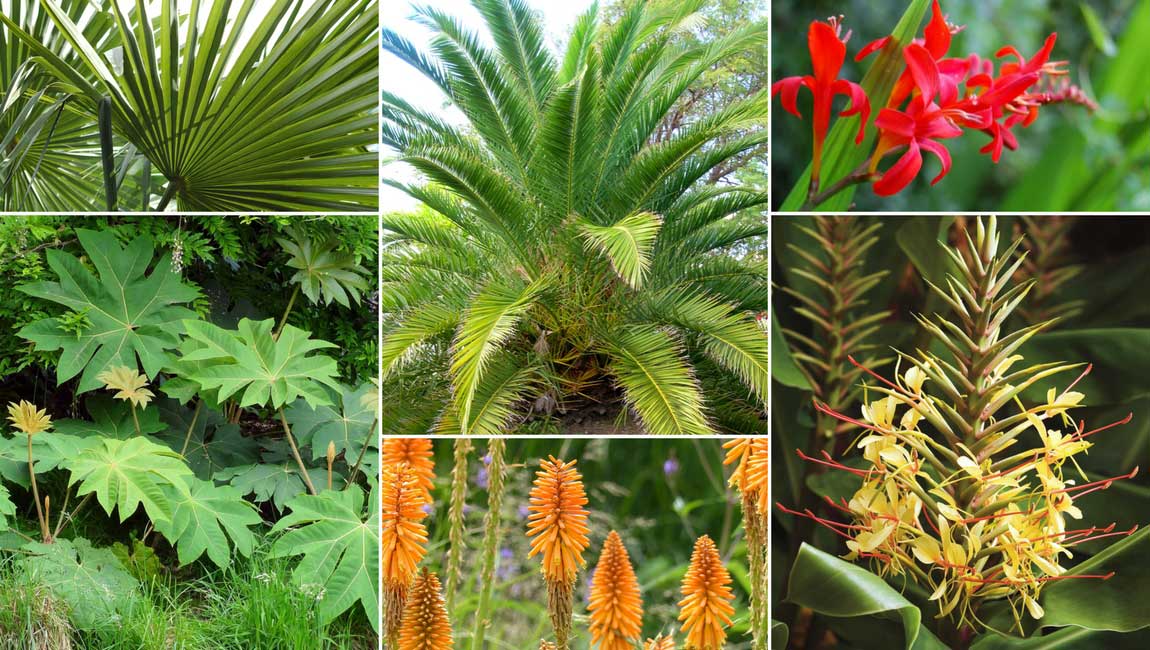
Use palms to create an exotic atmosphere! Trachycarpus fortunei (photo Vera Buhl), Phoenix canariensis (photo Forest & Kim Starr), Crocosmia ‘Lucifer’ (photo Vicky Brock), Tetrapanax papyrifera ‘Rex’, Kniphofia ‘Fiery Fred’ and Hedychium gardnerianum (photo J.J. Harrison)
Another interesting idea is to plant palms in a Mediterranean-inspired garden, to guarantee once again an exotic atmosphere — a holiday feel — but this time in a drier, less lush style. Create a mineral setting, perhaps a rockery, and include aromatic plants and grasses. Choose lavender, santolina, Stachys byzantina, Stipa tenuissima, achilleas… Favour plants with grey foliage and scented plants. Add a few small succulents, such as Sempervivum or Sedum, which can be tucked between stones. For a very exotic effect, enjoy the elegant silhouette of Yuccas, Aloes and Agaves. You can also include some euphorbias or cacti. To contrast this dry, rocky atmosphere, consider placing a small water feature or fountain nearby.
Palms can perfectly well be planted alone, to showcase their elegant architecture. You can plant them isolated in the middle of a lawn, and design the whole garden around them, placing them at the centre as a focal point separate from other beds. With their majestic, very upright habit, palms are also sometimes planted in alignment along a path or road (something often seen on the French Riviera). Finally, you can also grow palms in pots on a terrace, with citrus trees, strelitzias, bananas or passionflowers… That way you can easily bring them indoors for winter into a frost-free shelter.
Did you know?
- Multiple uses!
Palms can be used for their fibres, seeds or fruits. Raphia is a palm that yields the fibre of the same name. From the palm Calamus comes rattan, which can be woven and is also used to make furniture… Palms are also used to construct thatched roofs. The fruit of the palm Phytelephas produces vegetable ivory, used to make jewellery, buttons and decorative objects… The dragon’s-blood palm, Daemonorops draco, produces a red resin used for medicinal properties and as a dye. The fruit of Areca yields the betel nut or areca nut: it is made into a betel quid whose chewing has stimulant properties and acts as an appetite suppressant. Some palms produce a wax used to make candles.
- In food…
Palms are also used for food: notably dates from Phoenix dactylifera and coconuts (Cocos nucifera), but also palm sugar, obtained from Borassus flabellifer. Likewise, centre of stipes of several palms is edible and yields hearts of palm. Palm oil is produced by Elaeis guineensis, a species native to Africa whose intensive cultivation raises deforestation issues, notably in Malaysia and Indonesia. The palm Metroxylon sagu yields sago, a starch eaten particularly in Papua New Guinea in the form of cakes. Palm wine is also made by fermenting sap of various palms…
- Records
Palms break many records. Raphia regalis has the longest leaves in the plant kingdom: they can reach up to 25 metres long and 4 to 5 metres wide! The largest seeds are undoubtedly those of the sea coconut, nicknamed coco-fesse (Lodoicea maldivica): they can weigh 20 to 25 kg and measure 40 to 50 cm in diameter. The largest inflorescence in the world is that of Corypha umbraculifera: it can reach 7–8 metres high! Among palms, the tallest is Ceroxylon quindiuense, reaching 50 to 60 metres high.
- And in France…?
In France, best region to admire palms is the French Riviera, with gardens such as Villa Thuret in Antibes or Parc Phoenix in Nice. Elsewhere in France, greenhouses of botanical gardens sometimes hold very fine collections. Villa Thuret botanical garden has a superb collection of palms, some quite old, including spectacular specimens of Jubaea chilensis. You can consult the book The Art of Acclimatising Exotic Plants, the Garden of the Villa Thuret, by Catherine Ducatillion and Landy Blanc-Chabaud, published in 2010 by Quae.
Useful resources
- Our range of palm trees!
- Association website Les Fous de Palmiers, with a forum
- Book La connaissance des palmiers, by Pierre-Olivier Albano, published in 2002 by Edisud
- Find more botanical information on palms on the site Plantes & botanique
- Another site with extensive information on palm cultivation
- Discover indoor palms: Chamaedorea
- Discover our tutorial: How to dry a palm leaf?
- To prevent and cure: Diseases and pests of palms
Frequently asked questions
-
Should I cut dead leaves?
Some palms retain old leaves against the feather grass once they are dry, forming a veritable 'skirt' beneath the still-green leaves. This is the case, for example, with Washingtonia filifera. You can prune them for aesthetic reasons, giving the palm a tidier appearance. However, if you live in a cold area, it is preferable to leave them in place: these leaves form a layer that protects the feather grass from cold and pests.
-
My palm's leaves are turning yellow!
Main reason fronds turn yellow is lack of mineral nutrients. Plant is deficient: apply fertiliser or well-rotted compost. If grown in a pot, repot it. If your soil is lime-bearing, absorption of mineral nutrients may be blocked. Likewise, yellowing leaves can result from watering issues: they often indicate excess moisture, or sometimes, when it is the tip of the fronds that yellows and dries, lack of water. Water while allowing the growing medium to dry between waterings. It is also possible your soil is too compacted, causing root asphyxiation.
Yellowing can also be caused by the Paysandisia archon moth. Monitor crown condition (is it sagging?) and check whether any leaves are perforated.
-
My palm's leaves have dried out
If these are the lowest leaves and the rest of the crown is in good condition, this is perfectly normal: some palms form a "skirt" of dead leaves, keeping them around the trunk beneath still-green leaves. Dry leaves can also indicate a lack of watering or an atmosphere that is too dry, especially if you grow your palm indoors. Water regularly and don't hesitate to mist the foliage. A palm that has been frosted will also see its foliage dry out.
-
Leaves on my palm tree are perforated
You are probably facing the butterfly Paysandisia archon, an invasive species from Argentina and Uruguay. Larvae nibble at the top of the feather grass. Reporting a new outbreak and control of this pest are now obligatory.
-
Crown of leaves is thinning and sagging!
If crown is sparse and fronds are missing at the top, culprit may be Paysandisia archon moth or red palm weevil. Their larvae chew away at the top of the feather grass and bore galleries into it. Both are invasive species, spreading across French territory and can rapidly kill palms. Control of these pests is obligatory and involves spraying with nematodes, using pheromone traps or injecting insecticidal products into the feather grass.
- Subscribe!
- Contents
This form is protected by reCAPTCHA - the Google Privacy Policy and Terms of Service apply.

































Comments