Pairing Itea
Plant this remarkable shrub in your garden
Contents
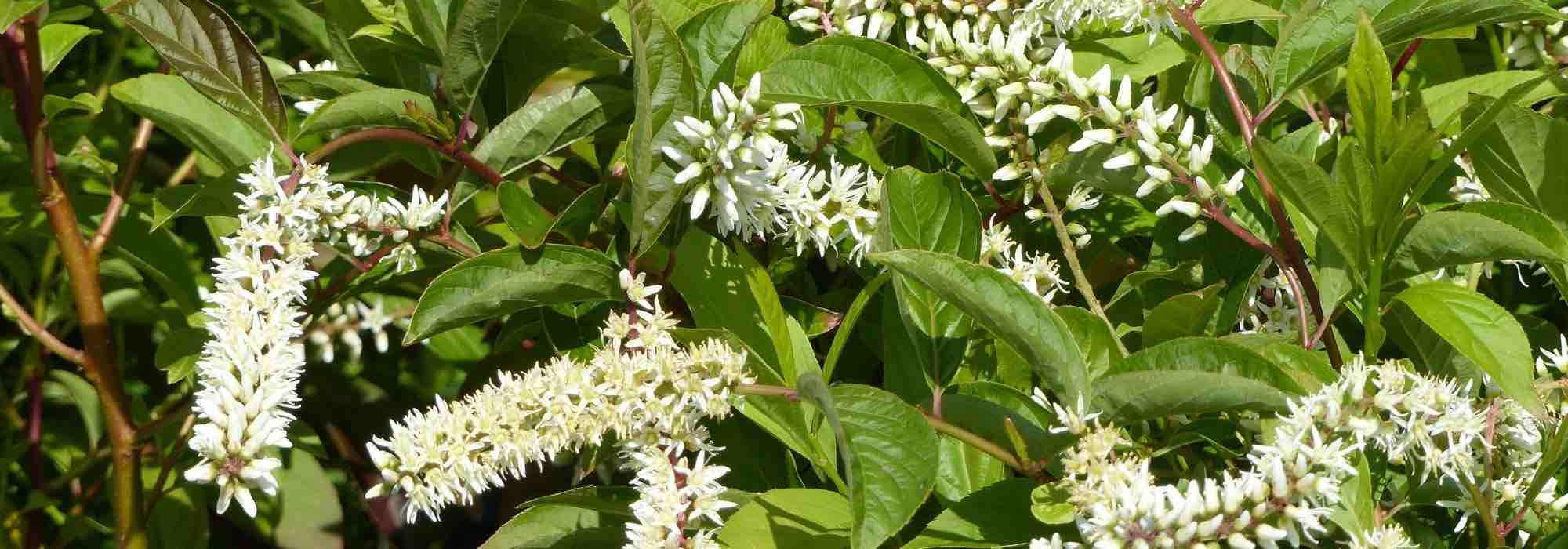
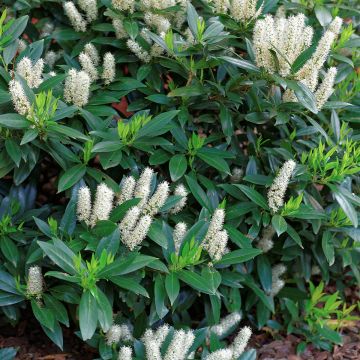
Itea is an appealing shrub, with an interesting habit, highly ornamental and with an unusual flowering. It needs a cool soil and some shade to perform well, not too calcareous. In cultivation, two species are mainly grown. The most common is Itea virginica, native to the southeastern United States, a deciduous shrub that flowers in summer with fragrant white spikes. Two cultivars of this species are well known to gardeners. The first, ‘Henry’s Garnet’, is very bushy; its foliage develops a pinkish tinge in summer and turns purple in autumn. The second, ‘Little Henry’, as its name suggests is the dwarf form of the first, reaching 1 m in height at maturity while Itea virginica typically attains about 2 m.
The other is Itea ilicifolia, native to temperate and tropical Asia. In September it bears a spectacular display of flowers that gives it strong architectural and aesthetic qualities. This flowering consists of pendulous aments 30 to 50 cm long, with the colour and scent of honey. It is evergreen; its foliage is leathery with thorny margins, resembling holly. It can be more imposing than Itea virginica, both in height and in spread.
Their cultivation requirements differ and affect how you will use them in the garden. Discover how to plant them in lush, exotic or more restrained planting schemes.

Around water features
Choose a moist position for the Itea virginica; banks or pond edges are therefore naturally ideal locations for it. Its upright habit and mature size of 2 m tall by 1.5 m wide make it suited to planting alongside perennials and sizeable shrubs, as found in the wet conditions that often create lush displays. In partial shade, its pale green leaves add brightness. Its aments of white flowers in mid-summer can be paired with other white blooms and graphic foliage.
You can also make use of its reddening autumn foliage by pairing it with brown-toned leaves. Think, for example, of Rodgersia pinnata ‘Bronze Peacok’, Lysimachia ciliata ‘Firecracker’, or Bergenias.
For a more modest version of a lush display in a smaller space, you could choose to plant a cultivar such as Itea virginica ‘Little Henry’ with other compact cultivars such as small Ligularias and loosestrifes.
Here, Itea virginica is planted alongside a Rodgersia pinnata, a meadowsweet (Filipendula ulmaria), an Astilboides tabularis and a burnet, Sanguisorba tenuifolia ‘Alba’.
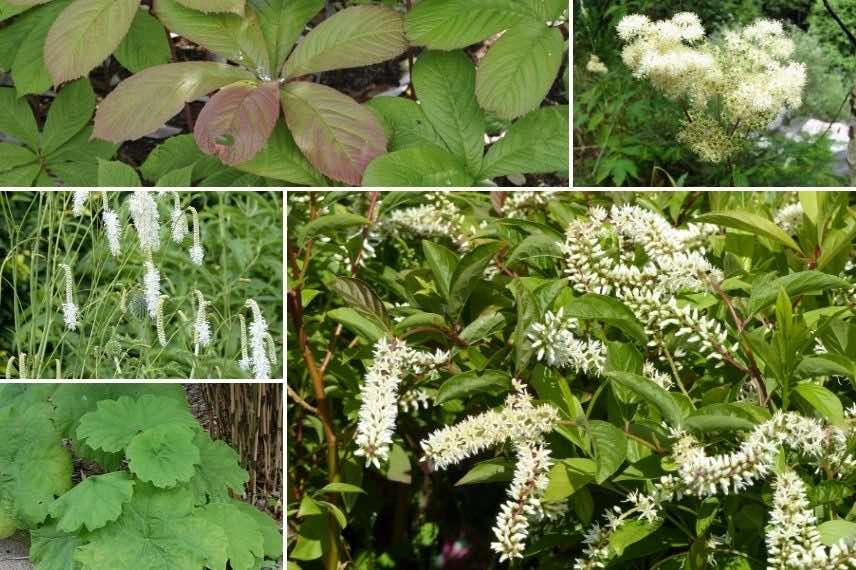
Rodgersia pinnata, Filipendula ulmaria, Itea virginica, Astilboides tabularis, Sanguisorba tenuifolia ‘Alba’
Read also
Itea: planting, pruning and careIn the understorey
Itea virginica also appreciates cool conditions and light, well-drained woodland soils. Plant it at base of a large deciduous tree with deep roots in loose, cool soil; it will benefit from leaf cover. It can also be planted simply in any semi-shaded situation, in fresh to moist soil. In moist soil, it tolerates full sun better, and tends to sucker and spread more than in fresh soil.
It is planted here under shade of a Pin oak (which, despite its name, does not like to have its feet in water). A fern, Dryopteris erythrosora and a spurge, Euphorbia amygdaloides ‘Purpurea’, accompany them with their changing, shimmering colours.
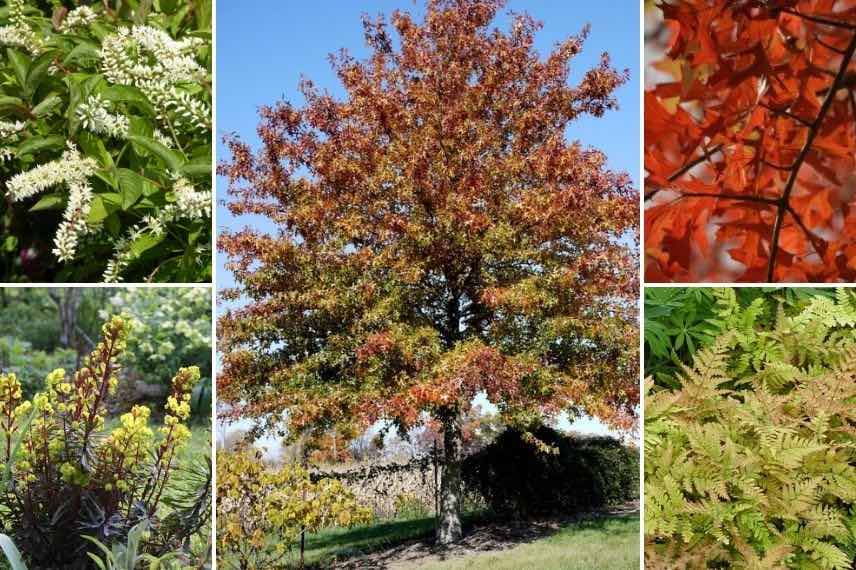
Itea virginica, Quercus palustris and its glowing foliage inset, Euphorbia amygdaloides ‘Purpurea’ and Dryopteris erythrosora
Discover other Itea
View all →
Available in 1 sizes
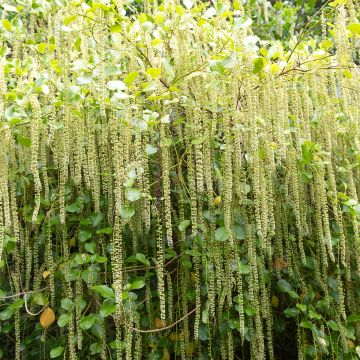
Available in 2 sizes
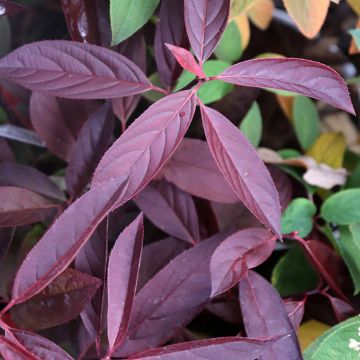
Available in 2 sizes
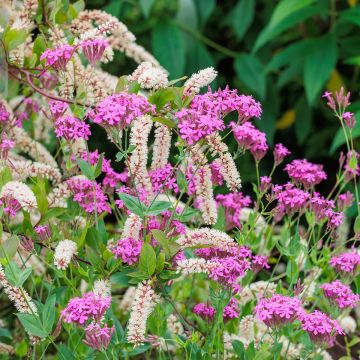
Available in 2 sizes
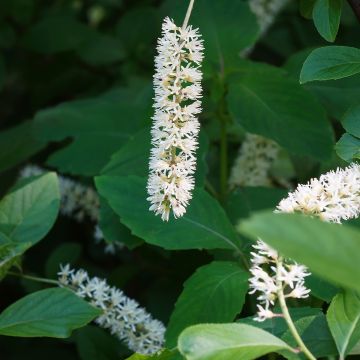
Available in 1 sizes
Available in 1 sizes
In heather soil beds
Soil conditions Itea prefers are compatible with planting shrubs and perennials suited to heather soil. Use this opportunity to create a bed in acidic or neutral, light, humus-bearing, well-drained yet cool soil. It therefore readily joins Camellias, the Heathers, Pieris, Hydrangeas, Japanese Maples, the Japanese cherries and the Magnolias.
Here the cultivar ‘Henry’s Garnet’, which blushes in summer and turns crimson in autumn, finds its place with a Japanese Maple with aconite-like leaves, Acer japonicum ‘Aconitifolium’, a Hydrangea aspera ‘Rosemary Foster’, a Pieris japonica ‘Katsura’ and a fernAthyrium filix-femina‘Victoriae’.

Acer japonicum ‘Aconitifolium’, Athyrium filix-femina ‘Victoriae’, Itea virginica ‘Henry’s Garnet’, Pieris japonica ‘Katsura’ and Hydrangea aspera ‘Rosemary Foster’
Read also
How to prune Itea?As a solitary specimen
All Iteas are beautiful planted as specimens: they have structure, an architectural habit and an originality that allows them to take centre stage alone. This is all the more true for larger botanical species such as Itea virginica and Itea ilicifolia, about which we have spoken too little given their visual qualities. They require somewhat different conditions to grow, which we develop in the following chapter.
Here is the Virginia Itea in its setting.

Itea virginica
Now here is Itea ilicifolia in flower, solitary and striking. In the following paragraph we look at how to care for it.

Itea ilicifolia in all its splendour on a red brick wall
In a warm position, alongside cacti and succulents
Itea ilicifolia does not share the same origins and growing requirements as Itea virginica. It is advisable to shelter it from cold winds and severe frosts. That is why it is often recommended to plant it against a wall, in a sheltered position, and to mulch its base for winter. However, it should not be in full sun, especially in southern regions where the intense midday sun should be avoided. Partial shade is therefore preferred. Once well established, it tolerates heat and dry soil better, as well as frosts down to around -15°C. One solution is to have it protected in its youth by plants taller than it, with increased attention to watering. Later, once mature, it can be exposed to sunlight.
An idea inspired by the Great Dixter garden in England: Itea ilicifolia is here planted alongside succulents and cacti with an Agave parryi var. huachucensis, an Agave parryi var. neomexicana, an Opuntia microdasys hardy to -5°C and an Erigeron karvinskianus with daisy-like flowers.
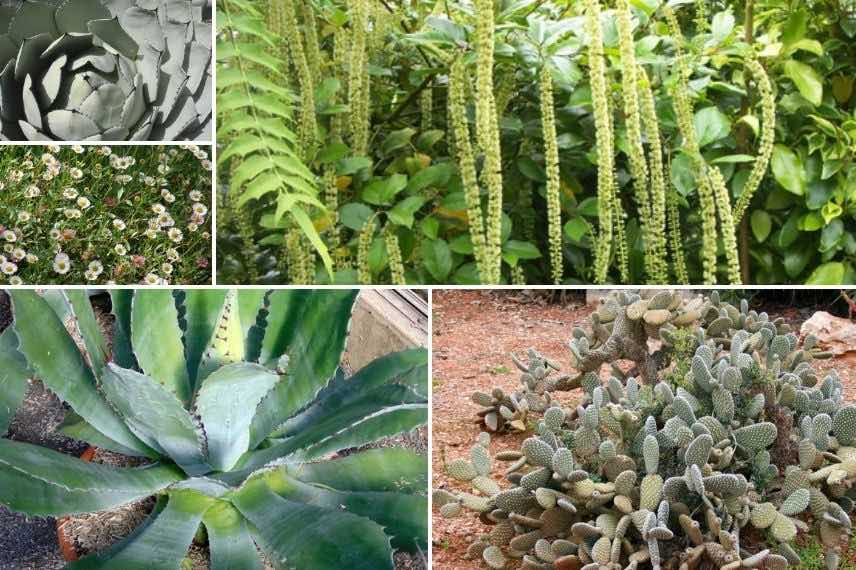
Agave parryi huachucensis, Erigeron karvinskianus, Itea ilicifolia, Agave parryi neomexicana et Opuntia microdasys
On terrace or balcony
Itea virginica ‘Little Henry’, given its compact size, is well suited to growing in a pot. It has the same qualities and characteristics as Itea virginica ‘Henry’s Garnet’, while being half its size. Place it in partial shade or shade to minimise evaporation of the potting mix and thereby reduce how often you need to water. You will thus be able to enjoy its fragrant flowering and changing foliage throughout the seasons. This shrub is very attractive on a balcony or terrace. If accompanied by some evergreens, its winter bareness is not a problem, especially as it loses its leaves late. Undemanding to maintain, but do take care not to forget to water it.
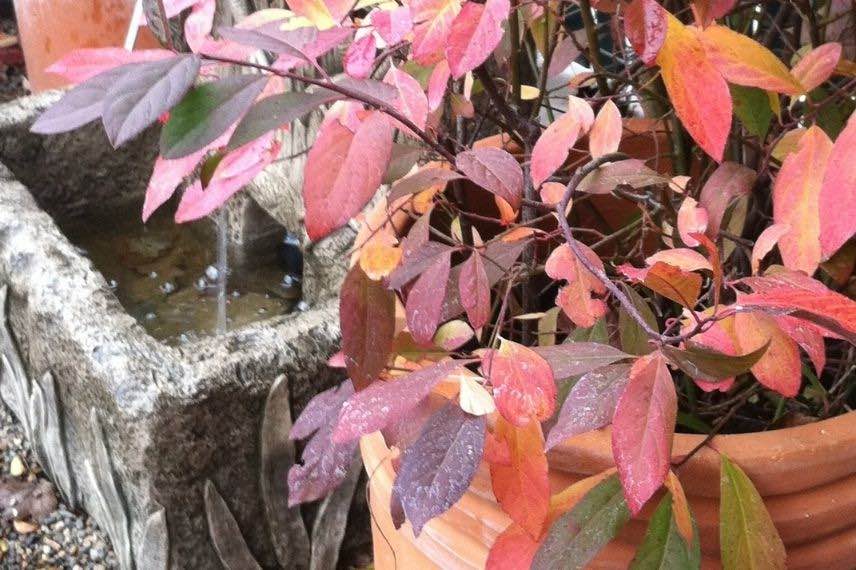
Itea virginica ‘Little Henry’ in a pot
Le jardin s’éveille lentement sous un voile de givre. Les pelouses, d’un vert mat figé, brillent comme un tapis de mica ; chaque brin d’herbe porte une goutte gelée qui tremble au moindre souffle. Les silhouettes des arbres, nues, se découpent nettes contre un ciel pâle ; leurs branches portent encore, claires comme de la dentelle, des cristaux de givre qui scintillent quand le soleil timide perce la brume. Au bord du potager, les têtes sèches des fleurs d’été — échinacées, scabieuses et rudbeckies — forment des sculptures oubliées, leurs akènes visibles comme autant de promesses pour le printemps. Les tiges sont raides, le feuillage disparu, et sous la terre, les bulbes reposent dans leur hibernaculum, tranquilles. Quelques oiseaux passent en éclairs, picorant les dernières baies de l’églantier ou les graines des capitules ; leurs traces sur la neige fraîche dessinent des chemins nerveux et joyeux. Près du bassin gelé, la surface lisse réfléchit les branches comme un miroir assombri. Une fine couche de givre a ciselé le bord des pierres, créant des dentelles éphémères. L’air est vif, chargé de l’odeur propre de la résine et de la terre froide. On entend au loin le craquement d’une branche qui cède sous le poids de la glace, un son sec qui rappelle la vigueur contenue des végétaux en dormance. Sur la pergola, quelques feuilles persistantes — lierre, laurier-cerise, houx — offrent un contraste de vert profond ; leurs baies rouges font comme des notes vives sur une partition blanche. Plus bas, des touffes de graminées hivernales ondulent encore, ajoutant du mouvement à l’immobile. Le jardin, malgré le silence et la lenteur du gel, respire la promesse : chaque écorce, chaque akène, chaque racine garde en elle l’histoire d’un cycle, prête à renaître quand reviendra la chaleur.
Plant it with a golden conifer, here a Thuya occidentalis ‘Yellow Ribbon’ alongside famous winter red stems of a dogwood Cornus alba ‘Baton Rouge’ or for a softer colour, another Cornus alba with purple branches: ‘Kesselringii’.
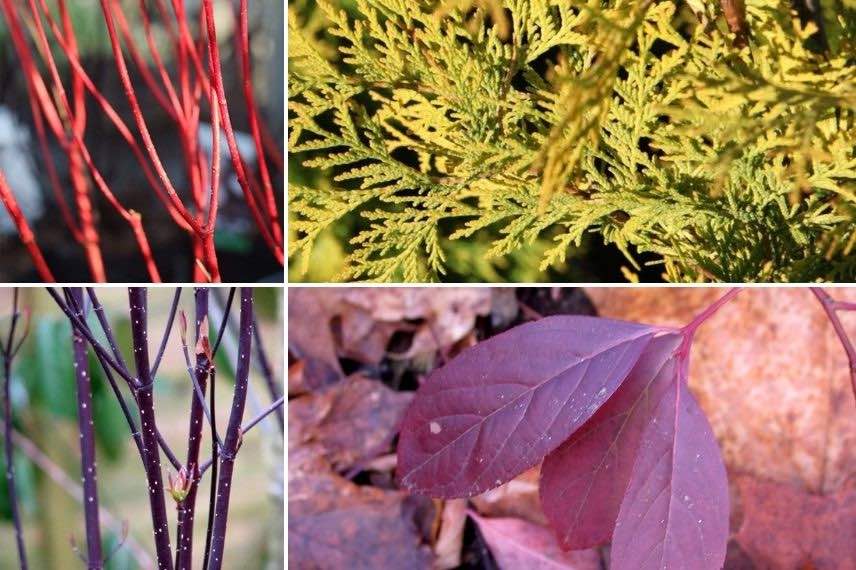
Cornus alba ‘Baton Rouge’, Thuya occidentalis ‘Yellow Ribbon’, Cornus alba ‘Kesselringii’ and Itea virginica ‘Henry’s Garnet’
With climbing plants
Itea virginica also fits easily into any garden style. Why not include it in a scene with climbers on a pergola? At around 2 m tall it complements them nicely.
Here with Rose ‘Rhapsody In Blue’, Chinese wisteria Wisteria sinensis ‘Alba’, Persicaria polymorpha and Viburnum opulus.
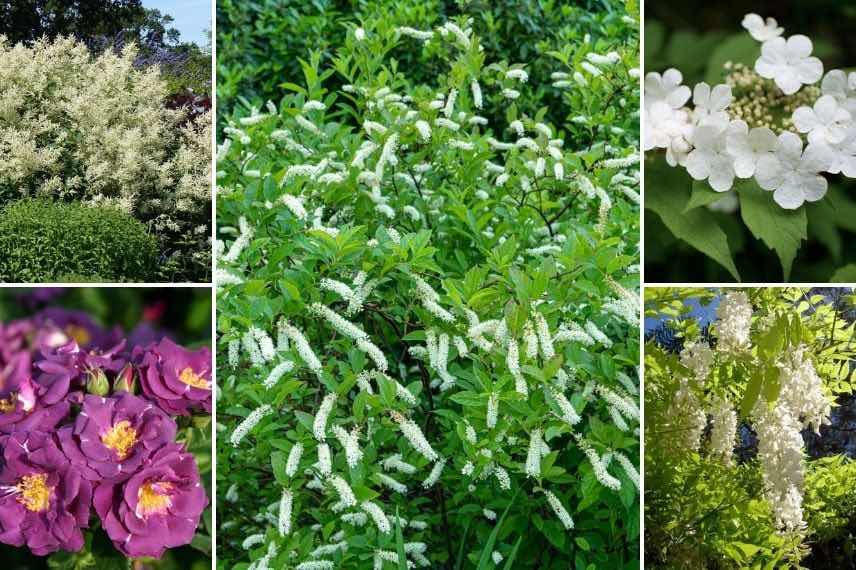
Persicaria polymorpha, Itea virginica, Viburnum opulus, Rose ‘Rhapsody In Blue’ and Chinese wisteria Wisteria sinensis ‘Alba’,
As cut flower arrangement
Branches with spectacular aments of Itea ilicifolia are prized by florists. Cut a few in September to make a pretty homemade bouquet with seasonal flowers such as asters, Japanese anemones, a few stems of grasses and anything flowering in your garden!
- Subscribe!
- Contents
This form is protected by reCAPTCHA - the Google Privacy Policy and Terms of Service apply.
![[plant_autocomplete plant_name="Virginia sweetspire"]](https://www.promessedefleurs.ie/blogwp/wp-content/uploads/2022/03/Associer-itea.jpg "[plantes nom=\"Itea\"]")

































Comments