





























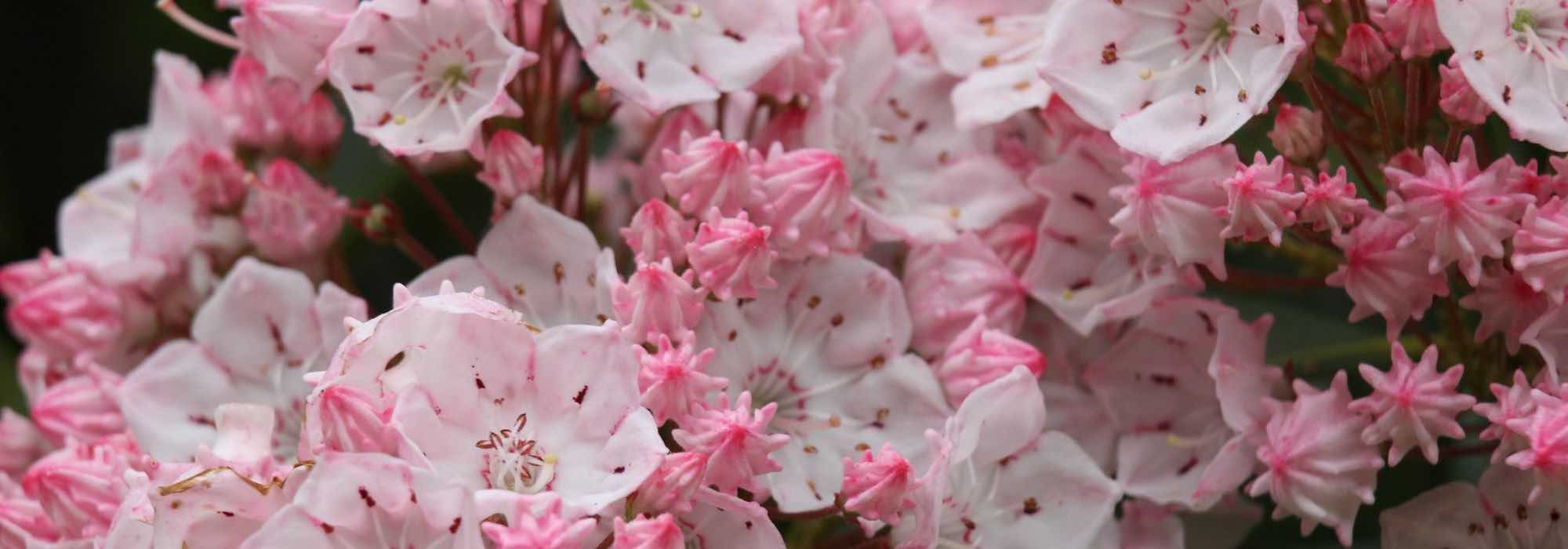
Kalmia: succeeding in pot cultivation
Enjoy its lovely flowering on the terrace or balcony.
Contents
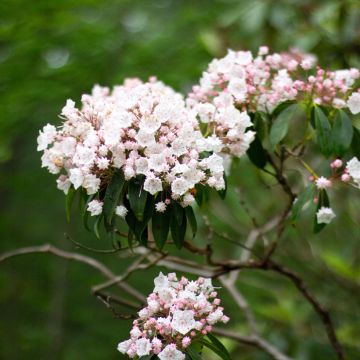
The Kalmia or mountain laurel is an acidophilous bush with glossy green evergreen foliage that adorns itself with a unique flowering in May and June. Still too rarely planted considering its ornamental qualities, it is a bush that reaches heights of 60 cm to 2 m for the largest specimens, very hardy and slow-growing. During its magical flowering in May and June, plicate, veined flower buds and waxy corollas, reminiscent of porcelain, coexist. The Kalmia enjoys shade and a bit of sun to bloom. It thrives in fairly cool and rainy climates: it flourishes in Brittany but not in regions that are too hot. It is acidophilous, so care should be taken to create a tailored substrate for it, more easily in pots than in open ground.
Discover our cultivation tips for planting a Kalmia in a pot to enjoy its ornamental evergreen foliage and its enchanting flowering at the end of spring.
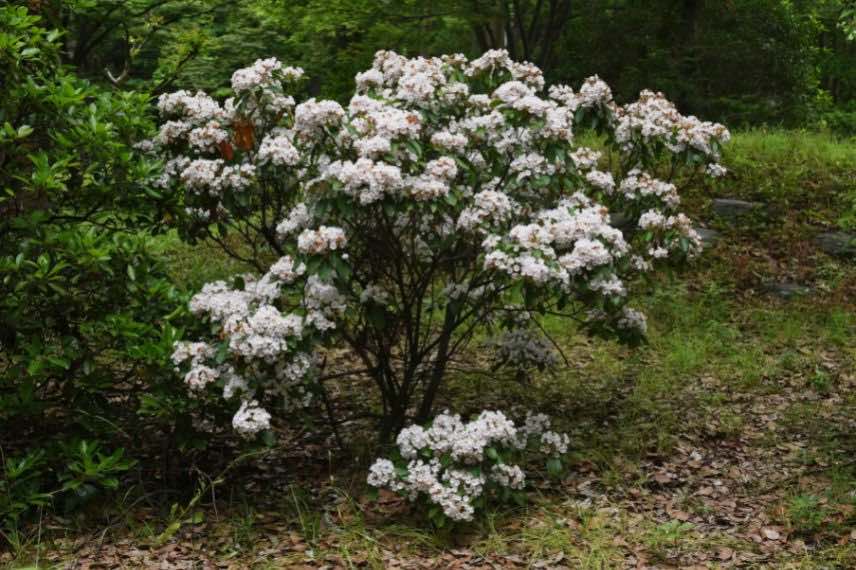
A Kalmia in all its glory
Which varieties to choose?
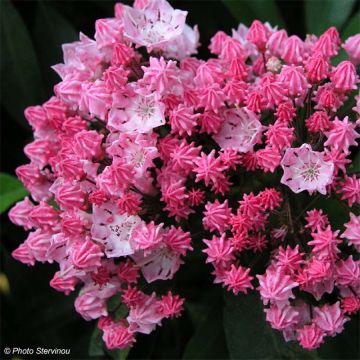
Kalmia has a slow growth rate and the size difference between varieties ranges from 60 cm for the smallest to 2 m for the largest. Generally, kalmias are as wide as they are tall, or slightly wider. Thus, all species and varieties can be planted, especially since they are all equally hardy, at least down to -20° C.
However, you may prefer the smaller varieties, reaching heights of 1 m to 1.30 m at maturity, such as kalmia latifolia:
- ‘Otsbo Red’ with flowers in shades of pink and red, featuring undulating foliage.
- ‘Minuet’ in rosy white and purple-red.
- ‘Madeline’, delightful, with a white centre washed with pale pink.
- ‘Bull’s Eye’ with dark purple flowers, speckled with white.
- ‘Tad’ with large, numerous flat flowers in chocolate colour.
- ‘Heart’s Desire’, unrestrained in cinnamon red.
- ‘Tofka’ with large white flowers speckled with dark red.
Or the smallest of all, which reach a height of 60 cm: the lovely Kalmia polifolia with fine foliage and small flowers in shades of pink, and the delicate Kalmia latifolia ‘Elf’ whose whitest flowers are barely speckled with pink.
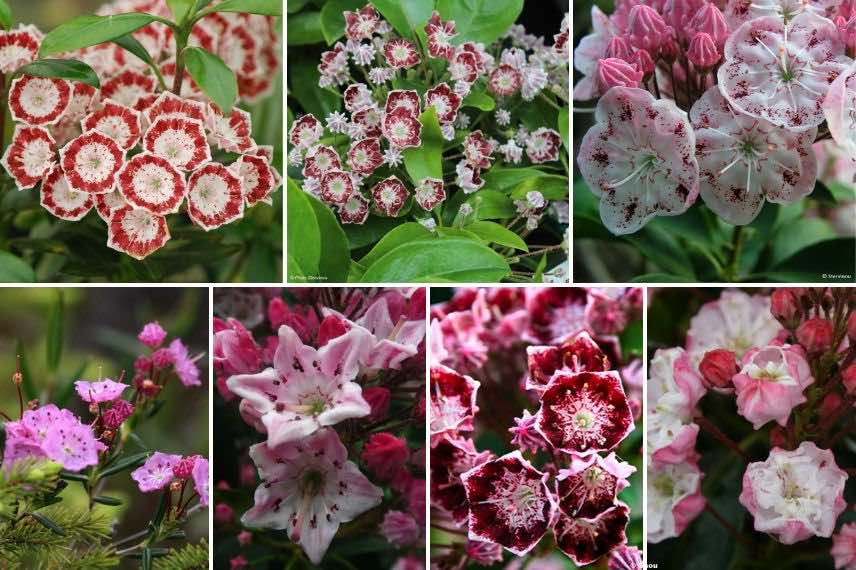
Some varieties of kalmia, clockwise from top: Kalmia ‘Minuet’, ‘Tad’, ‘Tofka’, ‘Madeline’, ‘Bull’s Eye’, ‘Otsbo Red’ and the botanical species Kalmia polifolia
Which pot?
Choose your preferred material; if you swear by terracotta, a porous and healthy material for roots, go for it. However, for a moisture-loving bush like Kalmia, all other less porous materials seem more suitable to avoid having a bush that is constantly dependent on water.
Plan for a pot that is three times larger than the root ball in both depth and width. To be more precise, it should ideally be at least 50 cm in diameter and 40 to 50 cm deep. The larger the pot, the more the substrate will retain its freshness when properly watered.
The pot must have drainage holes at the bottom to allow water to drain and prevent stagnation. Even though Kalmia thrives in cool, even moist soil, it should not retain water at the root level.
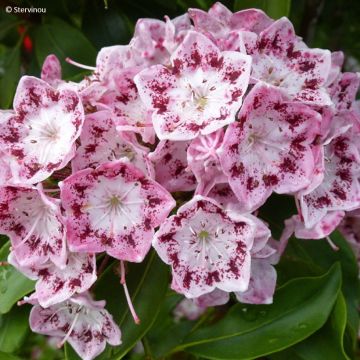
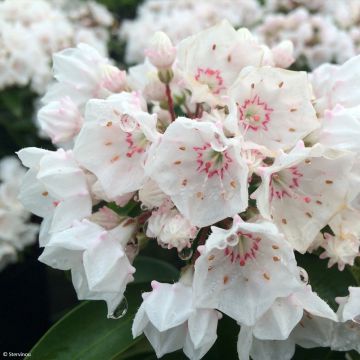
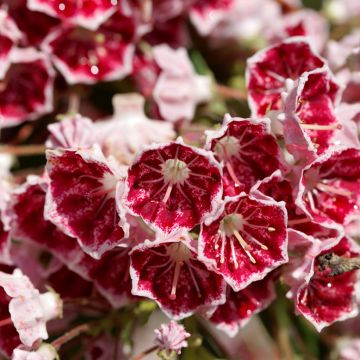
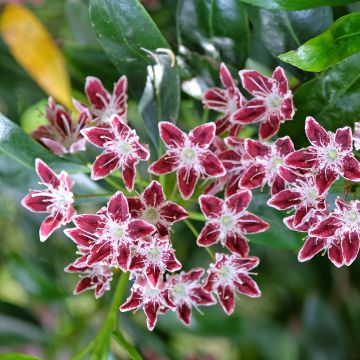
Discover other Kalmias
View all →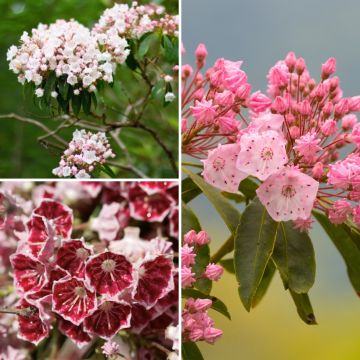
Available in 0 sizes
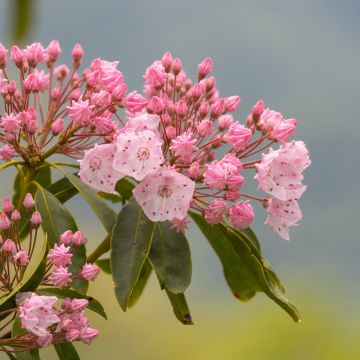
Available in 1 sizes
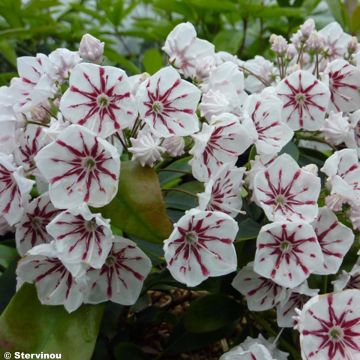
Available in 1 sizes
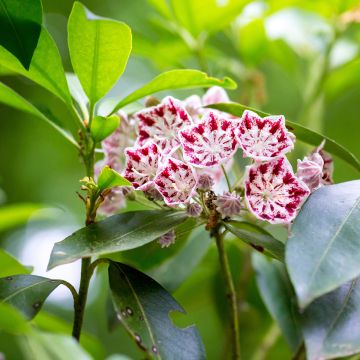
Available in 1 sizes
Available in 1 sizes
Available in 1 sizes
Available in 1 sizes
Available in 1 sizes
Available in 1 sizes
Available in 1 sizes
What substrate?
Attention to the substrate is crucial for successfully potting Kalmia, a rather demanding bush. This will significantly impact its watering needs.
For Kalmia, we need a substrate that is: acid pH, draining, humus-bearing, with very good water retention. Let’s assume that potting soils are always draining, but their water retention depends on their quality. Cheap potting soils do not retain water because the various components do not create a well-thought-out synergy. Choosing a quality potting soil quickly proves to be economical and rewarding for seeing your bush thrive. Quality potting soils have water retention suited to the types of plants, which is indicated on the composition on the back of the bag. On the Promesse de Fleurs website, in the potting soils category, there is a filter that allows you to choose based on water retention. Choose the highest values. For Kalmia, the best choice is to fill the pot 100% with an appropriate potting soil. There is no need to add draining material to the potting soil, as long as you place a layer of clay balls, gravel, or pumice (note that the latter is heavy) at the bottom of the pot. Select a potting soil for acidophilous plants and heather soil, such as the Klasmann Professional Heather Soil in a 45-litre bag. This way, you will have a substrate with an acid pH, good water retention, draining, and humus-bearing. Another advantage of this potting soil is that it uses peat sourced sustainably, respecting the environment. Peat is an acid pH element, which is interesting, but its extraction is problematic.
The other key element for a successful planting will be to mulch the top of the pot with several centimetres of organic mulch.
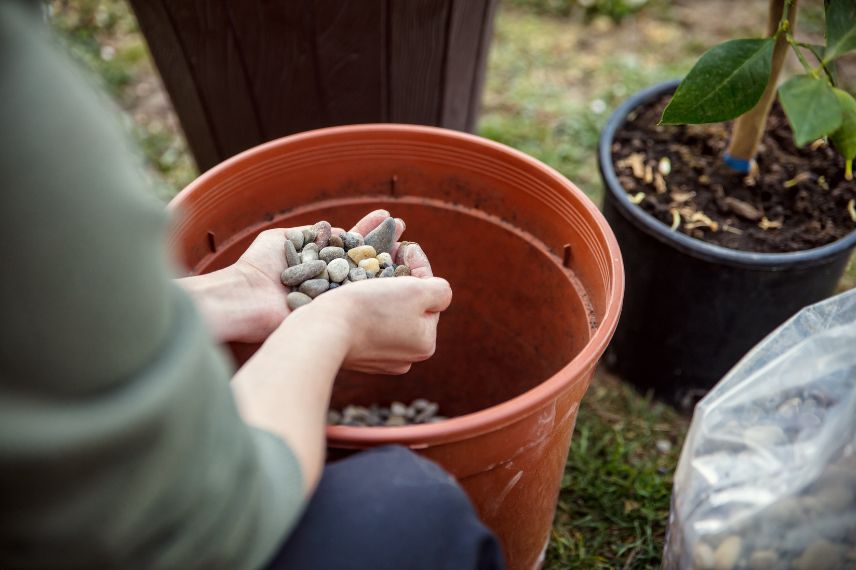
A drainage layer at the bottom of the pot is sufficient for Kalmia
When and how to plant Kalmia in a pot?
Pot planting of Kalmia takes place in spring. As it is a very hardy bush, you can also plant it in autumn, between September and November. However, keep in mind that a young bush, recently potted, does not have the same hardiness as a bush with established roots in the ground. If you live in an area subject to significant winter frosts, favour spring planting. If you proceed during spring or autumn rain, it will encourage recovery.
For planting, proceed as follows:
- Remove the root ball from its nursery container and untangle the roots if necessary.
- Soak it in a basin of water while preparing your pot.
- Add a drainage layer of a few centimetres at the bottom of the pot using clay balls, gravel, or pumice.
- Pour your substrate to about 1/3 of the pot.
- Position the root ball of your Kalmia ensuring that the collar of the bush is level with the surface of the pot.
- Check that the appearance and direction of the bush are to your liking and that it is upright.
- Fill in with substrate while lightly and evenly compacting.
- Fill to a few centimetres below the rim of the pot and compact once more.
- Water generously.
- When the water has been absorbed, add a bit of substrate if necessary, if any gaps have appeared.
- Carefully mulch with several centimetres.
What exposure does Kalmia require?
Choose a partially shaded location for Kalmia, avoiding direct sunlight during the hottest and most scorching hours of the day. You can even place it in dappled shade, as long as it is not too dense and the light is good. It does appreciate some sun to flower, either in the morning or late in the day. Once flowering is finished, you can move it to a slightly shadier spot.
It tolerates marine air, but place it in a sheltered position away from cold winds that it dislikes above all.
Planting it in too hot a climate is not advisable. It thrives in Breton climate or along the Atlantic coast, for example.
As it enjoys good ambient humidity, it is wise to surround it with many plants that promote this atmosphere.
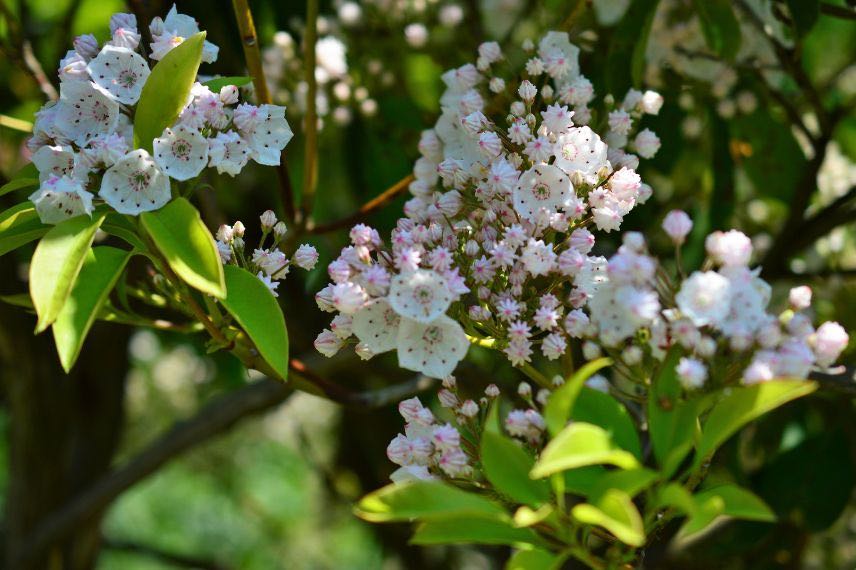
It is important to place Kalmia out of the scorching sun
How to care for a Kalmia in a pot?
Potted Kalmia requires regular and even frequent watering. Water thoroughly and then allow the substrate to dry out between waterings in the top few centimetres of the pot. This means you will need to be attentive from spring, during the growth of the young foliage and then the flowering, when temperatures rise. In summer, always be vigilant to ensure its evergreen foliage does not suffer, as this is when the flower buds form for the following spring.
Reduce watering in autumn and even more in winter, maintaining an average of two waterings per month, more if necessary. A bush in a pot that receives winter rains will not need as much watering as one placed under a roof, for example.
No fertiliser is needed for Kalmia. A yearly application of well-decomposed compost at the base will however be beneficial, when you are not repotting it. Repotting every two years until it reaches maturity is a reasonable average, provided the pot is large enough and the potting mix is of good quality.
- Subscribe!
- Contents
![[Kalmia in a pot]](https://www.promessedefleurs.ie/blogwp/wp-content/uploads/2023/03/Kalmia-reussir-sa-culture-en-pot.png "[Kalmia] Succeeding in pot culture")
Comments