





























How to choose a Hebe?
Buying Guide and Criteria for Finding the Ideal Shrubby Veronica Variety
Contents
There are around a hundred species of shrubby veronicas or Hebes, sometimes quite different from one another. Some stand out for their generous flowering, while others are valued for their colourful foliage or graphic silhouette.
These bushes thrive in mild climates and are relatively easy to care for, fitting seamlessly into all types of gardens. They also do well in containers, brightening up terraces, balconies, patios, or window sills. To help you choose the variety that best meets your needs, here is our buying guide.
Choosing a Hebe Based on Its Flowers
White Flowering Shrubby Veronicas
White flowering Hebes fit into all styles of gardens. They bring light, a refined touch, and perfectly highlight other colourful blooms.
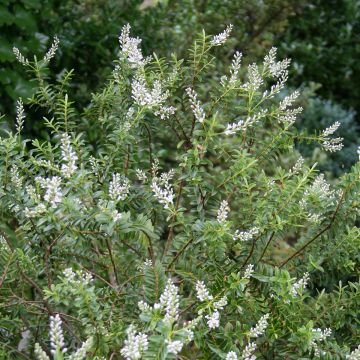
Among them, the Hebe rakaiensis, Hebe vernicosa, and Hebe pinguifolia ‘Sutherlandii’ produce large globose white spikes measuring 5 cm long. The Hebe brachysiphon offers slightly shorter and sturdier white spikes.
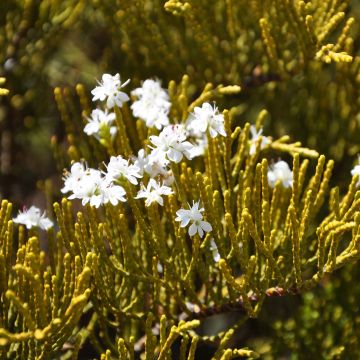
On the other hand, the Hebe ochracea reveals small white flowers of 2 cm, gathered in clusters at the axil of the leaves.
Pink Flowering Shrubby Veronicas
Pink flowering Hebes come in several shades, from the softest to the brightest. Some display a vivid pink, while others are tinged with mauve or violet.
The Hebe ‘Tip Top’ offers a delicate pale pink to white flowering, while ‘Purple Shamrock’ opts for small mauve-pink flowers. More vibrant, the varieties ‘Orphan Annie’ and ‘Celebration’ prefer a bright magenta pink.
‘Wiri Charm’, ‘Midnight Sky’, and ‘Joan Mac’ provide us with violet-pink spikes, while ‘Raspberry Ripple’ reveals an intense raspberry pink.
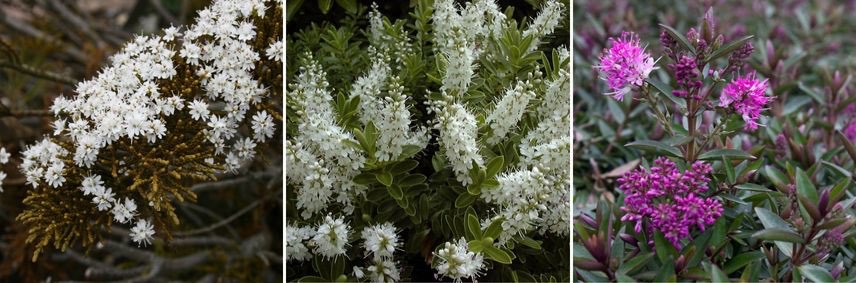
With white and pink flowers: Hebe ochracea, Hebe rakaiensis, Hebe ‘Raspberry Ripple’
Mauve Flowering Shrubby Veronicas
In a very soft colour, ‘Red Edge’ offers a pastel mauve-lilac flowering, fading over time to become almost white.
This is also the case with the Hebe diosmifolia, with its small globose pale lavender spikes.
Blue Flowering Shrubby Veronicas
Less common, some shrubby veronicas reveal a blue-tinged flowering. This is the case with ‘Wiri Image’, featuring mauve-blue spikes. Meanwhile, the Hebe pimeleoides ‘Quicksilver’ showcases a lovely blue-violet, just like ‘Ouessant’ with its long 8 cm spikes.
The flowers of ‘Autumn Glory’, ‘Claret Crush’, or the Hebe franciscana ‘Blue Gem’ offer a much more intense colour, a bright blue-violet.
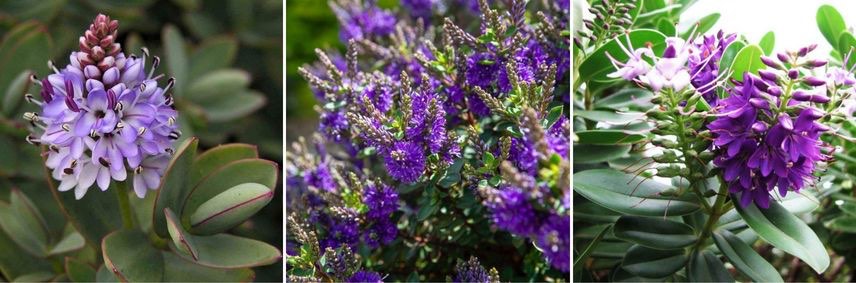
With mauve and blue flowers: Hebe ‘Red Edge’, Hebe ‘Claret Crush’, Hebe franciscana ‘Blue Gem’
Choosing a Hebe Based on Flowering Period
The flowering of shrubby veronicas generally occurs in summer and continues until the first frosts. The large-leaved Hebes are the most generous, capable of flowering from July to October, only stopping at the first frosts.
Among the remarkable flowering periods, we can mention:
- ’Autumn Glory’, which lives up to its name as this variety blooms extensively and late from early summer until November-December;
- ‘Garden Beauty Purple’, an early variety that reveals beautiful purple spikes in May-June;
- ‘Red Edge’, which produces small purple spikes in June, just like ‘Orphan Annie’ in magenta pink.
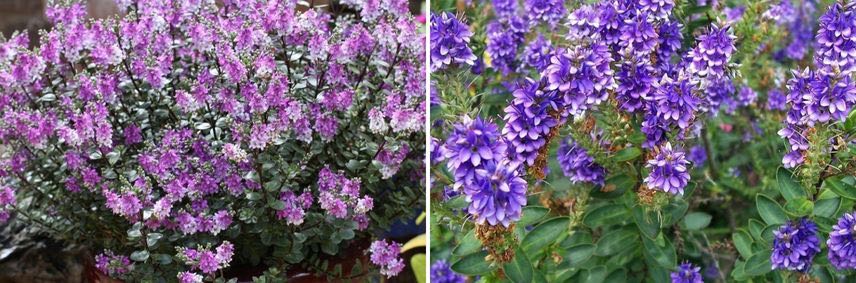
Hebe ‘Garden Beauty Purple’ and ‘Autumn Glory’
Discover other Hebe - Shrubby Veronica
View all →
Available in 1 sizes
Available in 1 sizes
Available in 1 sizes
Available in 1 sizes

Available in 1 sizes
Available in 1 sizes
Available in 1 sizes
Available in 1 sizes
Available in 1 sizes
Available in 1 sizes
Choosing a Hebe Based on Foliage
With Hebes, the foliage is tough and evergreen, remaining in place throughout the year.
Colourful Foliage
The most classic foliage colours range from light green to dark green. Varieties with small leaves tend to have a rarer or less significant flowering compared to those with large leaves. However, they are prized for the beauty of their foliage, which can be coloured, variegated, or even change over time.
In the case of Hebe pimeleoides ‘Quicksilver’, the foliage is silver-green, contrasting beautifully with its intensely purple stems.
For ‘Midnight Sky’, the leaves are initially green before turning to a glossy dark purple in response to the cold. Depending on the light, the foliage can appear almost black, giving this variety a unique and mysterious charm. Meanwhile, ‘Joan Mac’ has dark green-purple foliage all year round. One of the darkest winter foliages is that of ‘Santa Monica’: initially green-bronze, it turns red in autumn before becoming almost black as winter temperatures drop.
‘Garden Beauty’ produces glossy dark green leaves, borne on reddish stems. But with the first frosts, the bush dons a beautiful intense purple.
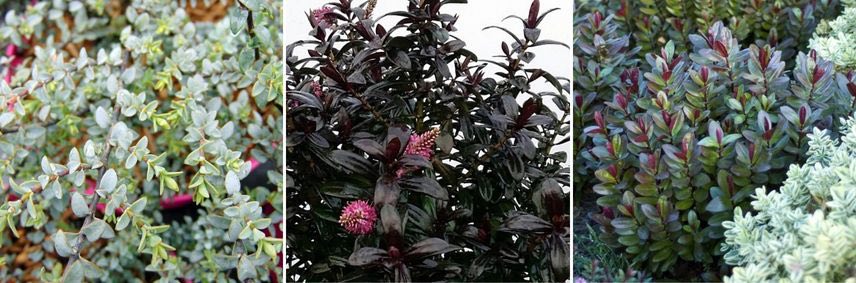
With colourful foliage: Hebe pimeleoides ‘Quicksilver’, Hebe ‘Joan Mac’, Hebe ‘Santa Monica’
On the other hand, variegated varieties also add a beautiful touch of colour and light:
- ‘Celebration’ has lovely variegated leaves of green, pink, and cream;
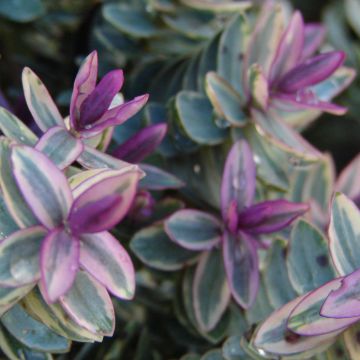
- ‘Heartbreaker’ produces green leaves tinged with purple and white, which then become intensely purple edged with pink in autumn-winter;
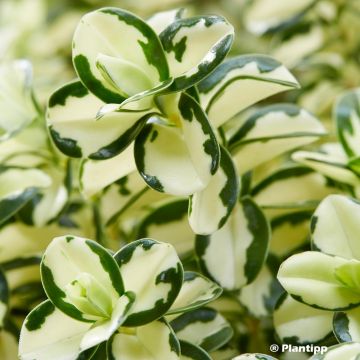
- the adorable ‘Tip Top’ features foliage combining cream-white, silver-green, and pink-purple margins;
- the bright ‘Jewel of the Night’ showcases leaves variegated with bright yellow and green, which take on pink and red hues in the cold;
- very original, ‘Leopard Spot’ has ivory-white leaves tinged with yellow and splashed with green.
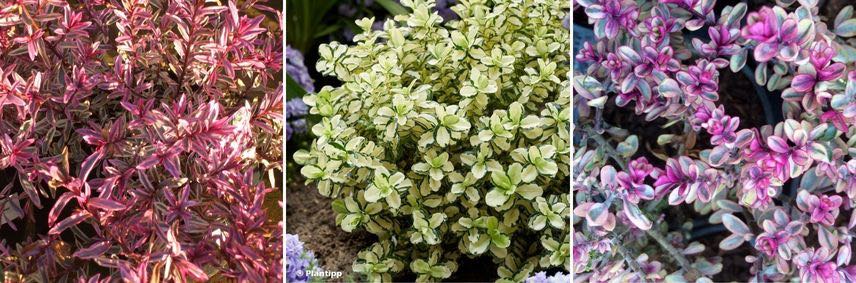
With variegated foliage: Hebe ‘Heartbreaker’, Hebe ‘Leopard Spot’, Hebe ‘Tip Top’
Remarkable Leaf Shapes
The Hebe ochracea features foliage with warm hues, a green tinged with copper-orange. It has the unique characteristic of having very tightly packed scale-like leaves, reminiscent of those found on heathers or certain dwarf conifers.
A distinctive leaf shape can also be found in ‘Cobb Valley’, which boasts small lanceolate leaves reminiscent of boxwood, in a lovely blue-green.
In ‘Green Globe’, the fine and dense foliage resembles that of santolina. Very bright, it displays a light green tinged with yellow.
Read also
When and how to prune shrubby veronica?Choosing a Hebe Based on Its Shape and Use
Compact Varieties
Small-leaved Hebes have compact and homogeneous forms, giving them a beautiful graphic silhouette. Slow-growing, they will fit perfectly in pots or containers, as well as in rockeries or at the front of borders.
This is the case with the highly regarded ‘Green Globe’, a true little green ball measuring 30 cm in all directions. Among the lovely rounded shapes, we can also mention ‘Lady Ann’ and ‘Purple Shamrock’ (60 cm in all directions) with their beautiful variegated foliage. A bit more imposing, the variety ‘Linda’ reaches 80 cm in all directions; it is distinguished by its beautiful and long pink flowering.
Spreading Varieties
These bushy veronicas, wider than they are tall, make perfect groundcovers. They will dress rockeries, slopes, or borders all year round with their dense and spreading foliage.
Consider for example:
- the Hebe pimeleoides ‘Quicksilver’ (45 cm in height and 90 cm in spread);
- ‘Red Edge’ (45 cm in height and 60 cm in spread);
- the Hebe diosmifolia (60 cm in height and 80 cm in spread);
- the Hebe rakaiensis (90 cm in height and 120 cm in spread).
Larger and Bushy Varieties
The slightly larger varieties will settle in borders or bushy hedges, but also in containers on the terrace. Consider:
- ‘Wiri Charm’, with its lovely dome-shaped habit reaching 90 cm in height and over 1 metre in spread;
- the Hebe franciscana ‘Blue Gem’, with its flexible silhouette measuring up to 1.50 metres in all directions;
- Anderson’s Hebe (Hebe andersonii), measuring about 1.80 metres in all directions and offering a lovely pink-violet spike flowering.
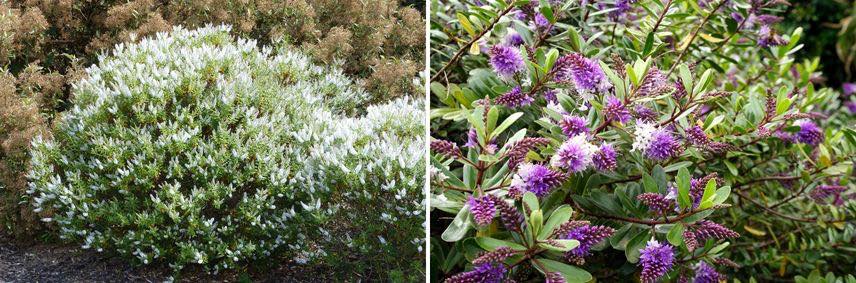
Compact Hebe and Bushy Hebe
Choosing a Hebe Based on Growing Conditions
Shrubby veronicas generally thrive in mild coastal climates, experiencing no severe winter frosts. They flourish along the Atlantic coast or in the Mediterranean region, provided they are sheltered from the scorching rays of the sun. In terms of soil, most prefer cool soil (remaining slightly moist) and rich in organic matter.
However, some varieties adapt to other specific growing conditions.
For regions with cold winters: the hardiest
The hardiness of shrubby veronicas varies depending on the varieties. The most tender cannot withstand temperatures below -5°C. The hardiest can tolerate down to -12 to -15°C, if grown in a sheltered position away from prevailing winds and in well-drained soil (without stagnant moisture).
In regions regularly subjected to frosts, opt instead for Hebe ‘Midsummer Beauty’, ‘Red Edge’, or ‘Raspberry Ripple’, a hybrid variety from Ireland that tolerates down to -12°C. Due to its montane origins, ‘Sutherlandii’ is also among the hardiest.
For humid climates: the most disease-resistant
Shrubby veronicas can be susceptible to certain fungal diseases in humid climates, such as powdery mildew. In such regions, choose varieties known for their resistance, like the Hebe from the ‘Wiri’ series. They also have fairly good hardiness, down to about -10°C.
‘Raspberry Ripple’ is also renowned as a variety that is less susceptible to foliar diseases.
For dry and poor soils, even calcareous: the most tolerant
In warm regions, such as in Mediterranean climates or the southwest, favour varieties with small leaves, which are more drought-tolerant.
Decidedly easy to care for, the ‘Wiri’ shrubby veronicas (‘Wiri Image’, ‘Wiri Charm’, etc.) can also be grown in poor soil, even calcareous. The same goes for Hebe rakaiensis or the highly adaptable ‘Sutherlandii’.
- Subscribe!
- Contents

Comments