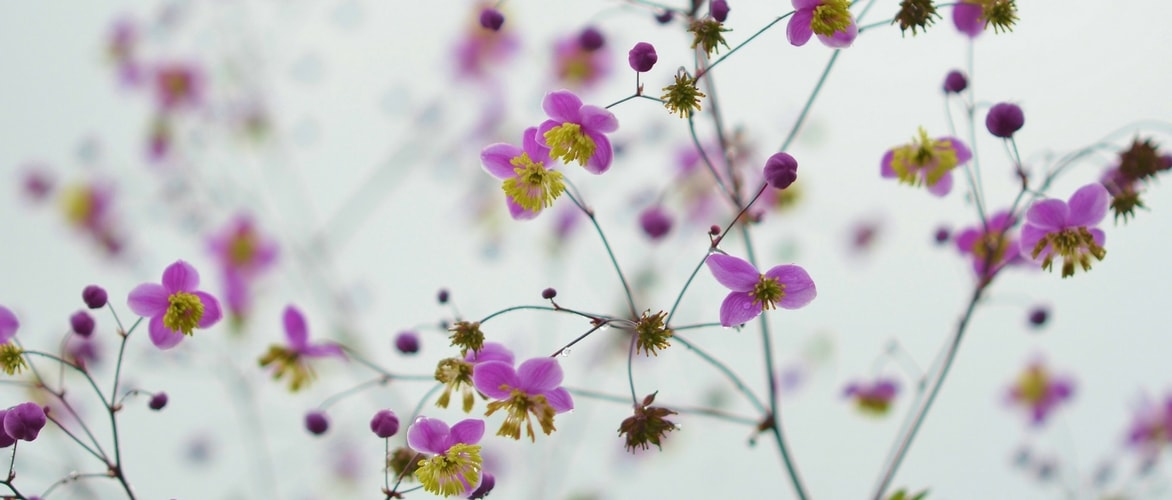
Thalictrum (meadow‑rue): planting, cultivation and companion planting
Contents
How to plant, to grow and to combine Thalictrum in the garden
- Floriferous and spectacular, imposing yet graceful perennial with the air of a giant gypsophila
- Its opulent, airy flowering in pink, lilac, yellow or white brightens shady corners in spring and especially summer
- It has beautiful lush foliage, finely cut, pale green or glaucous, similar to columbine
- Perfectly hardy and perennial, once well rooted in rich, cool soil, needs very little care
- Emblematic of soft-focus gardens or English mixed borders, it’s our favourite perennial for naturalistic scenes!
A word from our expert
Known as Pigamon or Pigamon with columbine-like leaves, the Thalictrum is a floriferous perennial with delicate, finely divided foliage in soft green or grey-blue, remarkable for the poetry and profusion of its flowering.
Its airy, vapoury inflorescences, which in some splendid cultivars such as Thalictrum delavayi ‘Splendide’ can reach over two metres in height, brighten shaded areas of the garden. Resembling clouds of dishevelled stars, its tiny flowers form from May–June to September, depending on variety, a lilac, pink, white or yellow haze. Thalictrum delavayi, the most emblematic of Pigamons, and Thalictrum aquilegifolium, are two notably floriferous species.
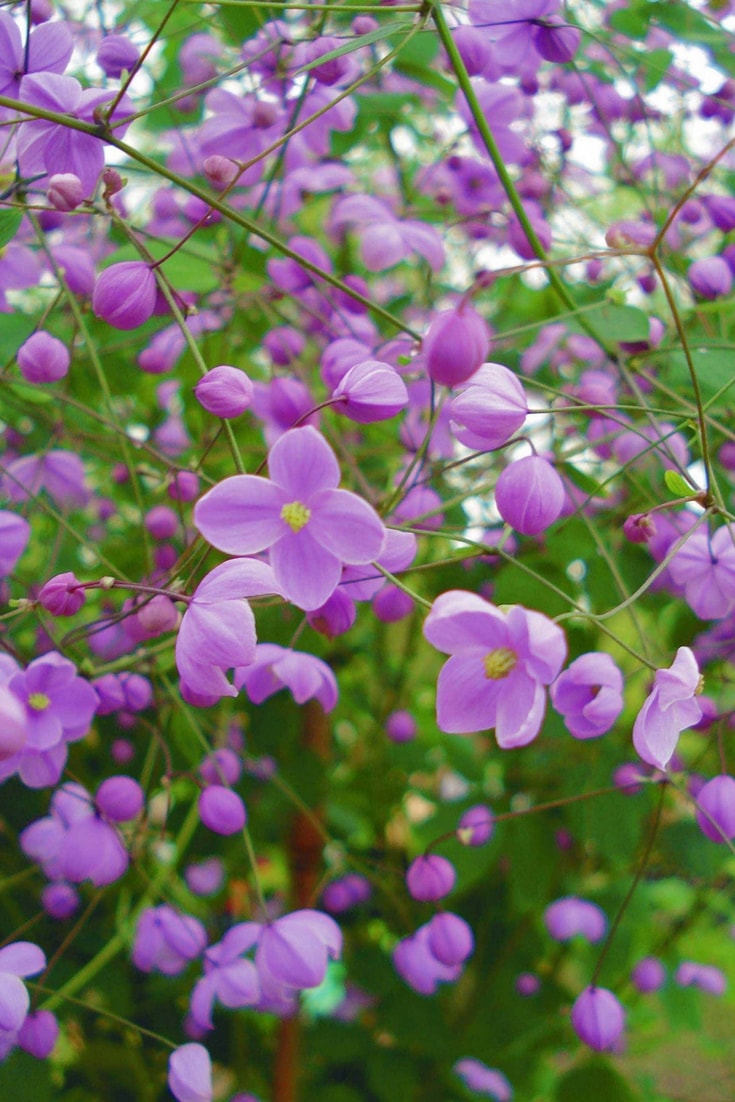
Thalictrum delavayi Splendide: a variety that truly lives up to its name
From towering specimens such as Thalictrum ‘Elin’ to groundcover species like Thalictrum kiusianum, Pigamon fits into every setting. Giants of the genus play a dazzling role as middle or back-of-border plants, creating a diaphanous mist. Lilliputian species form mossy, flowering carpets for fresh rockeries and low walls.
Its tall, feathery silhouettes, much prized in England, are classics of soft, naturalistic gardens, and bring a poetic, expressive touch to vicar’s gardens and mixed borders.
An essential in rose gardens, where it brings tone, lightness and transparency, Thalictrum is the ideal companion for old roses, with which it composes opulent, romantic spring and summer scenes.
Well established beneath the foliage of deciduous trees, in rich, cool but well-drained soil and sheltered from wind, Pigamon will in just a few years form generous clumps alongside Japanese anemones, bleeding hearts, Astilbes, astrantias, lilies, foxgloves or hardy geraniums. It creates a pleasing contrast when paired with plants of a firmer habit such as Hostas or ferns.
When cut, its light flower stems make very pretty fresh or dried country-style bouquets.
Romantic, airy, spectacular, discover Thalictrum, this large, easy-to-grow floriferous perennial that lights up the garden!

Botany
Botanical data
- Latin name Thalictrum
- Family Ranunculaceae
- Common name Meadow-rue, Delavay meadow-rue, Columbine-leaved meadow-rue
- Flowering May, June to July
- Height from 10 cm for dwarf species to over 2.50 m for the tallest
- Sun exposure partial shade, shade
- Soil type neutral to acidic (heather soil)
- Hardiness -15 °C
Thalictrum, also called meadow-rue, is an herbaceous perennial in the same family as buttercup: Ranunculaceae. Native to cool, humid mountain regions, it is most often found in temperate areas of the Northern Hemisphere — in America, Europe and Asia, mainly China and Japan. In the wild it grows at altitude, in cool shaded places, beside streams, in woods, in meadows and on grassy slopes.
Vigorous, meadow-rue can be planted throughout Britain and Ireland except in very windy areas and in Mediterranean climates. Most species clearly prefer regions with cool, humid summers. Its apparent lightness and delicacy are deceptive: it is a robust perennial with iron health. Fully hardy, meadow-rue withstands frost and copes well with brief periods down to -15 °C.
In Greek, Thalictrum means “that greens quickly”, a reference to its tendency to develop abundant foliage very fast.
More than 130 species of rhizomatous or tuberous perennials make up this genus. From huge specimens to groundcover species, each Thalictrum has its place in the garden. Under our latitudes we mainly grow Thalictrum delavayi, the most emblematic of meadow-rues, and Thalictrum aquilegifolium, two remarkably floriferous species. Some hybrids, such as Thalictrum ‘Elin’, can be giants reaching nearly 3 m in height. Among commonly grown species, Thalictrum rochebrunianum is one of the most imposing. Thalictrum actaeifolium and Thalictum flavum have the particularity of bearing fragrant flowers, and do not forget the charming groundcovers such as Thalictrum kiusianum, which does not exceed 10 cm.
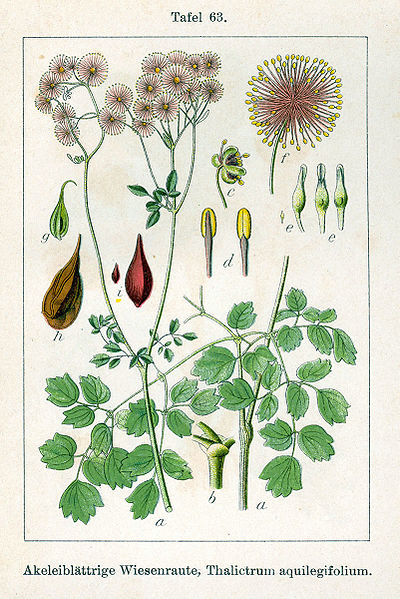
Thalictrum aquilegifolium – botanical plate
Large Thalictrum have an upright, airy habit forming broad, vigorous clumps, more or less flared, with a spread that can reach 60 cm. They are ideal placed at the back or centre of borders in semi-shaded areas, woodland edges or meadow-style gardens. The smaller species make good plants for cool rockeries.
A little slow to establish, meadow-rue needs about two years to thicken up and show its true stature. But it is worth waiting for: the older it gets, the more handsome it becomes. Once well rooted, this rhizomatous perennial grows quickly to form dense clumps. Almost indestructible, it has good longevity.
In April, from its sturdy crown emerge, slowly at first, finely divided leaves and tall graceful but sturdy stems, more or less furrowed, very branched, blue-green or brownish-purple to almost black depending on variety.
Very quickly, as temperatures warm, it forms in only a few weeks a large, light, floriferous mass made up of a cloud of small flowers.
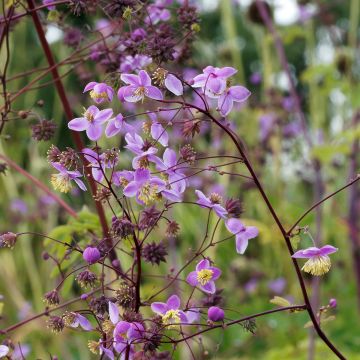
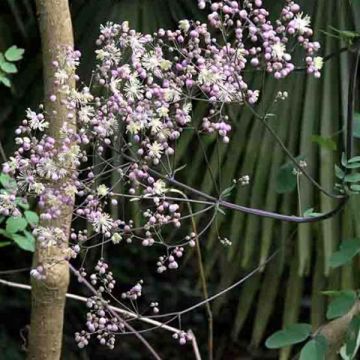
Spectacular, the feathery flowering gives this large perennial the appearance of a giant Gypsophila. From June to mid-September, flexible, very airy flower stems, which can reach 2.50 m for Thalictrum ‘Elin’, bear large panicles or loose corymbs, highly branched and carrying countless downy balls that open into small star-shaped flowers (1 to 3 cm). Pink, yellow, lilac, pure white or intense violet, they seem suspended in the air, spider-like constellations, attached to very fine peduncles. Lacking true petals, each flower has simple or semi-double sepals surrounding clusters of stamens sometimes so prominent that they give the flowers the look of mossy pompons recalling Gypsophila or mimosa.
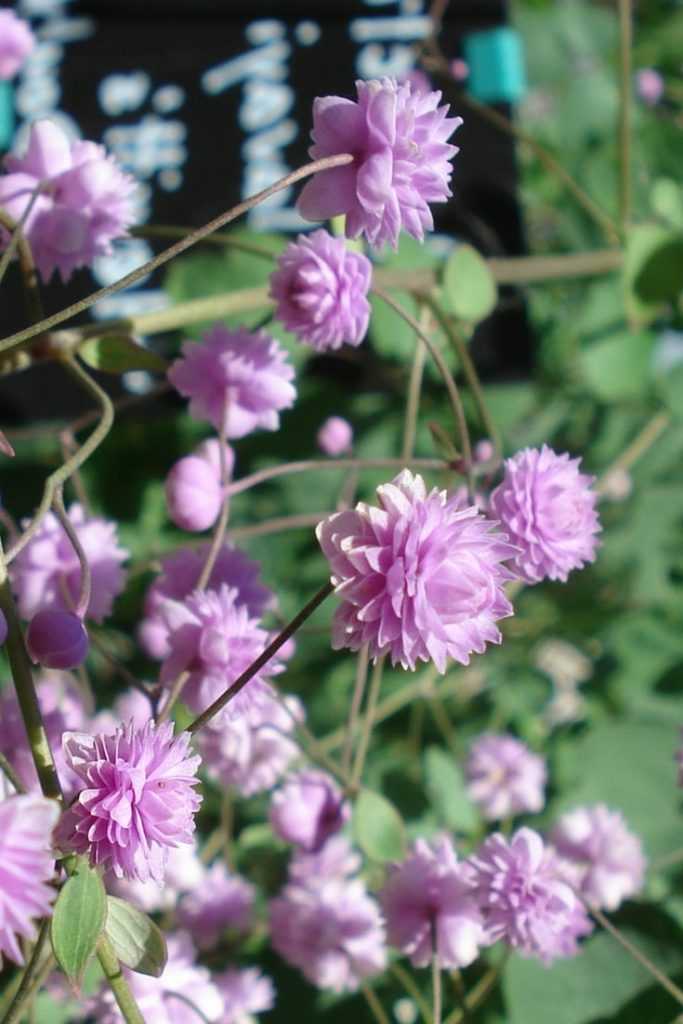
Thalictrum delavayi ‘Hewitt’s Double’
Flowers are sometimes bicoloured with white or pink sepals and contrasting purplish stamens, lilac with white tips, white with green touches or yellow. Sepals fall more or less quickly at the start of flowering, leaving clouds of starry stamens to provide the colour. Some cultivars, such as Thalictrum delavayi ‘Hewitt’s Double’, lack stamens and bear double flowers, resembling tiny soft, velvety roses.
Flowering lasts about a month. While Thalictrum delavayi flowers from summer to late autumn, Thalictrum aquilegifolium offers a spring bloom in May–June.
Scent is not the main asset of Thalictrum flowers; however, some species such as Thalictrum flavum and Thalictrum actaeifolium are fragrant and emit a light bergamot scent. Particularly melliferous, they attract pollinating insects.
Each pollinated flower produces a small winged fruit. In favourable conditions, in heavy, cool soil, Thalictrum (notably T. aquilegifolium) tends to naturalise by self-seeding. Once ripe, the brown seeds are dispersed by the wind.
The cloud-like inflorescences of meadow-rues make lovely airy bouquets, fresh or dried: in a vase the flowers last about a week after cutting. They are perfect in country-style and romantic arrangements, combined with roses, lilies or umbellifers.
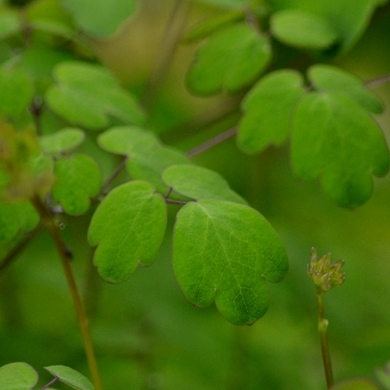
A pretty foliage recalling columbines
The foliage, of rare elegance, is as interesting as the flowering. Deciduous, it dies back in winter and only reappears late in spring, which allows Thalictrum to be paired with bulbous plants that will occupy the space early in the season. Finely cut and light, it evokes that of certain ferns such as the capillary, but even more so that of columbines: a resemblance that earned Thalictrum aquilegifolium the nickname “columbine-leaved meadow-rue”. Very fine in appearance and delicate, the toothed leaves are divided into rounded, flat leaflets of 3 to 5 lobes measuring, depending on species, from 10 to 40 cm. As they spread, they give the plant a certain opulence. The foliage takes beautiful shades of green, from lime-green to glaucous, slightly blue-silver.
Although it resembles Gypsophila paniculata, Thalictrum prefers the cool ambience of woodland edges; it likes bright situations but without strong direct sun during the hottest hours. Give it a place with morning or evening sun or beneath the canopy of deciduous trees. Conversely, Thalictrum dislikes overly dense shade that would limit flowering: do not place it in competition with shrubs that could deprive it of light and leave soil too dry in summer. Better give it a spot sheltered from dry, violent winds that might desiccate the foliage and flatten tall flower stems.
Very easy to grow and undemanding, it nevertheless requires, to flower well, soil rich in organic matter, well drained and free of lime. While it tolerates most soil types (except very poor, dry and stony ground), it typically prefers a woodland soil, neutral or acidic. It likes light soils, even heavy ones, provided they remain cool and sufficiently moist with a good mulch during the growing season. A cool soil allows vigorous development.
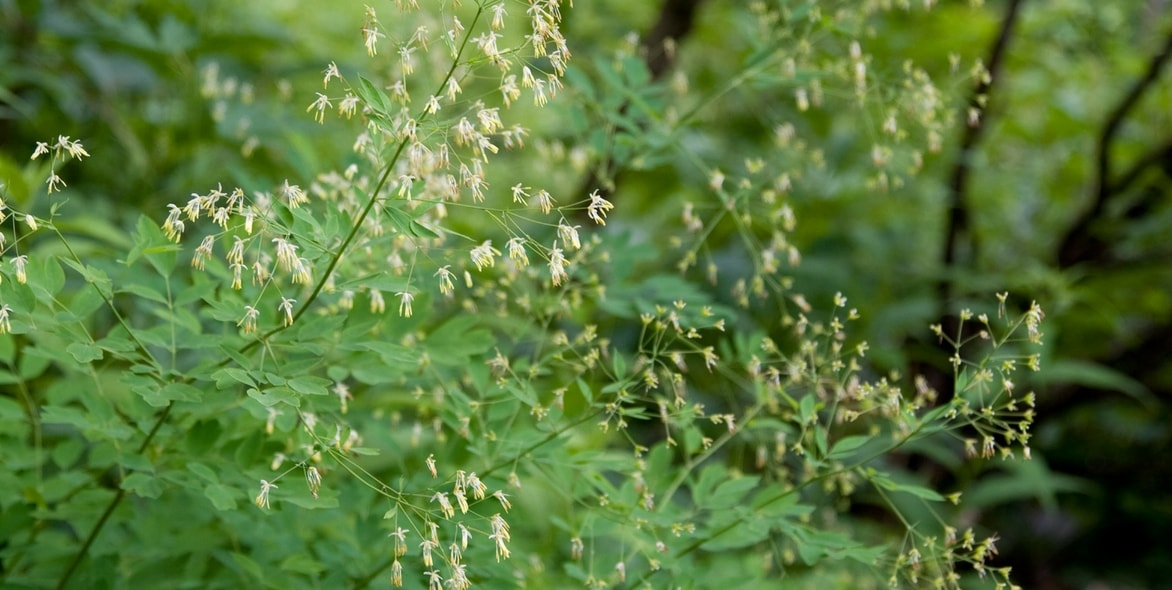
Thalictrum aquilegifolium in woodland
Huge specimens such as Thalictrum ‘Elin’ are rarely used as solitary plants but are placed at the back of borders, associated with other strong-growing perennials or with shrubs that act as supports, preventing clumps from flopping unsightly. Groundcover species, like Thalictrum kiusianum, are reserved for cool rockeries and flowering walls.
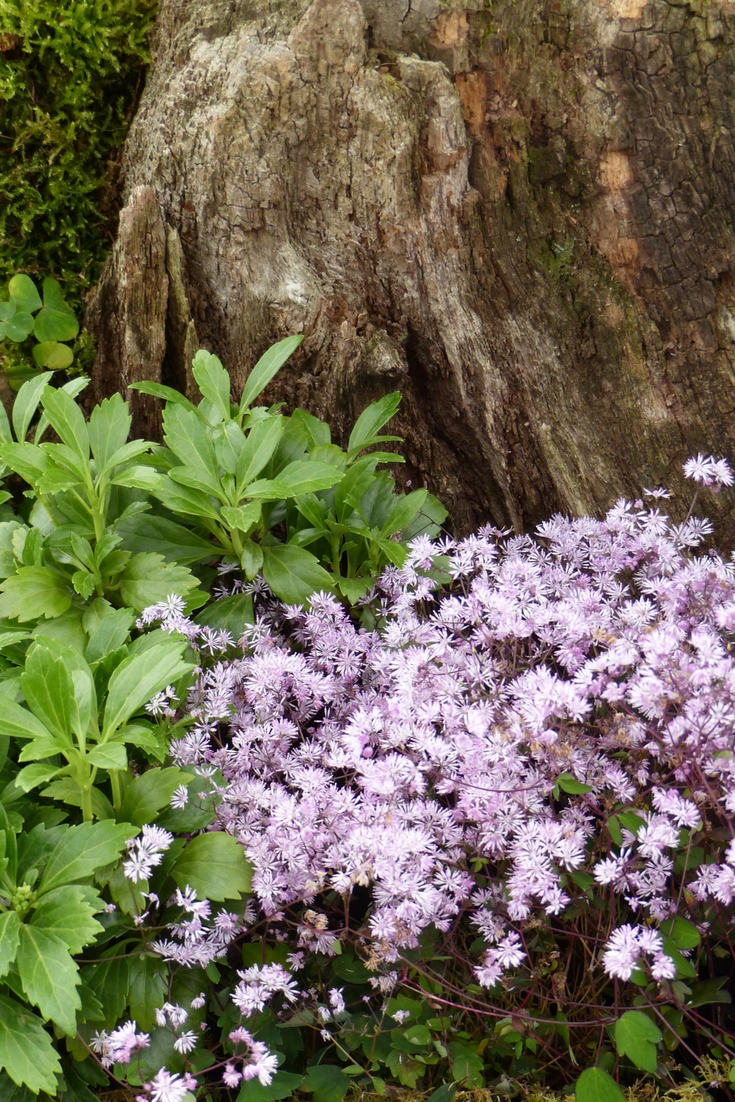
Thalictrum kiusianum and Pachysandra terminalis: a pretty combination for the base of a tree
The specific name delavayi was given to Thalictrum in honour of Father Jean-Marie Delavay, a Christian missionary who in the 19th century collected in China for the Muséum National d’Histoire Naturelle in Paris one of the largest botanical collections.
Main species and varieties
Genus Thalictrum includes around 130 species of variable size and flower colour. From lilliputian meadow-rues to giant meadow-rues, there is a place for each in the garden. Thalictrum delavayi is the most emblematic of the meadow-rues and, with Thalictrum aquilegifolium, is among the most floriferous in the genus. Both have many interesting cultivars. Among the most commonly cultivated species, Thalictrum rochebrunianum is one of the most imposing. While most meadow-rues are unscented, some give off a light fragrance. Large Thalictrum make good mid- or back-of-border plants for semi-shaded areas; dwarf meadow-rues such as Thalictrum kiushianum make good plants for cool rockeries, slowly forming a charming, very floriferous little carpet.
Thalictrum delavayi - Meadow-rue
- Flowering time July to September
- Height at maturity 1,70 m
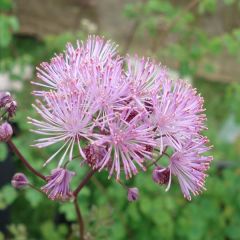
Thalictrum aquilegiifolium - Meadow-rue
- Flowering time July, August
- Height at maturity 1,20 m
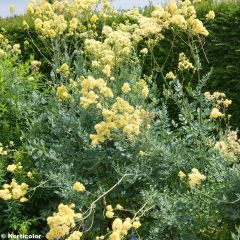
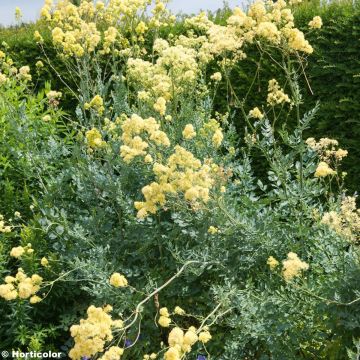
Thalictrum flavum subsp. glaucum - Meadow-rue
- Flowering time July, August
- Height at maturity 1 m
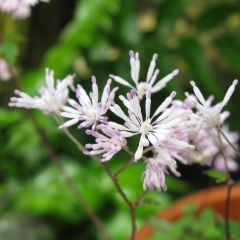
Thalictrum kiusianum - Meadow-rue
- Flowering time May to October
- Height at maturity 15 cm
Giant meadow-rues:
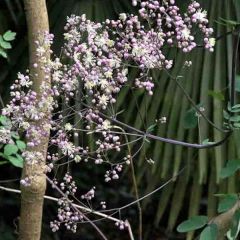
Thalictrum Elin - Meadow-rue
- Flowering time July to September
- Height at maturity 2,50 m
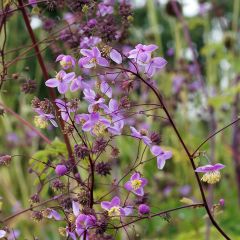
Thalictrum delavayi Splendide - Meadow-rue
- Flowering time July to November
- Height at maturity 1,75 m
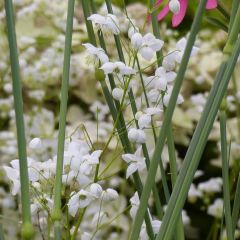
Thalictrum delavayi Splendide Album - Meadow-rue
- Flowering time August, September
- Height at maturity 1,50 m
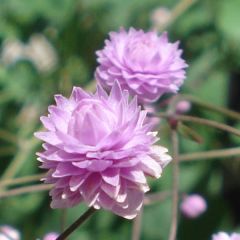
Thalictrum delavayi Hewitts double - Meadow-rue
- Flowering time July to October
- Height at maturity 1 m
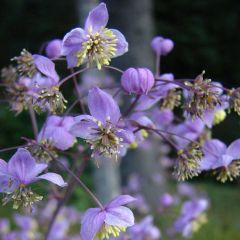
Thalictrum rochebrunianum - Meadow-rue
- Flowering time August, September
- Height at maturity 1,50 m
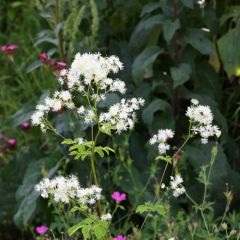
Thalictrum aquilegifolium Album - Meadow-rue
- Flowering time July, August
- Height at maturity 1,20 m
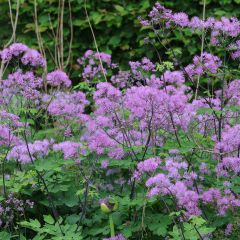
Thalictrum Black Stockings - Meadow-rue
- Flowering time July, August
- Height at maturity 1 m
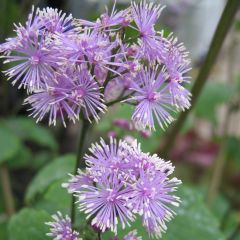
Thalictrum actaeifolium Perfume Star - Meadow-rue
- Flowering time July, August
- Height at maturity 80 cm
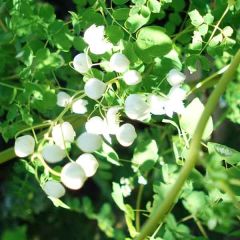
Thalictrum delavayi Album - Meadow-rue
- Flowering time August, September
- Height at maturity 1,50 m
Thalictrum delavayi Splendide - Meadow-rue
- Flowering time July to November
- Height at maturity 1,75 m
Thalictrum Elin - Meadow-rue
- Flowering time July to September
- Height at maturity 2,50 m
Thalictrum delavayi Splendide Album - Meadow-rue
- Flowering time August, September
- Height at maturity 1,50 m
Discover other Thalictrum - Meadow Rue
View all →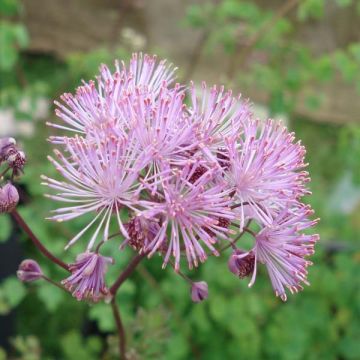
Available in 1 sizes
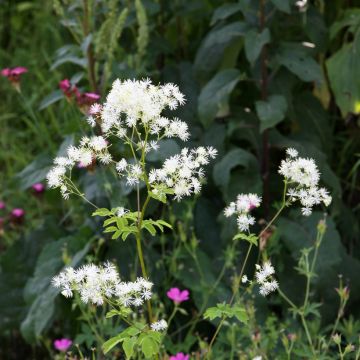
Available in 1 sizes
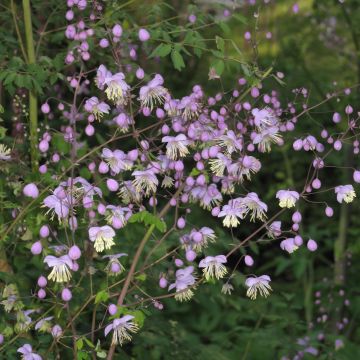
Available in 2 sizes
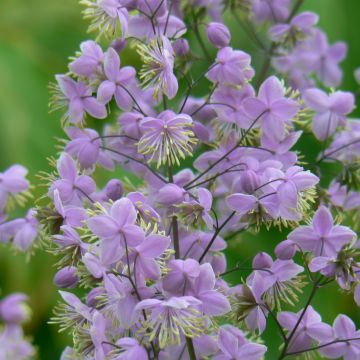
Available in 1 sizes
Available in 3 sizes
Available in 2 sizes
Available in 0 sizes
Available in 1 sizes
Available in 0 sizes
Available in 0 sizes
Planting and care
When to plant?
Thalictrum can be planted in spring from March to May after frosts, or in autumn from September to November, after the high summer heat.
Where to plant?
Although it looks like an easy-to-grow perennial, Thalictrum has a few requirements: it dislikes hot, drying exposures, dry, strong winds and competition from roots.
Vigorous, Thalictrum grows almost everywhere in France, except in dry, very windy regions and in Mediterranean climates, because it dislikes scorching sun. Pigamon will tolerate summer heat in temperate areas provided the soil remains consistently moist and cool.
Hardy, it withstands frost and tolerates temperatures down to -15 °C but only for short periods.
Thalictrum is grown in a rather shaded and well-exposed spot, sheltered from strong winds: it will thrive in partial shade, protected from direct sun, under deciduous trees which will bring welcome coolness. It prefers an open situation, which encourages it to reach full height. Too dense shade would limit flowering: do not place it where shrubs will deprive it of light. It also dislikes root competition: make sure to give it some space!
It has one formidable enemy: wind. A situation that is too windy is a threat to these tall perennials. Their feathery silhouettes are graceful so long as they remain upright! Reserve a spot sheltered from dry, strong winds that could desiccate the foliage and flatten the clumps.
While it fits into any planting scheme, it really comes into its own as a mid-border or back-of-border plant. The tallest varieties (Thalictrum ‘Elin’, Thalictrum delavayi ‘Splendide’, Thalictrum rochebrudianum) are planted at the back of borders, giving a vapoury relief and striking verticality. Planting on a lower level will allow full enjoyment of their flowering.
Groundcover species such as Thalictrum kiusianum, are perfect in shady rockeries and in cool beds.
How to plant Thalictrum?
Thalictrum is slow to establish but once well established, after about two years, it is very long-lived. The secret to growing this vigorous perennial therefore lies in planting.
- The soil must be cool to moist, but well drained (excess winter wet can be fatal), slightly acidic and rich in organic matter. It does not like dry, poor soils where it will never be lush. It prefers soils from fairly heavy to light kept sufficiently moist with a good mulch during the growing season.
- It tolerates slightly clayey soils but dislikes very heavy soils. Do not hesitate to mix well-rotted compost into the bottom of each hole, at a rate of 5 to 10 L, before placing the rootball.
- Keep soil cool at the base of Thalictrum with mulch, especially during summer: this is the guarantee of prolonged flowering.
- Once young plants are established, do not disturb them. It is only in the second year that they will begin to fill out and flower properly.
- If you love the delicately cut, lush foliage of Thalictrum, so do slugs and snails! As foliage disappears in winter, it is wise to mark plant positions with a small stake so you can monitor slugs and snails in spring when they devour young shoots. Fern liquid manure helps control them.
- Plant 2 to 5 plants per m2, spaced at least 50 cm apart. Thalictrum does not like root competition: avoid planting too close to shrubs. It is a very airy plant that remains transparent; planting in groups gives the best effect in a border.
- For giant pigamons, staking is sometimes essential, especially if planted alone. Bear this in mind: it will prevent stems breaking at the first gust of wind — one strong gust and your border will look like a battlefield after the storm! Another solution to stop flowering stems collapsing in the middle of a border is to plant Pigamon alongside other plants and shrubs on which it can lean.
- A living mulch made of groundcovers such as Pachysandra, periwinkles or bugles will keep the base cool.
- Water regularly during the first summer to promote rooting.
Care
Once established in ideal growing conditions, Thalictrum is undemanding. Very disease-resistant, it requires little care and proves to be a trouble-free perennial with robust health! Provided the soil remains cool and sufficiently nourishing.
- Each winter, spread a generous layer of fallen leaves; as they decompose this vegetal mulch will turn into humus.
- Feed every spring with compost to improve winter drainage and encourage root development.
- Stake tall specimens if necessary, as they are very sensitive to wind.
- During dry, hot periods, mulch and water very regularly in the late afternoon. It tolerates summer heat, provided watering is daily.
- Pruning is not necessary: simply remove faded flowers regularly to prolong flowering and prevent excessive self-seeding.
- At the end of autumn, cut back spent stems by half.
- Avoid cutting the plant right to ground level in autumn: as foliage only reappears in spring, you might forget where it is!
Possible problems
Pigamons have only one known enemy: slugs and snails. Easy to grow, they know no real diseases, except perhaps powdery mildew during drought. Watch for slug attacks at the start of the growing season!
Read also
Fluffy plantsSowing
Clump division is possible but delicate, risk of damaging root is considerable. We do not recommend it, especially since Thalictrum is very easy to sow.
Indeed, sowing is the simplest method : this perennial is very easy to grow from seed. If some varieties, such as Thalictrum delavayi ‘Hewitt’s Double’, which is sterile, as well as hybrids, do not propagate by sowing, most pigamons produce seeds that germinate easily. Sowing is carried out in autumn with fresh seeds of the year, harvested as soon as they turn brown, before they dry out, or with seeds sold in packets.
- Sow immediately under a cold frame in a mix of potting compost and garden soil. This cold period will encourage germination.
- Plant seeds 6 mm deep.
- Allow two to three months for germination; they will germinate in spring.
- Pot on when seedlings have strengthened and reach 5 cm in height.
- Protect young plants from slugs when planting.
Companion planting for Thalictrum
A reliable choice for lightly shaded borders, Thalictrum is perfect for brightening cool spots and playing with shades and gradations. With its tall airy silhouette, delicate, light foliage and pastel inflorescences, it transforms a simple perennial border into a poetic mixed border. It is the ideal companion for old roses, with which it composes opulent, romantic spring and summer scenes. It adds to the charm of English cottages and to soft-focus informal country or vicarage-style gardens, bringing height, exuberance and lightness. It is a staple of rose gardens.
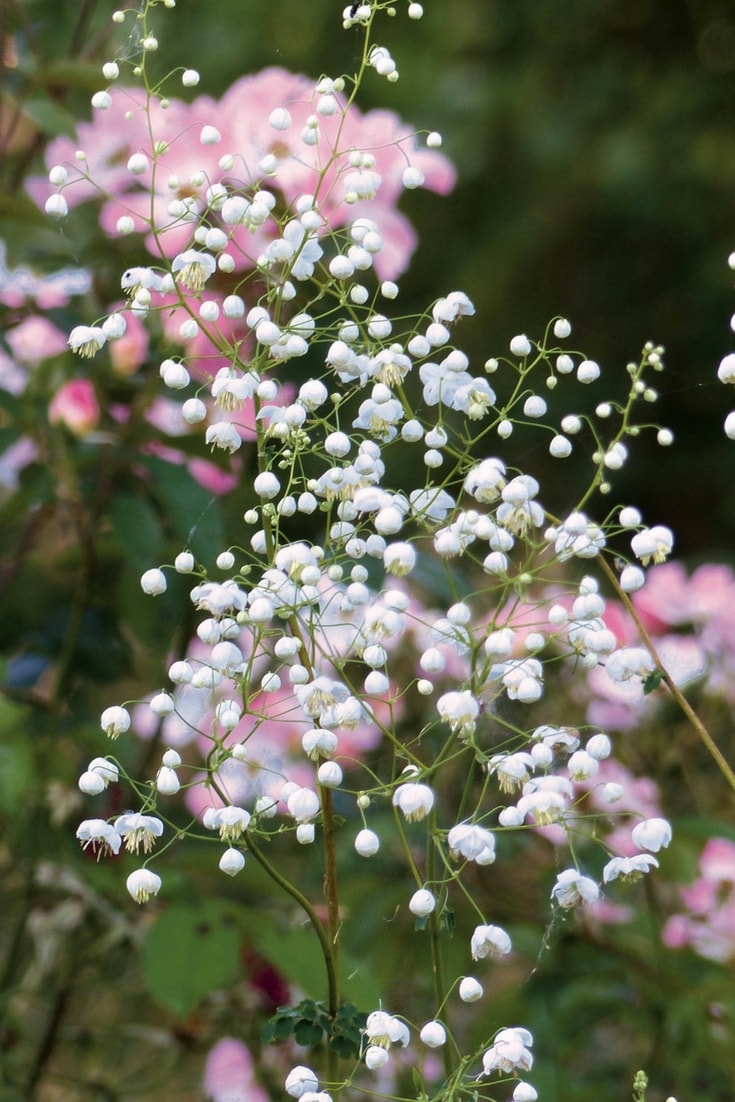
Thalictrum Splendide White against a background of roses: a true wonder for romantic gardens
It thrives in a community, alongside vigorous perennials that will precede or follow its flowering, such as Japanese Anemones, Bleeding Hearts, Aconite, Columbines, Astrantias, Foxgloves or hardy geraniums.
Whether tall or groundcover, Thalictrum fits into every setting, and can play the dazzling role of a mid-border or back-of-border plant creating an evanescent mist or that of a mossy flowering carpet for cool rockeries.
It creates a pleasing contrast when paired with stiffer-growing plants such as Hostas or ferns and works wonderfully with heather-soil shrubs such as Hydrangeas, with which it composes lush borders.
You can also create beautiful combinations with lilies, Astilbes or grasses or with Uvularia grandiflora. Thalictrum flowering in late summer and early autumn pairs beautifully with Asters, which it accompanies in flower. And to keep the base of Thalictrum cool, consider groundcovers such as sweet woodruff, a carpet of periwinkles or Bugles in soft pink.
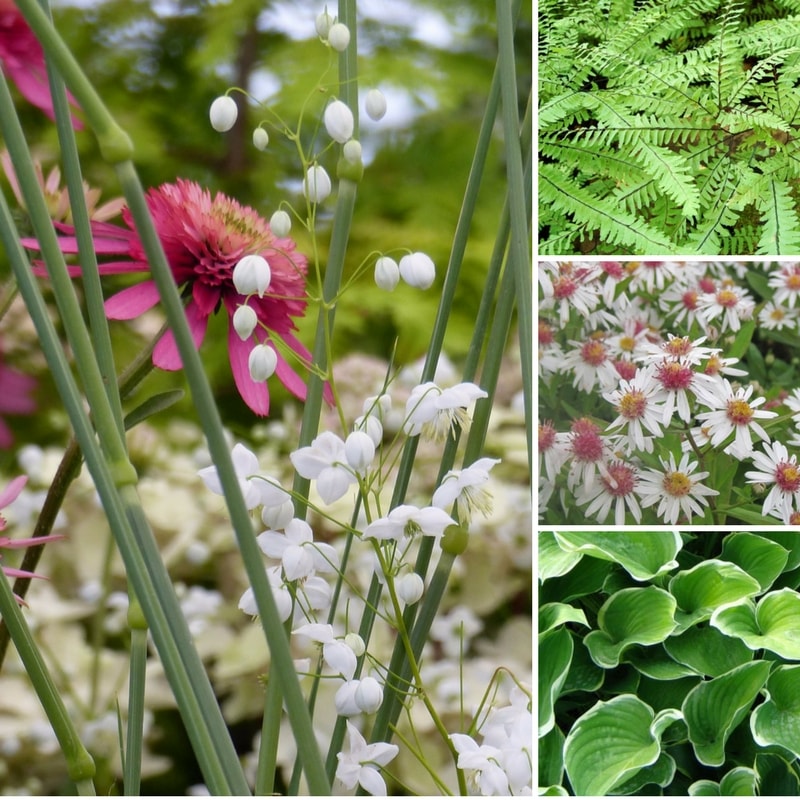
Another example of a combination: Thalictrum delavayi Splendide Album with Echinacea Catharina, Aster lateriflorus Chloe, Hosta Sagae and Adiantum aleuticum Imbricatum
Need more inspiration? Discover our advice sheet: “Thalictrum, Pigamon: 8 beautiful pairing ideas”.
Useful resources
- Collect Pigamon seeds! This perennial is one of the easiest to sow!
- Planting perennials is easy with our advice sheet
- Which plants pair well with Thalictrum? Pierre, our horticultural engineer, shares his valuable guidance.
- Also discover our advice sheet on slow-to-establish plants
Frequently asked questions
-
Planted two years ago, my Pigamon hasn't grown. Is that normal?
Yes, don't worry. Pigamon needs about two years to settle in properly and reach its full potential. It will be slow to establish during the first few years, but it is worth the wait: the longer it grows, the more beautiful it becomes. Once well-rooted, this rhizomatous perennial grows quickly to form dense clumps. Your patience will be rewarded: once established, it is almost indestructible!
-
Can Thalictrum be planted on its own?
Yes, it's possible, but the effect will be less striking than when planted en masse. Its beauty only reveals itself when combined with other perennials. Very large specimens are rarely used on their own; they are best planted in the middle or at the back of a border, alongside other vigorous perennials such as hostas or Japanese anemones, or with shrubs such as hydrangeas, which will provide support and prevent their clumps from flopping over in an unsightly way.
-
I have a shady rockery; which Thalictrum should I choose to flower it?
Genus Thalictrum includes giant specimens but also groundcover species, less well known yet remarkably floriferous. Thalictrum kiushianum will be superb in cool rockeries, shady borders and flowering low walls. Year after year it will form a charming little carpet, highly floriferous, producing from April to June, and again in September, a profusion of small pompom flowers in delicate pink-mauve.
-
My garden is quite exposed to wind; can I try growing pigamon?
Pigamon has a formidable enemy: the wind! A site that is too exposed is a threat to these tall perennial plants. Give it a spot sheltered from dry, violent winds that could desiccate the foliage and make the clumps flop over. Another precaution, especially for giant varieties, is staking. It's essential, especially if, as in your case, they are exposed to wind. Otherwise the stems would break at the slightest gust and your border would look like a battlefield after a storm! To avoid this, we also recommend planting Thalictrum with other perennial plants or shrubs, which it can lean on for support.
- Subscribe!
- Contents
This form is protected by reCAPTCHA - the Google Privacy Policy and Terms of Service apply.