
Tomato looper, a pest spreading from the South
Identification, symptoms and treatments of tomato noctuid moth
Contents
It’s often a small hole with well-defined edges, visible on green or ripe tomatoes, that catches the gardener’s eye. Then, when cutting open the tomato in question, you may find a small green caterpillar that has cosily settled in the fruit’s flesh, literally devouring it. Unless it has already moved on to find another host elsewhere… Whether you live in southern France, where it had previously been confined, or further north, you may already have encountered this pest? Behind this caterpillar lies a moth, the tomato moth (Helicoverpa aemigera), sometimes called armigère.
Let’s get to know this pest that can cause significant damage to tomato crops, and look at the various methods of prevention and control.
To find out more: Tomatoes: sowing, planting, care and harvest.

Tomato moth: what exactly is it?
Behind every caterpillar there is always a moth. And the moth responsible for damage to your tomatoes is the tomato moth, also called the armigera or Helicoverpa armigera. This lepidopteran is a nocturnal moth of tropical or subtropical origin. Arriving during the 2003 heatwave, it established itself in southern France, where it began to attract attention. With recent heatwaves it has been creeping slowly northwards across the country. Thus, living and gardening near Saint-Étienne in the Loire at about 650 m altitude, I observed its presence for the first time in summer 2023 in my tomato plot.
A nocturnal moth active in spring
Mr and Mrs Helicoverpa armigera are slightly different. Both about 4 mm wide, they are distinguished by wing colouring, orange-brown in the female and grey-green in the male. The forewings are also edged with a line of black spots. The female is slightly longer than the male, more robust too. Their mating flight takes place at dusk or at night as soon as soil temperature reaches 17–18 °C, that is in April–May in the south, a little later elsewhere. During their short lives, male and female feed on nectar from surrounding flowers and quench thirst with dew. Then the female can lay between 300 and 500 eggs, usually on young shoots, on the underside of leaves and on flower buds. Spherical and flattened at the poles, these eggs change from yellowish-white to brown. Incubation lasts only four days! Then the larvae hatch.
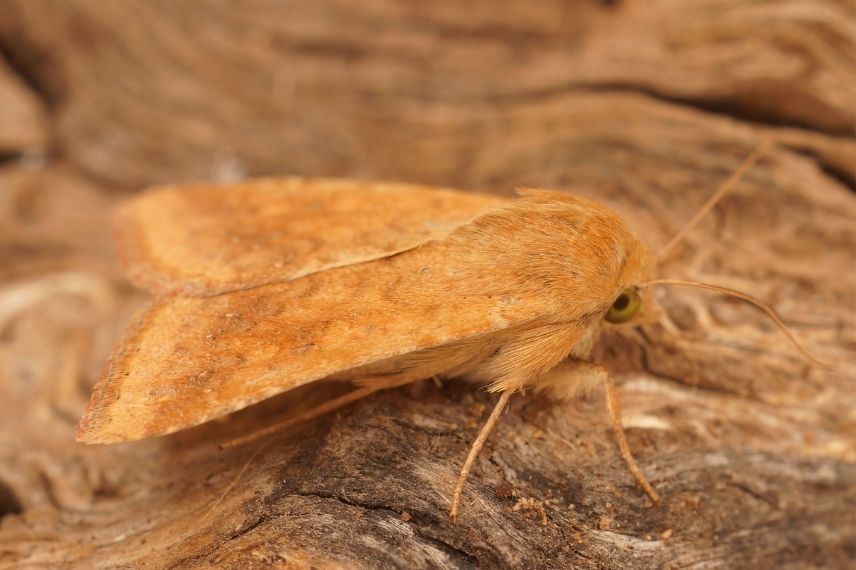
Adult female Helicoverpa armigera
Life cycle of the caterpillars
Larvae of the tomato moth go through six stages of development, the duration of which depends on temperature. Larval development can be as short as 18 days at 22 °C and as long as 50 days at 17 °C. On hatching, young caterpillars, which roam about, feed on young leaves. They can be very aggressive, even cannibalistic, towards their conspecifics. By the second instar they bore into fruits, whether green or ripe, making a small hole often quite close to the peduncle. They feed and defecate inside, which renders tomatoes unsuitable for consumption. At the end of development these caterpillars, variously coloured green, yellow or brown, measure 30–40 mm long.
Once fully fed, after the six stages of development, the caterpillars burrow into the soil to pupate. They spend the winter there as pupae. And, the following spring, they return!
What damage to tomatoes and other vegetables?
Tomatoes are mainly targeted by these moths, but they can also attack peppers and aubergines, squashes, beans and sweetcorn. In other regions they also wreak havoc on cotton or tobacco plantations. They cause huge commercial losses for growers, because once “the worm is in the fruit” it becomes completely inedible. This is because caterpillars chew away tomato flesh, fouled by their frass. By contrast, damage to leaves at early larval stage is far less significant.
As moths are quite hard to spot in flight, or even their eggs, damage is usually detected only after it has occurred. And the first unmistakable sign is a hole in the tomato. Often just one per tomato, typically perfectly round. Cutting open the tomato, depending on larval stage, reveals gnawed flesh and sometimes the caterpillar still present.

A small, neat round hole in the tomato is a sign of tomato moth attack
If climatic conditions allow, several generations of tomato moths can follow one another during a growing season.
How to control tomato moth?
It is relatively difficult to control the tomato moth. Because when first symptoms are seen, caterpillars are quietly settled inside fruits of their host plant, completely inaccessible.
To control them, you therefore need to act at other stages of their life cycle. But natural control options remain limited. The only truly effective treatment is Bacillus thuringiensis (Bt), a microbial insecticide effective against adults and especially larvae in their first instar. But you must not miss them, because they are vulnerable for only four short days, often well hidden under leaves. As for adults, they fly at dusk or at night. Needless to say, they generally go unnoticed. That is why market gardeners set pheromone traps before spraying Bt to monitor moth flights. It is also recommended to repeat Bt sprays every 10 days over all parts of the tomato plant, including, and especially, the undersides of leaves.
By closely inspecting your crops (and with a good pair of glasses), you can also spot caterpillars at their final instar when they are looking to burrow into soil for diapause. You can also try to find eggs!
Finally, the primary control method is to systematically destroy infested tomatoes. Do not leave them to rot on the ground where they fall!
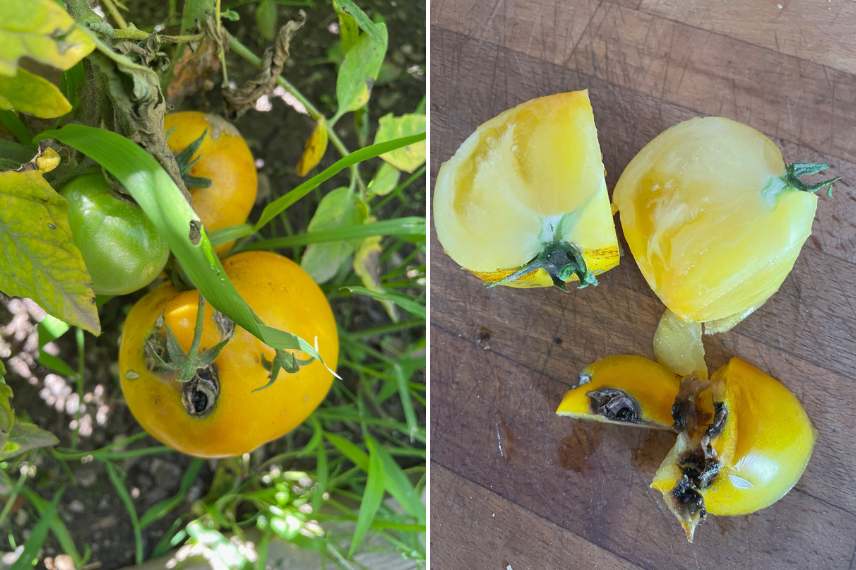
Here, this tomato appears to be attacked by the tomato moth. In fact, it is simply hail damage. No sign of caterpillar!
And you can count on help from a few beneficials, namely tits (which love caterpillars of all kinds!), bats, very effective at dusk, and hoverflies. That is why it is essential to promote biodiversity to attract tits and other predators to your garden.
To find out more :
How to prevent Helicoverpa armigera attacks
As biological control of tomato moth looks set to be difficult, best to focus entirely on prevention! And preventive methods are numerous. Deploying them all will increase your chances of deterring tomato moths from establishing in your garden:
- Install horticultural fleece or insect netting as soon as tomato plants are planted, in April or May depending on region, to prevent egg-laying directly on the host plant. If tomatoes are grown under glass, closing openings in the evening and at night is sufficient to keep adults away.
- Set up pheromone sex traps for tomato moths to detect adult flight and act accordingly.
- Carefully remove weeds from around tomato plants. Adults can find a useful food source there and drink dew.
- Encourage establishment of natural predators of tomato moths by installing feeders and nest boxes, or by planting berry-bearing shrubs for tits. Hoverflies can be attracted by planting melliferous plants or by building bat shelters.
- Strictly apply crop rotation. Caterpillars overwinter in soil at the base of their host plants.
- Carefully destroy all crop debris: leaves, stems and unharvested tomatoes.
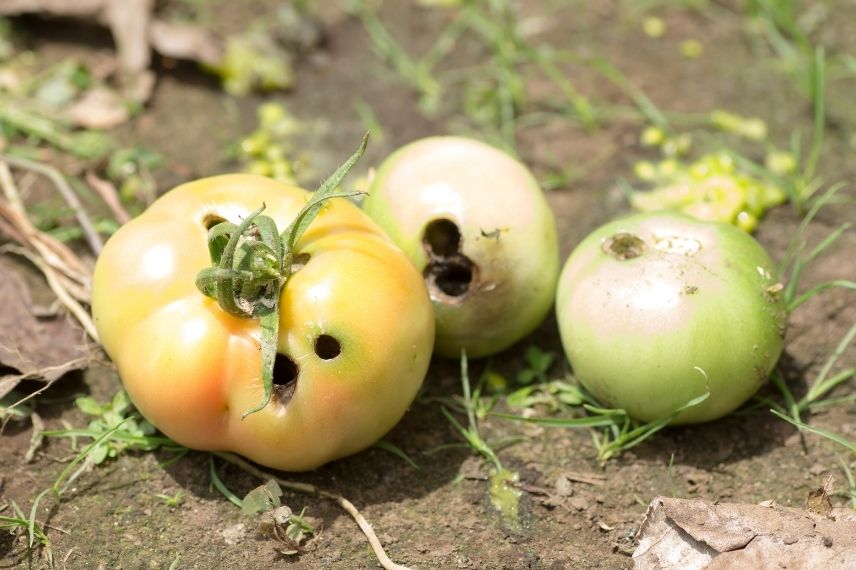
However, here the larva is clearly in the fruit!
Personally, as every year, I let my four hens into my veg patch in winter when crops are scarce. By scratching the soil and pecking, they quite reliably destroy any larvae. This season, so far, no small holes visible in the tomatoes…
- Subscribe!
- Contents
This form is protected by reCAPTCHA - the Google Privacy Policy and Terms of Service apply.


































Comments