






























My lilies fail to bloom, why?
Our tips for getting lilies to bloom
Contents
Late-spring or midsummer-flowering bulbs, refined, romantic and exotic and often scented, the lilies form a large, well-known family among gardeners. There are times when their flowering does not live up to our expectations. They have leaves, but as far as flowering goes, it’s a complete lull or negligible… What has happened then? Is it down to the variety or species chosen, or to the cultivation method? Why don’t lilies flower, or not as much as we’d like? We provide a few pointers in this guide to help you better understand these flowers and ensure a flowering worthy of the name.

Lilium tigrinum

Growing requirements for lilies
Elegant, the lily reveals its charm, its many colours and large flowers, in gardens of very different styles, and it can also be grown in pots for the smaller varieties. There are about 80 species of lily, some of which are delicate in cultivation. Here are the key points to remember about their needs:
- Soil: for all lilies, the soil should be well-drained, loose, rich in humus and organic matter, and acidic (except for Lilium candicum, Martagon lilies and, Lilium longiflorum and Lilium henryi which grow in calcareous soil).
- Exposure: Some lilies originating from montane or woodland areas are more suited to partial shade, such as Martagon lilies, Lilium henryi, Lilium mackliniae but also Lilium hansonii and Lilium rubellum, but dense shade is detrimental to them, and they are not the most cultivated species here. The vast majority of lilies thrive and flower well in full sun in most regions. In the strongly exposed southern regions, bright partial shade is ideal. Lilium candicum is the only one that tolerates drought well, more suitable for the southern half of the country.
- Hardiness : they are largely hardy, their bulbs planted deeply in the ground providing protection. But this does depend on their origin: they come to us from Asia, Europe or the Americas.
- Planting depth : apart from Madonna lily which is planted close to the surface, the other lilies are planted at a depth of between 15 and 20 cm.
→ All about Lilies in our complete dossier: Lilies: planting, cultivation and maintenance.
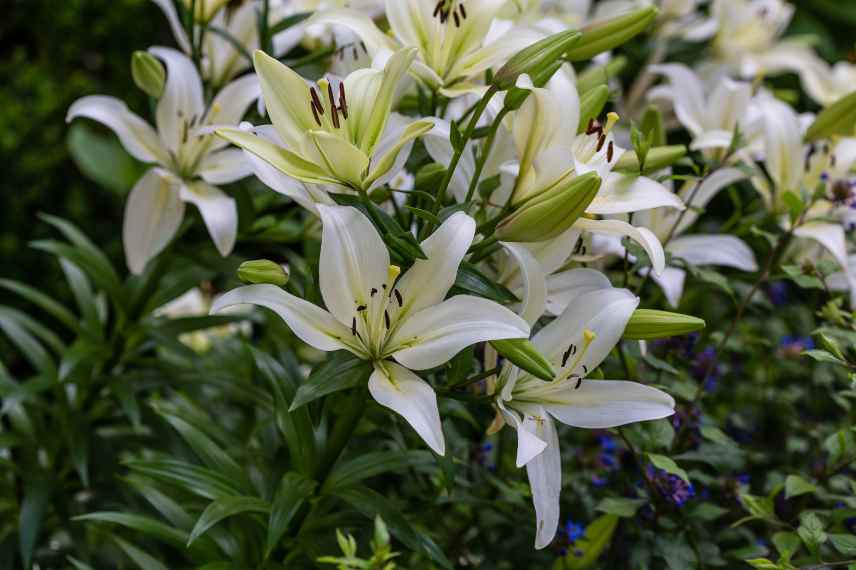
Lilium candicum (Madonna lily): a sunny exposure promotes a beautiful flowering
Read also
When should we plant summer bulbs?When and how do lilies bloom?
Lilies bloom, depending on the countless species and horticultural varieties, between May and September. Most bloom between June and July, some botanical lilies as early as May such as the Lilium pumilum. So check the cultivar you have planted; there is a good chance that a lily that isn’t flowering is a late-flowering lily, as with some Oriental hybrids, for example.
They sometimes bear a single crown-like flower, but more often several, from five to ten, sometimes even an inflorescence consisting of a cluster of around twenty flowers as with some cultivars of Lilium henryi (Lilium ‘Lady Alice’) or the Martagon lilies.

Martagon lilies and Asian lilies: two distinct inflorescences, but always a single stem bearing more or less flowers
The main reasons why lilies do not bloom
If you do get a start of leaf-out on a well-developed stem (which means you haven’t planted the bulb the wrong way round!), you need to look for the reasons elsewhere…
They are not getting enough sun
Lilies are sun-loving plants, and if planted too shady, they may not flower correctly, especially in the northern half of France. As with clematis, for lilies we speak of planting the crown to the sun and the base in shade. This means that the lily needs a minimum amount of light to flower (at least 6 hours), even though some tolerate more partial shade (Lilium martagon, Lilium henryi, Lilium mackliniae, or Lilium hansonii for example). A poor exposure and too little sun will hinder the lilies’ flowering.
→ Read more about light in the garden: exposure, sunlight, shading and brightness.
They were planted poorly or at the wrong time
Planted too late, the lilies did not have time to grow, and did not undergo a cold period that encourages them to produce flowers, as is the case for Lilium candidum (Madonna Lily). The planting period depends on the type of lily: oriental lilies, more delicate, are ideally planted in spring, while hardier lilies such as the regal lily are planted in autumn.
Planted too closely, lacking air around the bulbs, they will also struggle to grow well, hence generally poorer flowering. Usually you plant each bulb at a distance of 10–15 cm, even if you want a mass effect by planting several bulbs.
They were multiplied by scale cuttings or by dividing bulblets
If you have propagated your lilies by external scale cuttings or by dividing bulblets – these mini bulbs forming around the mother bulb (or for Lilium bulbiferum, Lilium tigrinum and Lilium lancifolium, at the leaf axils) – do not be surprised if there is no flowering the following year. Lilies produced from scale cuttings then require at least two to three years to flower and are grown in a nursery during this period before transplantation. So there is no need to worry if that is the case.
→ Also read our tutorial: How to propagate bulbs by scaling?
They have fallen victim to the lily beetle
The lily beetle, the main pest of lilies, can also cause flowers to abort. It is a red-coloured beetle in the same family as ladybirds. An infestation in spring can even kill your bulbs. It is the larvae that destroy the leaves and the floral buds. Inspect your lilies regularly, on and under the leaves, to see if they are affected.
→ Learn how to deal with the lily beetle in our fact sheet: Lily beetle, dealing with attacks
They have exhausted the soil
If lilies are long-lived perennials that are hardy and reliable, staying in place for many years, they are heavy feeders and nevertheless quickly exhaust the soil, in just a few years. To feed them properly and to promote good flowering, you should replace the surface substrate every three or four years: in autumn, apply a rich mix, such as leaf mould or well-decomposed compost.

Read also
How to choose a lily?Care tips and mistakes to avoid
- Do not confuse the different species of lilies and their planting method (period and depth):
– Madonna lilies (Lilium candicum) are planted in late summer or early autumn, at 3-4 cm below the soil, and 20 cm apart.
– All other lilies are planted at a depth of between 15 and 20 cm, i.e., 2 to 3 times the size of the bulb.
– Botanical lilies, including martagon lilies, are planted at a depth of 10 to 25 cm,
– Oriental lilies (hybrids) and Asian lilies are planted in spring, from March to May, at a depth equal to 2-3 times the size of the bulb.
– The regal lily is planted at a distance of 20-30 cm, and at a depth of 15-20 cm. - Managing watering : Yes, lilies prefer soil that remains cool during their growth and flowering, but that does not mean they should be overwatered. So be mindful of watering; as often, under-watering is preferable to overwatering, due to the risk of rotting the bulbs. Mulching with mulch or compost in spring is ideal to keep the plant’s base cool. In pots, do not water more in autumn or winter; seasonal rains will suffice.
- Cut the flowers progressively as they fade, but just at the upper third of the stem, to allow the bulb time to rebuild reserves thanks to the remaining foliage. The best is to cut the stems back to the base once the foliage has yellowed and dried at the end of the season.
- In terms of fertiliser, you can always add a slow-release fertiliser (bone meal or ground horn, rich in phosphorus) before or at planting. Ash and its supply of potash are also beneficial for bulbs, including lilies (at a low dose, scratched into the soil in spring), but above all no nitrogen fertilisers. When planted in pots, the ideal is to stimulate flowering with a liquid fertiliser rich in potassium, such as a fertiliser for flowering plants.
→ Learn more with our articles: 10 tips for successfully growing lilies, How to have lilies in bloom all summer?
- Subscribe!
- Contents

Comments