





























Which hydrangeas thrive in shade?
Navigating the different Hydrangea species for a shaded display
Contents
Hydrangeas are garden staples, gracing gardens with abundant, colourful, long-lasting flowering. While some species grow well in sun, others thrive remarkably well in semi-shaded or shaded areas. This makes them ideal for gardens with less sun exposure or for woodland understoreys where light is dappled. The following article presents a selection of hydrangeas that thrive in shade, thus providing an ideal solution for gardeners looking to brighten the dark corners of their garden or terrace, by understanding the specific needs of these species and following some care tips.
To learn more about hydrangeas, see our full guide: Hydrangeas: planting, pruning and care.

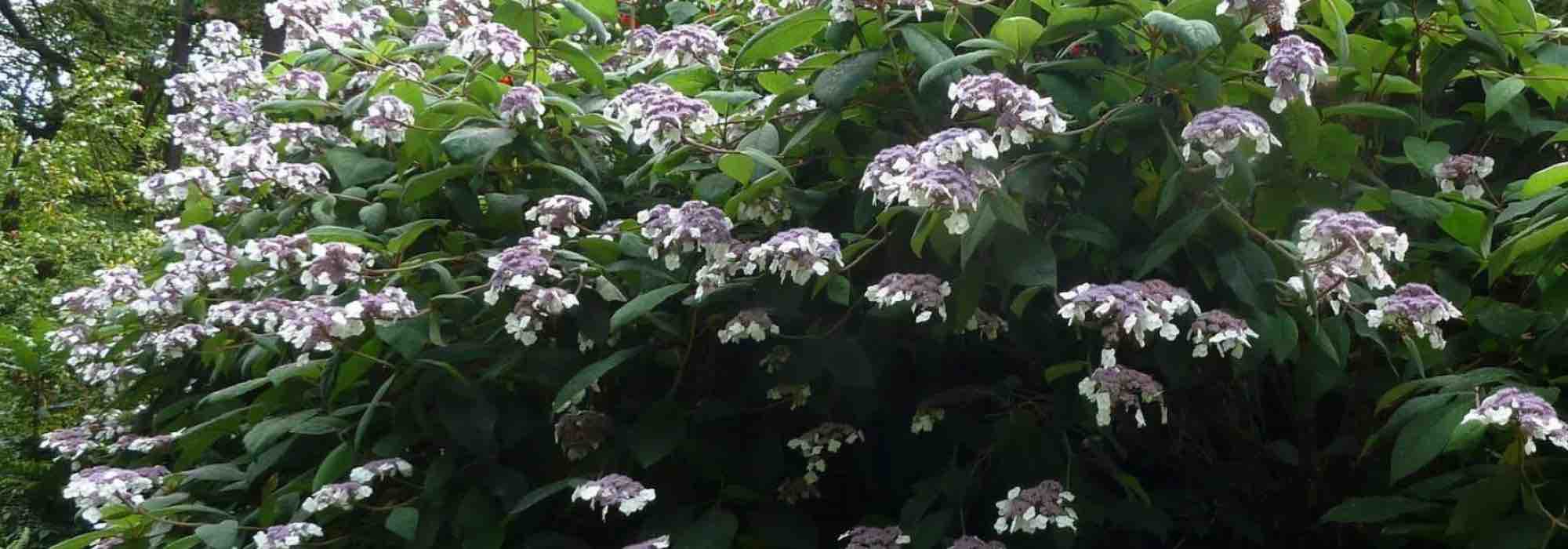
Hydrangea or Hydrangea aspera, for partial shade in the north and shade in the south.
Hydrangea, or Hydrangea aspera is a species that develops flowers in flat umbels, also known as Lacecap. They consist at their centre of a velvety cluster of fertile mauve or violet flowers, surrounded by large sterile flowers, or ‘pseudo-flowers’, whose colours range from white to mauve, violet or pink depending on the variety. Hydrangea aspera features superb dark-green foliage, covered with a light silky down. It forms an airy shrub reaching 2 to 3 metres in height. Hardy, it prefers a partly shaded and sheltered exposure, tolerating cold and drying winds poorly. It is ideally grown in a woodland ambience, facing north or west, as it fears drought in both soil and air. In the south, you can even plant it in denser shade to spare it the intense heat.
This species does not have the same soil requirements as other hydrangeas; it can grow in neutral soil, not necessarily requiring an acidic soil such as heather soil. A slightly alkaline soil is even possible, provided there is not much active lime. Shade from trees is preferable to that provided by a wall. It is ideally planted on the edge of trees or in light woodland, where its architecture blends well with the upper layers of large shrubs and trees, as in nature. There it also benefits from a touch of coolness, even beneficial humidity. A soil fairly rich in humus suits it well, cool or slightly damp but well-drained.
Many beautiful varieties come from the species Hydrangea aspera, such as ‘Anthony Bullivant’, recipient of an Award of Garden Merit from the Royal Horticultural Society, or ‘Velvet and Lace’, with violet, lilac and mauve tones of stunning beauty.
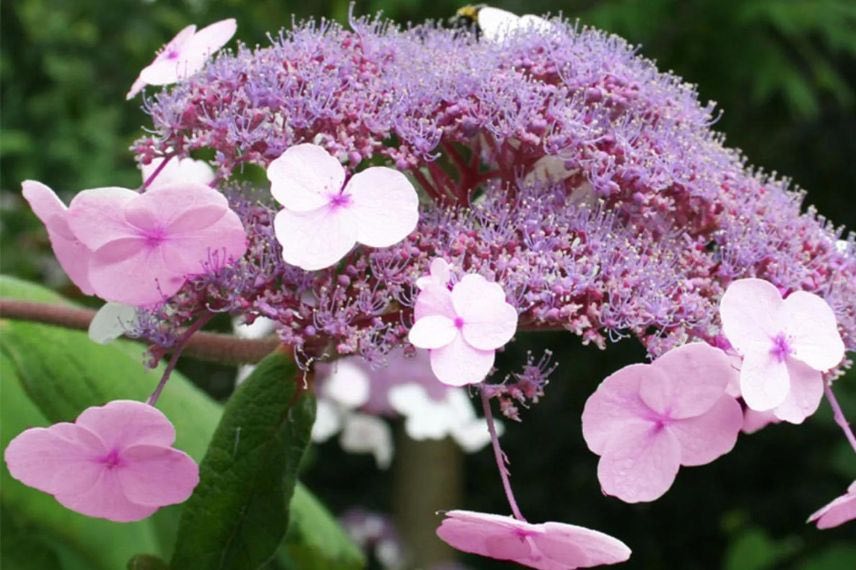
Hydrangea aspera ‘Anthony Bullivant’
Read also
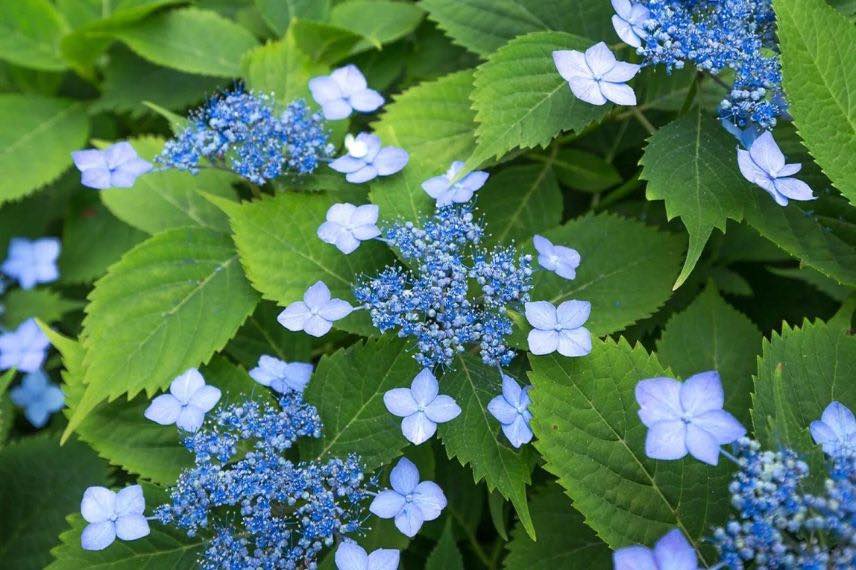
Hydrangeas: how to choose them?Hydrangea or Hydrangea serrata, for shade or partial shade.
Climbing hydrangeas
Whatever species, all climbing hydrangeas appreciate shaded spots or north- or east-facing walls in the morning sun. Largely overlooked, these are very useful and particularly ornamental in shaded situations. They have the advantage of clinging on their own with their climbing roots and dress walls or fences very elegantly. Most have deciduous foliage, but a few species have evergreen foliage. They all develop beautiful aerial umbels of flowers, often white or cream in colour and sometimes pink. The foliage can be variegated or coloured with red tones.
These hydrangeas prefer deep, humus-bearing soil with no excess of lime. However, Schizophragma hydrangeoïdes requires acidic to neutral soil, lime-free, and likes clay soil, but well-drained. You can mulch the base in summer to keep the roots cool, and water regularly if summers are very dry.
Look at the beautiful varieties such as Hydrangea petiolaris, the best known, but also the Schizophragma hydrangeoïdes or the Hydrangea anomala ‘Crug Coral’ with pink flowers. For evergreen foliage, turn to Hydrangea seemanii or the Pileostegia viburnoides for example.
→ Read also our advice sheet: Top 7 climbing hydrangeas.
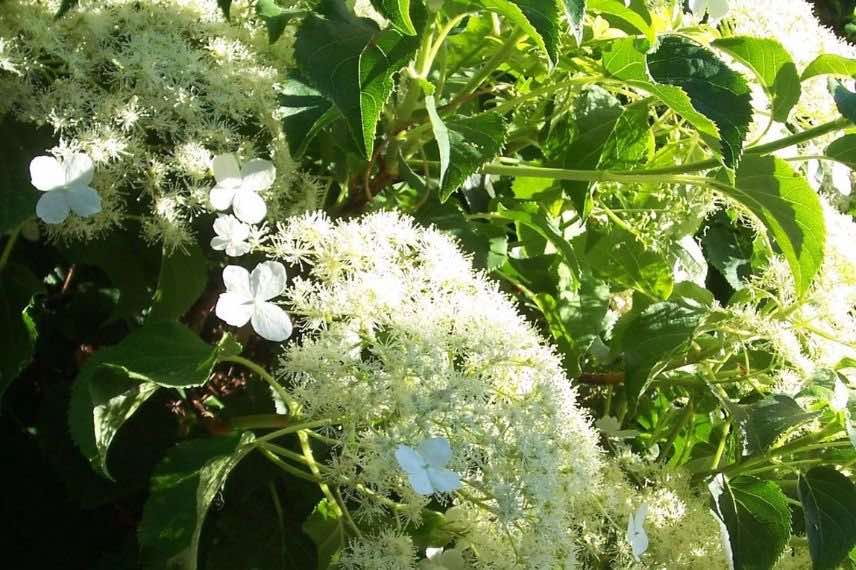
Hydrangea petiolaris
Read also
Hydrangea: 7 ideas to pair it withFor partial shade or north-facing conditions, Hydrangea macrophylla.
L’Hydrangea macrophylla is the best-known of hydrangeas, with its rounded heads often seen in front of Breton and Norman houses in a north-facing position, shaded. Originating from Japan, it grows near the coast, in a mild and temperate zone, which explains why the north-west climate suits it so well.
According to the cultivars, the flowers are either in double umbels or simple. They can be ball-shaped, consisting of sterile flowers or pseudoflowers. The umbels can also be flat, known as lacecap, formed of fertile flowers in the centre and sterile flowers at the periphery. The colours are increasingly varied: pink, mauve, white, violet, green, carmine red and, of course, blue on acidic soil. The deciduous foliage is pale green, sometimes variegated with white or cream.
The famous blue colouring is obtained in acidic soil, though this is not always sufficient. It is the presence of aluminium sulfate in the soil that will blue Hydrangea macrophylla. Naturally present in slate, it can also be bought as a powder under the name alum stone or blue alum.
Plant Hydrangea macrophylla in a partly shaded position, for example against a wall facing east, or even to the north, sheltered from cold and drying winds. It prefers deep, cool, yet well-drained, fairly fertile soil.
Many cultivars exist to suit all tastes. For example, look at ‘Blauer Zweg’, with a very deep blue in acidic soil, ‘Blaumeise’ with flat-topped heads, ‘Hovaria Hopcorn’ with curved sepals evoking lilac, or ‘Tricolor’ and its variegated foliage. For a more classic and simple variety, admire the very beautiful ‘Mousseline’.
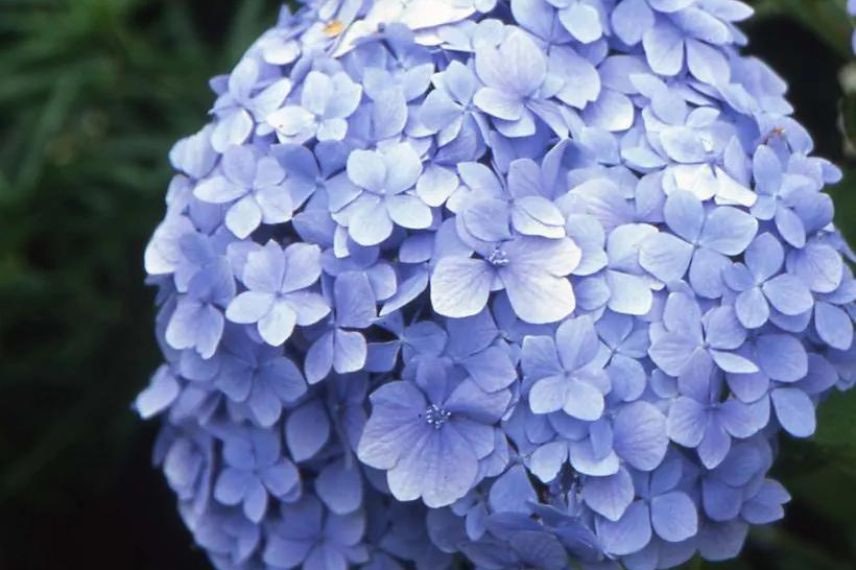
Hydrangea macrophylla ‘Mousseline’
Hydrangea involucrata for partial shade or light shade.
Finally, the Hydrangea involucrata, surely the least known of them all and with fewer representatives, is a dwarf hydrangea, rarely exceeding 1 metre in height. Their summer flowering is abundant and prolonged, in the form of peony-like buds opening into flat, airy inflorescences. Originating from the moist, high-altitude forests of Japan and Taiwan, Hydrangea involucrata tolerates slightly calcareous soils, but it requires a shaded exposure and a cool environment. Choose a position in partial shade or light shade, sheltered from cold, dry winds. With their modest growth, they are ideal for small gardens and container cultivation.
The deciduous foliage is distinctive, textured and soft to the touch. Admire the botanical species or the cultivar ‘Yoraku Tama’, which has earned the Royal Horticultural Society’s Award of Garden Merit.
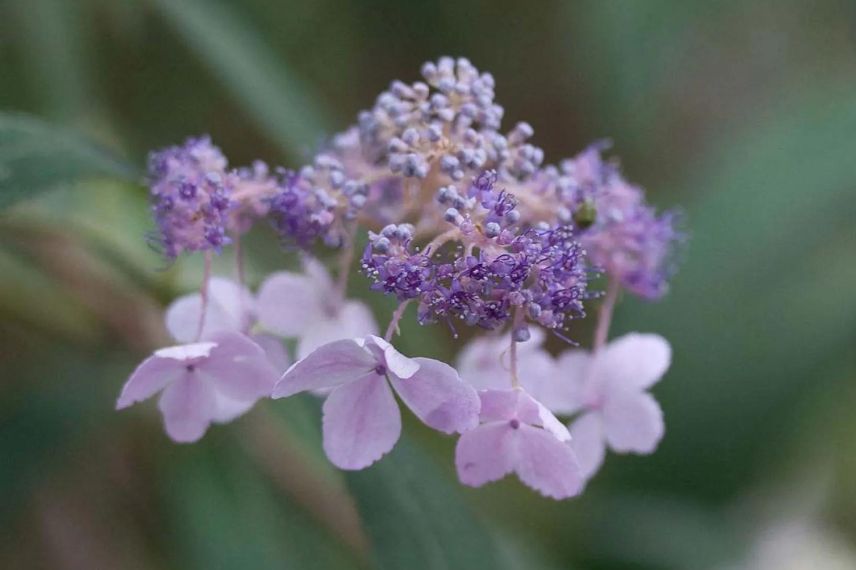
Hydrangea involucrata
- Subscribe!
- Contents
Comments