



























Sweet apple or tart apple?
Choosing an apple tree based on the flavour of its fruit
Contents
Choosing an apple tree is no easy task given the numerous varieties, both old and local, alongside the many modern cultivars. Beyond the shape of the tree (low, half-standard, or standard, columnar, fan-trained, dwarf…), the selection of an apple tree can be based on a criterion that truly makes a difference: flavour! Some prefer juicy apples with a very sweet taste, while others favour fruits with a firm texture and a more or less tangy flavour. In any case, it is often challenging to find the variety that truly matches one’s desires. We have made a selection of apple trees with sweet or tangy apples, as well as those that offer a perfect balance.
The best varieties of sweet apples
Although the apple is classified among the sweetest fruits (it contains between 10 and 15% carbohydrates, particularly fructose), not all apples are equal in terms of sweetness! Some have a higher sugar content, making them delightful to taste.
Here is a selection of apple trees known for the particularly sweet flavour of their fruits:
The ‘Fuji’, with large green fruits washed with red
The ‘Fuji’ apple tree, created in Japan in 1939, produces large green fruits washed with red, with firm and crunchy flesh, quite juicy and particularly sweet. The apples have good storage qualities and are harvested from mid-October to the end of November.
It is a fairly susceptible tree to scab and rust, but resistant to downy mildew and frost. Not self-fertile, it is pollinated, among others, by ‘Golden Delicious.’
The ‘Gala’ and ‘Royal Gala’, the essentials
The ‘Gala’ and ‘Royal Gala’ apple trees offer red and yellow striped apples, with firm, rather crunchy and sweet flesh, very fragrant, often enjoyed as dessert apples. Its flavour makes it one of the most consumed apples in France, whether raw or cooked.
The medium-sized fruits reach ripeness in September and can be stored for several weeks.
Self-sterile varieties, ‘Gala’ and ‘Royal Gala’ require the presence of other apple trees like ‘Elstar’, another sweet apple variety, or ‘Golden Delicious’ to bear fruit.
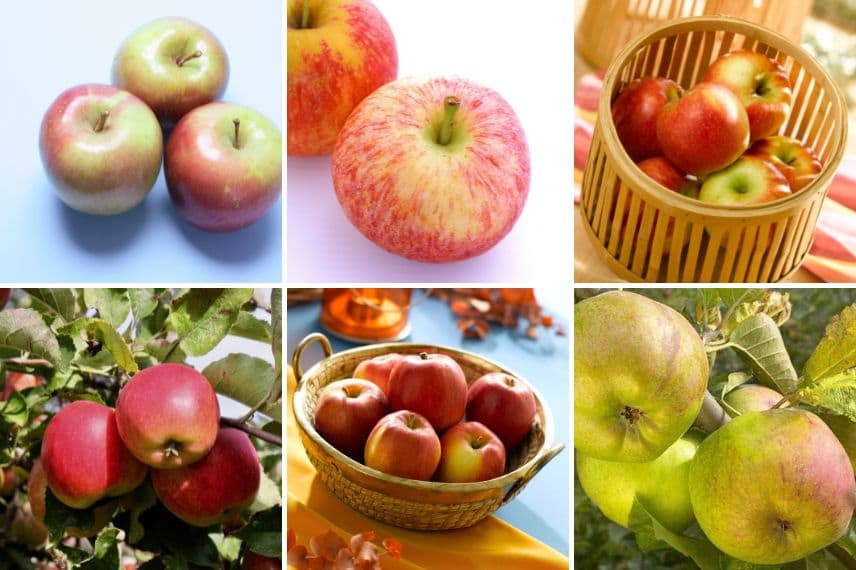
The varieties ‘Fuji’, ‘Gala’, ‘Jubilé’®, ‘Jonagold’, ‘Harmonie’® and ‘Rambour d’hiver’ offer sweet-flavoured apples.
The ‘Jubilé’®, the apple for sugar lovers
The variety ‘Jubilé’® produces apples highly appreciated for their fine and crunchy flesh, and the sweet and juicy flavour of its delicately coloured red and yellow fruits.
The harvest of these delicious apples occurs in October, and the fruits can be consumed until February.
As for the tree, it has good vigour, is not very susceptible to diseases, and is very hardy, but may show a tendency to alternate bearing, meaning it only produces every other year. Additionally, it is self-sterile and must be planted near pollinator varieties like ‘Reine des Reinettes.’
The ‘Jonagold’, the large green to yellow apple striped with red
The variety ‘Jonagold’ is characterised by its large apples with green-yellow skin striped with red. The flesh is yellow, rather crunchy and juicy, and especially sweet. It is an excellent dessert apple, which can be cooked in the oven or used in pies.
The fruits reach ripeness in October. They can be stored until January if kept cool. It is a very vigorous, productive, and hardy tree.
This is a self-sterile variety that can be associated with ‘Melrose’ or ‘Reine des Reinettes’ for good pollination.
The ‘Harmonie’®, an apple with a firm texture
‘Harmonie’® is a creation by Delbard, producing beautiful red apples on a golden yellow background, with firm, juicy, and sweet flesh. The apples can be enjoyed raw or cooked, in compotes and pastries.
The tree shows good vigour and produces abundantly from mid-October. The apples can be stored until mid-February. It is a disease-resistant variety, hardy down to -20°C but self-sterile. Pollination will occur thanks to the ‘Jubilé’ variety.
The ‘Rambour d’hiver’, an old variety with large yellow-green fruits
‘Rambour d’hiver’ is an old variety with large yellow-green fruits, striped with red on the sunny side. It is an excellent apple for cooking, juices, and pastry preparation. Its flesh is white-green and quite crunchy.
The harvest takes place in October, and the apples can be stored until January.
This old variety shows a very good resistance to diseases but is not self-fertile. It is therefore necessary to associate it with a variety that blooms in April, such as ‘Reine des reinettes’.
Read also
Apple tree: planting, pruning and careThe main varieties of tart apples
Some apples have more tart, fruity flavours on the palate. These apples are characterised by a refreshing sensation when bitten into.
The ‘Granny Smith’, the beautiful green with a tart flavour
There’s no need to introduce the ‘Granny Smith’ as it is instantly recognisable with its shiny green skin. Its white flesh is crisp, very refreshing and juicy. It’s an excellent eating apple that can also be added to salads.
This late variety reaches ripeness in January, which is why it is recommended for regions south of the Loire.
It is a self-sterile variety but makes a good pollinator. Pair it with ‘Melrose’ or ‘Idared’.
The ‘Belle de Boskoop’ with grey-green skin
The ‘Belle de Boskoop’ is an apple, originating from the Netherlands, with grey-green skin, sometimes speckled with red, and a tart to acidic flesh, suitable for eating fresh, juicing, but best cooked in pies or baked. Its flesh is very crisp, slightly grainy, and juicy.
It is a very hardy variety, suitable for mountain cultivation, that reaches ripeness from October to November. It is highly resistant to canker and scab.
This is a non-self-fertile variety that pairs well with ‘Reine des Reinettes’.
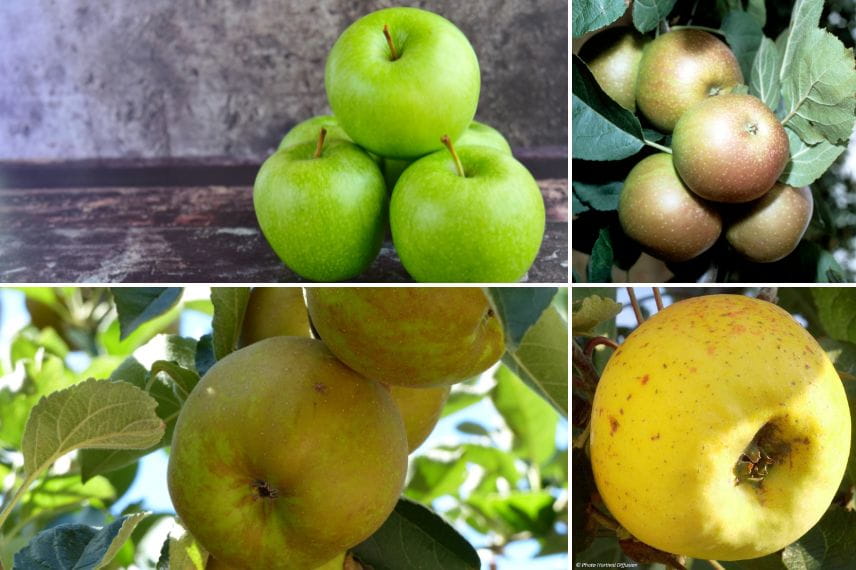
The varieties ‘Granny Smith’, ‘Belle de Boskoop’, ‘Reinette grise du Canada’ and ‘Transparente de Croncels’ offer a tart flavour
The ‘Reinette grise du Canada’, with large flattened apples
The ‘Reinette grise du Canada’ produces large flattened fruits with a russet-grey skin and fine, melting and juicy flesh, of very good taste quality, enjoyed raw with a knife or baked.
It is a traditional, vigorous variety with a spreading habit that can be grown at altitude. The apples reach ripeness between November and January.
Self-fertile variety, the ‘Reinette grise du Canada’ will have better fruiting if planted alongside another variety.
The ‘Transparente de Croncels’ with beautiful light yellow apples
‘Transparente de Croncels’ is an excellent apple with large fruits that have fine, tender and juicy flesh with a tart flavour. Its fruits have fresh almond and hazelnut aromas. Its flesh becomes mealy at ripeness. It is excellent for baking, making compote, and jelly.
It is a very early variety that produces fruit from the end of August. It is also very hardy. Self-sterile, it should be planted with a pollinator variety like ‘Reine des Reinettes’.
The ‘Jacques Lebel’, with large asymmetrical fruits
‘Jacques Lebel’ is a variety with large asymmetrical fruits, golden yellow, striped with pink to red. Its flesh is tart and fine, moderately crisp, making it ideal for excellent compotes, pies, or juice.
It is a vigorous, semi-early variety with significant growth. Harvest begins in early September, and the fruits can be stored until December.
It is also self-sterile and should be paired with apple trees like ‘Reine des Reinettes’ or ‘Transparente de Croncels’.
Discover other Apple trees
View all →
Available in 1 sizes
Available in 0 sizes
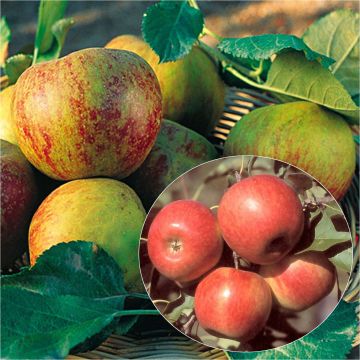
Available in 0 sizes
Available in 0 sizes
Available in 0 sizes
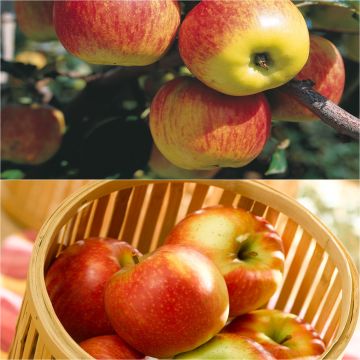
Available in 0 sizes
Available in 4 sizes
Available in 2 sizes
Available in 2 sizes
Available in 1 sizes
Well-balanced apple varieties
Certain other apple varieties exhibit balanced flavours between sweetness and acidity. They have a good fructose content but present a tangy flavour.
‘Ariane’®, the recent apple with red fruits washed with yellow
Created by INRA in 1979, this apple variety features firm, crunchy, sweet, and tangy flesh. The fruits boast a shiny red skin washed with yellow. It holds up well during cooking, making it ideal for pies.
‘Ariane’® is a scab-resistant variety, productive, with fruits harvested in September and October. They can be stored for up to 7 months.
Self-sterile, it should be paired with ‘Royal Gala’ or ‘Reine des Reinette’.
‘Braeburn’, a delicious apple, raw or cooked
The ‘Braeburn’ offers crunchy, juicy fruits with a yellow skin that is almost green, striped with brick. It is a delightful eating apple that can also be cooked.
This variety prefers regions with a mild climate. Harvest occurs at the end of October, and the apples can be stored until April.
This variety is self-fertile and productive, but susceptible to diseases.
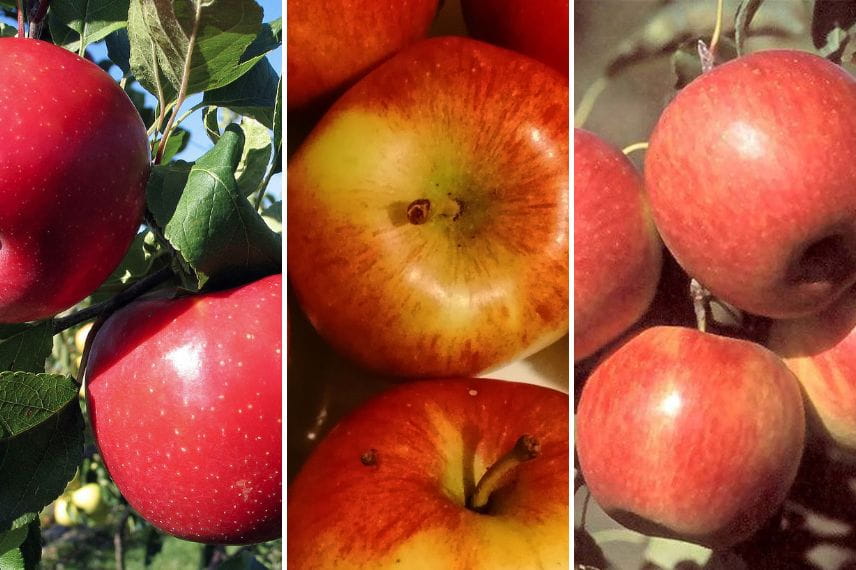
The varieties ‘Ariane’®, ‘Braeburn’, and ‘Reine des Reinettes’ offer sweet and tangy flavours
‘Reinette de France’, with yellow flesh
The ‘Reinette de France’ is a variety that offers fruits rich in sugar and delicately tangy. Its rough skin displays a greyish-yellow colour marbled with red on the sunny side. Its flesh ranges from white to yellowish. The fruits can be used in pies, compotes, and sautéed dishes, and can accompany savoury meals.
Harvest takes place in October; the fruits can be eaten until the end of winter.
It is a variety that is not very susceptible to scab but is not very vigorous and is not self-fertile.
‘Reine des Reinettes’ with highly fragrant fruits
The ‘Reine des Reinettes’ offers medium-sized fruits with yellow-orange skin vertically striped with red. Its flesh is creamy, crunchy, and very fragrant. It is an excellent eating apple or can be used in pies.
This variety is very resistant to spring frosts and can be planted at altitude. It is a variety known for its pollination qualities.
Harvest occurs in early September, and the fruits can be stored until March.
- Subscribe!
- Contents

Comments