





























How to choose a chestnut tree?
Our buying guide to choosing the perfect chestnut tree for your garden.
Contents
The chestnut tree is part of those fruit-bearing trees whose undeniable ornamental qualities are appreciated. Long-lived, this majestic tree with a rounded habit in the beech family (Fagaceae) grows to a height of around 30 m, and offers a magnificent white flowering in late spring. Cultivated for millennia, it can be traced back to Antiquity, and in the Middle Ages it was valued for its wood, but also, even then, for flour extracted from its fruits.
Chestnut cultivation has remained in use, emblematic in Ardèche, in the Cévennes, the Limousin and Corsica, where the tree finds favourable conditions for its flourishing. Around sixty varieties now exist, arising from hybridisation between the European chestnut (Castenea sativa) and the Japanese chestnut (Castanea crenata).
Are you looking for a chestnut tree for its fruit production, or for its habit and its unique foliage providing superb shade? In short, are you wondering how to choose the right chestnut tree variety? Here is a selection of criteria to help you lean towards one or the other of the many chestnut tree varieties available across the territory.
→ Discover our complete guide on the Chestnut tree: planting, pruning and care.
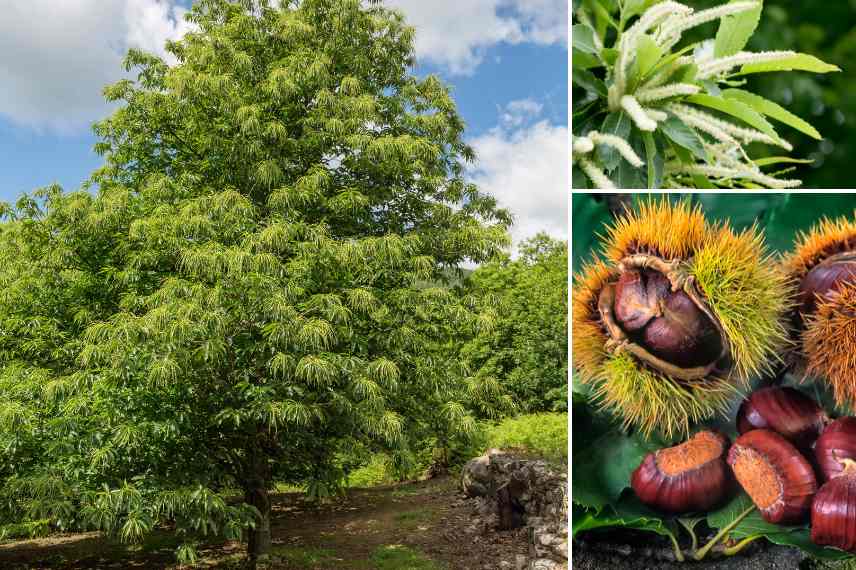
The chestnut tree: a majestic tree suited to large gardens, both handsome and useful!
According to the region
Originating from southern Europe and North Africa, the chestnut tree requires sun and warmth in summer. This is no accident: its preferred regions lie in the southern half of France, where it thrives. It is therefore regarded as a thermophilic and sun-loving species. Cold will therefore limit its cultivation, but too much humidity in June to July, the period of peak pollination, should also be avoided.
The chestnut tree, however, is best planted at low altitude; its preferred zone, generally between 300 and up to 700 m, is where it will receive enough warmth, on a sun-exposed hillside. Traditional chestnut-growing regions are the most conducive to its cultivation, such as the Cévennes, Ardèche, Cantal, Corrèze, Périgord and Quercy, Limousin, the Massif des Maures in the Var, and Corsica. In these low-altitude, non-calcareous mountain massifs, it has its rightful place. All chestnut trees have the enormous advantage of tolerating summer drought once established. However, none will tolerate cold northerly winds.
Marigoule is often found in the south-west up to Brittany, below 400 m; ‘Précoce Migoule’ and ‘Bournette’ are, on the other hand, adaptable in many plain regions. Among those that can be planted at altitude in the south-east of France are ‘Comballe’, and farther north in France, as they do not like climates that are too hot, ‘Bouche Rouge’ and ‘Marron de Redon’.
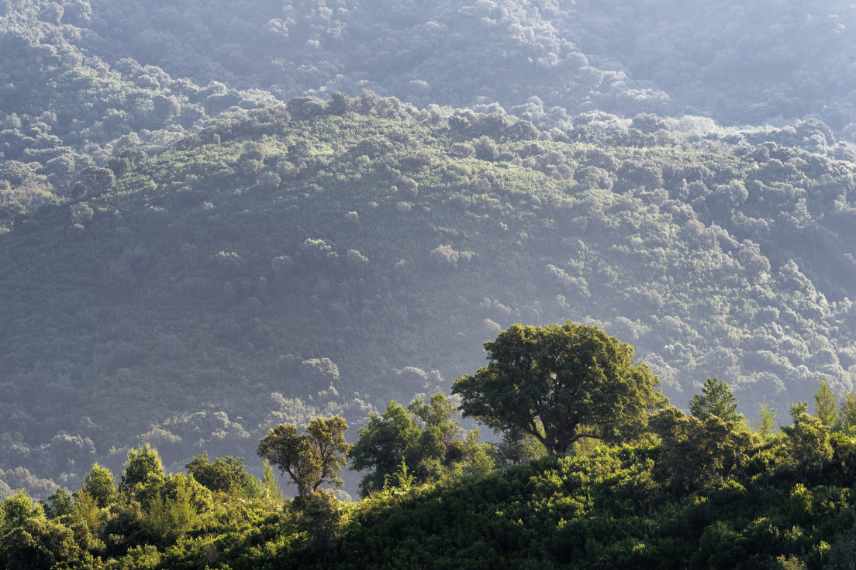
Chestnut trees in the Castagniccia region, near Corte in Corsica
Read also
Growing hard shell fruits in the gardenDepending on soil type.
Chestnut trees all require acidic soil (pH between 4.5 and 6.5), and not too dry. Most species will grow well if the soil is light and well-drained (they favour loam-sandy, siliceous to stony soils), with no excess moisture and, above all, not calcareous (which would trigger chlorosis, and, in the longer term, kill the tree). Its root system is deep and then spreads widely, providing it with good resistance to heat and summer drought. Your soil must possess these qualities if you want to plant a chestnut tree on your plot.
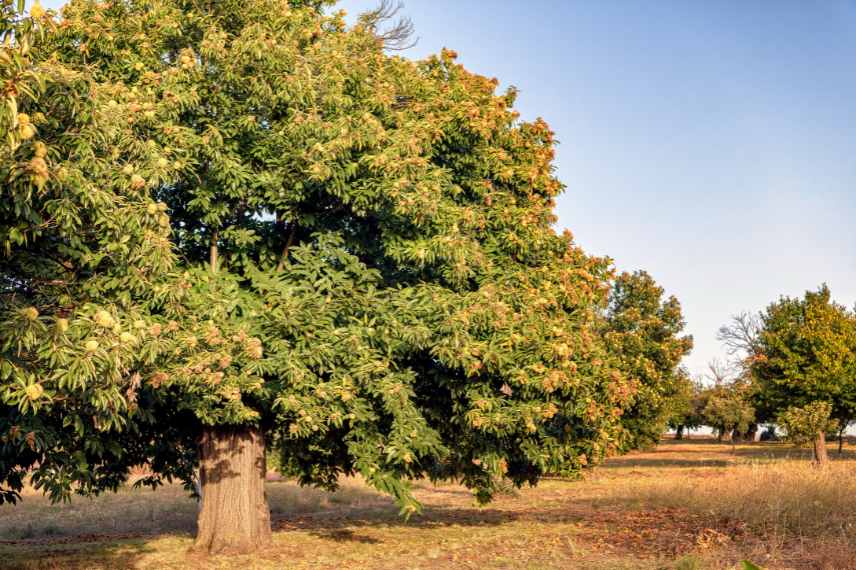
Acid soil is essential for the longevity of your chestnut tree
According to its hardiness.
If the chestnut tree is hardy, withstanding negative temperatures down to -25°C, it is no less sensitive to early and late frosts, as well as winter temperatures that are too low. This can affect its flowering, and consequently jeopardise fruit production. According to the region, it is therefore important to be mindful of varieties with bud burst periods that are later.
‘Comballe’ is among those that bud late in spring, enabling establishment in a large number of regions. ‘Bouche Rouge’ will also be of interest in regions with late frosts, as it buds and flowers late.
Among chestnut trees sensitive to winter and spring frosts, to be grown in regions with a mild climate, in the southwest of France: ‘Bouche de Bétizac’, ‘Marlhac’, and Marron de Lyon. Due to some sensitivity to cold, ‘Maraval ‘ and ‘Marigoule’ will thrive in the warm regions of the southwest of our territory.
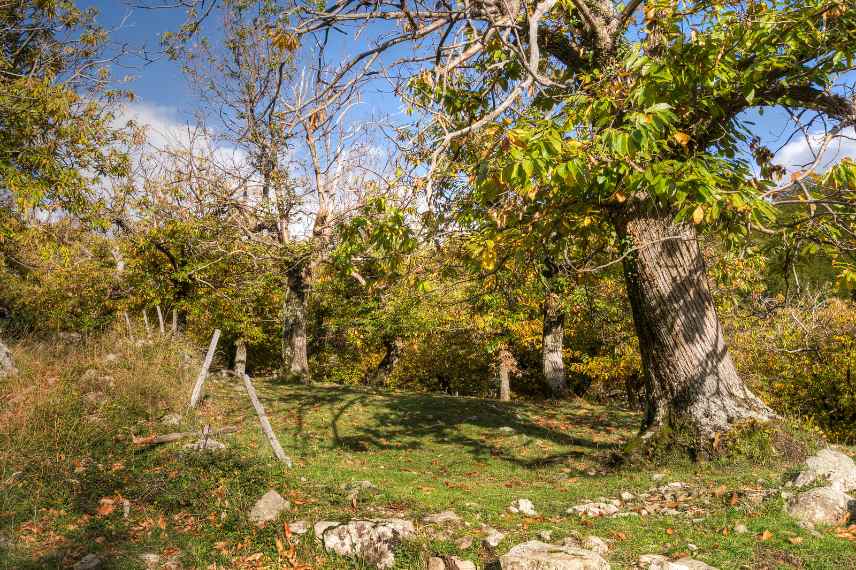
Some chestnut trees are particularly sensitive to early frosts due to their early flowering.
For its ornamental character
A chestnut tree of considerable stature will outlive you and your descendants! It should be placed only in a large space within a big garden or planted as a solitary tree in an orchard, and installed in a sunny position where there will be little competition from shading. The flowering, in the form of long, upright aments, pale yellow, at the end of spring, is a delight, fragrant, and, moreover, it is very melliferous. We also appreciate its beautiful autumn colours, ranging from yellow to russet.
The type species Castanea sativa is already very beautiful in its own right, growing to a height of 20 to 30 m with a spread of around 10 m. But some varieties derived from hybridisation with the common chestnut are also very decorative; they feature variegated foliage, such as Castanea sativa Aureomaculata, heavily mottled with yellow, or Castanea sativa ‘Variegata’, with cream-white variegation, or the striking Castanea sativa ‘Aspleniifolia’, with laciniate leaves.
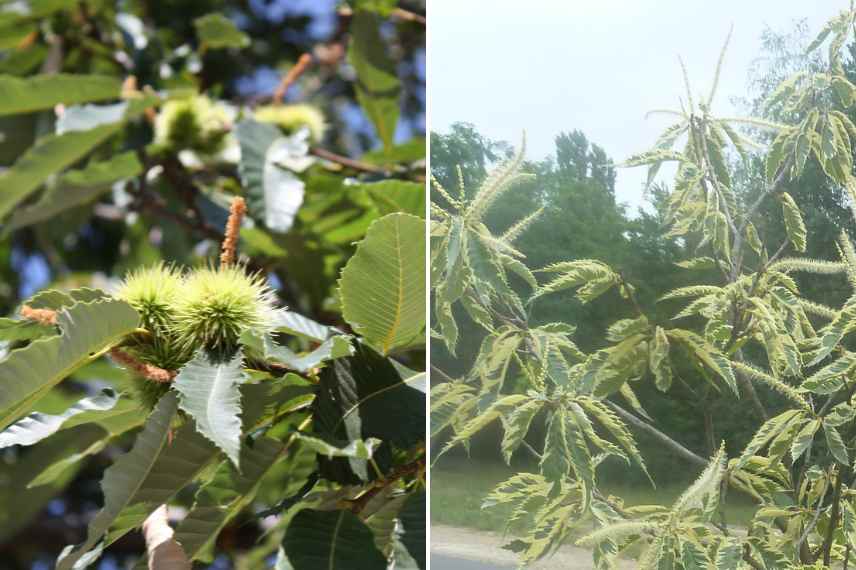
On the left, the common chestnut; on the right, foliage of Castanea sativa ‘Aureomarginata’ (© Magyar – Wikimedia Commons)
Depending on the harvest period.
Chestnut harvest takes place in autumn, from late September to late October in most regions. Chestnuts are inserted into the large spiny burrs, which are edible, and perhaps it is for their fruit that you might want to grow a chestnut tree. The fruit’s ripeness is indicated by the burrs dropping, which may sometimes fall already open on the ground.
The onset of fruiting is more or less rapid depending on grafted varieties : (‘Bouche Rouge’ rather slow — at least five years of cultivation – while ‘Bournette’ will be faster, just like ‘Comballe’, ‘Marigoule’ or ‘Maraval’, from the 3rd or 4th year).
Early chestnut trees
They open the harvest season as early as mid-September: ‘Précoce Migoule’, the earliest, followed by ‘Précoce de Vans’, ‘Bournette’ and ‘Bouche de Bétizac’. ‘Maraval’ and ‘Marlhac’ are also early, with a harvest able to begin in September.
Semi-early to semi-late chestnut trees
For a harvest from late September to mid-October: ‘Nouzillard’ is harvested in early October. ‘Marlhac’, ‘Maraval’ and ‘Marso’, but also ‘Marigoule’, the first half of October). ‘Comballe’ and ‘Sardonne’ (syn. Marron de Lyon’) also known as Dorée de Lyon, and ‘Pourette’ are also semi-late chestnut trees.
Late to very late chestnut trees
Their fruits are harvested in October, up to early November: ‘Verdale’ and ‘Maridonne’ as well as ‘Belle Epine’ are late varieties. ‘Bouche Rouge’ and ‘Bouche de Clot’ are the latest of chestnut trees, between mid-October and the end of October.
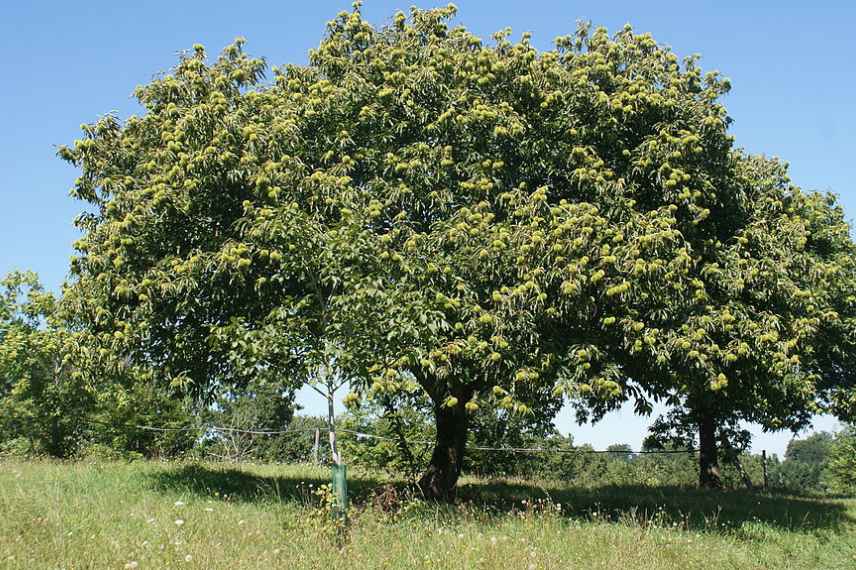
Castanea sativa ‘Maraval’ in the Parc naturel régional du Périgord-Limousin (© Wikimedia Commons – Blandine Gacka)
According to its productivity
One might wish to plant one or more chestnut trees mainly for their fruits growing inside the famous spiny burrs. A mature tree will yield between 10 and 20 kg of fruit at around ten years of age. But it should be noted that it is around 30–40 years when the tree becomes most productive. Depending on the variety, as well as soil quality and pollinators, productivity can vary… and regular harvests.
‘Bouche de Bétizac’ and ‘Comballe (or Combasle)’ are praised for their high yield, Comballe being the star of French chestnuts, in terms of harvest quantities across France. ‘Belle Epine’ and ‘Bournette’ also prove to be very productive. At Maraval and Marlhac, the fruits are large and plentiful.
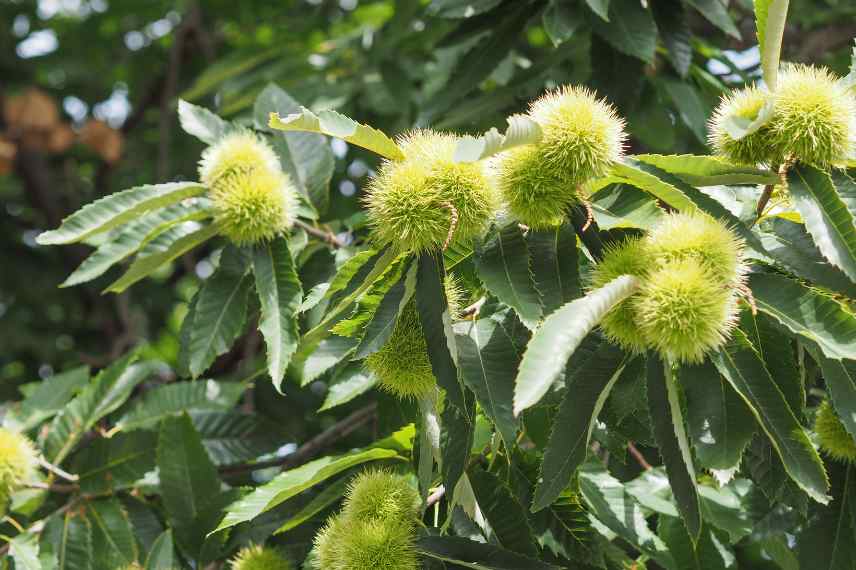
Some chestnut trees are much more productive than others
According to the size and flavour of the fruits.
The flavour of chestnuts does not necessarily go hand in hand with their size. On the common chestnut tree (Castanea sativa), the husks are fairly small, around 2 cm, which can be tedious for some preparations.
The recent hybrids ‘Bouche de Bétizac’, ‘Marigoule’, ‘Bournette’, ‘Sardonne’ ( Marron de Lyon ) or ‘Précoce Migoule’ yield the largest fruits, but not necessarily the most delicate in flavour.
‘Comballe’ has a sweet flavour and a fine texture and ‘Bouche Rouge’ also proves to be particularly aromatic, but not very sweet. ‘Pourette’ has a fine and sweet flesh, with ‘Nouzillard’ producing large, round fruits, a delicate and tasty flavour. ‘Marron de Lyon’ and ‘Marlhac’, which also bear large fruits, have a fairly floury and sweet flesh.
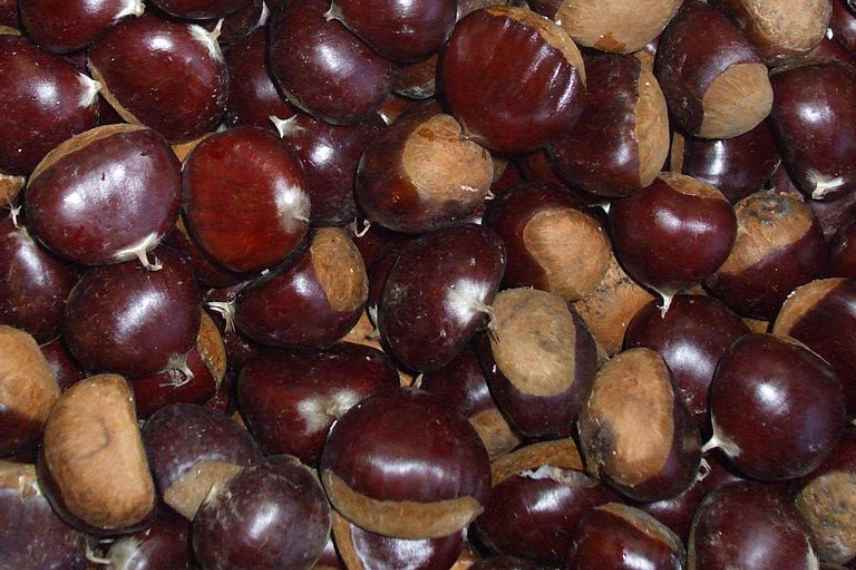
Chestnut ‘Marigoule’ (© Wikimedia Commons)
Depending on how you use chestnuts... or leaves.
The flavour of chestnuts varies enormously depending on soil type, sunlight and size. We will use them in many ways in cooking, and there is a distinction between consumption as an eating fruit (grilled, roasted or boiled), processed into candied chestnuts or into jam and chestnut cream, but also into flour. Honey production and the use of the leaves are, of course, also feasible, though less common for the home gardener.
- Edible fruit: it is the sweetness or the firmness of the fruit that is sought. When paired with poultry, or simply grilled like “hot chestnuts”, we enjoy chestnuts such as the Maridonne or Comballe, the delicious Sardonne, very sweet, or Aguyane of Italian origin. To make chestnut cream, Pourette, quite sweet, is ideal, as is ‘Maraval’.
- Candied chestnuts: one may wish to grow chestnut trees to turn chestnuts into candied chestnuts, this delicate confection candying in a sugar syrup. We favour large-calibre fruits that hold up well to cooking, and that are little or not compartmentalised and regular, such as ‘Bouche Rouge’. ‘Bouche de Clos’ or ‘Bouche de Clot’ are often used to make candied chestnuts. ‘Comballe’ with large, very sweet fruits is also interesting. ‘Dorée de Lyon’ (which is none other than the Lyon Chestnut or Sardonne’), originating from the Piedmont region of Italy, with a sweet flavour and large round fruits, is also an excellent choice.
- Chestnut honey: if it is chestnut honey you are interested in producing, as this melliferous tree is rich in pollen and its honey is one of the most powerful and aromatic, we advise choosing varieties described as long-staminate, i.e. with long stamens, producing pollen more abundantly (bees feed mainly on the male flowers). We would favour, for example, a variety such as ‘Marigoule’.
- Flour: finally, for those who would like to venture into chestnut flour production (gluten-free) we often prefer small-fruited varieties (it takes about 4 kg of fruit to obtain 1 kg of flour): the standard species is therefore ideal, as is ‘Précoce de Vans’ with small fruits, for example. But the smaller the fruits, the longer the peeling work…
Note: brown chestnut leaves (collected in autumn) surround certain Corsican cheeses, but also the famous banon, a delicious Alpine goat cheese from the Alpes-de-Haute-Provence, or the Mothais des Deux-Sèvres. They allow them to be preserved and give them a woody flavour thanks to the tannins in the chestnut leaf. All chestnut leaves will be suitable for this ancestral use!
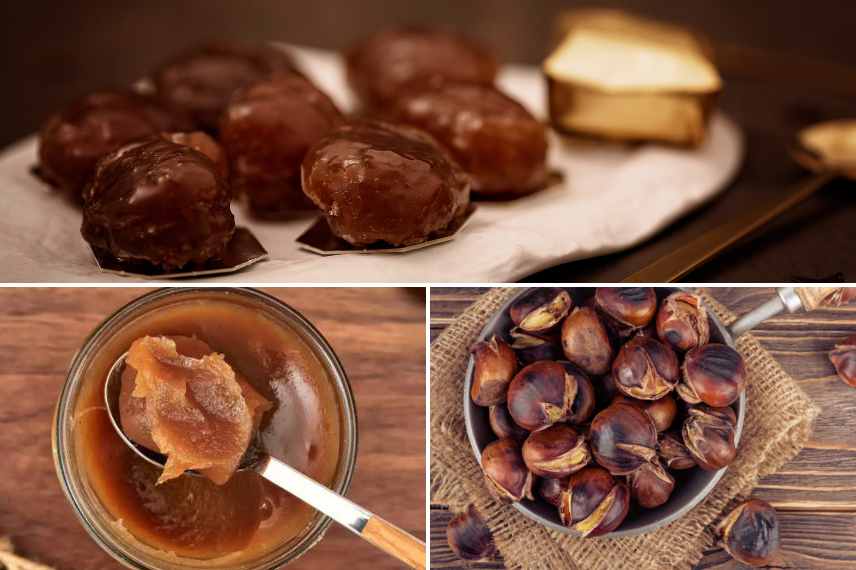 You will certainly use your chestnuts to enjoy them grilled, in chestnut cream or jam… and why not try candied chestnuts?
According to its mode of reproduction: self-fertile or not
Planting two or more chestnut trees is always preferable to ensure cross-pollination and good fruiting, and it is advisable to look for trees with similar flowering times. But some chestnuts are self-fertile, such as Marron de Lyon, and ‘Maraval’.
Based on disease resistance
Chestnut trees produced from hybridization (often between Castanea sativa and the Castanea crenata, Japanese) offer better resistance to diseases known to affect this tree such as ink disease (Phytophthora cambivora) and leaf rust; ‘Marigoule’ and ‘Marsol’ resist ink disease (Phytophthora cambivora) and leaf rust; ‘Bouche de Bétizac’ resists bark canker (Cryphonectria parasitica). ‘Marlhac’ generally resists diseases well. ‘Comballe’ is susceptible to diseases and to rot, which gives chestnuts a shorter shelf life.
- Subscribe!
- Contents
Comments