





























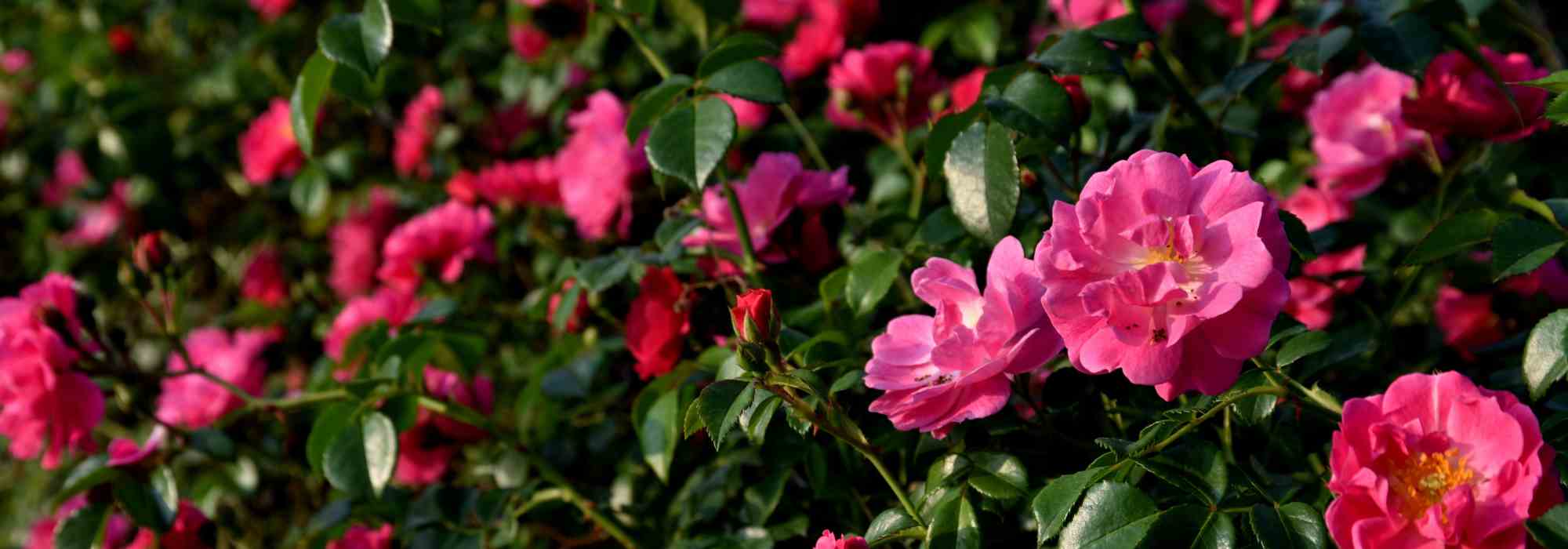
Botanical and wild roses: a natural garden!
Their many advantages in the garden!
Contents
As gardens strive to be increasingly natural, and wild roses, dog-rose flowers and other Gallica roses are on the rise. These single-flowered roses charm with a typically delicate fragrance. They establish themselves as reliable choices and boast undeniable qualities, including their undemanding nature and ease of cultivation. If they flower only once from May, June or July, their robustness and ability to thrive in challenging areas are appreciated, as are their very decorative fruits.
Let us celebrate these lovely roses and rediscover their prized qualities for our gardens with Gallica roses, white varieties, rugose forms… and many more!

Beautiful simplicity
What we love most about wild roses is their completely natural appearance, their small flowers in fresh colours and an understated elegance. They bloom for a short period because they are non-repeat-flowering, but with incredible generosity, often for a full month.
Far from the neat, sophisticated look of turbinated flowers, most of these roses feature five-petalled corollas, as with Gallica roses (Rosa gallica), and small blooms (usually between 3–4 cm in diameter, slightly larger in Rosa rugosa). Much less prized than the so-called modern roses, eglantine-flowered roses are beautifully simple and offer a relaxed habit. They are ideal for natural gardens, countryside gardens and rustic gardens. They are indispensable in a romantic-style garden!
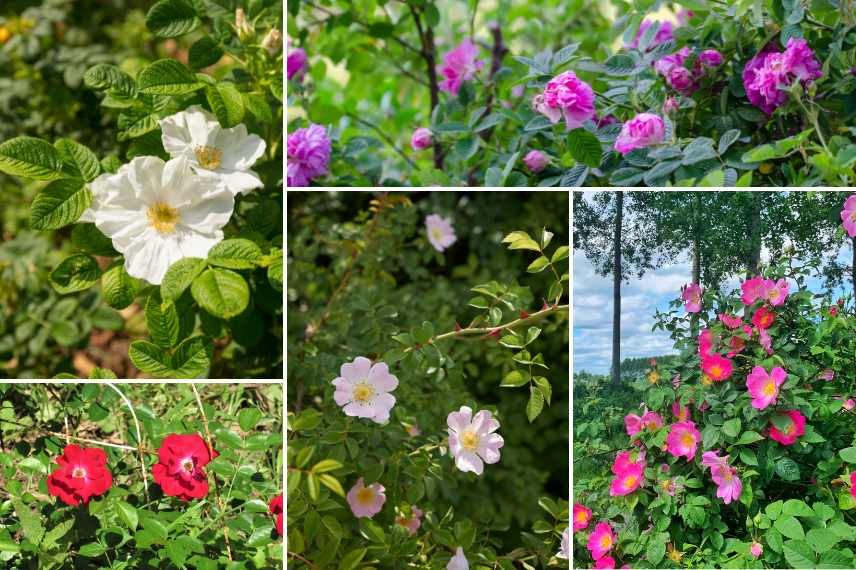
Wild beauties, from pure white to vibrant red: Rosa rugosa ‘Alba Plena’, Rosa damascena, Rosa moyesii, Rosa canina, Rosa gallica
Roses that are good for biodiversity.
Wild and botanical roses have the advantage of being melliferous: they attract bees, but also bumblebees and even garden wildlife. Among them are Rosa rubrifolia (or Rosa glauca) and Rosa canina, which are pollen-rich only, a trait shared by many wild roses that do not contain nectar. Native in origin for some, such as the dog rose, they provide a food source for all the garden’s pollinators. Rosa hugonis, of Chinese origin, is, for its part, a very beautiful melliferous botanical rose with its pale lemon-yellow cup-shaped flowers.
The late-summer and autumn fruiting in this type of roses is particularly abundant and a delight for birds (but also for the gardener, as they linger on the shrub for a long time): these are the hips (cynorrhodons), also called dog roses. This is especially true again for Rosa rugosa, Rosa canina (dog rose), and Rosa rubrifolia (or Rosa glauca).

Rosa hugonis, Rosa glauca and hips of Rosa canina
Hardy roses
These wild roses have been cultivated for centuries, and it is their resilience and robustness that make them so appealing. Their root system is well developed and deep, ensuring adaptation to a wide range of soils and to challenging growing conditions. This type of rose will generally be very tolerant of harsh winters and severe climates. They can be used without fear in poor soils, and whether by the sea or in the mountains.
Originating from the Near and Middle East, Gallica roses have retained a great aptitude to grow under drought and in poor, rocky soils and rocky soils. Many wild roses will also appreciate poor, sandy soils such as Rosa pimpinellifolia (or Rosa spinosissima), but also Rosa rugosa ‘Alba’ or horticultural varieties such as Rosa rugosa ‘Roseraie de l’Haÿ’. Rugosa roses and the rubrifolia roses (Rosa glauca) are, too, perfect for coastal settings, readily tolerating sea spray, winds and a generally poor soil. One can also plant in a dry garden some robust roses such as the Rosa sempervirens.
In the mountains, one can rely on Chinese-origin species, such as Rosa moyesii and its varieties, or again Rugosa roses (these again!) such as the Rugosa rose x ‘Frau Dagmar Hastrup’, with a delightful pale-pink flowering.
Finally, more than with traditional roses, you can plant these wild-looking roses in semi-shaded situations, given their behaviour in their natural habitat, often at the edge of a hedge.
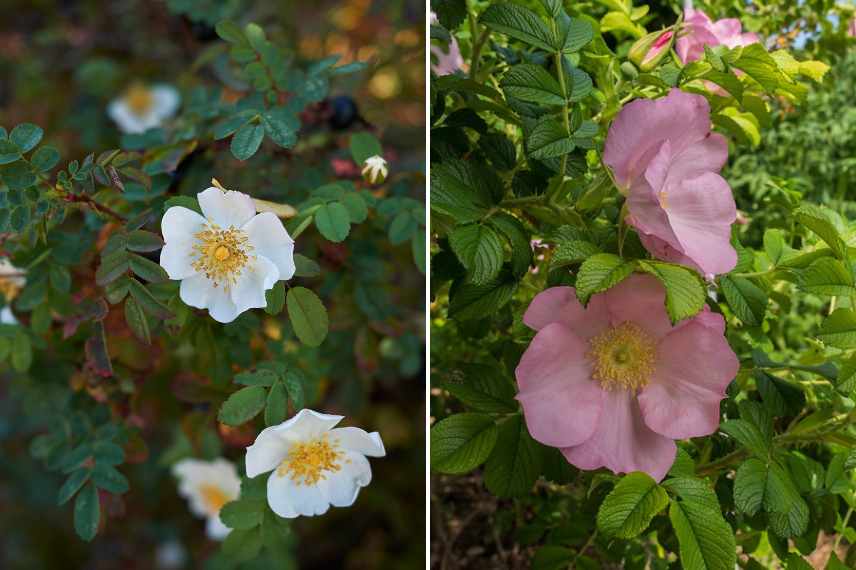
Rosa pimpinellifolia and Rosa rugosa x Frau Dagmar Hastrup” (© F.D. Richards)
... and disease-resistant
Botanical and wild roses have another string to their bow: they are robust and very reliable. Few problems to note with these ancestors of our modern roses, as their often dense foliage resists common diseases on roses. They will, however, always prove to be somewhat more susceptible to foliar spots, particularly in regions with heavy rainfall. These wild roses are, moreover, used as rootstocks for a large number of modern roses, as they prove hardy (such as the dog rose Rosa canina), but above all less susceptible to powdery mildew and vigorous (as Rosa multiflora), and also adaptable to calcareous soils.
Among these roses with robust health and particularly healthy: Rosa rubiginosa with pink flowers and yellow stamens, the rugosa roses (Rosa rugosa) resistant to fungal diseases, Rosa pimpinellifolia with white flowers, or also Rosa x moschata ‘Mozart’ … among others.
This type of wild roses can thus live very long in gardens: up to 300 years for dog roses (rosiers églantiers)!
→ Also read: Why are roses grafted?
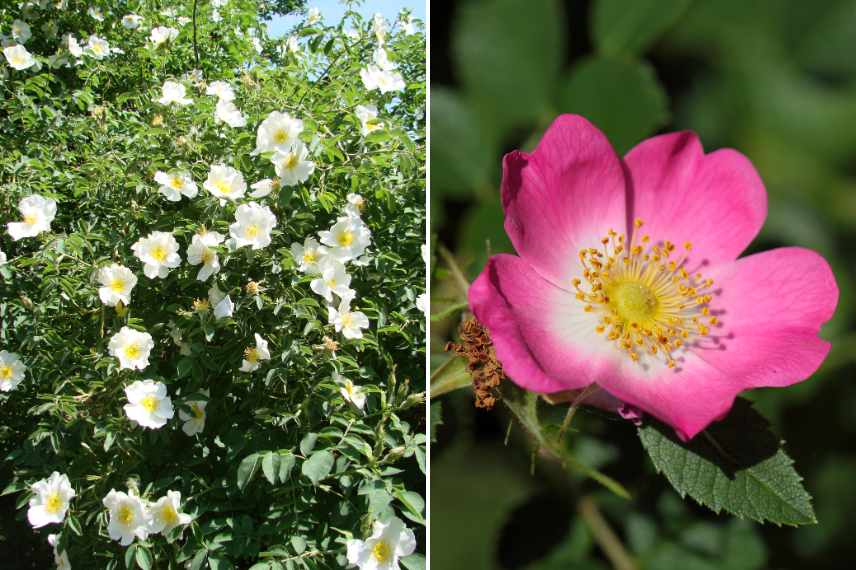
Rosa multiflora and Rosa rubiginosa
A subtle fragrance
They are certainly not the most fragrant, a quality that has been sought after and developed over the years by modern rose breeders. But some botanical or wild roses reveal a very pleasant fragrance. This includes Rosa arvensis (syn. Rosa candida), the field wild rose with white flowers, of Rosa sempervirens, with adorable cream flowers, but above all, Rosa gallica var officinalis known as the Provins rose which is one of the most fragrant, distilling notes of old rose. Let us not forget Rosa rubiginosa (and its hybrids), but also the hybrids of musk roses musk roses like the sublime Rosa x moschata ‘Francis F Lester’, a rambling rose bursting with white blooms in May–June, or Rosa x moschata ‘Millie Fleur’. Rosa rugosa ‘Rubra’ and Rosa luciae, a botanical rose with white flowers contrasted by golden stamens, are also worth considering for a garden with delicate fragrances!
→ Also read The Scent of Roses
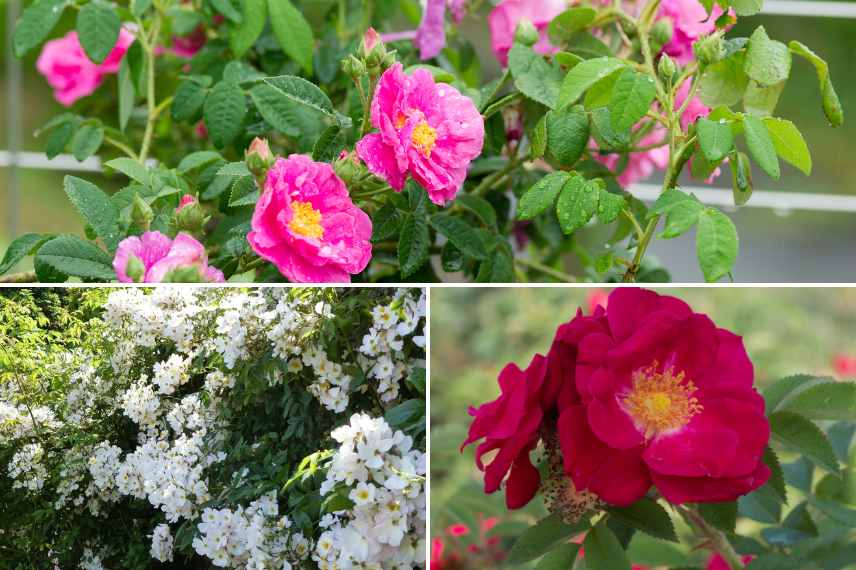 Rosa gallica var officinalis, Rosa x moschata ‘Francis F Lester’ and Rosa rugosa ‘Rubra’
Low-maintenance roses... or nearly so
There are many species of wild roses that are undemanding in terms of maintenance. In the wild, they receive no care whatsoever and bloom year after year… Do take care to remove suckers (more common on these wild roses) as well as dead wood. This type of generous and prolific roses also benefits from having their spread kept in check, depending on where they are planted. Undemanding by nature, you will avoid over-fertilising them.
The evergreen rose (Rosier sempervirens) with small white flowers requires absolutely no pruning, and in this respect it is very useful for forming an informal cottage-garden hedge. The Rosa rugosa, Rosa canina, Rosa chinensis, Rosa glauca can also do without pruning.
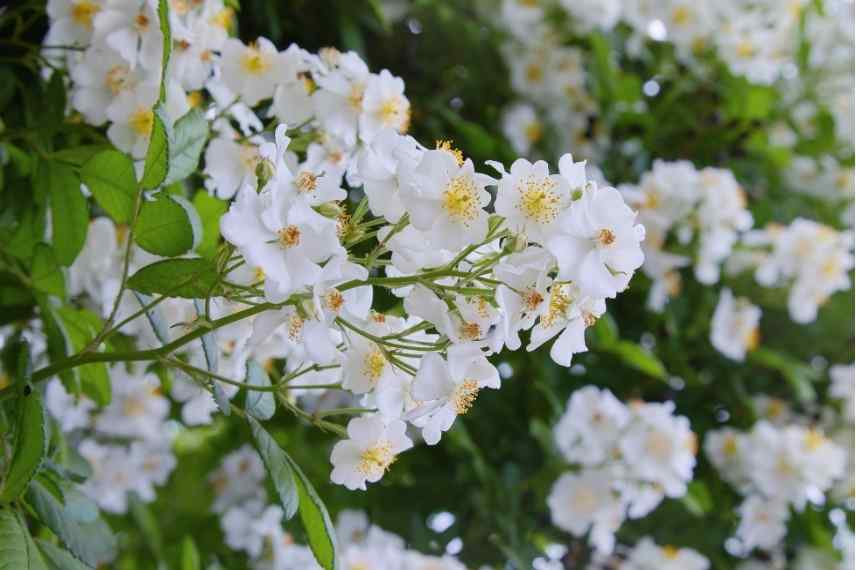
Rosa arvensis: a white beauty for the busy gardener!
- Subscribe!
- Contents

Comments