





























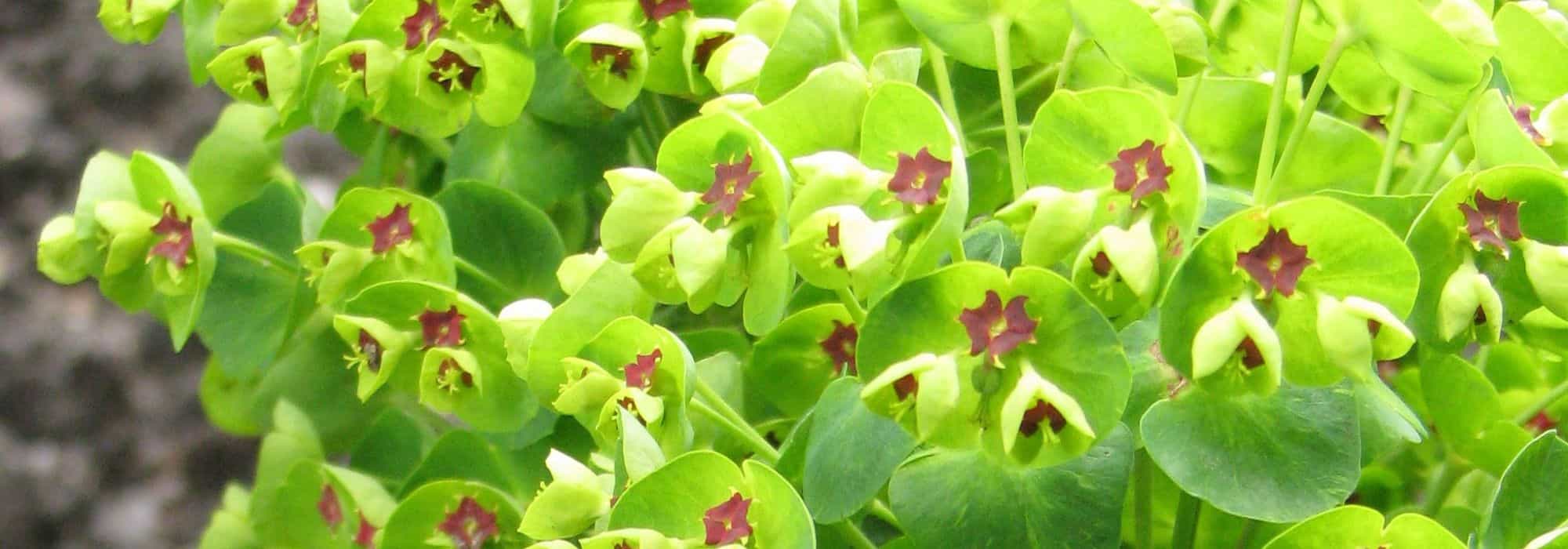
Euphorbias for Dry Soil
Discover 7 drought-resistant varieties
Contents
Euphorbias are perennial plants highly valued for their colourful foliage and bright flowering, often in shades of green, sometimes purple or variegated with cream. Depending on the varieties, they can be more or less tall, herbaceous, arborescent, or succulent, resembling cacti. While most prefer sunlight, some species of euphorbia tolerate summer drought very well once well established.
Discover 7 varieties of drought-resistant euphorbia to plant in a garden, border, pot, or dry rockery.

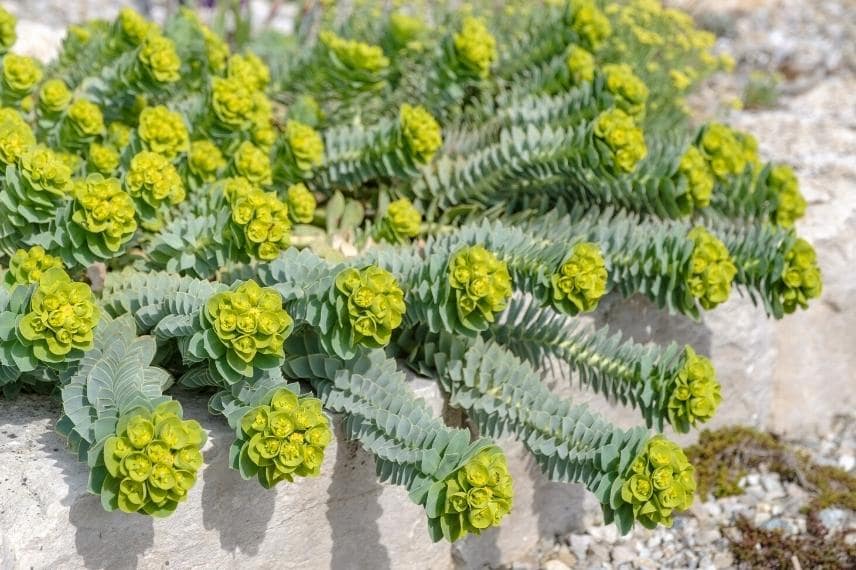
Euphorbia myrsinites
The Euphorbia myrsinites, commonly known as Corsican Spurge, is a perennial of Mediterranean origin, particularly suited to dry, hot summers. Small in stature, it forms a compact tuft of 10 cm in height, from which tentacle-like, creeping stems emerge. These stems are adorned with evergreen leaves, succulent, and a lovely blue-green colour. Then, in spring, they bear magnificent chartreuse green flowers for several weeks.
A true sun-loving plant due to its Corsican origins, the Euphorbia myrsinites thrives in sunny situations, in dry soil during summer, well-drained, but is sensitive to excess water, even in winter. Hardy, it withstands winter cold down to -15 °C when well established. It will find its place in a rockery or a dry garden, alongside grasses, particularly Stipa tenuifolia and Elymus magellanicus.
Read also
Euphorbias: 7 successful pairing ideasEuphorbia characias
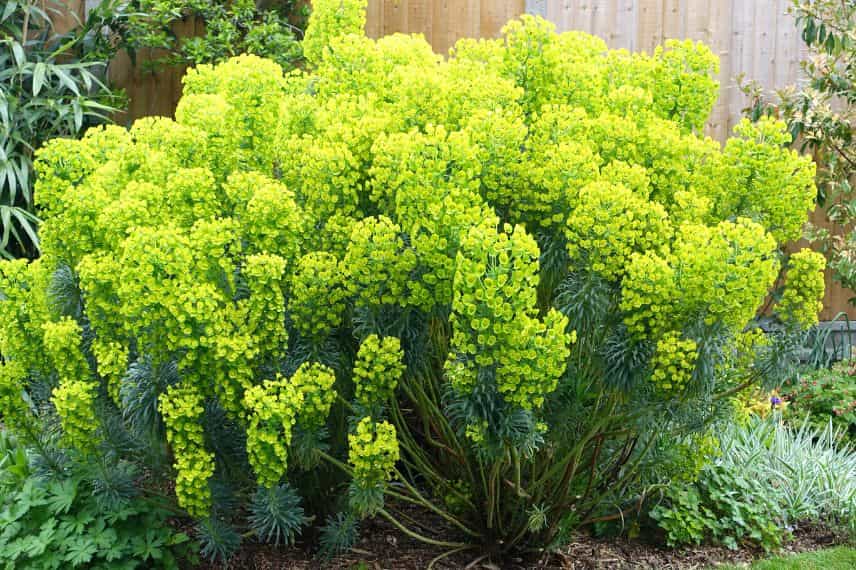
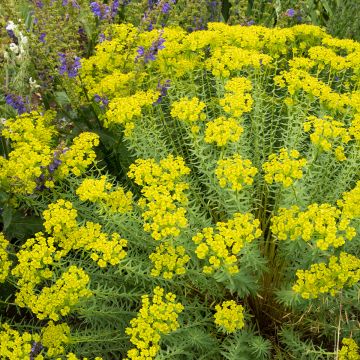
Euphorbia characias, also known as the Mediterranean Spurge, stands out for its bushy habit, reaching up to 1 metre in width depending on the region. It decorates the garden and borders even in winter thanks to its evergreen foliage of bluish-green colour. Throughout the summer, from June to September, it produces large, bright yellow-green panicles of flowers.
Of Mediterranean origin, it is perfectly suited for a border or dry rockery, in full sun or partial shade, in preferably rich, well-drained, neutral to calcareous soil, even stony. Not very frost-sensitive, it tolerates frosts down to -15 °C when well established. This spurge will make a lovely duo alongside a Phormium ‘Pink Panther’.
Discover other Euphorbia - Spurge
View all →
Available in 1 sizes
Available in 2 sizes
Available in 1 sizes

Available in 2 sizes
Available in 2 sizes
Available in 1 sizes
Available in 1 sizes
Available in 1 sizes
Available in 3 sizes
Available in 1 sizes
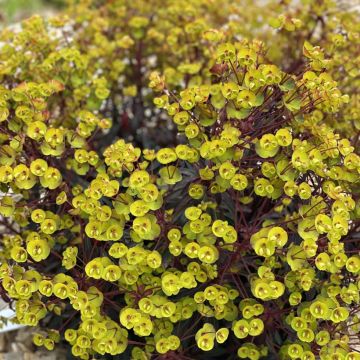
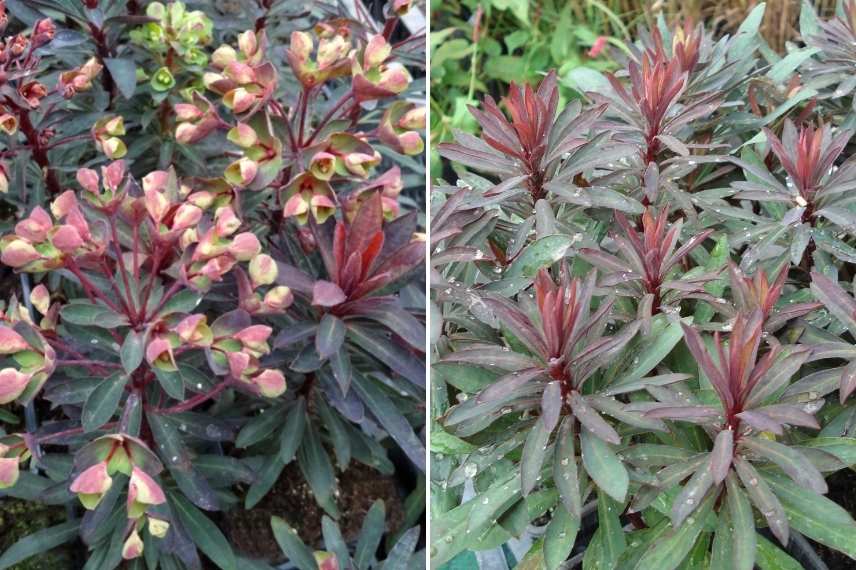
Euphorbia 'Black Bird'
The Euphorbia ‘Black Bird’ is a beautiful, low-maintenance variety that is robust and well-suited to summer drought. It is also appreciated for its attractive evergreen foliage, which is deep purple when young, evolving to bronze green. The more sunlight this euphorbia receives, the darker its young leaves will become under the light. It also offers a lovely flowering display from March to May, blending both yellow and purple hues, with a red peduncle.
The Euphorbia ‘Black Bird’ has a compact habit, forming a ball shape of 40 to 50 cm in all directions, making it perfect for pots or perennial borders. Low-maintenance and not frost-sensitive, it will thrive in stony, even poor soil, in full sun or light partial shade. Although it prefers slightly moist, well-drained soils, it will easily acclimatise to summer drought. Its coppery purple colour will highlight the vibrant hues of tulips or the white of hyacinths.
Read also
Euphorbias: which variety to choose?Euphorbia characias 'Tasmanian Tiger'
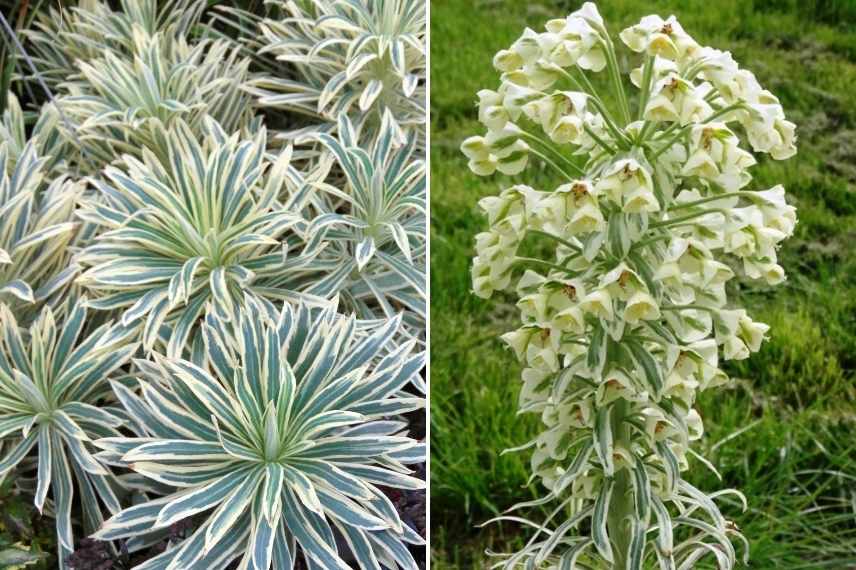
Euphorbia characias ‘Tasmanian Tiger’, also known as Variegated Spurge, is a variety particularly valued for its beautiful evergreen foliage, which is blue-green in colour and marginate with bright cream. Very original, it also offers an abundant flowering in the same light tones at the beginning of spring. This large spurge can reach 80 cm when in bloom and will add a lovely volume to a border. Not very frost-sensitive, it is hardy down to -15 °C.
The ‘Tasmanian Tiger’ spurge enjoys a sunny position in well-drained soil, even dry in summer, stony and poor. It will bring softness to borders, alongside a Sedum ‘Black Knight’ or a Houseleek ‘Dark Beauty’.
Balearic Spurge
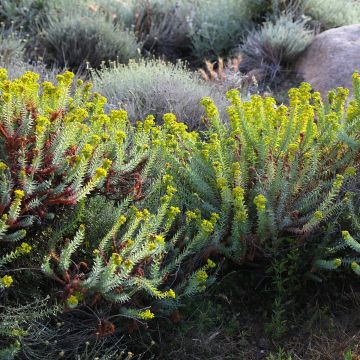
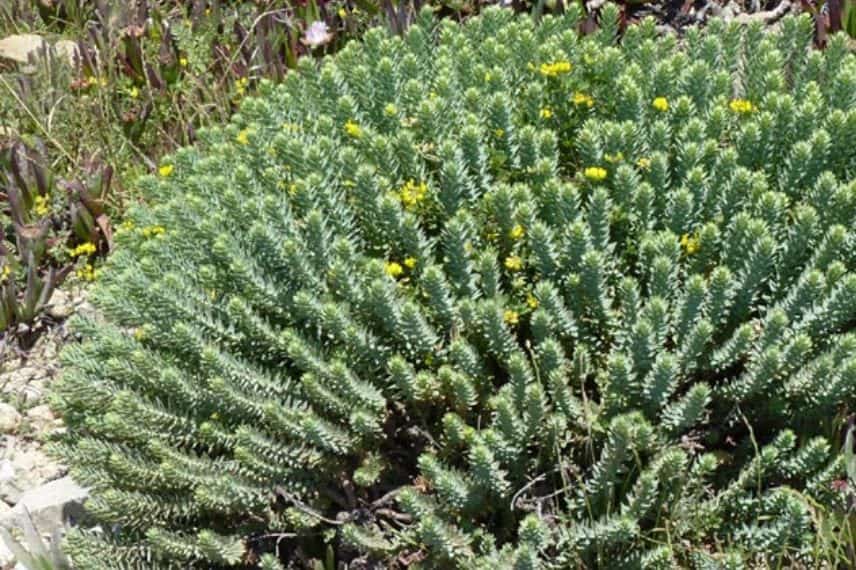
Euphorbia pythiusa, commonly known as the Balearic spurge, develops into a bushy clump, giving it the appearance of a small conifer. It is often referred to as “the little fir spurge” due to its dense, ramified foliage and reddish stems, laden with very imbricate grey-green leaves. With its slow growth, it takes on the shape of a large cushion, reaching an overall spread of 40 cm in all directions. Its flowering lasts all summer, from June to August, in the form of small bouquets of acid green flowers. As they fade, the flowers take on a lovely rusty hue.
With its Mediterranean origins, Euphorbia pythiusa thrives in full sun, in light, sandy or stony soil, dry to slightly moist, but especially well-drained, as it is sensitive to excess moisture. It also prefers neutral soil, slightly calcareous or slightly acidic and tolerates wind very well, including sea spray. Moderately hardy, it withstands occasional frosts down to -11 °C.
This Balearic spurge will find its place in a dry rockery, on a slope, in an exotic or contemporary border, and in coastal gardens. To highlight it, it can be paired with grasses, such as Fescue ‘Elijah Blue’ or with the orange flowers of certain Agastaches.
Euphorbia martinii 'Baby Charm'
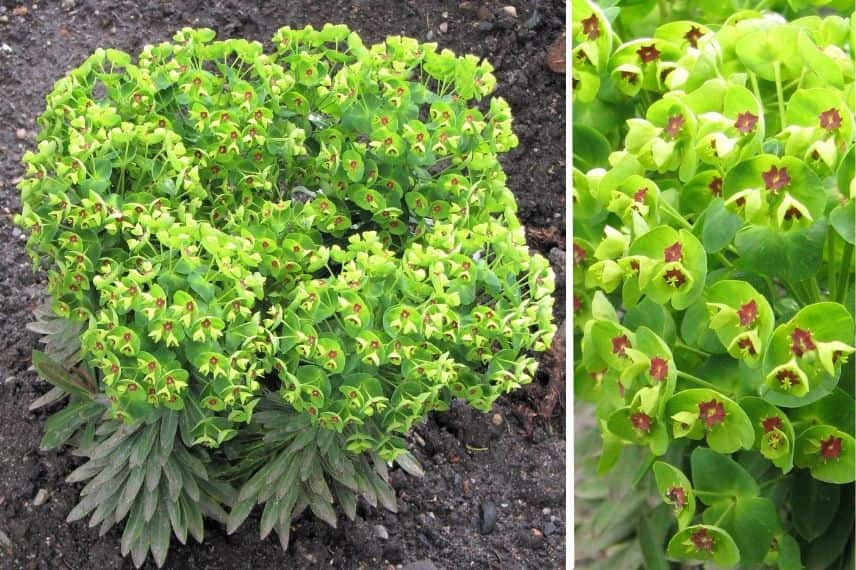
Euphorbia martinii ‘Baby Charm’ is a dwarf variety of the Martin’s Spurge, rarely exceeding 30 cm in height. With its beautiful evergreen foliage, it forms a lovely dense cushion in bluish-green tones on reddish stems. It stands out for its bright flowering, chartreuse green, almost yellow, enhanced by its red nectariferous glands that create a lovely contrast from April to June.
The ‘Baby Charm’ Spurge enjoys a very sunny position, in poor, stony, ordinary, calcareous or slightly acidic soil, but well-drained. It dislikes heavy, waterlogged soils in winter. This is a perennial well adapted to drought, once established.
It will naturally find its place in rockeries, pots, dry gardens, or sunny slopes. For a lovely contrast, pair it with the blue flowering of a rosemary or an Aubrieta.
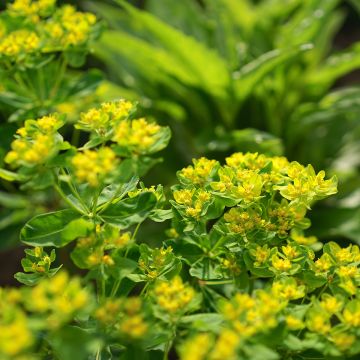
Euphorbia amygdaloides 'var. robbiae'
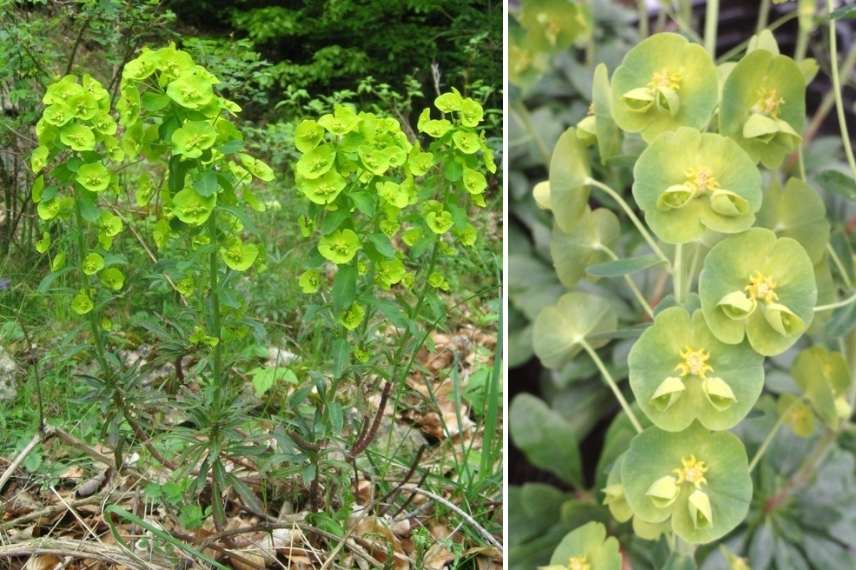
Euphorbia amygdaloides ‘var. robbiae’ is a perennial perfectly suited to the dry shade of woodlands, allowing it to be planted beneath trees. From April to May, it produces chartreuse flowers with a hint of yellow, bringing light to the dark corners of the garden. Its leaves, dark green in colour, are semi-evergreen in regions with mild winters. This Euphorbia is also very hardy, able to withstand temperatures as low as -20 °C once well established. Its upright stems form a bushy clump about 50 cm wide, and its habit is rather spreading.
Euphorbia ‘var. robbiae’ easily adapts to all types of soils, even clayey, as long as it can benefit from the shade of trees. Although it prefers humus-bearing and slightly moist soils, it copes very well with summer drought once established. It will be perfect in a woodland setting, alongside the blue flowers of Vinca and Brunnera.
To find out more
- Discover all our Euphorbia varieties.
- To learn more, browse our article on Euphorbias: planting, growing, and maintaining.
- Note: the sap of Euphorbias consists of an irritating and toxic latex. Always remember to handle them with gloves, keep an eye on children playing nearby, and warn them.
- Subscribe!
- Contents
Comments