





























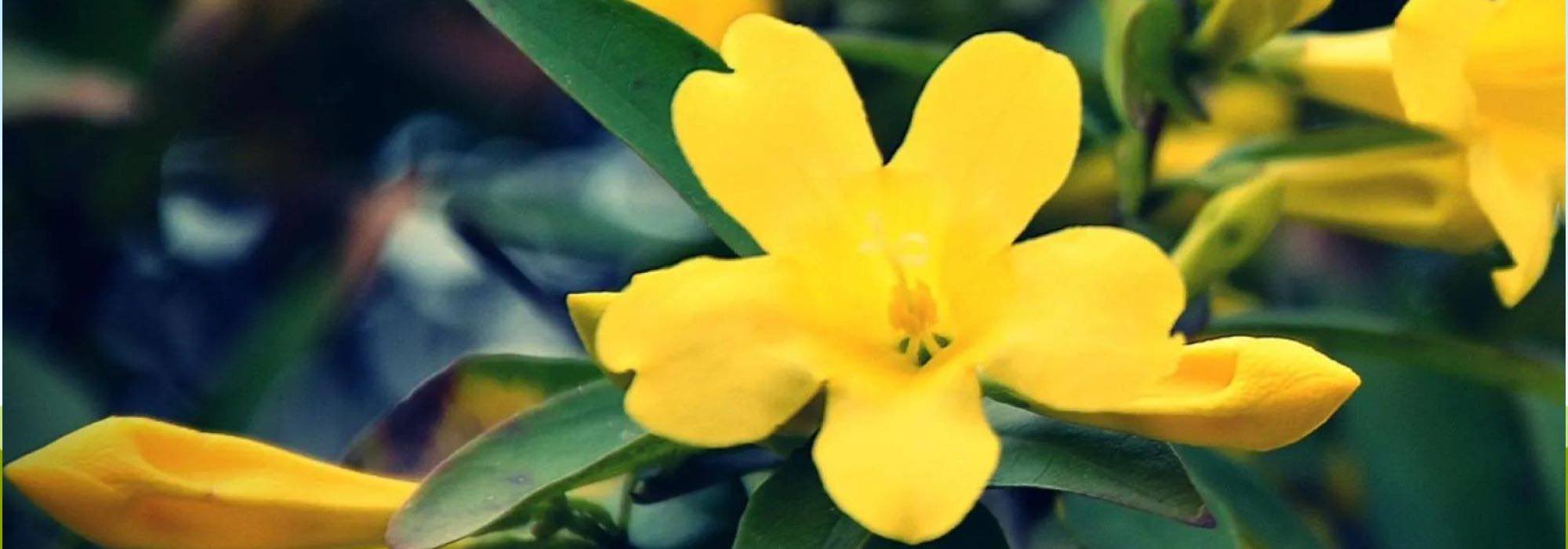
Discover the top five hardiest jasmines
A selection of hardy jasmines that withstand frost and winter cold.
Contents
The jasmines enchant us with their abundant flowering, sometimes very fragrant. But these plants are often regarded as frost-prone. It is true that some varieties do not tolerate cold or severe frosts beyond -5°C to -8°C. This therefore means they should be grown in the garden only in mild regions, or overwintered in pots during winter.
But some jasmine species prove hardier and will be able to brave the winter cold. So discover these hardy jasmines, which can be grown in most of our regions. Additionally, we advise protecting them with a thick mulch at their base and choosing a non-windy location.
And to learn everything about jasmine cultivation, discover our guide: Jasmine: planting, maintenance, pruning

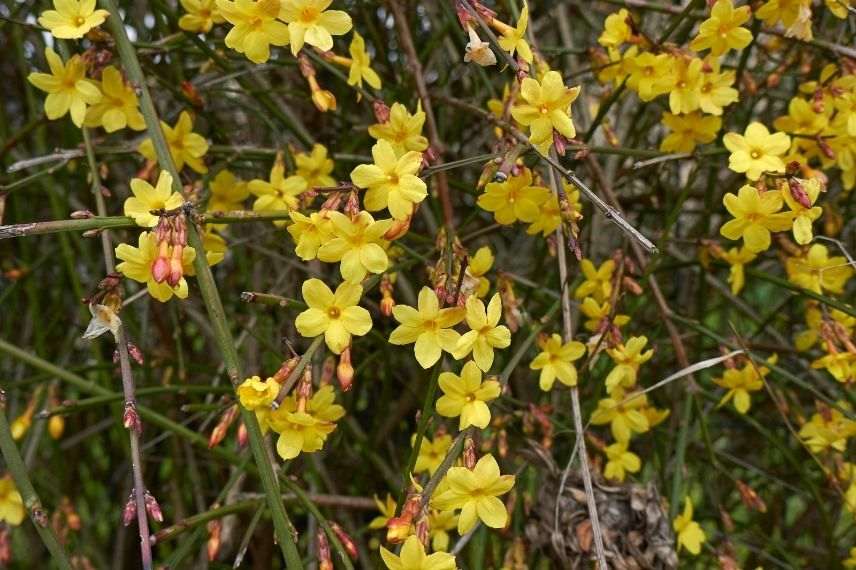
The Jasminum nudiflorum
The Jasminum nudiflorum is among the hardiest jasmins. This winter jasmine blooms, as its name suggests, during the cold season. The period can run from January to March. It thus brightens the shortest days of the year, thanks to its small lemon-yellow flowers, appearing on branches still bare. We forgive its lack of fragrance, as it brings a real touch of colour and warmth to the garden or in a pot, at a time when most other plants are in dormancy. This jasmine, moreover, has the peculiarity of being able to bloom even in the snow.
Jasminum nudiflorum is a hardy and tolerant species. It is capable of withstanding frosts down to -15°C, and perhaps a little more if the soil is perfectly drained. It is important that water does not stagnate there to optimise its frost resistance. Conversely, it will also tolerate drought well once established, whereas most jasmins require soil to stay cool. This cold-hardy jasmine will therefore thrive in most of our gardens. Easy to grow, it will establish itself in full sun or partial shade, in all soil types.
This species behaves more like a bush than a climbing plant. At maturity, it will reach up to 3 metres in all directions. Its slender, somewhat stiff shoots will look good in a loose hedge, but can also be trellised to dress a wall or other unattractive structure. It also looks wonderful, placed at the top of a wall, from which it will cascade down like a pretty living fountain.
Read also
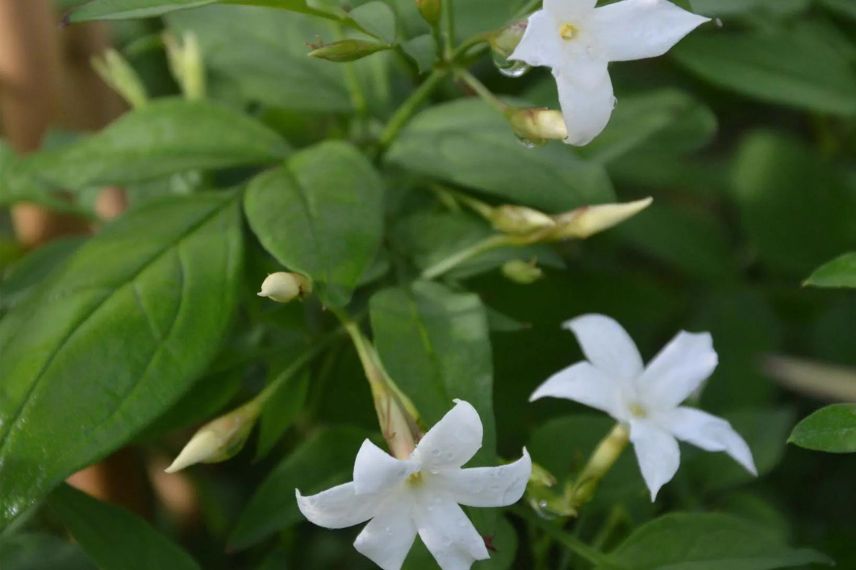
Choosing a JasmineJasminum officinale
The common jasmine is a safe bet for all gardens. It is among the hardiest of the genus, as it is capable of tolerating frosts down to -12°C, even -15°C. The stump may resprout after these hard frosts, but the above-ground parts will be destroyed at around -10°C. For its part, the foliage disappears as soon as temperatures fall below -5°C.
This fragrant jasmine is also prized for the fragrance of its flowers. It flowers throughout the summer, from July to September, or even into autumn if the soil remains cool enough. It produces an abundance of small white star-shaped flowers, which diffuse strong floral notes, which are almost heady in their intensity. They are prized in perfumery, but also in cooking and herbal medicine.
Its climbing habit can reach substantial size in favourable conditions, exceeding 5 metres in height with a 3-metre spread.
This hardy climbing jasmine will be perfect for dressing a trellis, an arch, an arbour or even a balcony balustrade. Its stems naturally wind themselves around available supports. Easy to grow, it can be cultivated in full sun or partial shade in ordinary soil, but must be well-drained.
Jasminum humile
The Italian Jasmine is a little less hardy than its congeners previously mentioned, but it still boasts frost resistance down to -10°C, even -12°C. The foliage will remain in place in regions with mild winters, which experience only light, occasional frosts.
At the start of summer, it flowers, revealing an abundance of small yellow flowers, particularly bright.
Its habit will, over time, develop into a trailing or climbing shrub if supported. This makes it versatile in the garden. Expect 3 metres in height with a 2 metre spread.
Tolerant, it tolerates all well-drained soils, including calcareous and somewhat dry soils. It will be planted in full sun or partial shade in regions with hot climates. Less well known than other jasmins, the Jasminum humile would undoubtedly deserve more space in our gardens. 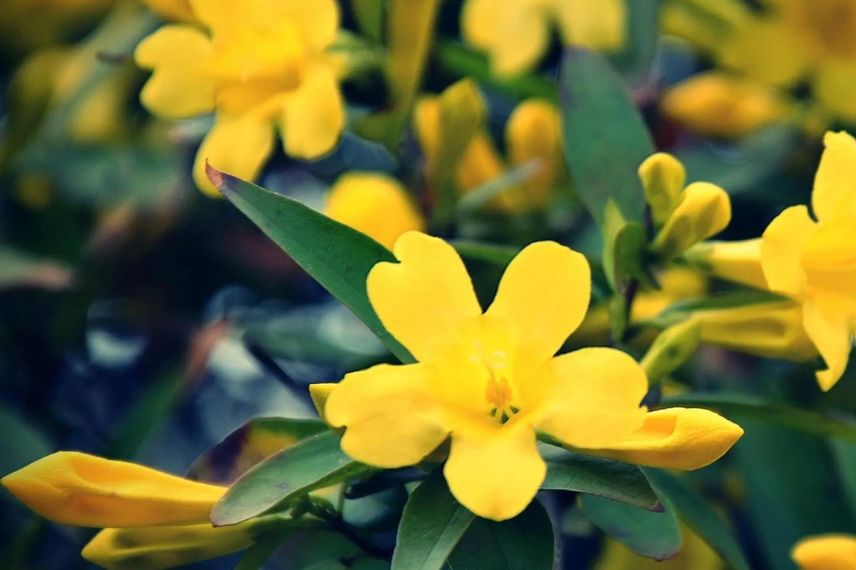
Jasminum beesianum
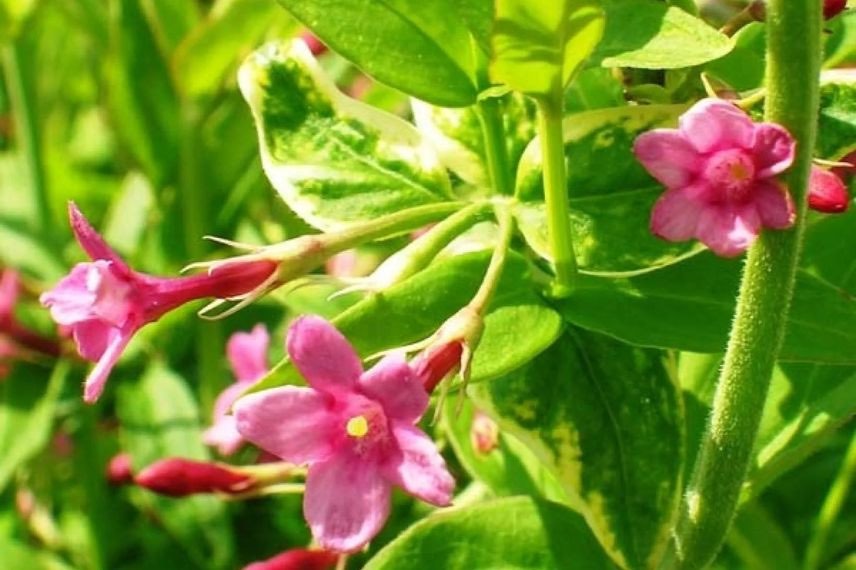
Jasmin beesianum is a species rarely seen in gardens. However, it benefits from several qualities. This climbing plant flowers from mid-spring to mid-summer, producing striking carmine-red flowers, unusual for a jasmine. They are lightly scented. This flowering is followed by fruiting in the form of small black berries.
Hardiness around -9°C, and possibly more in sheltered situations, which still allows it to be grown in several of our regions.
Dimensions: about 3 metres high by 2 metres wide.
Plant it in full sun, in soil that remains cool and moist. The Jasminum beesianum will need to be trellised to climb a fence, a pergola or any other support.
Star jasmine
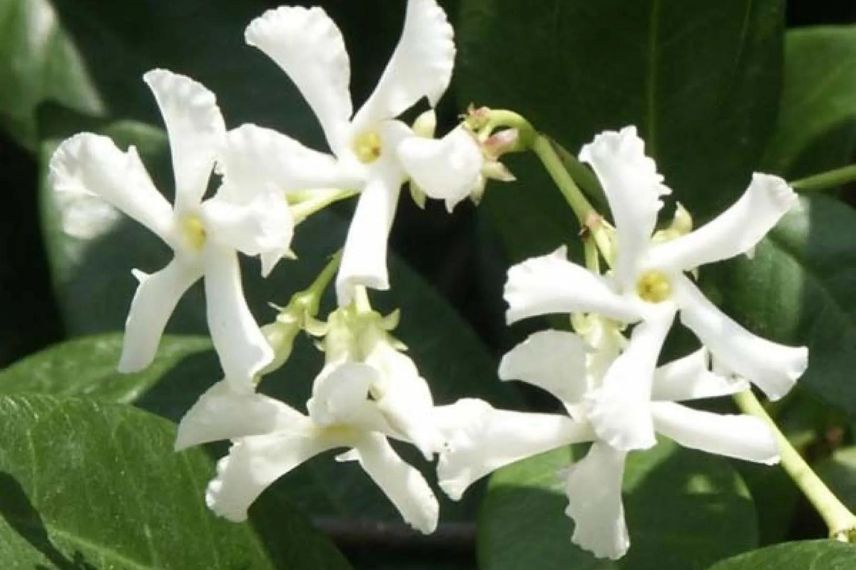
Trachelospermum jasminoides are also known as ‘star jasmine’. These climbers native to China actually belong to the periwinkle family. They can reach around 6 metres in height and 3 metres in spread.
These frost-hardy climbers for cold climates have the advantage of being quite hardy, as they can withstand frosts down to -10°C, even -12°C if the soil is sufficiently well-drained.
The flowering features an abundance of small white flowers, which appear between June and August. Well scented, it exudes spicy and sweet notes, sweeter than the fragrance of other jasmines. The foliage is evergreen, which adds further aesthetic interest.
Plant star jasmine in full sun, in moist soil, and it will even tolerate occasional drought, including chalky soils. Use it as a climber or as a creeping groundcover.
- Subscribe!
- Contents
Comments