





























Choosing a persimmon tree: our buying guide
Find the best paw-paw variety according to different criteria.
Contents
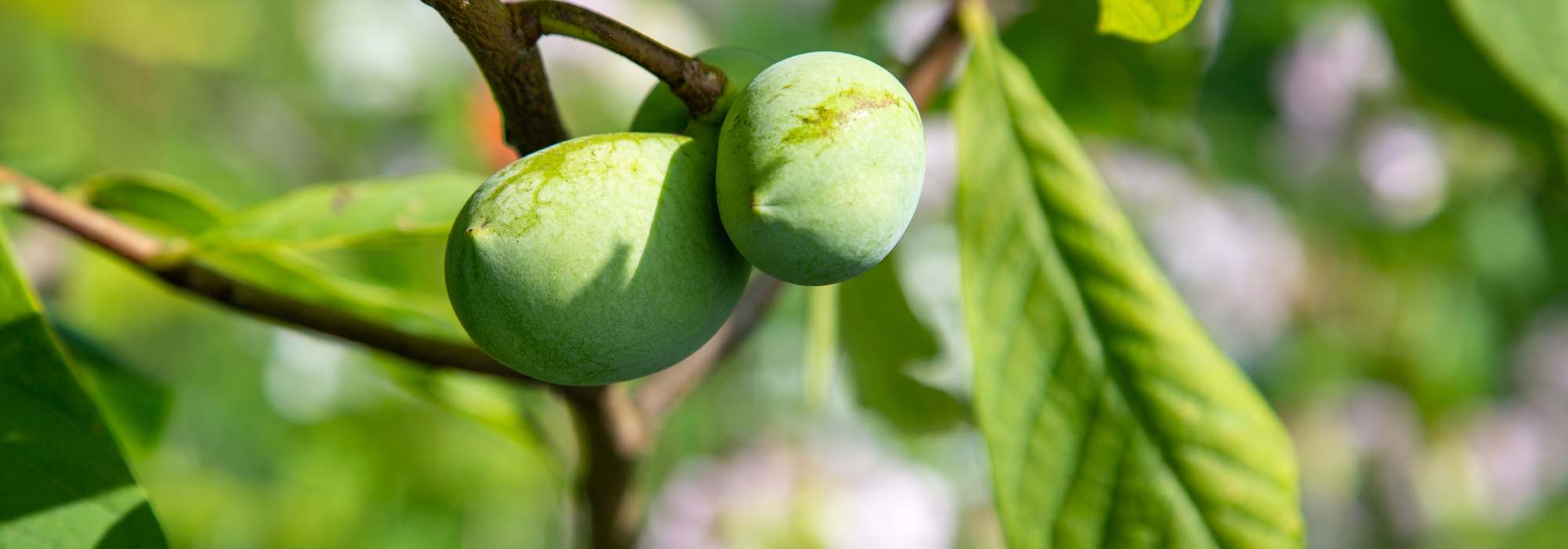
Logically, if you are wondering about choosing the best variety of paw-paw (Asimina triloba) to plant, you already know this fruit tree native to the United States and Canada, still relatively little known in Britain and Ireland. But it deserves real attention! Indeed, the paw-paw (the common name used in the United States) is a small deciduous tree that adapts perfectly to our climate: to bear fruit, it needs hot, slightly humid summers and cold winters (noting that it is hardy to -25°C!). With relatively slow growth, it will bear fruit after 3 to 6 years of cultivation. But it’s well worth the wait. In terms of flavour and texture, paw-paws evoke mango, ripe banana and pineapple all at once. These fruits, resembling large berries with a green-yellow epidermis and yellow or orange flesh, bring an exotic touch to your meals, wherever you live. They can be eaten fresh, or processed into compotes, ice cream or juice.
And for those who are not yet convinced, know that the paw-paw forms a small tree that hardly exceeds 5 m in height and 2 to 2.5 m in width if pruned annually. With green foliage that turns a beautiful yellow in autumn, the paw-paw also offers a beautiful bloom in burgundy to wine-red.
Discover our buying guide to choose the variety that best matches your tastes, the size of your garden and your growing conditions.
To learn more: Paw-paw, paw-paw: plant, grow, harvest

Self-fertile or not?
Naturally, the pawpaw tree is a self-sterile fruit tree, which means you must plant at least two specimens of different varieties to hope for proper fruiting, or even abundant if the growing conditions suit them. Unlike some fruit trees that rely on good or poor pollinators, all pawpaw varieties can be planted side by side so that they pollinate one another. Cross-pollination, primarily carried out by flies, but also by a few beetles and butterflies. Indeed, the flowers, solitary or gathered in small clusters, which take the form of pendulous bells in a deep purplish-red, almost wine-red, exhale a rather repugnant odour of spoiled meat. But rest assured, you really have to put your nose up to the flower for our delicate nostrils to detect this particular scent. On the other hand, insects are not misled by it, especially the flies! Some orchardists even place piles of manure at the foot of the trees to attract these flies.

The pawpaw flowers have the peculiarity of emitting a spoiled-meat odour, particularly perceptible to insects
That said, for most varieties, you should plant at least two trees at a reasonable distance of 10 metres apart to bear fruit.
Nevertheless, thanks to selections made by passionate breeders, some pawpaw trees are nowadays self-fertile. One plant is enough to produce fruit. Even so, two trees planted not far apart will always guarantee better fruiting. Among the self-fertile pawpaws, two varieties stand out:
- The Asimina triloba ‘Sunflower’ which produces large mid-to-late-season fruits with pale yellow skin and pale yellow flesh. These fruits, weighing around 200 g with excellent flavour, reach ripeness between September and October
- The Asimina triloba ‘Prima 1216’ is a small, very vigorous and productive tree that yields pawpaws with green skin and yellow flesh, averaging 200 to 250 g. These fruits benefit from good flavour and few seeds.
We always recommend planting two pawpaw trees of different varieties, as the flowers of this fruit tree are protogynous. This means that these hermaphrodite flowers develop their reproductive organs at slightly offset times. The stigma of the pistil, the female organ, reaches ripeness before the stamens, the male reproductive organ. By planting another tree nearby, you increase the chances of pollination. Some orchardists increase the chances with hand pollination.
Read also
Pawpaw diseases and parasitic pestsDepending on the flavour of the fruits
Pawpaws are somewhat unusual fruits and decidedly exotic in appearance and flavour. Their external appearance and shape, oval and slightly lobed, evoke both mango and cacao-pod from cacao trees. They are covered with a relatively thin skin, green or slightly yellow, depending on the variety. Once the skin is removed, the flesh is usually yellow or orange. This flesh is soft, fairly creamy, and its flavour recalls that of ripe banana, mango and pineapple, with sometimes a subtle note of coconut. These fruits must be harvested at full ripeness, but they are very fragile. This is why they cannot withstand transport or handling, making them very rare on supermarket shelves or from greengrocers. In addition to the melt-in-the-mouth flesh, pawpaws contain many black seeds, fairly large and inedible. Some breeders strive to reduce the number of seeds to make the eating experience more pleasant.
Among all pawpaw varieties, some truly stand out for the flavour and creaminess of their fruits. And in particular the ‘Asimina triloba ‘Shenandoah Peterson®’, which owes its existence to the renowned breeder Neal Peterson (all the varieties he has developed bear names of rivers or streams). Very sweet and sugary, its large fruits exhale a delicious fragrance and contain a melt-in-the-mouth flesh with very well-balanced flavours. These fruits contain few seeds. The Asimina triloba ‘Mango’ is also renowned for the gustatory quality of its pawpaws of good size, with a yellow-orange, very creamy, supple flesh and a strongly pronounced mango flavour.
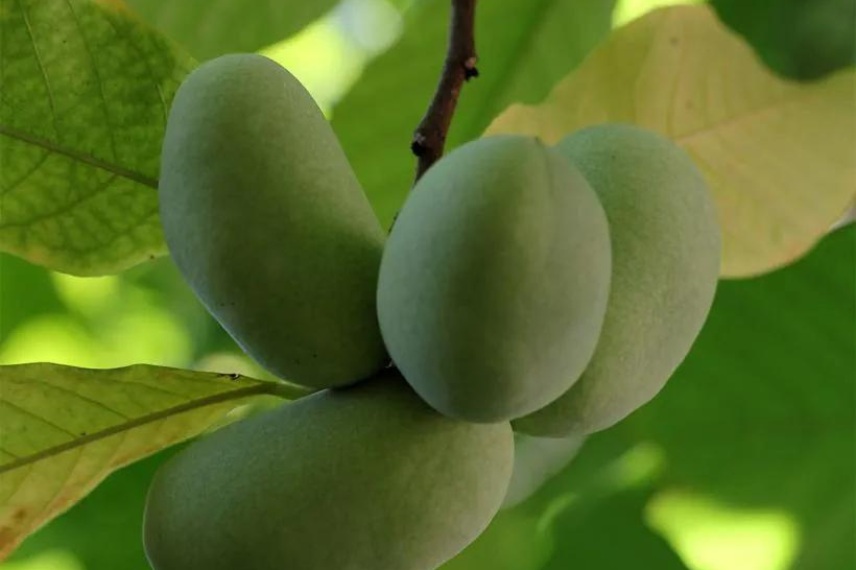
Asimina triloba ‘Shenandoah Peterson®’ is renowned for the exceptional flavour of its fruits
For those who dislike the presence of seeds, the variety Asimina triloba ‘Susquehanna Peterson®’ is perfect. It contains only 3% seeds and offers firm, but melt-in-the-mouth flesh with a truly distinctive flavour. The fruits of this variety are very large in calibre. The variety ‘Prima 1216’ also offers a very good balance between flesh and seeds, and excellent flavour. Just like the variety Asimina triloba ‘Overleese’ with oval fruits and yellow-orange flesh that contain very few seeds. The fruits of this variety can reach 300 g.
According to the earliness of fruiting.
The pawpaws reach ripeness between the end of August and October. But the peak production occurs between late September and October. Some varieties ripen earlier than others. And in particular the Asimina triloba ‘Allegheny Peterson®’, which offers fruits of medium size (about 150 g) with yellow, firm flesh, endowed with a scent of citrus trees. Its fruits contain a relatively large number of seeds.
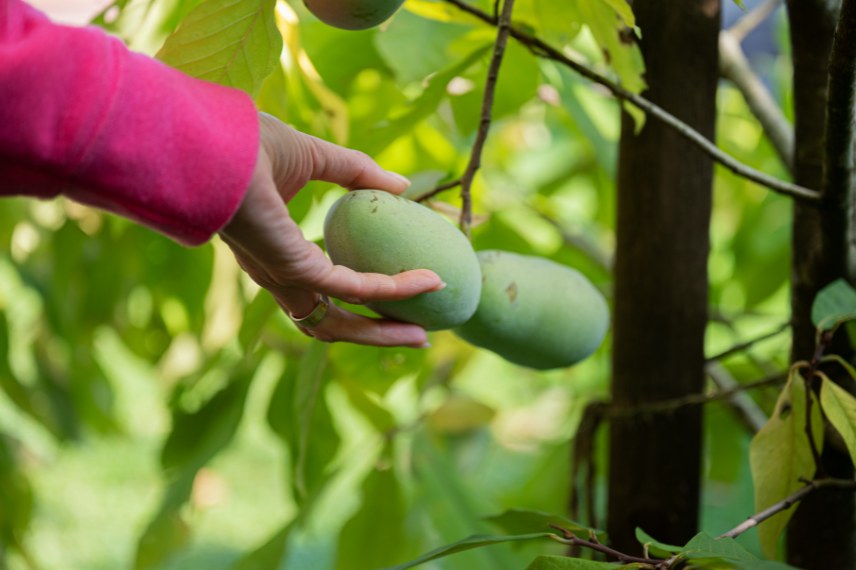
The harvest of pawpaws occurs between late August for the earliest varieties and late October for the late varieties
The variety Asimina triloba ‘Prolific’ is also known for its early ripening. Its fruits, medium-sized, weighing between 200 and 225 g, have pale yellow flesh that is very fragrant.
In line with productivity
For those seeking productivity, a variety that already lives up to its name: the Asimina triloba ‘Prolific’. It is a pawpaw tree renowned for its very high yield of medium-sized fruits (about 200 g). Fruit set also occurs earlier. This variety was discovered in the 1980s–1990s in Michigan by Corban Davis. ‘Shenandoah Peterson®’ is also ranked among the most productive varieties, as is ‘Allegheny Peterson®’, a tree on which one sometimes needs to remove fruit to increase the size of the others.
Depending on tree size.
The pawpaw is a small tree that can nevertheless reach 5 to 10 m in height, with a spread of 3 to 5 m. However, if pruned, its dimensions will be more modest. If you have a small garden where space is tight, we recommend the variety Asimina triloba ‘Wells’, an American David Wells selection, which produces small fruits with green skin and orange-yellow flesh, very tasty, and which will not exceed 5 m in height and 2.5 to 3 m in width without pruning.
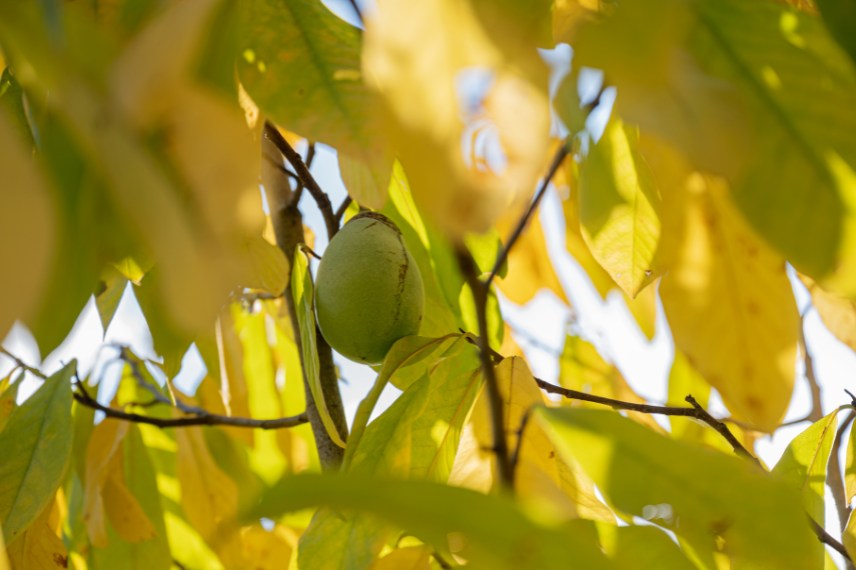 The pawpaw forms a tree with a pyramidal habit, 5 to 10 m tall and 3 to 5 m wide if not pruned.
- Subscribe!
- Contents

Comments