





























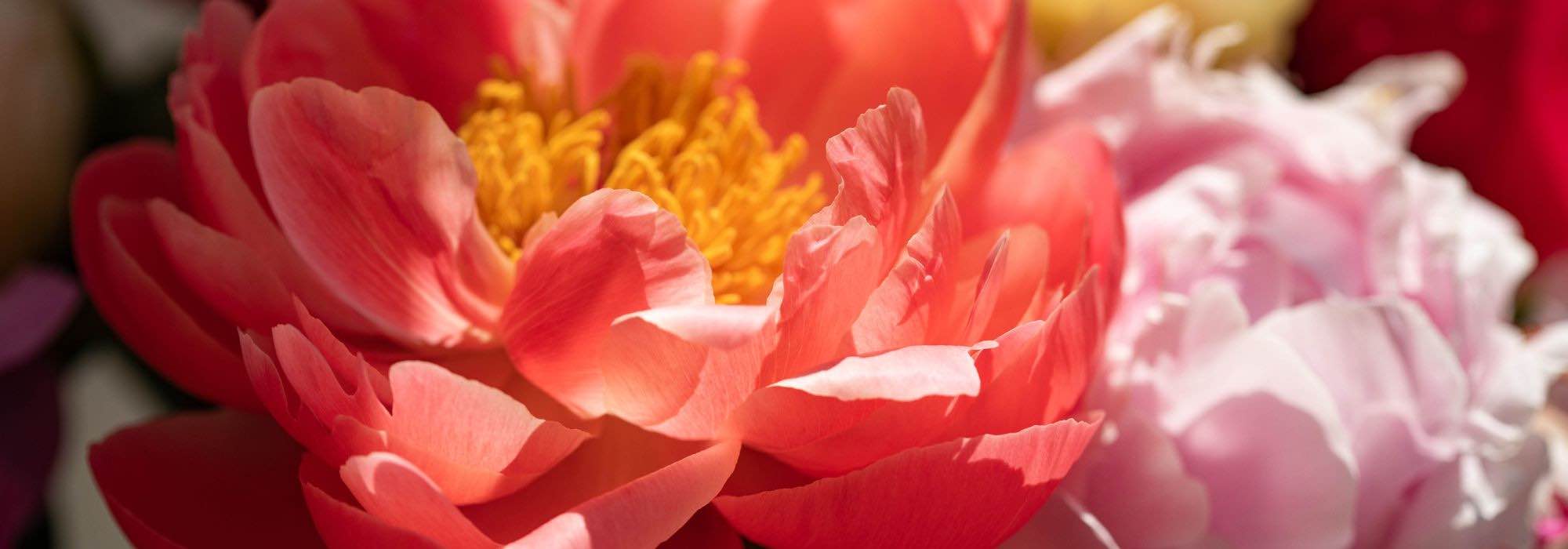
Everything about peonies: types, history and colour symbolism
Origins and Symbolism of Peonies
Contents
Often used to create bouquets and floral decorations for weddings or celebrations, the peonies, or Paeonia are a marvel, with their abundance of silky petals and their elegant palette of pastel or vibrant colours. From the simple corolla of petals revealing a heart of yellow stamens to enormous, double, fluffy or frilled balls, these perennial plants have no equal when it comes to charm. With their highly dissected foliage, which appears in spring and falls away in autumn, and their colourful flowers ranging from all shades of pink to deep red, white and even yellow, they are greatly admired by cut-flower enthusiasts. Peonies, which bloom around May, from mid-April to mid-June, express a multitude of feelings and emotions and have a long vase life. Discover the different types of peonies, their origin and history, their use in floral art, as well as the meaning of their colours in the language of flowers.

Different types of peonies
Peonies are famous for their spectacular flowering and wide variety of colours. Gardeners and flower enthusiasts look forward to peony season in May, when these vibrant blooms transform gardens into living paintings. Very hardy and vigorous, they prefer sunny positions in rich, well-drained soil.
There are three main types of peonies: Herbaceous peony, shrub peony, and Itoh peony.
- Herbaceous peony, also known as Chinese or Japanese peony, is the one most commonly encountered. Very hardy, it dies back in winter.
- Shrub peony, highly prized in China, differs from the previous one by its shrub form and a larger size, reaching between 2 and 3 metres in height. They bear enormous blooms and do not die back in winter.
- Itoh peony is the result of a cross between herbaceous and shrub peonies. It is also hardy and offers large blooms in colours less common, such as peach, apricot or canary.
These different types of peonies require slightly different growing conditions.
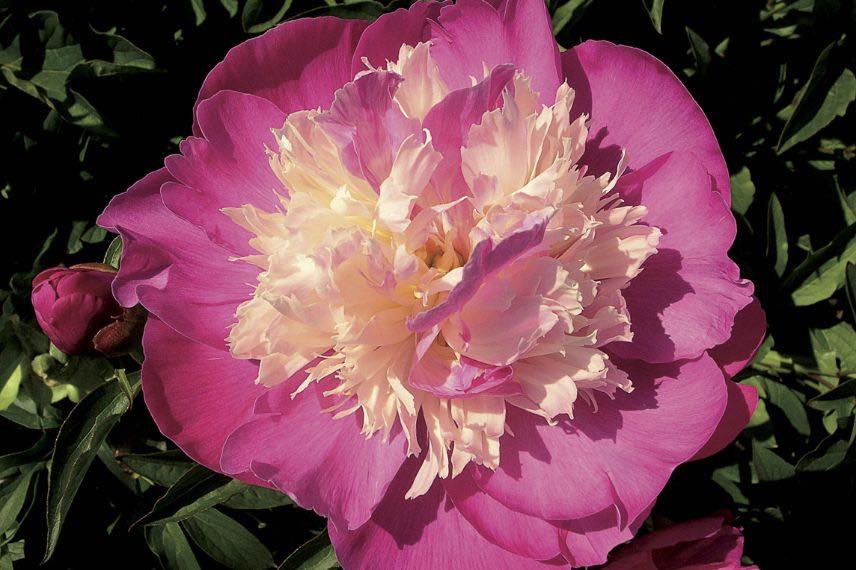
Itoh peonies, hybrids, often offer colours less commonly seen
Read also
5 pink-flowered peoniesOrigin and history of peonies
Herbaceous peonies originate in Europe, Asia—especially China—and North America. The officinal peony has been used since antiquity for the medicinal properties of its roots.
Cited by ancient physicians, Hippocrates and Dioscorides, as well as in Homer’s Iliad, the peony is associated with numerous tales in Greek mythology, such as the healer god Paeon, and the nymph Paeone, who was turned into a peony for her indiscretion.
Peonies appear widely in botanical treatises and in the gardens of kings, such as those of Henry IV, as early as the sixteenth century.
Empress Josephine owned hybrid peonies in her collection of cultivated plants at the Château de Malmaison. These peonies were presented to her by the Chinese emperor Jiaqing.
Shrub peonies are native to China and have been cultivated there for more than 2,000 years for their beauty as well as their medicinal properties. They were introduced to Japan in the eighth century and to Europe in the nineteenth century.
In China, peonies are regarded as the ‘queens of flowers’. They symbolize wealth, prosperity, honour, beauty and love.
Use in floral art
Peonies are often used for weddings due to their sophisticated appearance, elegance and a romantic colour palette. They grace bridal bouquets and the floral décor at celebration venues.
As gifts, peonies express sentiments of happiness, love, honour, well-being and prosperity, which makes them ideal for many occasions, particularly for celebrating Mother’s Day or to declare one’s love.
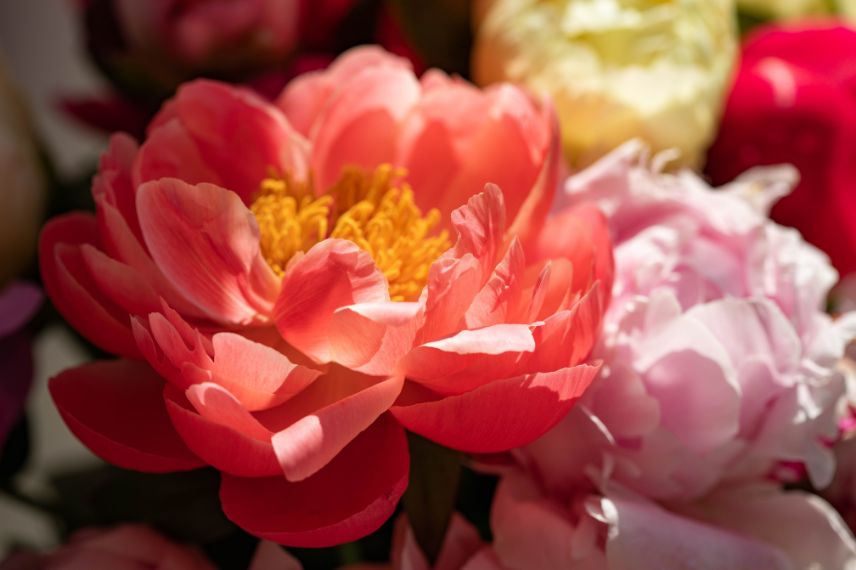
Peonies are widely used in floral design for their opulence and sophistication
Read also
6 red-flowered peoniesColour meanings
Red, pink, white, yellow and sometimes orange peonies can be found.
- Red: the red peony symbolises passionate love and respect. It is often given in romantic relationships to express intense feelings.
In Asia, red peonies symbolise wealth and happiness.
Among safe bets is the peony Paeonia lactiflora ‘Van Houtte’ and its large cardinal-red flowers with ruffled petals and a heart of yellow stamens. Also treat yourself to the cherry-red of the generous flowers of the Paeonia lactiflora ‘Peter Brand’.
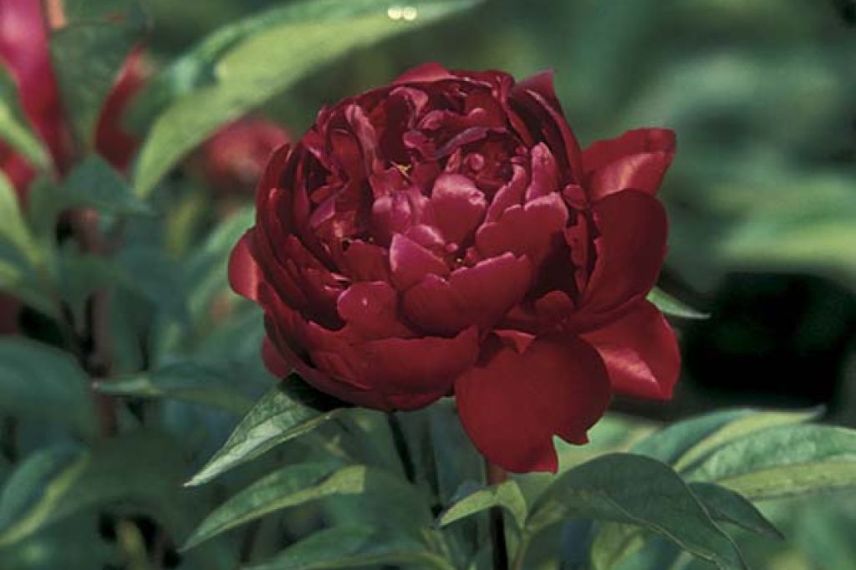
The Peony‘Peter Brand’ expresses passion
- Pink: the pink peony comes in many shades and symbolises romantic or budding love. Symbolising gentleness and tenderness, pink can also express shyness.
In this colour, a wide range is available, from pale pink to vivid pink. Let yourself be inspired by the Paeonia lactiflora ‘Sarah Bernhardt’ with pale pink double flowers and fragrance. Or by the peony botanique – Paeonia officinalis Mollis, which offers single flowers in calyx-shaped form tinted with a vivid pink, revealing a heart of yellow stamens. - White: the white peony expresses purity and respect. It is often used in wedding bouquets and to symbolise modest love.
Among white peonies, the Paeonia lactiflora ‘Duchesse de Nemours’ is prized for its double, fragrant flowers, with white, slightly yellow- and green-tinged petals. - Yellow: less common than the preceding colours among peonies, yellow represents wealth, prosperity, as well as joy in cut flower arrangements.
Awarded in the United States, the Paeonia lactiflora ‘Lemon Chiffon’ features large lemon-yellow, semi-double flowers, with ruffled petals opening to a heart of orange-yellow stamens. - Orange: also not common, this pastel shade adds softness and originality to a bouquet, such as the Paeonia lactiflora ‘King’s Day’ and its delicate salmon hues. Orange expresses cheerfulness and warm relationships.
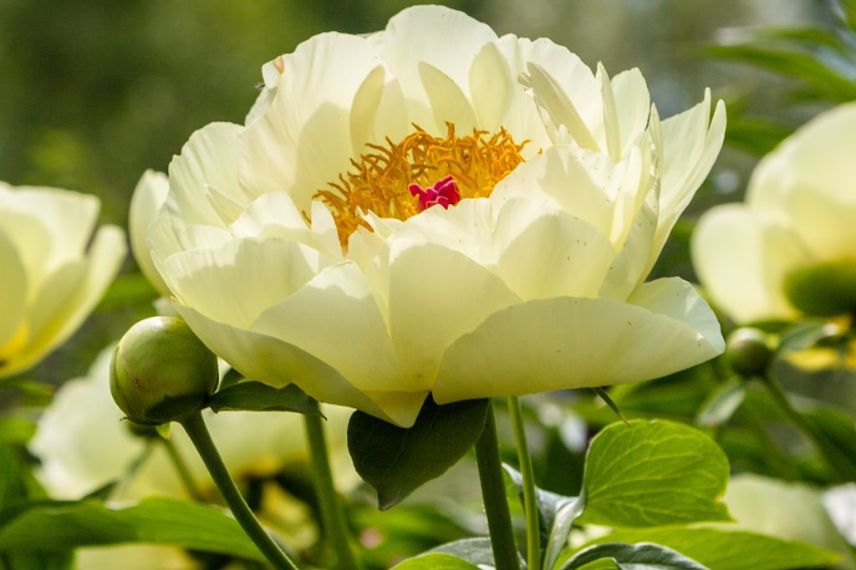
Paeonia lactiflora‘Lemon Chiffon’ : yellow, though uncommon, represents joy, wealth and prosperity
- Subscribe!
- Contents
Comments