





























6 pairing ideas with Eremurus
Romantic or exotic
Contents
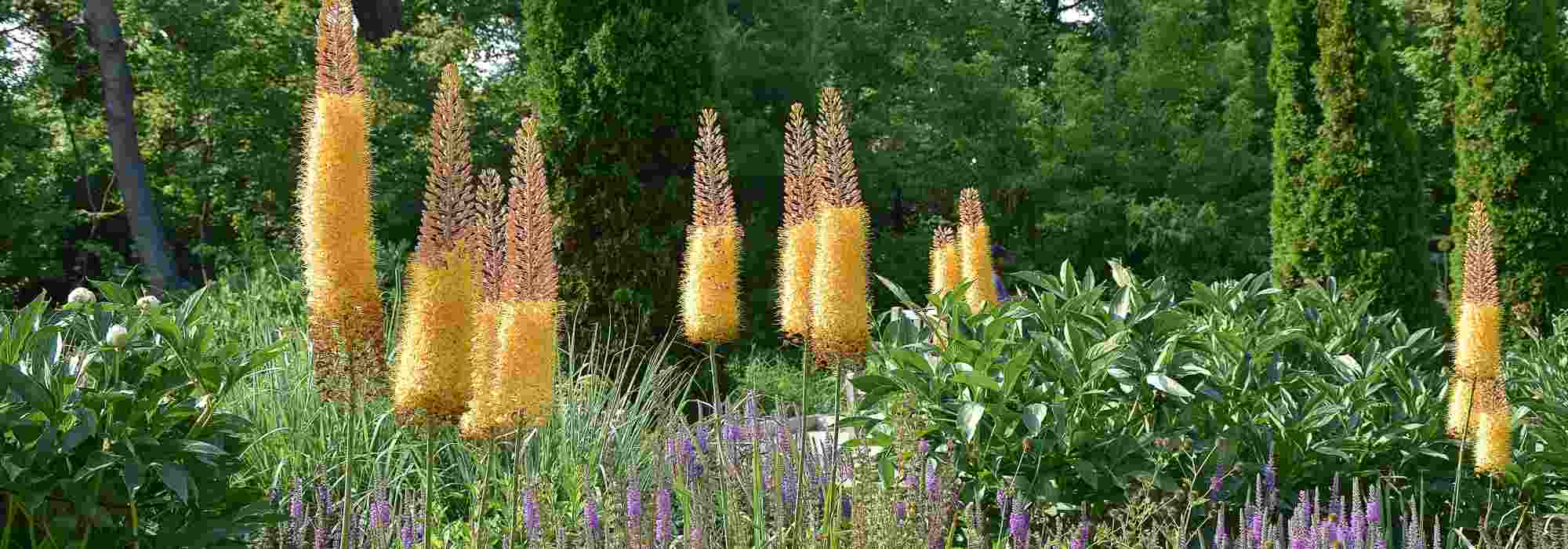
With their tall flower spikes sometimes reaching over 3 m from the ground, Eremurus or Foxtail Lily never go unnoticed. These spectacular bulbous perennial plants bloom for 4 weeks in spring or summer, typically in warm tones of yellow and orange, but sometimes white. Very graphic and essential if you want a touch of exoticism, Eremurus are welcome in all gardens to bring grandeur, balance, and colour. However, they do require plenty of space! Vigorous and very hardy, they thrive in full sun, which highlights their colourful spikes, and in deep, well-drained soils. Embrace the height and discover our 6 successful pairing ideas with Eremurus!
Eremurus, a sculptural beauty with multiple associations

To structure a flower bed
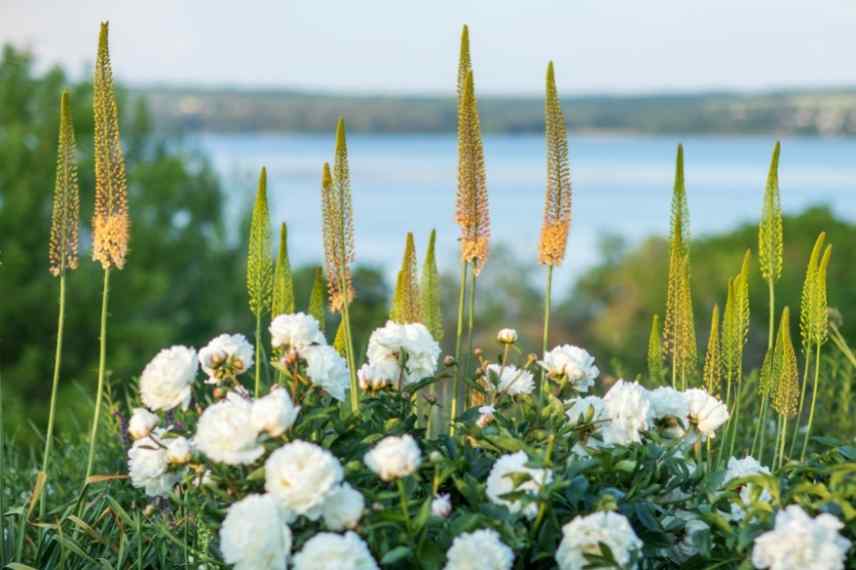
The vertical dimension provided by Eremurus helps to structure a somewhat flat perennial or bush bed, infusing it with height and breaking the monotony. The tallest varieties, such as Eremurus Robustus or Eremurus Brun, should be planted in the background to add depth and lighten the bed. Majestic as they reach heights of between 2 and 3 m, they create vertical accents and striking, colourful focal points.
Eremurus are well-suited for large beds with other summer-flowering perennials that will conceal their base, provided there is enough space to avoid suffocation, as they do not tolerate root competition well. You can accompany them with other spikes such as those from Lupin ‘Le Chandelier’ and Agastaches ‘Kudos Yellow’. With their colourful leading shoots, they will be sensational, especially when contrasted with flat inflorescences like those of Achillea millefolium (‘Hannelore Pahl’), the beautiful small blue balls of ‘Echinops ritro’ or the large pom-poms of Echinacea purpurea ‘Milkshake’. You can balance these vigorous accents and lighten the scene with grasses, such as the majestic Stipa gigantea, Stipa tenuifolia, or Miscanthus. You will create a lovely, lush bed with minimal maintenance.
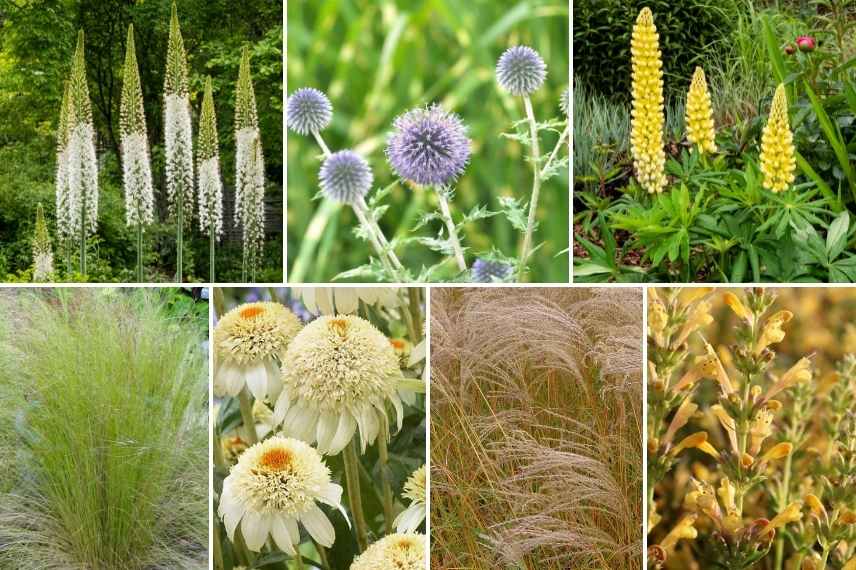
Eremurus robustus, Echinops ritro, Lupin ‘Le Chandellier’, Stipa tenuifolia, Echinacea purpurea ‘Milkshake’, Miscanthus sinensis ‘Flamingo’ and Agastache ‘Kudos Yellow’
In a contemporary display
Eremurus are plants that thrive in a graphic and contemporary garden style. Here, muted tones, white, and silver are preferred. To warm up a minimalist atmosphere with formal lines, opt for the immense ivory white spikes of Eremurus ‘White Beauty Favourite’. To accompany it, choose graphic plants such as Eryngium yuccifolium, a striking sea holly with small round white flowers, Veronicastrum virginicum var. album and Agapanthus ‘White Heaven’ with particularly graphic umbels. Also consider Kniphofia ‘Ice Queen’ with its spikes in various shades of white or, less conventionally, Angelica archangelica, with its large umbels of greenish flowers. Pair them with box balls for structure or with some wild grasses like Stipa ichu, or Muhlenbergia rigens with its long, fine grey-green leaves or with small blue fescue (Fescue ‘Elijah Blue’), which are more structured, for example.
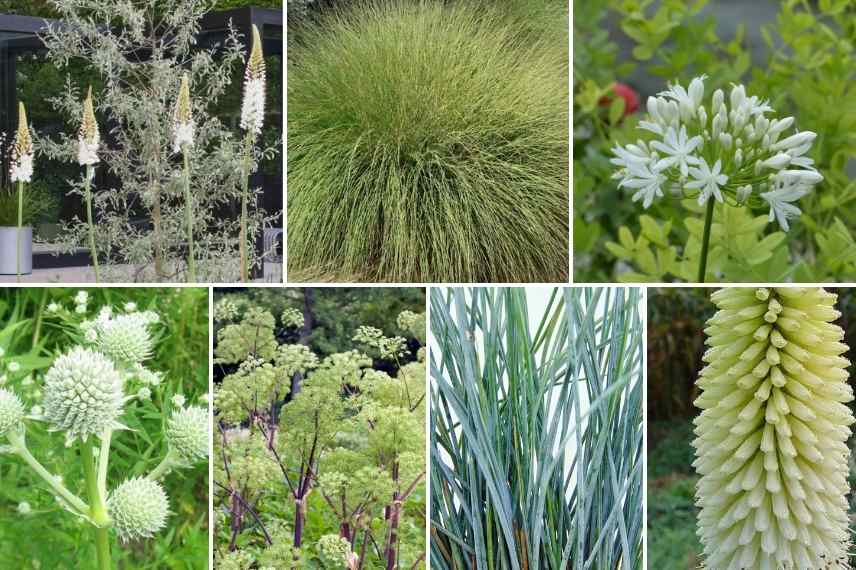
Eremurus ‘White Beauty Favourite’, Muhlenbergia rigens, Agapanthus ‘White Heaven’, Eryngium yuccifolium, Angelica archangelica, Festuca ‘Elijah Blue’ and Kniphofia ‘Ice Queen’
Discover other Spring bulbs
View all →
Available in 1 sizes
Available in 1 sizes
Available in 1 sizes
Available in 1 sizes
Available in 1 sizes
Available in 2 sizes
Available in 1 sizes
Available in 1 sizes
Available in 1 sizes
In an exotic and lush garden
The sometimes saturated colours of the spikes of Eremurus give them an exotic look, perfect for integrating into a stunning decor. They form large clumps that are both vibrant and graphic. Their colourful flowering sets the tone in a large sunny border. Start by composing a lush setting with the foliage of palms, castor beans, yuccas, phormiums, cordylines and the astonishing Eryngium agavifolium with its agave-like leaves. This combination will naturally structure an exotic and wild garden.
This type of composition highlights warm tones. Choose an Eremurus ‘Tap Dance’, which in summer rises to 1.50 m above the ground with sunny yellow spikes. Plant it in groups alongside acanthus, daylilies, Kniphofia ‘Flamenco’ or ‘Red Rocket’, and California poppies. In this type of scene, also integrate an Agave montana, cannas, and lobelias to perfect this exotic atmosphere.
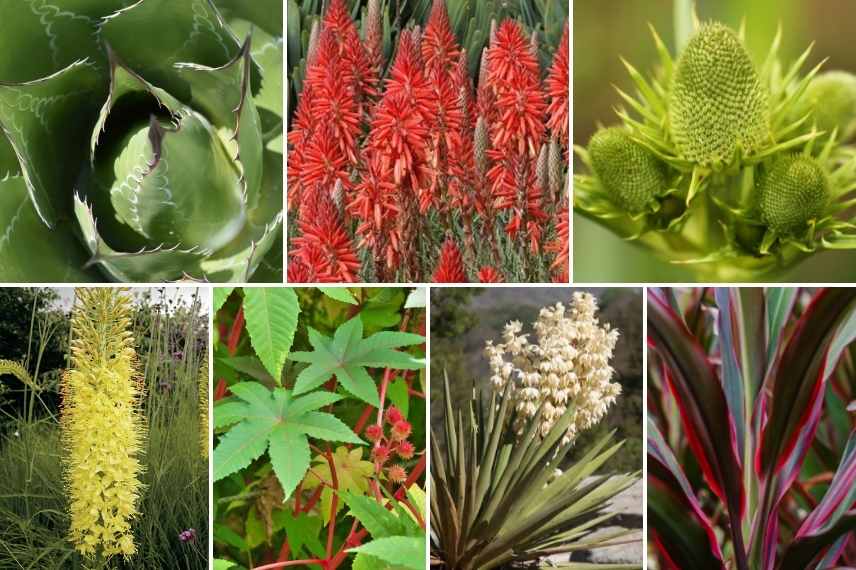
Agave montana, Kniphofia ‘Red Rocket’, Eryngium agavifolium, Eremurus ‘Tap Dance’, Ricinus communis, Yucca and purple cordyline
Read also
Eremurus: planting and careIn a scree garden
Eremurus or Foxtail Lily thrives in full sun and well-drained soils, naturally finding its place in a mineral-dominant garden. It tolerates calcareous and poor soils quite well. You can pair it with other plants that handle drought relatively well. For example, choose Eremurus ‘Cleopatra’. You will create a lovely floral scene with contrasting blue, purple, and yellow-orange flowers by combining it with the globular forms of Allium christophii, the blue umbels of Agapanthus ‘Navy Blue’, and the understated Nepeta x faasseni ‘Purrsian Blue’. Also pair it with yellow phlomis and Mullein, Verbascum bombyciferum ‘Polarsommer’, and Eryngium bourgatii, all three magnificent in a dry garden. To give impact to this understated environment, also consider the remarkably architectural silhouette of Dasylirion longissimum, which forms a spherical rosette. To fill the space, think of a carpet of Delosperma, or a few blue clumps of Triteleia laxa that won’t smother your Eremurus, as it does not appreciate competition at all.
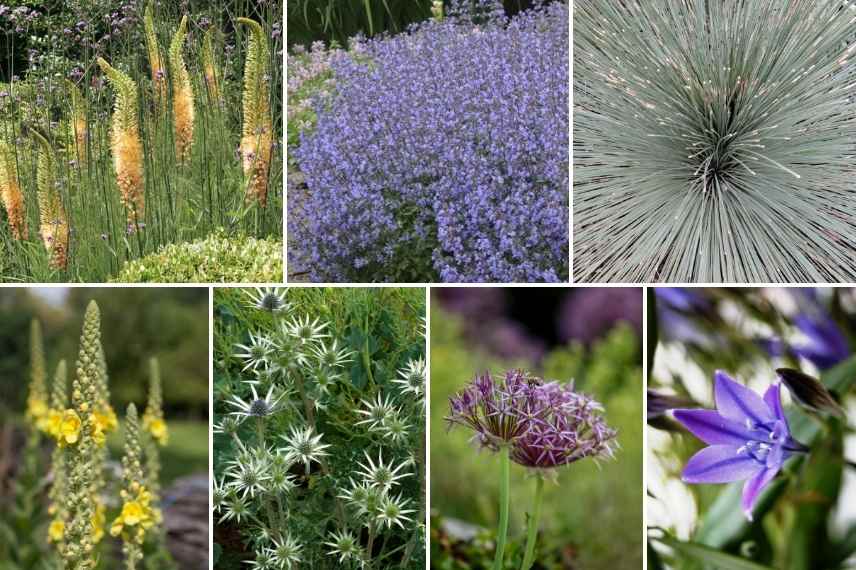
Eremurus ‘Cleopatra’, Nepeta faasseni ‘Purrsian Blue’, Dasylirion longissimum, Verbascum bombyciferum, Eryngium bourgatii, Allium christophii, and Triteleia laxa
In a border with warm tones
The vertical dimension provided by eremurus adds depth to a somewhat flat border. Choose the smaller varieties, such as the Bungei, which reaches about 1m in height, or the Eremurus x ‘Isabellina Pinokkio‘ with its long copper-orange spikes that does not exceed 90 cm in height. They should be planted alongside Delphiniums ( ‘Dark Blue-Black Bee’, for example), Digitalis grandiflora, Lupinus polyphyllus ‘Gallery-Blue‘, and Verbascum with their upright flower spikes, all equally structural. These plants will enliven this area by creating colourful vertical and graphic accents, instantly infusing vitality into this display. At their feet, place shorter plants, such as the Centranthus, sages, santolines, or Geum. A Pennisetum setaceum ‘Rubrum’, with its foliage coloured in purple to chocolate red, will provide an interesting echo by complementing the colour palette.
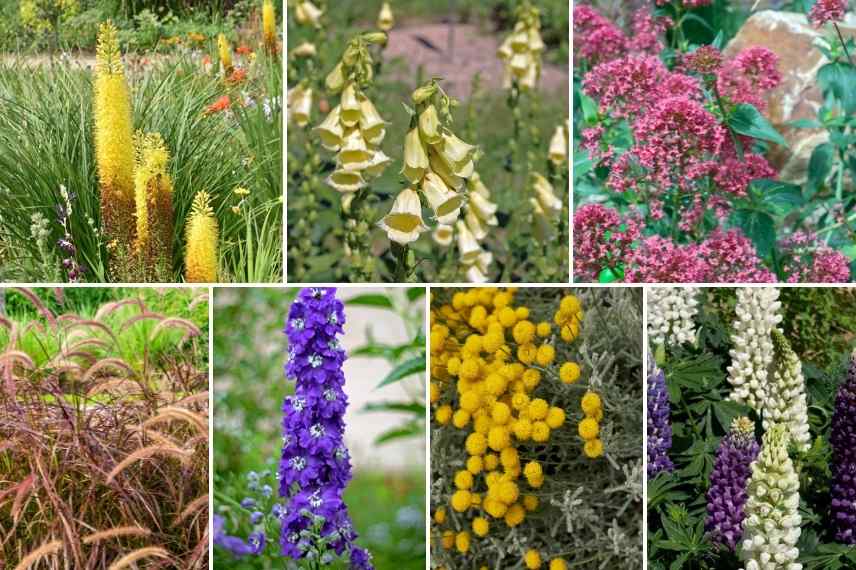
Eremurus bungei, Digitalis grandiflora, Centranthus ruber, Pennisetum setaceum ‘Rubrum’, Delphinium, santoline, and Lupinus polyphyllus ‘Gallery Blue’
In a romantic scene
Don’t be fooled by their reputation! Some delicately beautiful eremurus allow for the creation of fresh, opulent, and romantic scenes. For example, you can plant in groups of 3, the Eremurus ‘Romance’ with pale salmon-pink flowers, dotted with coral stamens, or the Eremurus himalaicus. Given their majestic stature, reaching up to 1.5m in height, place them in the middle of the border. In the background, create a curtain of dark bushes that will highlight their pastel shades, with a Lagerstroemia indica ‘Black Solitaire’, an astonishing crape myrtle that is quite hardy with dark burgundy-black foliage, and English roses.
Invite a Cynara cardunculus, a cardoon with extraordinarily bright silver-grey foliage that will enhance all its neighbours. To perfect this summery atmosphere with soft colours, mix in some clumps of white lupins Lupinus ‘Noblemaiden’, Baptisia pendula ‘Alba‘, Allium bulgaricum, and white gaura with their light flowering. Accent this composition with Papaver orientale ‘Perry’s White’, a white poppy with a wine-red centre, and Artemisia ludoviciana ‘Silver Queen’ which forms a magnificent silver-grey clump.
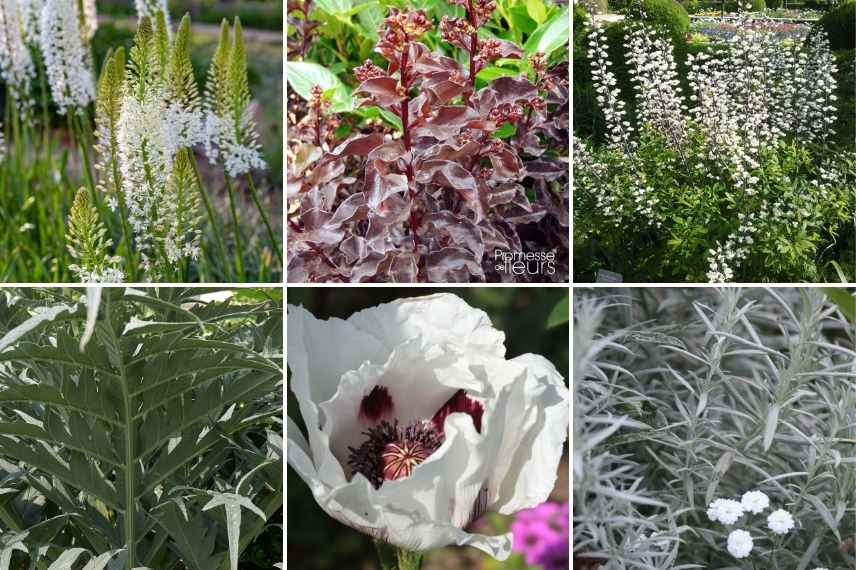
Eremurus himaliacus, Lagerstroemia indica ‘Black Solitaire’, Baptisia pendula ‘Alba’, Cynara cardunculus, Papaver orientale ‘Perry’s White’ and Artemisia ludoviciana ‘Silver Queen’
For further reading
- Discover all our varieties of Eremurus
- To learn everything about their cultivation, browse our guide
- Subscribe!
- Contents
Comments