





























5 inspirational pairing ideas with Paulownia
Exotic or romantic, an exceptional tree for the garden!
Contents
Trending tree for its resistance to hot summers, the Paulownia, or empress tree, is a name you will keep hearing in contemporary landscape designs.
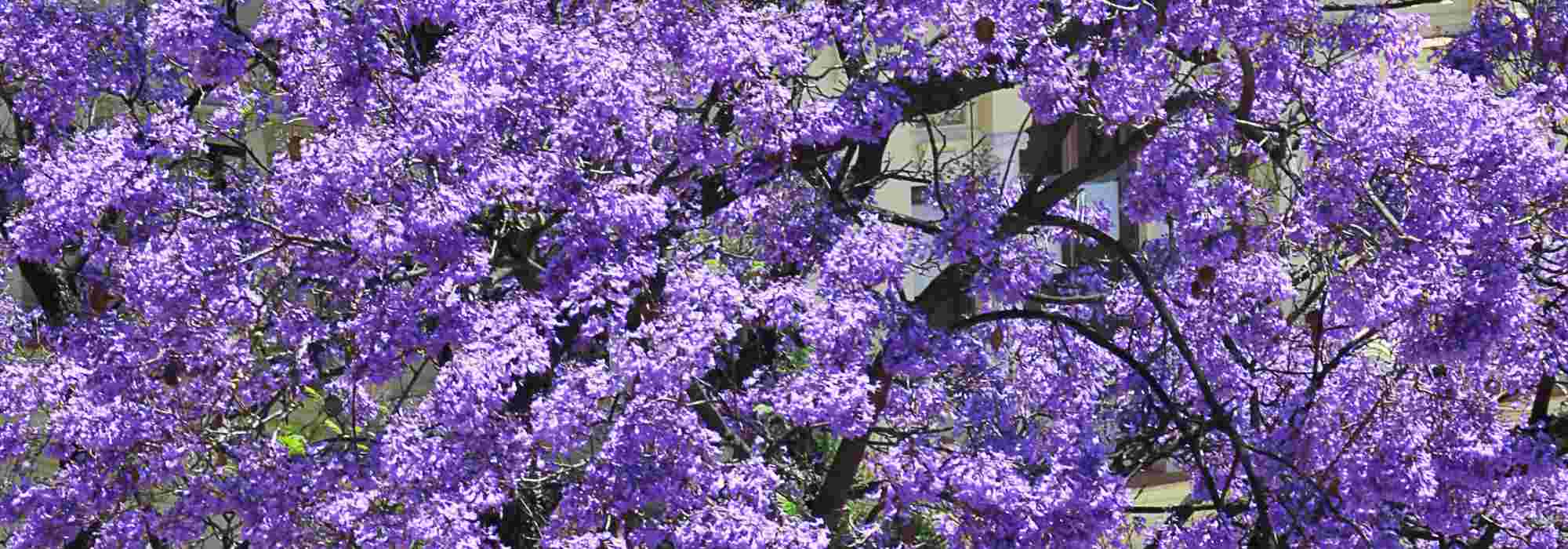
Extraordinary in spring when it is cloaked in a cloud of blue flowers, it becomes majestic as soon as its enormous foliage appears.
If it looks wonderful planted as a specimen on a lawn, where it radiates in spring and remains majestic for the rest of the year, it can also be paired. Yes, but not just anywhere, as it has real character!
It thrives best in a sunny position, or in bright, half-shade, and sheltered from cold winds to protect its early flowering.
We present five scenes featuring the Paulownia for contemporary gardens.
→ To learn more about this blue-flowering tree, see our full dossier: Paulownia, empress tree: planting, cultivation and care
→ Also listen to our podcast:

In a blue garden
One of the very few trees with blue flowering that grows in our latitudes, Paulownia can boast of being the perfect choice to reign in splendour in a blue monochrome garden. Between April and May, it will reveal its splendid inflorescences in blue-violet thyrses. This flowering being ephemeral, it is useful to pair it with other blue-flowering shrubs or climbing plants that flower at the same time such as lilac lilac ‘Captain Baltet’ and a Chinese wisteria, and later other species to follow suit. You thus compose a blue garden over several months!
Essayez de rapprocher dans ce jardin des arbustes, des plantes vivaces et plantes grimpantes bleutées, comme des romarins, des Céanothes, par exemple le cénaothe caduc pallidus ‘Marie Blue’, des sauges arbustives ou herbacées bleues, un gattilier pour le plein été, et des Caryopteris pour venir clore ce festival azuré en fin d’été. Dans les endroits ombragés du jardin, si votre terre est acide, vous aurez l’embarras du choix avec quelques Hydrangeas aux boules bleutées et même avec certains Rhododendrons. Don’t forget the glaucous foliage such as that of an Eucalyptus, and the two-tone flowering of some plants to lighten the overall effect, such as Iris ‘Haut les Voiles’ for example.
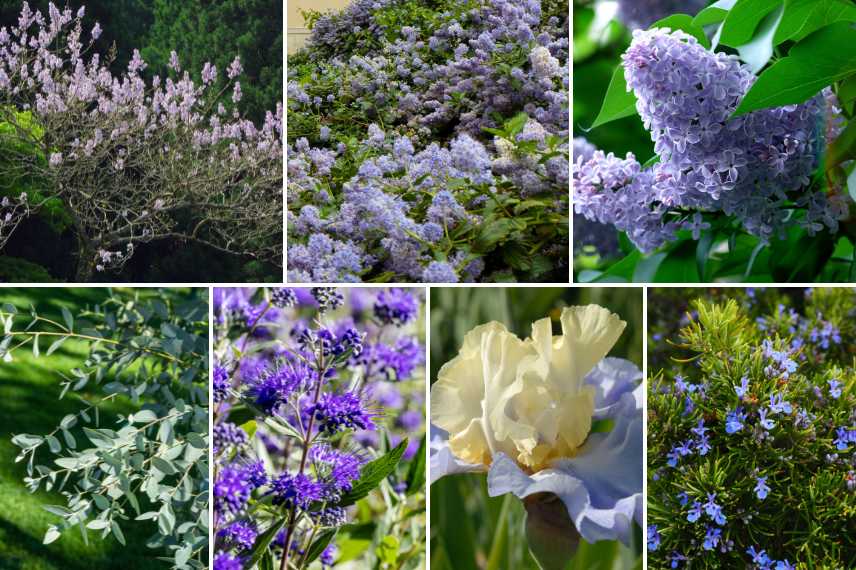
Paulownia tomentosa, Ceanothus pallidus ‘Marie Blue’, Syringa vulgaris, Eucalyptus, Caryopteris, Iris ‘Haut les Voiles’ and rosemary
Read also
Designing a blue gardenIn exotic settings
With its large leaves, among the largest in the plant world for a tree, Paulownia has a place in an exotic-style garden. For this purpose, it is not the tree form that interests us, but the potential of its large leaves in the juvenile stage. We then use Paulownia as a summer-border plant, grown at the top of a willow for the summer bedding schemes, because it grows exceptionally quickly. By cutting it back to ground level each year, we simply benefit from its foliar mass: this coppice pruning encourages the formation of vigorous shoots and yields very large leaves at the expense of the flowers.
Thus we have a generous plant that will grow to about 2 m tall, and will blend advantageously into a border with a wide range of flowering displays in pink to red tones, not forgetting orange: common Rose mallow (as Hibiscus moscheutos ‘Red’), cannas, Alstroemerias, Hedychiums, etc. Bushes with handsome and ample foliage such as Melianthus major, the banana trees, the Tetrapanax will add to the escapist feel! Here, we have also invited a Brazilian feijoa (Feijoa sellowiana) for the radiant exoticism of its spring flowering. For this kind of scene, plant more closely together and emphasise the tropical look with plenty of plants.
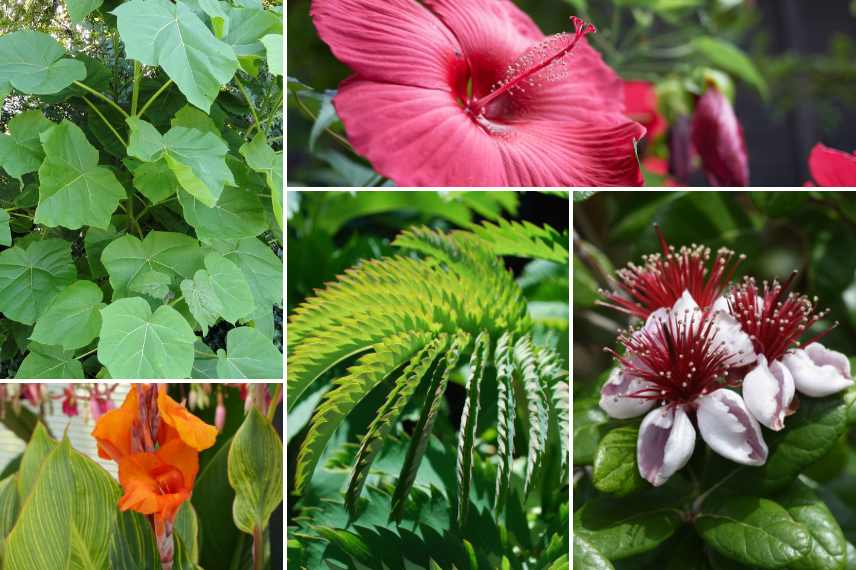
Paulownia fortunei, Hibiscus moscheutos, Canna striata, Melianthus major and Feijoa sewolliana
In a violet and orange pairing for a dazzling spring display.
The vibrant colour of Paulownia in spring allows you to play with similar and complementary colours, from yellow, through apricot to orange, and blue to violet tones. We can enjoy the tree’s spectacular flowering to pair with bushes and perennial plants flowering at the same time, between April and May depending on the region, in mauve to plum tones. Always ensure you choose neighbouring plants that will accompany the Paulownia at the same time as its flowering, for a magical display of colour! We have here thought of Columbines, Alliums, Euphorbia griffithii and a Laburnum to prolong the brightness and abundance of flowers, but you could just as well insert Chinese azaleas (there are many orange-coloured varieties flowering at the same time such as Azalea coccinea ‘Speciosa’, Azalea ‘Gibraltar’ or ‘Fire Ball’), Rhododendron ‘Olga’, Irises such as Iris germanica ‘Tanzanian Tangerine Sunset’, Clematis macropetala with blue flowers, Itoh peonies in salmon colours…
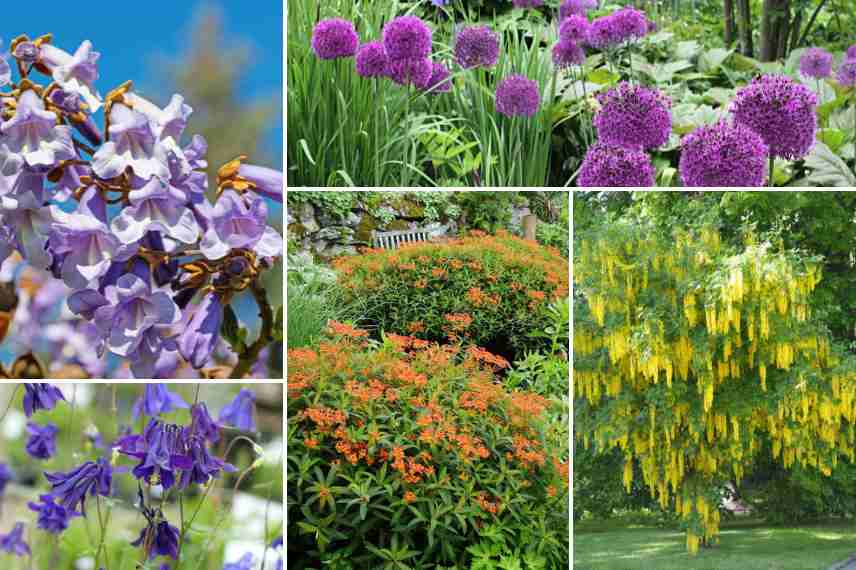
Paulownia fortunei, Alliums, Aquilegia vulgaris, Euphorbia griffithii and Laburnum
In a park
Given its mature size (up to 10 m tall), Paulownia is generally suited to a specimen plant in the garden. It is then better imagined in large spaces or parks to showcase it to best effect. A Paulownia tomentosa makes a striking impact when planted on a lawn, where its crown of giant leaves provides excellent shade for our increasingly hot summers. Not far away, other trees with character can be added, without competing with it: Liriodendron (Virginian tulip tree), sycamore maple, Magnolia grandiflora, Gleditsia triacanthos (American honeylocust), etc.
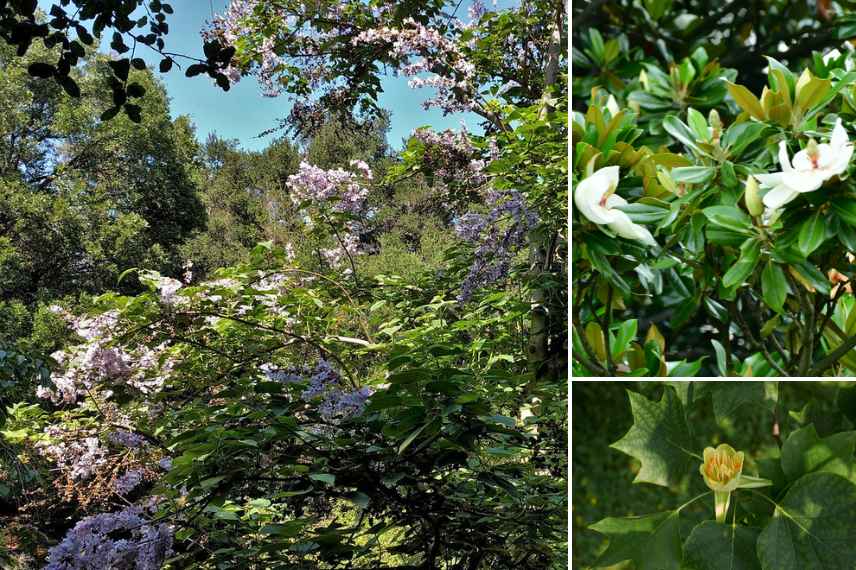
Paulownia kawakamii (© Cultivar 413), Magnolia grandiflora and Virginian tulip tree
In perfect blue-and-yellow harmony.
Another charming option is to let your Paulownia take centre stage in a setting built around the yellow-and-mauve duo. It’s a gentle and romantic pairing, delightful for spring, especially when you choose as the focal counterpoint a Chinese wisteria which gracefully responds to its tubular flowers with fragrant, pendulous clusters, ranging from purplish to lilac. To these two spring garden stars, blend in a few soft yellow flowering displays, such as those of a yellow Magnolia, flowering on bare wood (here the Magnolia acuminata ‘Butterfly’), a golden Cornus mas, and a groundcover composed of Epimediums whose foliage in nuanced tones will take over from the aerial flowering, concurrent and in colours from yellow to light mauve.
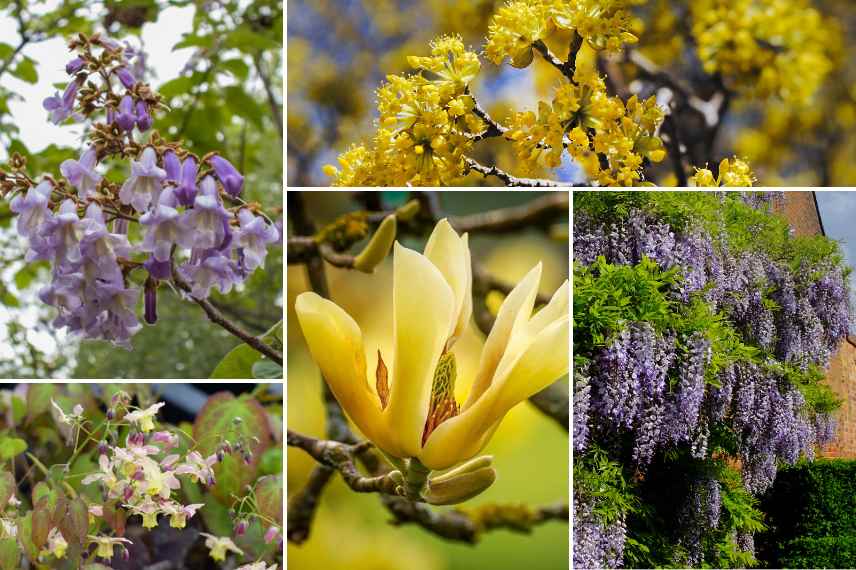
Paulownia, Cornus mas, Epimedium versiculor ‘Cupreum’, Magnolia acuminata ‘Butterfly’ and Wisteria sinensis
- Subscribe!
- Contents
Comments