





























The question may seem odd, but at a time when we seek to limit the time spent in the garden and avoid heavy gardening chores, one might wonder: should we still plant bamboo in our gardens?
On the side of its detractors, criticism abounds, and they see this plant as a hindrance to gardening, an invader that colonises flowerbeds, a conqueror that takes advantage of absence to impose its dominance over the rest of the garden. According to these same detractors, bamboo grows too quickly, constantly sheds its leaves, and grows in a disorderly manner. In short, it is a mundane bush that grows too much and requires constant pruning.
Its admirers, on the other hand, are full of praise and see bamboo as an excellent evergreen plant that does not lose its foliage in winter and is perfect as a privacy screen or windbreak. An exotic plant with a Japanese aesthetic and a graceful, lightweight silhouette that rustles and undulates with the slightest breeze. An architectural plant with stiff, colourful culms and elegant branching.
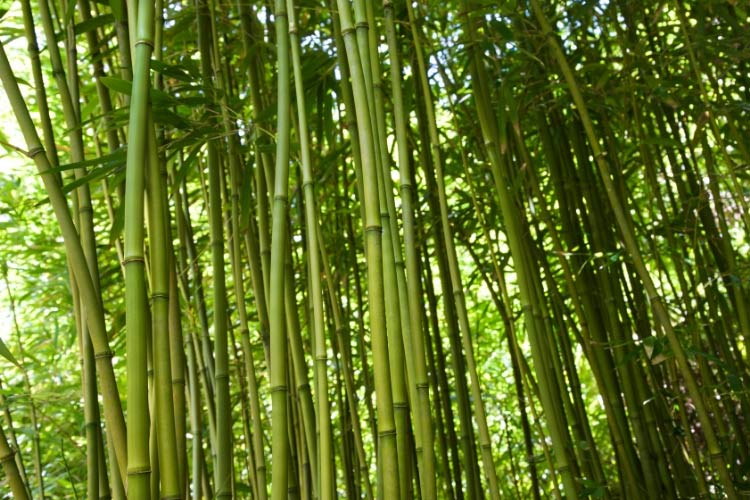
Not just one bamboo, but many bamboos
Generally, people think of bamboo as if there were only one variety. However, bamboos are highly diverse, ranging from the small Arundinaria pumila, barely 20 cm tall, to the monstrous Phyllostachys edulis, which reaches over 20 m. Bamboos comprise several hundred species and varieties. To clarify, horticulturists have grouped them into two subfamilies: the running types, which spread and colonise if not contained, and the clumping or cespitose types, which thicken from the base and grow more modestly.
In the running family, we find the star of them all, Phyllostachys, followed by Semiarundinaria, Pleioblastus, Sasa, Chimonobambusa, Shibatea...
In the clumping (non-running) family, the most famous is Fargesia, followed by Yushania, Chusquea, Thamnocalamus, Indocalamus...
How to choose?
It’s child’s play, and the determining question boils down to are you ready to arm yourself with a spade to dig a trench 50 cm deep?
If the answer is yes, digging a trench is the necessary chore that allows you to install a rhizome barrier and thus stop the growing expansion of running bamboos. This "barrier" is simply a sufficiently thick PVC film to stop underground rhizomes and contain them. How to install this famous BAR (rhizome barrier)? It’s simple: dig a trench all around your bamboo, in the desired shape and length. Place your BAR slanted outward so that the rhizomes are guided and slide upwards. Leave it protruding by 10 cm, then backfill while compacting.
This is an essential chore if you wish to create a hedge of Phyllostachys or if you want to plant large bamboos in isolation or in a flowerbed. This way, you will access a great diversity of bamboos.
My favourites: Phyllostachys aureosulcata 'Aureocaulis' for its fluorescent yellow culms, Semiarundinaria fastuosa 'Viridis' for its spectacular and exotic appearance, and Sasa tessellata for its exotic foliage that reminds me of Asia.
If the answer is no, one word of advice: plant clumping bamboos! In other words, non-running bamboos that are unlikely to wander into your neighbour's garden and turn yours into a wild forest. Fargesias, which are increasingly available in the market, are the best candidates! They are perfect for pot cultivation, especially all varieties of Fargesia murielae and are interesting in small gardens where space is limited. However, they do have some drawbacks: they are more expensive, grow much slower (count at least 5 years to obtain a well-furnished plant), are smaller (measuring between 1.5 and 3 m), and do not offer the same diversity of shape and colour as running species.
My favourites: Fargesia murielae 'Jumbo' for its dense and compact habit, Fargesia robusta for its impressive size, and Fargesia nitida Great Wall for the unique colour of its culms.
In summary, if you are a fan of cool and relaxing gardening and digging a trench seems like an insurmountable chore, opt for non-running bamboos. For others, don’t hesitate for a second to plant and mix running and non-running bamboos. Finally, know that there are forums dedicated to bamboos where experts and enthusiasts share valuable advice on "Boo": http://lesbambous.fr/forum/

Comments