





























The common hornbeam, Carpinus betulus by its sweet Latin name, is a tree that is said to be very widespread but which is, in my opinion, not planted enough. I have scrutinised the hedges and gardens in my neighbourhood: no hornbeam or hornbeam hedges to be found. So yes, I am indignant because this tree offers numerous qualities!
To begin with, let’s have a quick introduction: the common hornbeam belongs, like birch, alder, and hazel, to the family Betulaceae. It is recognised by its pale grey bark that cracks with age. It bears elliptical, green, serrated leaves with prominent veins. When planted in a hedge, it is commonly referred to as "hornbeam hedge". It is a tree quite similar to beech… but you can easily differentiate it by remembering this little phrase: "the charm of Adam is to be naked" or the hornbeam has teeth and the beech has hairs, referring to their leaves... I am sure you will remember this 😉
Native to Europe and Asia Minor, it is indigenous and considered, in France, as commonplace. Is that why we make the mistake of not paying attention to it?
To remedy this, here are 5 good reasons to invite it to your garden.
Why planting hornbeam in the garden?
1) Hornbeam is a good neighbour and requires little
Hornbeam knows how to live in society, as its requirements are low. In the forest, it grows effortlessly in the shade of large oaks. In the garden, it’s the same: it is a good neighbour that asks for nothing more than a deep, rather cool, and not too acidic soil. It does not require much light and thrives perfectly well in shade or partial shade without being allergic to the sun, provided it is not too scorching.
2) Hornbeam is charming, all the time
Not quite deciduous, not entirely evergreen, hornbeam is marcescent and that is its poetry! Indeed, in autumn, its leaves take on a lovely amber colour, eventually turning to a tobacco hue, but they do not fall; they remain attached until the new ones appear.
Some find this sad in winter. For my part, I equally enjoy its romantic slumber, like Sleeping Beauty, as much as its spring awakening. And it is always with great pleasure that I observe, in spring, the budding of its buds, which give rise to lovely pale green leaves, pleated like origami.
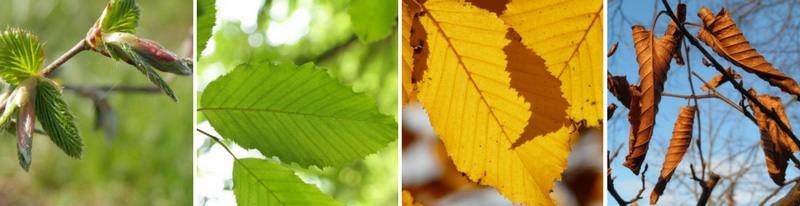 The 4 seasons of Hornbeam
3) Hornbeam can do it all
Yes, hornbeam can do it all! Planted in isolation and allowed to express itself fully, it easily reaches 15 metres and becomes a tree with an upright habit if you choose the fastigiate variety (Carpinus betulus fastigiata). In terms of colour, 'Orange Retz' offers, in autumn, a flamboyant foliage that brightens up the garden.
But it can also form monospecific hedges or "hornbeam hedges" of unparalleled chic. And you will decide the height and thickness. In a low hedge, it organises space or highlights without obscuring. Taller, it serves as a screen, windbreak, or sunshade. It is ideal for creating traditional vegetative rooms but fits with all styles of gardens, from the most modern to the classic. It provides a neutral and uniform backdrop that showcases perennials and grasses, whether your garden is inspired by naturalism, very English, or even Japanese.
For eco-conscious gardeners, of which I am one... it is a must for bocage hedges, free and natural. It cohabits with oak, chestnut, and field maple while welcoming beneficial insects, which are so useful in the garden.
Finally, it is said to be excellent firewood... but who, unless it composes a wooded area intended for this use, would be foolish enough to cut it down for heating?
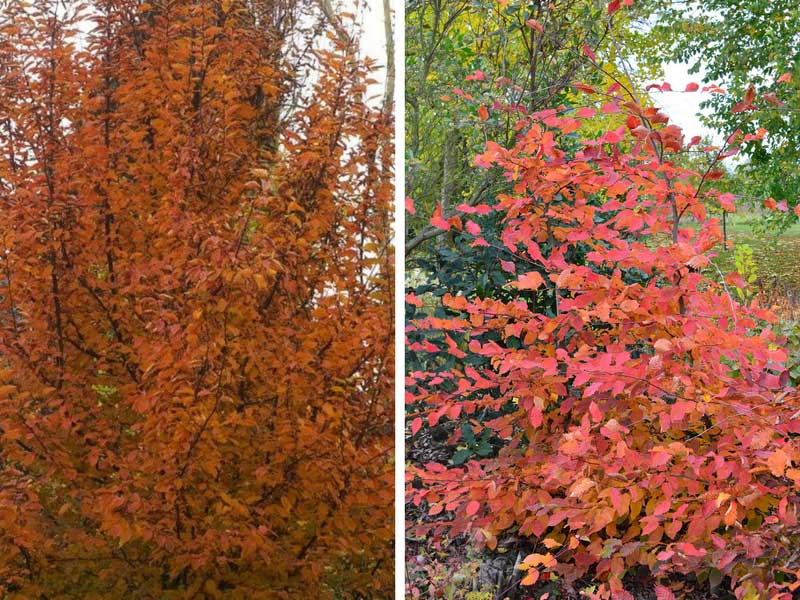 Carpinus betulus 'Orange Retz' and 'Rockhampton Red': two varieties with stunning autumn colours!
4) Hornbeam tolerates pruning well, it is obedient and malleable
When planted closely in a hedge, hornbeam does not grow too fast or too slowly. It is not a chronic scruff that forces you to spend the summer with shears in hand, but it forms, in two or three years, a screen that is quite satisfactory for preserving your privacy in the garden. Malleable, it tolerates pruning and can be shaped as you wish. You can thus create narrow and regular lines or let your imagination run wild and create gentle undulations, very much in vogue at the moment, create passages or even charming oculi. And if you enjoy ambitious projects, why not build a small maze in the style of a "French garden" (like at Villandry) or a charming vegetative tunnel. It can also be trained as a curtain or in large topiary shapes.
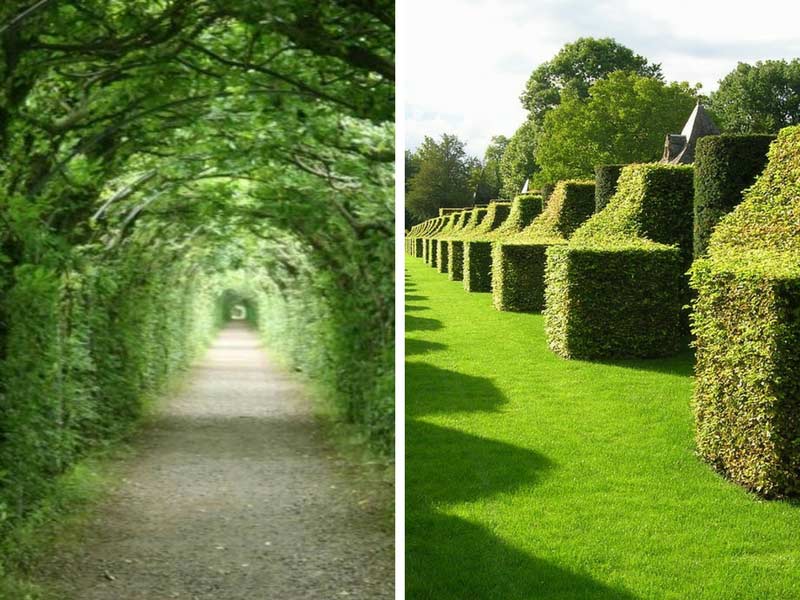 Hornbeam hedge at Haut-Maris (La Reid - Belgium) - Gardens of the Manoir d'Eyrignac
5) Hornbeam is durable and resistant to diseases
Hornbeam is a durable tree with a lifespan of around 100 to 150 years, and it is very resistant to diseases. It may, very occasionally, suffer from chlorosis or a mite, Aculops macrotrichus, but this is anecdotal compared to the fate of other trees, almost doomed before they are planted. By the way, where do you think the expression "to be as fit as a fiddle" comes from?
So, in case it wasn't obvious, I am a true hornbeam enthusiast! And you? Do you have any in your garden?
To learn everything about hornbeam, discover the complete file dedicated to it: "Hornbeam, hornbeam hedge: planting, pruning, and maintaining"

Comments