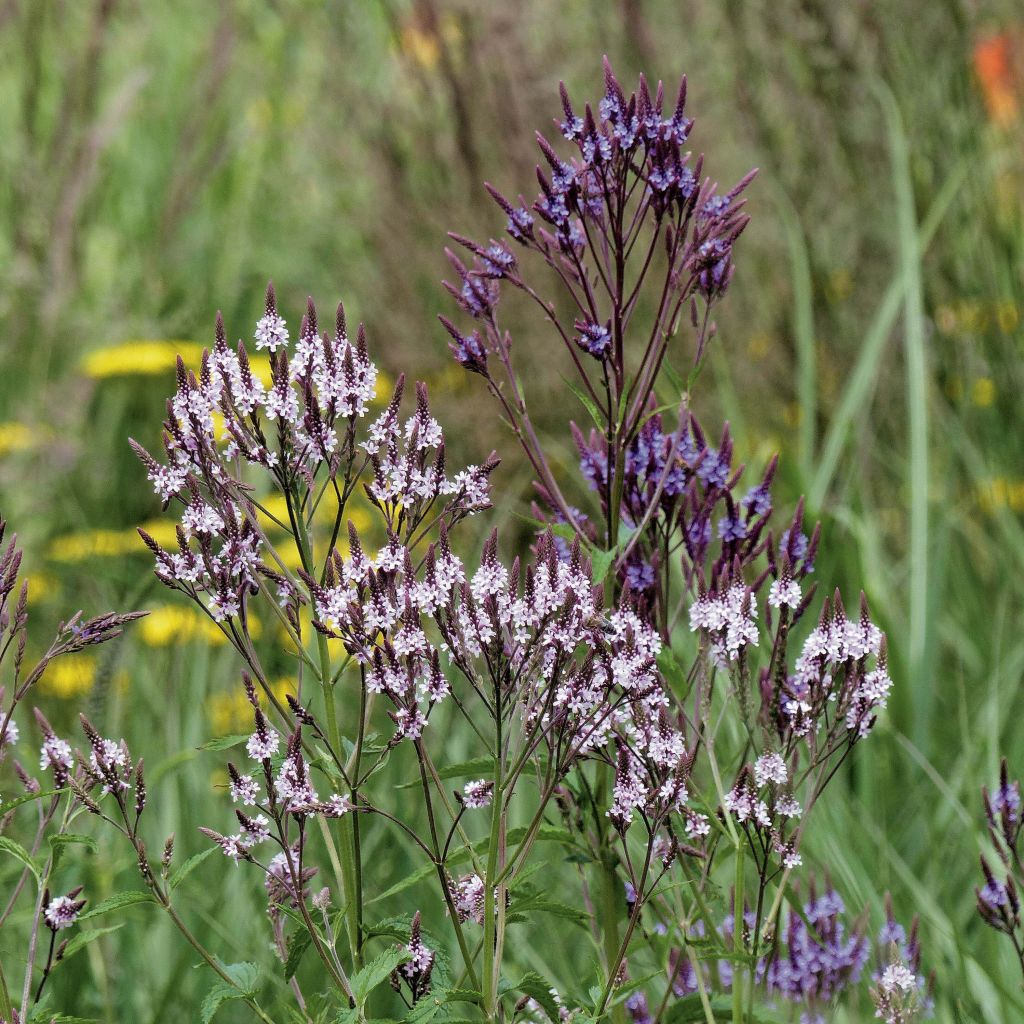
Duo of Verbena hastata
Duo of Verbena hastata
Verbena hastata Rosea, bleue.
Verveine des marais - verveine hastée
Be careful because the height of the plant indicated by Promesse de Fleurs is not accurate! The adult plant reaches a height of 2m (7ft), which can cause real aesthetic problems when designing flower beds based on the dimensions provided! This verbena self-seeds very easily, last year I cut them after flowering when they were in seed and threw them in the compost. They were covered with mown grass and various vegetation, and this year I discovered flowering plants in my compost pile. The stems are strong and resistant to wind, providing light and airy touches of colour to be reserved for the background of the flower beds.
Thomas, 21/09/2022
Back-to-school special offer!
Get €10 off for every €50 you spend! And get up to €40 off on a single order.
How does it work?
1. Shop your favourites
Add your favourite plants to your basket. For every €50 you spend (excluding delivery charges, store credit and the plastic-free option), you’ll receive a €10 voucher.
€50 spent = €10 voucher
€100 spent = €20 voucher
€150 spent = €30 voucher
€200 spent = €40 voucher
2. Place your order
Once your basket reaches one of the spending thresholds, place your order. You can even choose your delivery date!
3. Receive your voucher
As soon as your order has been shipped, you’ll receive an email containing your personal voucher code and its value.
4. Use it on your next order
Your voucher is valid for 90 days from the date you receive it. It can be used once only, on a new order worth at least the value of the voucher, excluding delivery charges.
Please note: Vouchers can be combined with other offers, but cannot be split or refunded.
Home or relay delivery (depending on size and destination)
Important: You may be charged customs duties by your country’s customs authorities upon delivery.
Schedule delivery date,
and select date in basket
This plant carries a 12 months recovery warranty
More information
We guarantee the quality of our plants for a full growing cycle, and will replace at our expense any plant that fails to recover under normal climatic and planting conditions.

Does this plant fit my garden?
Set up your Plantfit profile →
Description
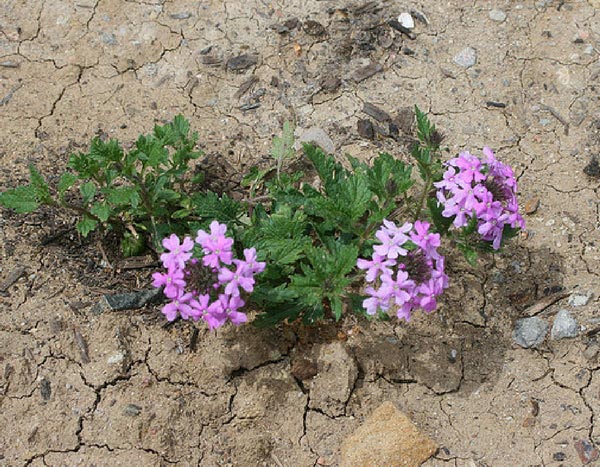
A Duo of Verbena hastata with soft pink and lavender blue flowerings. These are stately perennials full of poetry to be tried in a large planting bed or near water. Their flowers, made of fine branching candelabras formed by very straight spikes, covered with tiny flowers, renew themselves for at least three months, in summer, and their vegetation also adorns itself with very beautiful colours in autumn. They succeed everywhere, in any humid, damp or occasionally dry soil, in the sun, and self-seed easily in the garden.
This duo consists of:
1x Pink hastate Verbena: with spikes covered with tiny pink flowers with purple bracts.
1 x Blue hastate Verbena: the same, with flowers of a soft and bright lavender blue.
Originally from Canada and the United States, Verbena hastata, belongs to the family of Verbenaceae. In nature, it colonises damp soil, riverbanks, wet meadows, and flood plains. It is a perennial herbaceous plant, but of short life, sometimes considered as an annual or biennial. Depending on the moisture of the soil, it will reach 60 cm (24in) to 1m (3ft) in height, by 50 to 60 cm (20 to 24in) in width. It develops from a fibrous and rhizomatous stump, forming an erect, narrow tuft, composed of quadrangular stems sometimes ramified towards their ends. The leaves are opposite, 10 to 13 cm (4 to 5in) long, 2.5 cm (1in) wide, lanceolate, veined, coarsely dentate, bright green in color until summer. The vegetation of this Verbena takes on beautiful shades of pink, purple, yellow, and orange from late summer to the first frosts. From June to September, the stems branch out at their upper ends and give rise to thin and pointed inflorescences, 10 to 15 cm (4 to 6in) in length, composed of numerous buds opening into small five-petal flowers, 5 mm (1in) in diameter, from bottom to top. The flowering is followed by the formation of small, very hard, elongated fruits containing seeds that self-seed easily. Small colonies of plants are also produced from the rhizomes. Plants grown from seeds are more vigorous and more tolerant to drought.
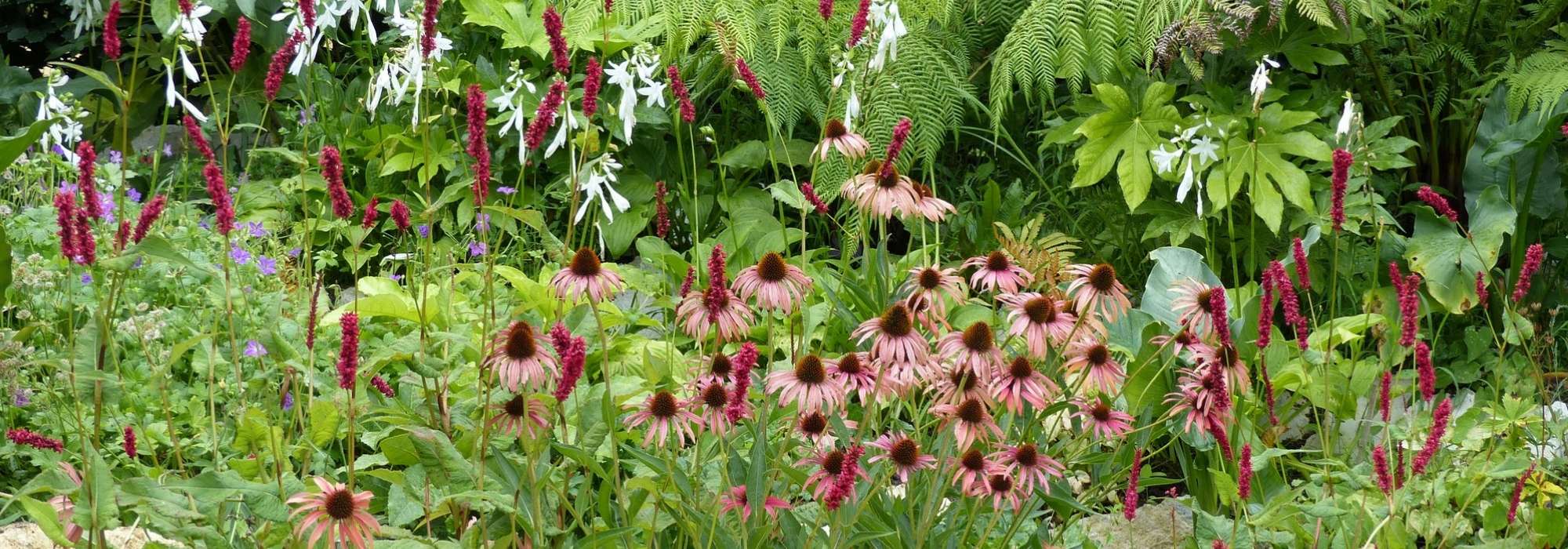
Still little used in our gardens, Verbena hastata is nevertheless easy to grow, valuable for bringing vertical lines to perennial beds, and delightful in cottage gardens. This plant is remarkable at the edge of a water, in damp soil, provided it is planted as a group. In a slightly wild scene, it emerges from the disheveled or orderly tufts of amaranths, aster laevis, and grasses (small miscanthus, eragrostis, stipes). It also performs quite well in drier soil, however, it will remain smaller. Its light, very architectural spikes, contrast with the roundness of roses, and its purple stems wonderfully accompany the grey or silver foliage of artemisias, the metallic blue of Elymus magellanicum, or rust of Carex buchananii. The Verbena hastata can also be used to prepare herbal teas.
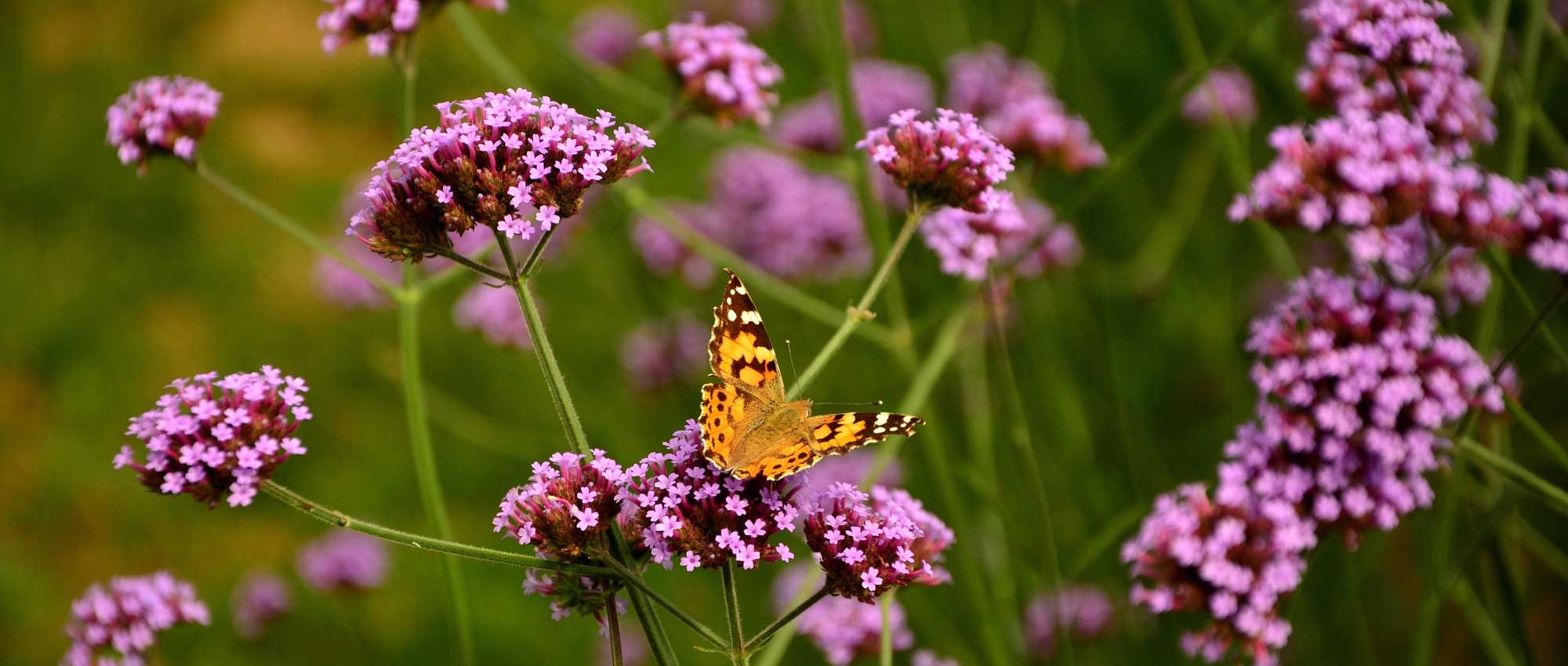
Flowering
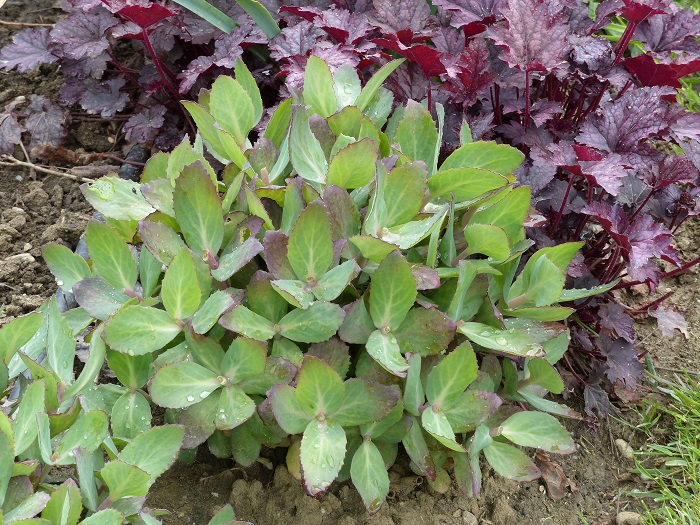
Foliage
Plant habit
Botanical data
Verbena
hastata
Rosea, bleue.
Verbenaceae
Verveine des marais - verveine hastée
North America
Planting and care
Plant Verbena hastata in ordinary soil, even occasionally flooded or dry, neutral, acid or chalky, preferably in the sun or in light shade in very hot regions. In shaded and humid conditions, it may be susceptible to powdery mildew. However, it prefers loamy and fertile soils, deep enough to accommodate its developing root system. Remove faded flowers as they appear to limit spontaneous sowing. It is a short-lived perennial, which can, under certain growing conditions, behave like an annual or biennial. Regular removal of faded flower spikes can prolong its lifespan. These plant self-seeds.
Planting period
Intended location
Care
Planting & care advice
-
-
-
-
-
-
-
-
-
, onOrder confirmed
Reply from on Promesse de fleurs
Recently viewed products
Haven't found what you were looking for?
Hardiness is the lowest winter temperature a plant can endure without suffering serious damage or even dying. However, hardiness is affected by location (a sheltered area, such as a patio), protection (winter cover) and soil type (hardiness is improved by well-drained soil).
In temperate climates, pruning of spring-flowering shrubs (forsythia, spireas, etc.) should be done just after flowering.
Pruning of summer-flowering shrubs (Indian Lilac, Perovskia, etc.) can be done in winter or spring.
In cold regions as well as with frost-sensitive plants, avoid pruning too early when severe frosts may still occur.
The harvesting period indicated on our website applies to countries and regions in USDA zone 8 (France, England, Ireland, the Netherlands).
In colder areas (Scandinavia, Poland, Austria...) fruit and vegetable harvests are likely to be delayed by 3-4 weeks.
In warmer areas (Italy, Spain, Greece, etc.), harvesting will probably take place earlier, depending on weather conditions.
The sowing periods indicated on our website apply to countries and regions within USDA Zone 8 (France, UK, Ireland, Netherlands).
In colder areas (Scandinavia, Poland, Austria...), delay any outdoor sowing by 3-4 weeks, or sow under glass.
In warmer climes (Italy, Spain, Greece, etc.), bring outdoor sowing forward by a few weeks.
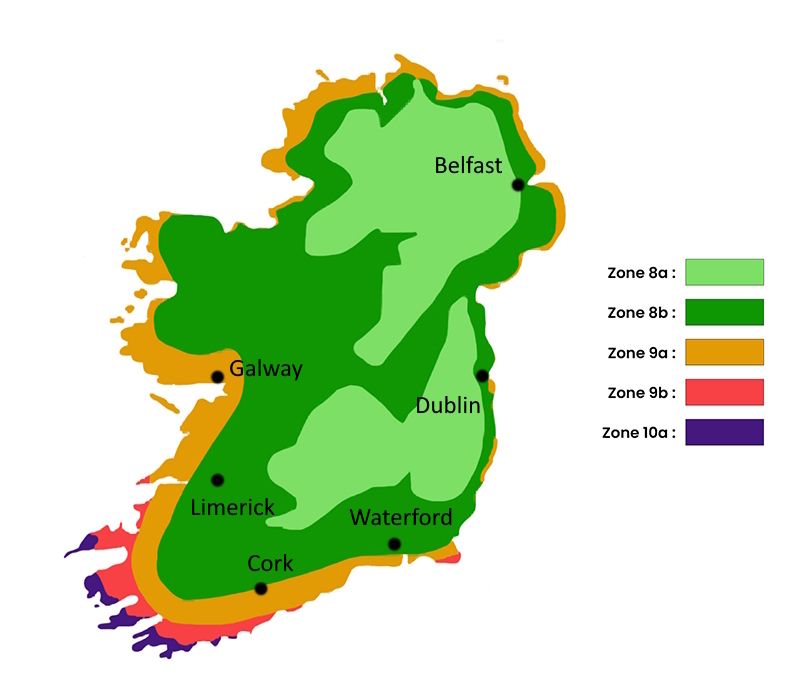
The planting period indicated on our website applies to regions in USDA Zone 9a (East Coast and Midlands: Dublin, Wexford, Waterford, Kilkenny, Portlaoise). It will vary depending on where you live:
- On the west coast and in the north-west (Galway, Limerick, Sligo, Donegal, Westport), delay planting by 1 to 2 weeks in spring and bring it forward by 1 to 2 weeks in autumn compared to the dates given, preferably choosing periods without strong winds.
- In the inland hills and plateaus (Wicklow Mountains, Macgillycuddy’s Reeks, Connemara, Killarney), it is best to plant in spring (April–May) or autumn (September–October), avoiding periods of waterlogged soil in winter and strong winds, which pose the main risk to newly planted trees in these areas.
The flowering period indicated on our website applies to regions in USDA Zone 9a, such as the East Coast and Midlands, including Dublin, Wexford, Waterford, Kilkenny and Portlaoise.
This will vary depending on where you live:
- On the west coast and in the northwest (Galway, Limerick, Sligo, Donegal and Westport), it will be delayed by one to two weeks compared to the given dates, due to stronger Atlantic winds and less spring sunshine.
- In the inland hills and plateaus (the Wicklow Mountains, the Macgillycuddy's Reeks, Connemara and Killarney), flowering will be delayed by two to three weeks. Flowering mainly occurs between May and July, with the limiting factors being less frost and more of the excessive humidity, strong winds and lack of sunshine that are characteristic of these areas.
Shipping country and language
Your country of residence may be:
Your country of residence is:
For a better user experience on our website, you can select:
Your shipping country:
-
 Austria
-
 Belgium
-
 Bosnia & Herzegovina
-
 Bulgaria
-
 Croatia
-
 Cyprus
-
 Czechia
-
 Denmark
-
 Estonia
-
 Finland
-
 France
-
 Germany
-
 Greece
-
 Hungary
-
 Iceland
-
 Ireland
-
 Italy
Italy
-
 Latvia
-
 Liechtenstein
-
 Lithuania
-
 Luxembourg
-
 Malta
Malta
-
 Netherlands
-
 Poland
-
 Portugal
-
 Romania
-
 Serbia
-
 Slovakia
-
 Slovenia
-
 Spain
Spain
-
 Sweden
-
 Switzerland
Language:
-
French
-
 English
-
Spanish
-
Italian
-
German
-
Portuguese
-
Dutch
-
Finnish
My Account
Hello
My wish lists
My cart
Log in / Register
Existing customer?
This form is protected by reCAPTCHA - the Google Privacy Policy and Terms of Service apply.
New customer?
Create an account to track your orders, access our customer service and, if you wish, make the most of our upcoming offers.