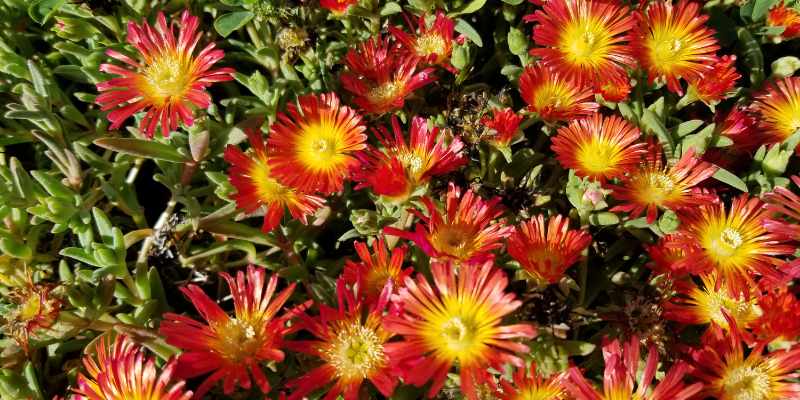
Delosperma Delosperma, or ice plants, are delightful succulent groundcover plants to place in full sun on rockeries or borders. Resilient and suited to warm climates, they flower profusely throughout summer. To obtain new plants, sowing, propagation by cuttings or division of clumps are recommended.
We explain in detail how to proceed in this tutorial.
When to multiply Delosperma?
That depends on the technique used and the species.
- For sowing, sow in March under cover, or outdoors in May, when temperatures allow in your area (ideal for Delosperma cooperi and Delosperma ecklonis).
- For propagation by cuttings, take advantage of pruning and tidying work in spring to root the cut branches. Summer is another window for Delosperma cooperi, Delosperma ecklonis, Delosperma basuticum and Delosperma nubigenum.
- For division of an established clump, March–April or September–early October is ideal. Works well with Delosperma nubigenum, Delosperma cooperi and Delosperma ecklonis.
Equipment
- a pruning shear kept well sharpened (for stem cuttings).
- a seed tray (for sowing).
- Pots in terracotta or plastic.
- some potting compost (sowing and cuttings type) or soil mixed half and half with coarse sand to obtain a well-draining substrate.
- a small hand trowel (for dividing clumps).
- labels (for sowing).
1- Multiplying Delosperma by sowing
Avoid sowing hybrids because there is always a risk of variability in colour.
- Prepare a very well-draining substrate (half potting compost, half perlite or sand).
- Sow seeds on the surface, without burying them (they need light to germinate).
- Water lightly using a spray bottle to maintain moisture, without excess.
- Germination normally takes about three weeks at 20–25°C.
- When seedlings have 2–3 leaves, prick them out into individual pots, still under cover.
- Harden off plants by putting them out for a few hours each day in semi-shade before planting them in their final position in May (after last frosts).
- Final planting: in May or June — when night temperatures exceed 10°C — plant in full sun, in a trough, a pot, or in the ground.
2- Propagation by stem cuttings of Delosperma
As noted above, stem cuttings offer a very good success rate with species that have fleshy, thick stems. They root very easily:
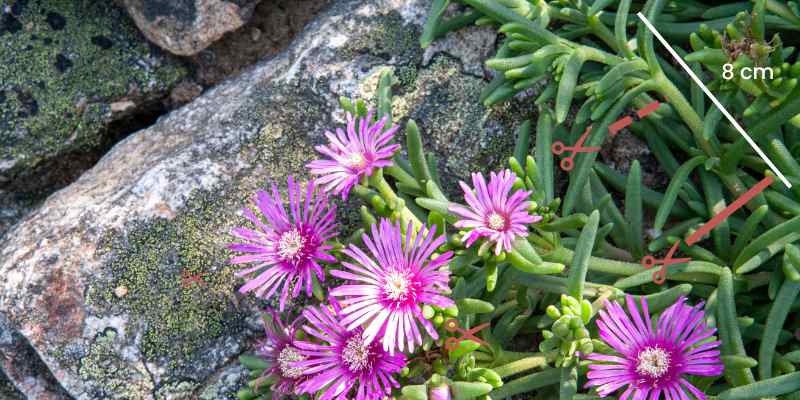
- Take stem cuttings about 8 cm long, cutting 3 cm just above a node (this is where roots will form), and at the level of the upper node. Slightly notch the upper node to increase rooting. Prefer stems with adventitious roots if possible.
- Leave to dry for 24 hours before planting, in a shaded place.
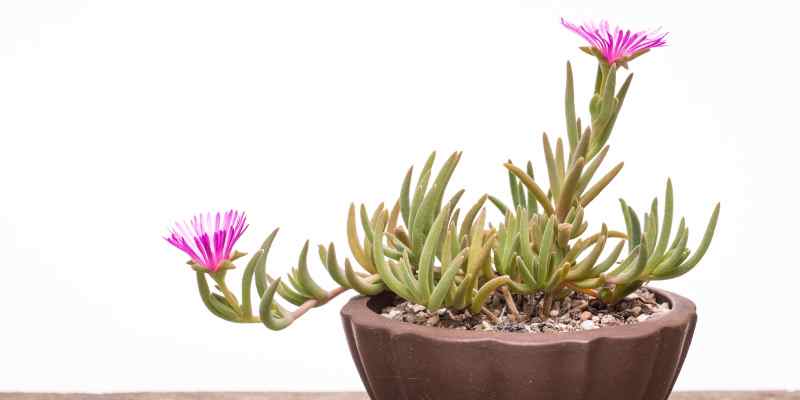
- Insert the cutting, laid flat in a pot or planter, down to the second node in a well-draining substrate (compost + sand). The first leaves should touch the soil.
- Insert the cutting into the substrate, burying 1–2 nodes below the surface.
- Firm gently with a finger to stabilise the cutting.
- Water sparingly, with a spray bottle.
- Keep at 20°C in bright, indirect light. Then overwinter frost-free under a cold frame.
- Plant out in the ground the following spring when soil is well warmed and all risk of frost is gone, or leave in their pot if that is their intended use.
3- Division of Delosperma clumps
Last option, less common, but ideal for cespitose species such as Delosperma nubigenum or Delosperma cooperi, which can also respond well to this method:
- Separate outer offshoots with roots by hand or using a disinfected knife.
- Plant each division into a well-draining substrate.
- Water lightly after dividing to encourage establishment.
Keys to success
- Always use a well-draining substrate (mix of potting compost + sand/perlite).
- Avoid excess water after propagation, whatever the technique used, to prevent rotting.
- Avoid sowing in autumn: seeds need warmth to germinate.



































Comments