
Video transcript: Begonia grandis Evansiana
Remarkable hardy groundcover begonia
Contents
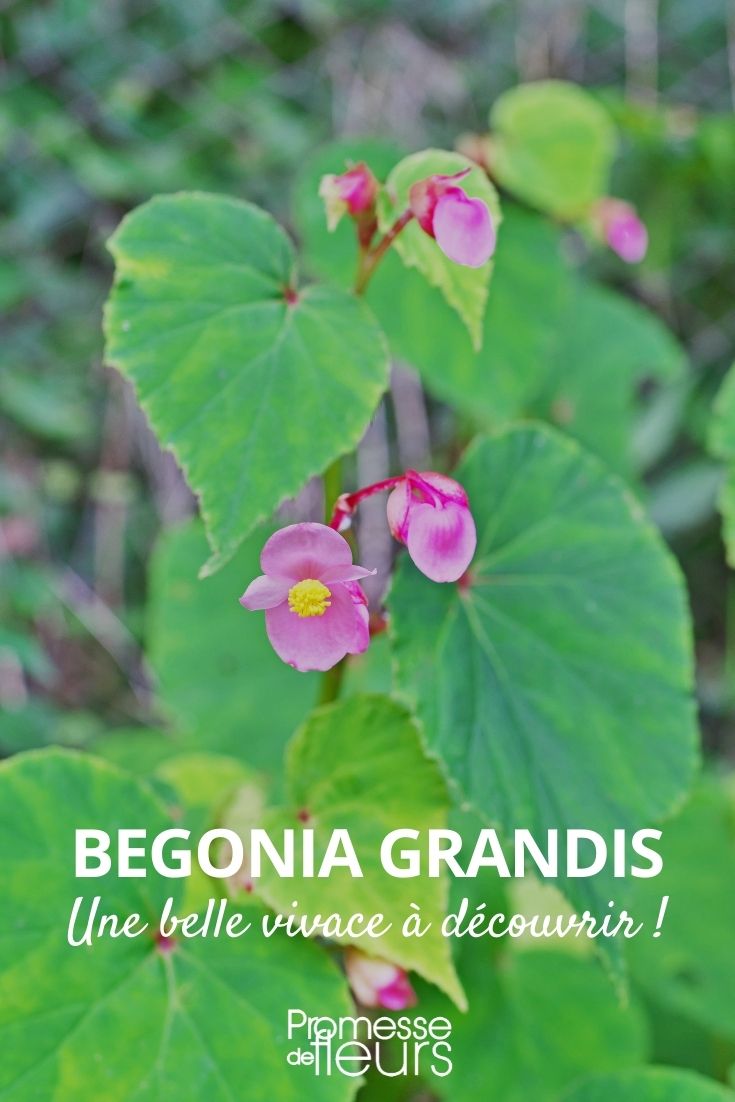
Begonia grandis ssp. Evansiana or Madame Evans’s Begonia is a hardy groundcover begonia, native to humid forests of China. This perennial requires cool to moist soil, neutral to acidic, and a part-shade position, even shade in southern regions. This perennial breaks dormancy late in the season, but also flowers late: July to October. Its main assets are its light-green foliage, with a pinkish-purple underside, and its tendency to grow and spread rapidly.

Presentation of Begonia grandis Evansiana
Read also
How to recognise a perennial begonia?Begonia grandis: a bit of botany
Begonia grandis ssp. Evansiana is a botanical begonia of the family Begoniaceae, native to humid forests of China.
Madame Evans’ Begonia is a bulbous groundcover perennial, fast-growing and reaching 80 cm in height. Its turgid stems remain erect thanks to internal water pressure.
Flowering occurs from July to October in clusters of pink flowers (a white-flowered form also exists: Begonia grandis ssp. Evansiana var. alba) : a time when few other flowers remain in the garden.
Foliage is a beautiful pale green, very fresh. But underside of leaf is pink, veined with red, adding a colourful touch to partially shaded or shaded borders.
Plant disappears completely in winter, then resumes growth late in spring (May).
Michael’s good idea : grow Begonia grandis in a raised position to make the most of its beautiful foliage colours.
How to grow Begonia grandis?
This perennial requires fresh to moist soil year-round. Soil should also be fertile and humus-bearing, rather neutral to acidic, but above all not calcareous.
Begonias are shade plants (in the south of France) or part-shade (elsewhere in France and in Belgium). They can be planted in early spring (March–April) before leaf development, or in autumn (October).
Begonia grandis is a hardy groundcover perennial (‑15 °C) that spreads rapidly. Moreover, to multiply, Begonia grandis adopts a particular technique. After flowering, small bulblets, actually mini-tubercles, develop in leaf axils. These fall and thus give rise to another plant. You can therefore obtain self-sown seedlings of this type of Begonia at the original planting spot, but… sometimes also a few metres away. A great opportunity to give some to friends and neighbours!
Michael’s tips: although perfectly hardy, this Begonia appreciates a good layer of leaf litter in winter to protect its tubercles. Moreover, plant emerges late in spring, only in May. To avoid accidentally striking it with a spade: consider placing a stake or anything else to mark its position!
- Subscribe!
- Contents
This form is protected by reCAPTCHA - the Google Privacy Policy and Terms of Service apply.

































Comments