





























My maple isn't turning red, why?
Our explanations of this phenomenon and our tips to help it take on a scarlet hue.
Contents
The maples delight us with their eye-catching foliage, palmately lobed, which often takes on splendid autumn colours. This is, in particular, the case for red maples (Acer rubrum) and Japanese maples (Acer palmatum). Alongside other trees and shrubs with attractive autumn colour, such as hornbeams, privets or parrotias, they truly enchant the garden late in the year, lighting it up with their blazing colours. Let us explore together the mysteries behind maple leaf colouration: why do their leaves redden in autumn? Why do some maples not colour? And how can we help them achieve a scarlet hue? Here we answer all your questions about this natural phenomenon!

Why do leaves change colour in autumn?
Leaves are usually green, as they contain chlorophyll: this pigment enables the plant to capture light energy and to synthesise organic molecules from water and CO2. The green colour is reflected by the leaves, which is why we see them in that colour. The other pigments present in the leaf are masked by chlorophyll. In autumn, the shortening of day length and of temperatures signals to the trees that winter is approaching. They then seek to go into dormancy by blocking the sap supply to the leaves. The chlorophyll pigments are no longer renewed and thus disappear, while the other pigments present in the leaves, such as carotin and xanthophylls, which are responsible for orange and yellow colours, become visible. In autumn, the leaves also synthesise new pigments, the anthocyanins, which give the characteristic red hues of maple leaves in autumn.
To understand this natural phenomenon, discover our article: Why do leaves change colour and fall in autumn?
Read also
Create a beautiful autumn gardenPlusieurs érables prennent une teinte rouge à l’automne. Voici les plus courants avec des exemples de cultivars connus: - Acer rubrum (érable rouge) – coloration automnale rouge vif. Cultivars populaires : ‘Red Sunset’, ‘Autumn Blaze’, ‘October Glory’. - Acer x freemanii (érable Freeman) – hybride érable rouge x érable esquim, affichant souvent du rouge/orange en automne. Cultivar notable : ‘Sienna Glen’ (et d’autres). - Acer saccharum (érable à sucre) – peut afficher du rouge/orangé en automne, selon le climat et l’exposition. - Acer palmatum (érable du Japon) – de nombreux cultivars virent au rouge spectaculaire en automne (par exemple ‘Bloodgood’, d’autres variétés à feuillage rouge en automne). - Acer ginnala (érable de l’Amour) – petite à moyenne taille, belles teintes rouge/orangé en automne. Conseils pour obtenir le meilleur rouge: choisir des cultivars à feuillage rouge/intense, planter en plein soleil sur un sol bien drainé, et privilégier des nuits fraîches après les fortes journées estivales. Si vous le souhaitez, je peux proposer une version adaptée en anglais britannique pour publication WordPress.
There are many species and varieties of maples, and they do not all colour the same way. Among the most colourful, there is obviously the red maple, Acer rubrum, whose leaves take on a deep red hue in autumn. Its leaves are initially green tinged with red when they appear in spring, then they become green in summer, before taking on a splendid scarlet red in autumn. Acer ginnala also takes on very beautiful red-orange hues.
Similarly, Japanese maples are renowned for their leaves that blush red or orange, even yellow, depending on the varieties. Discover notably the Japanese maple ‘Osakazuki’, which becomes blood red, or ‘Emerald Lace’. These maples will bring a spectacular splash of colour to your garden in autumn!
Discover our advice sheet: “Japanese maples: the most beautiful autumn colours”
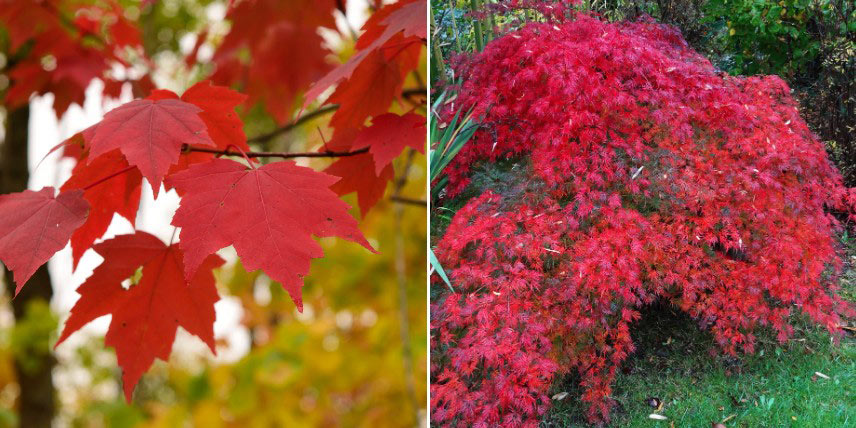
The autumn foliage of the red maple (Acer rubrum) and that of the Japanese maple ‘Emerald Lace’
Why isn't my maple turning red?
If your maple does not display the expected colouration, several factors may be responsible.
- The climatic conditions, in particular, have a major influence: if autumn temperatures are too mild, the maple may delay going into dormancy, preserving the chlorophyll present in its leaves, and those leaves will then stay green longer. L
- The soil also influences the colouration of the maple. The red maple (Acer rubrum) needs deep and cool, or even damp, soil that is acidic and clayey. Its scarlet red colour will then be particularly pronounced! For Japanese maples, colour will be more intense if the tree is planted in neutral to slightly acidic, well-drained soil.
- In addition, the overall health of the tree is essential. A maple stressed by drought, diseases, or nutrient deficiencies may struggle to synthesise the anthocyanins and to develop a nice red colour in autumn.
- Finally, ensure you have the right variety. If conditions are right, your maple is healthy and it does not display the right colouration, there may have been a mislabelling or confusion about the purchased variety.
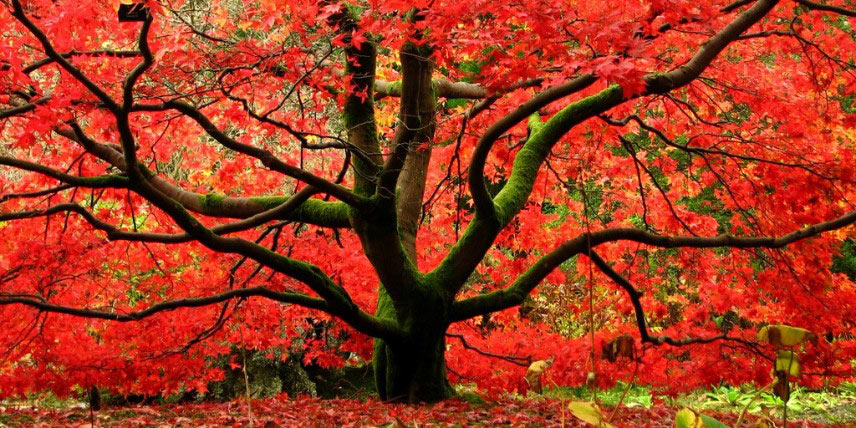
Acer palmatum ‘Osakazuki’
What can be done to help it develop a red tint?
To promote a beautiful red colour on your maple, here are a few tips:
- Make sure soil and light conditions are suitable. They should be mildly acidic or neutral and well-drained for Japanese maples, and cooler for red maples. Also ensure your maple receives adequate light. A maple exposed to full sun tends to develop a better autumn colour; for Japanese maples, favour a position in partial shade, as direct sun may scorch their leaves.
- Watering and drainage: Adequate watering is crucial, especially during dry spells. However, ensure the soil provides good drainage to prevent root rot.
- Feed your maple with a balanced fertiliser in early spring, or well-decomposed compost, to be incorporated into the soil by a light raking. Avoid excessive nitrogen which can promote leaf growth at the expense of colour.
- Prune your maple judiciously to remove diseased or dead branches. Good air circulation and a healthy structure promote the tree’s overall health.
- Be vigilant for signs of disease or pests. A healthy maple is more likely to display a beautiful autumn colour.
- Subscribe!
- Contents
Comments