





























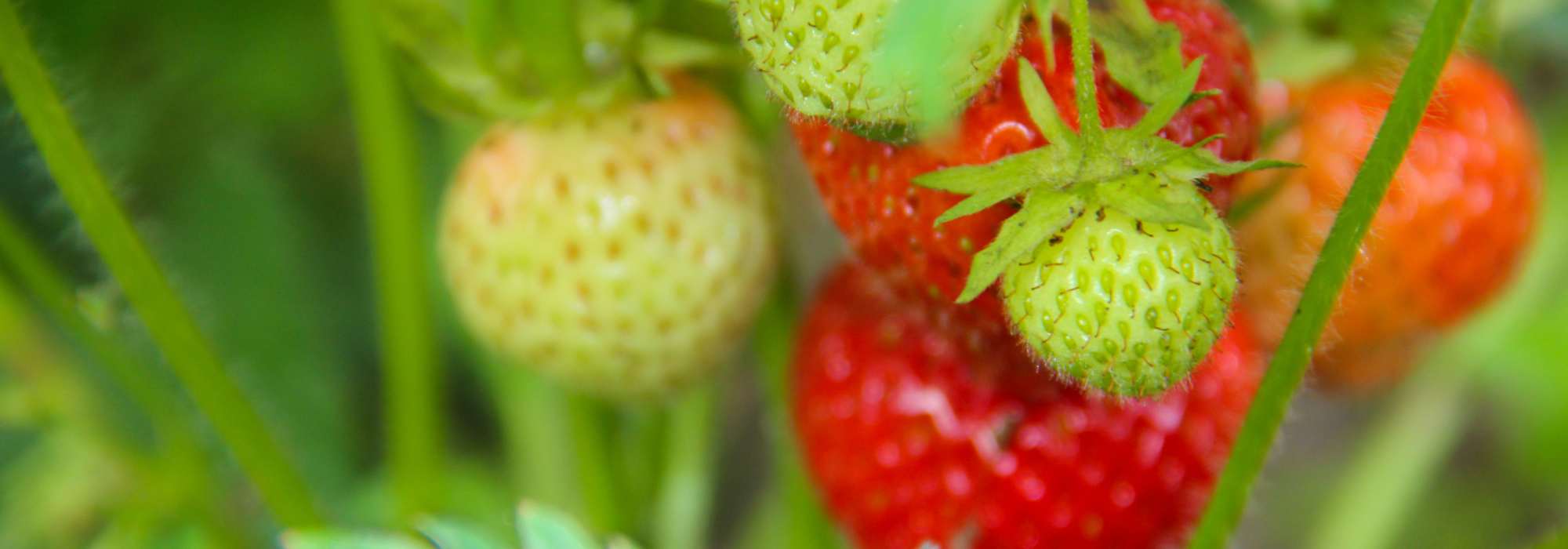
Why aren't my strawberry plants bearing fruit?
Understand why your strawberry plants aren’t producing fruit and discover solutions to remedy the problem.
Contents
Fairly easy to grow, strawberry plants (Fragaria x ananassa) find a place anywhere: in a vegetable patch close to the veg, as a decorative groundcover, in a corner of the garden, at the base of shrubs, or even on a balcony or terrace in a large trough or planter. And beyond the fact that this edible perennial invites indulgence, it forms a small clump, with rootstocks and dentate leaves of a fairly dark green. In April–May, small flowers, usually white but sometimes pink, appear. And that’s where the magic happens: the lower part (the receptacle) of the flowers swells with juice and becomes the strawberry itself, speckled with tiny seeds, the achenes, which are the true fruits of the plant.
Strawberry plants offer a multitude of species and varieties: there are small-fruited strawberry plants, the four-season strawberries, which bear fruit continuously from May to October. Larger-fruited strawberry plants are either non-remontant, fruiting only once in spring, or remontant (repeat-fruiting), with fruits ripening continuously from spring to autumn.
As for the pleasure of picking strawberries (and eating them on site!), it is unmatched—provided you have good yields. Indeed, strawberry plants can sometimes be temperamental.
Discover the various reasons why strawberry plants fail to fruit, and, most importantly, the solutions to address the shortfall of strawberries.
Before understanding why your strawberry plants are not fruiting, I invite you to read the following article: Strawberry plant: how to plant, grow and maintain.

Because your strawberry plants are too old.
Overall, A strawberry plant bears fruit for three to four years. Then, it declines, degenerates and yields fruits significantly smaller, or even none at all. That is why it is essential to renew strawberry plants after three to four years, in a new location, to achieve handsome harvests of large fruits. Moreover, propagation is really very simple. The best solution is to renew strawberry beds by a third or a quarter each year. Thus you will always have strawberries of good size and in abundance!
The simplest technique is obviously to buy new strawberry plants. Take the opportunity to try new varieties and vary flavours in your dessert plates. But one can simply multiply strawberry plants by layering stolons. These stolons, that is, the long flexible shoots that run along the ground, appear in autumn. They tend to root themselves. As soon as the roots are visible at the base of the stolon’s rosette, simply separate this rosette from the mother plant by cutting the stolon with a clean and disinfected blade. The rosettes can be planted immediately in the ground or in a pot.
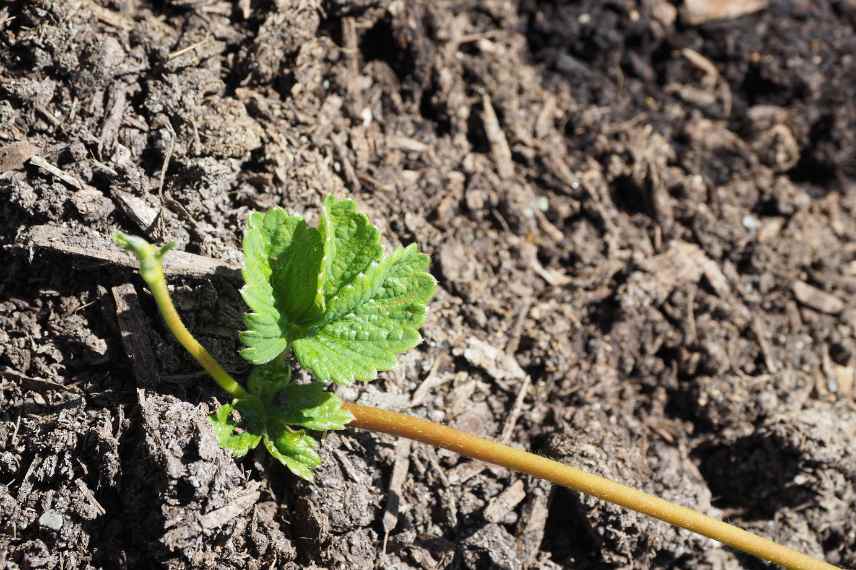
Propagation by stolons allows you to renew strawberry plants
For all you need to know : How can you obtain or propagate strawberry plants for free?
Read also
How to protect strawberry harvests?Because your strawberry young plants did not benefit from optimal planting conditions.
Strawberry plants are hardy down to -25°C. In other words, they will grow almost anywhere, including in regions with the harshest montane climates. So cold will not stop a strawberry plant from bearing fruit. That said, strawberries prefer full sun, even though they can thrive in partial shade.
However, strawberry plants can be a little more particular about soil. Indeed, they favour good garden soils, deep, humus-bearing and friable, neutral or slightly acidic. They especially dread poorly drained soils that retain water. Roots that stand in water can thus explain poor fruiting or even a total absence of fruit. Consequently, If your soil is heavy and waterlogged, it is best to plant your strawberry plants on a raised bed 10 to 20 cm high. Otherwise, before planting, it is advisable to work the soil deeply a few days beforehand, remove stones and weeds and add a little well-decomposed compost or manure.
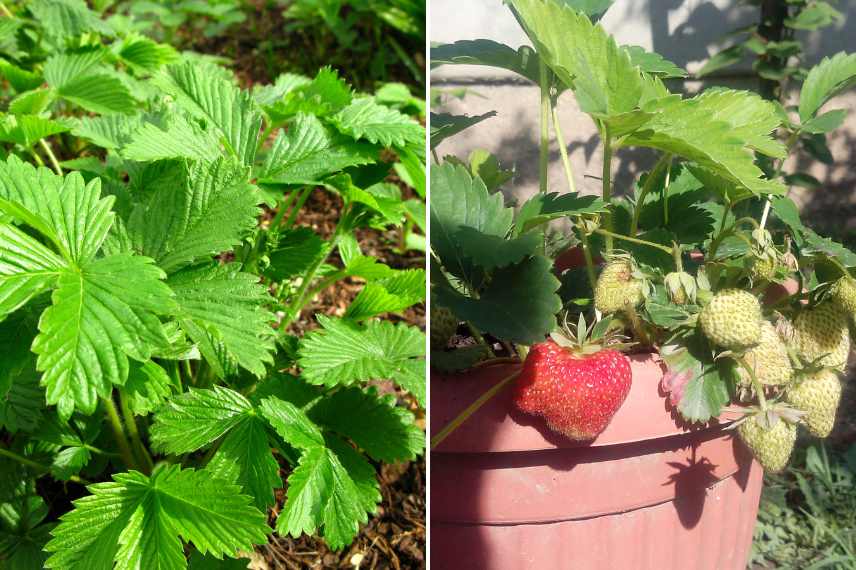
Poor plantings in the ground or in pots can affect strawberry fruiting
Strawberry plants should ideally be planted 25 cm apart in rows 60 cm apart.
If your strawberry plants are grown in pots, in excellent-quality potting compost. It is also possible to plant them in a mixture comprising good garden soil, potting compost, sand and well-rotted compost. It is also essential to ensure good drainage. The container must be perforated and filled with a good layer of gravel or clay pebbles.
Finally, a poorly planted strawberry plant can lead to poor fruiting. Indeed, the collar of the strawberry plants should be slightly flush with the soil surface.
As for the best time to plant strawberries, it is the end of summer or the beginning of autumn—August or September. It is indeed at this time that the stolons develop and root naturally. Moreover, they will have plenty of time to settle in to provide a good harvest in spring. By contrast, if your strawberries were planted in spring, they will only produce small fruits and in small quantities.
For further reading: Growing strawberries on a balcony
Because pollination did not take place correctly.
Without going into details of flower structure and pseudocarp, pollination of strawberry plants is quite peculiar. That said, the strawberry plant can be pollinated in three different ways: either by gravity, i.e., self-pollination, by wind, or by pollinating insects. It should be noted from the outset that the first two pollination techniques do not yield the best results. Strawberries are often smaller and misshapen, less coloured, and above all produced in smaller quantities. On the other hand, pollination by insects is a guarantee of higher-quality harvest. And strawberry flowers possess all the qualities needed to attract numerous pollinating insects. But not all are equal!
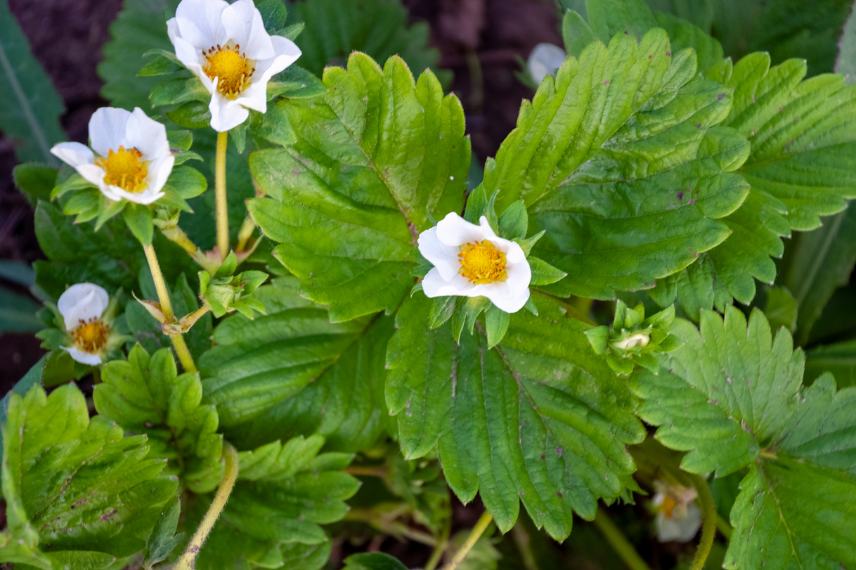
Pollination of strawberry plants by insects yields prettier fruit
Therefore, if your garden, balcony, or terrace is frequently visited by solitary bees or hoverflies, excellent pollinators, you will have lovely strawberries. However, if you have few insects, results won’t be optimal. So, to attract foraging insects, you absolutely need to introduce biodiversity into your garden by planting annuals, perennials or bushes with melliferous and nectariferous flowering, but also by providing shelters for these insects.
Further reading :
Because your strawberry plants are not being properly looked after.
Not overly demanding, strawberry plants require a few care steps. If you give them no special maintenance, fruiting will inevitably be compromised. Here are the minimal steps to obtain beautiful, deep red fruits bursting with sweetness:
- Strawberry plants that are always thirsty and prefer fresh soil require regular watering (one to two times a week), especially during flowering in spring and fruiting. Waterings should be increased in hot weather.
- To keep soil warm in winter and cool in summer, limit weed growth, avoid soil staining and fruit rot, mulching is recommended. The option of black mulch films or biodegradable sheets is possible, but the best remains straw, linseed pellets, buckwheat hulls or the RCW to install in March–April. In winter, it is always possible to install a winter protection fleece or a tunnel.
- Dry or damaged leaves should be removed in autumn. Similarly, it is preferable to cut the runners to preserve the mother plant.
- A small addition of compost is essential in spring to promote fruiting. Also read: How to fertilise strawberry plants naturally?
Because your strawberry plants are affected by diseases or parasites.
In addition to this interview, your strawberry plants should be monitored closely to prevent pest invasions or the onset of diseases. The main enemies of strawberry plants are slugs and snails, which not only attack the young shoots but also the fully red, ripe strawberries. There are many ways to deter them, but wood ash and coffee grounds are certainly the most effective. Alternatively, slug barriers, copper self-adhesive tapes, or copper wire are also very effective, as is Ferramol, suitable for organic farming.
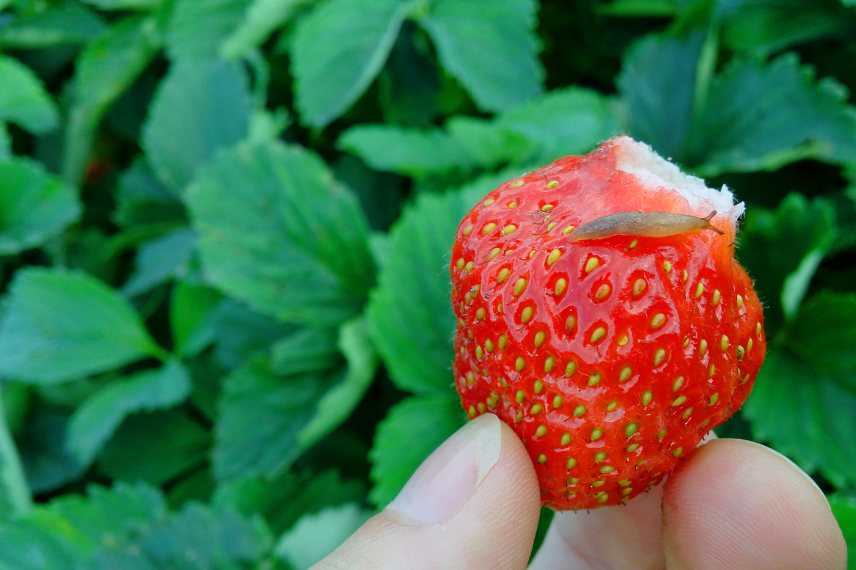
Slugs are formidable enemies of strawberries
Strawberry plants can also be susceptible to purple spot disease. It is then sometimes enough to remove the affected leaves. Botrytis, powdery mildew and anthracnose are fungal diseases, often linked to poor growing conditions. Your strawberry plants are probably planted too closely together, in soil far too wet. Sometimes simply moving the plants and replanting them in drier soil, at least 25 cm apart, can help.
To learn more:
- Subscribe!
- Contents
Comments