





























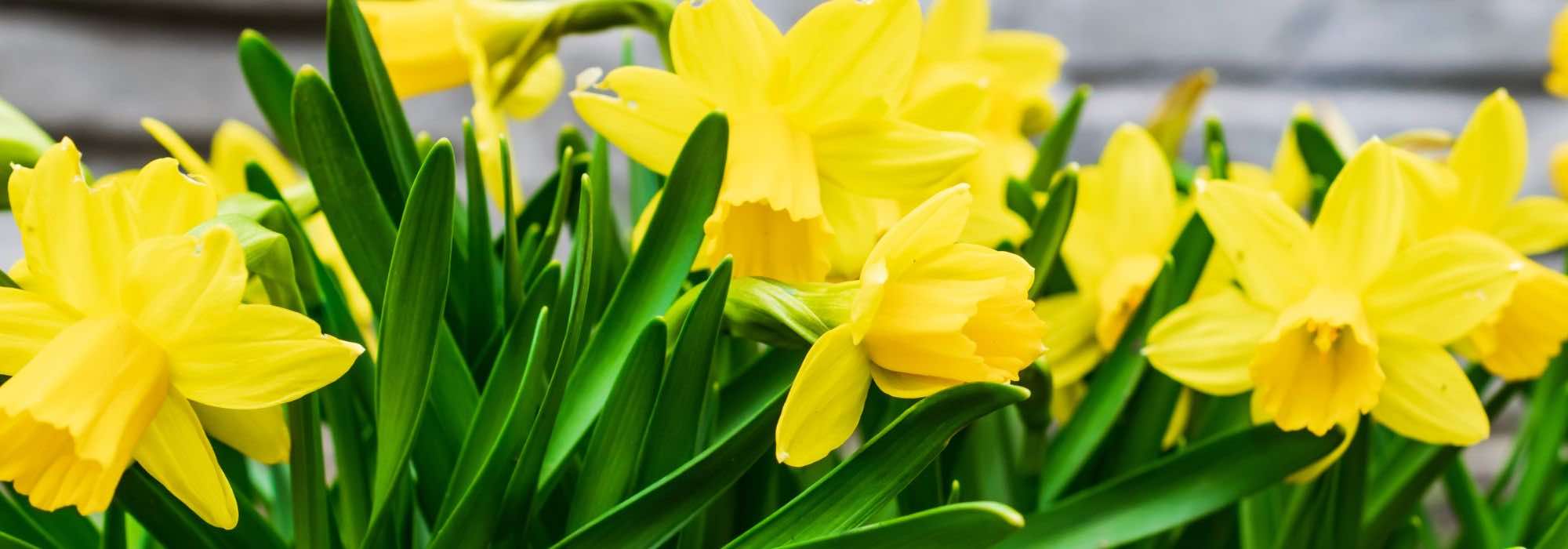
Why aren't my daffodils flowering?
The reasons why daffodils fail to flower.
Contents
Renowned for their ease of cultivation, daffodils or jonquils punctuate gardens and balconies with their yellow, orange or white flowers from spring, sometimes even in winter. Some also charm the gardener with their fragrance. These bulbous plants are vigorous perennials that re-emerge each year after winter. They offer a wide diversity of choices, with around one hundred species and thousands of varieties. Narcissi bloom in trumpet-shaped flowers atop a tuft of slender, elongated leaves. They grow readily in full sun or partial shade, in any soil type, even heavy and clay soils, with a few exceptions. If your narcissi fail to flower, there could be several reasons: bulbs no longer having sufficient nutrient reserves, planting or maintenance errors, unfavourable weather, small animals that have passed by… Discover why your narcissi are not flowering and the solutions available to you to get the most from them.
Common planting mistakes
Bulbs selection
Choosing Narcissus bulbs is very important because it is thanks to the nutritional reserves stored in the bulb that daffodils will be able to bloom. Thus, if you plant damaged, mouldy, or unhealthy bulbs, you are unlikely to see your narcissi flowering next spring. A healthy narcissus bulb looks firm, hard and not crumbly, with no white mould, and is not too small.
Solution: choose your bulbs carefully before planting.
When to plant?
Narcissus bulbs are planted in autumn, from September to November, or December. Planting in autumn gives them time to establish in the soil to perform at their best the following spring. The earlier the bulbs are planted in autumn, the earlier the flowering will be in spring.
Solution: plant bulbs during the ideal period: in autumn.
Where to plant?
Narcissi should be planted in sun or partial shade. A position that is too shaded may prevent flowering. These plants will establish in any well-drained soil or heavy clay soil, with the exception of Narcissus tazetta and Narcissus triandrus, and small-sized varieties, which prefer well-drained soils.
Solution: choose a sunny or shaded spot and respect the soil type that best suits the variety you are planting.
How to plant them?
The bulb is composed of a bud that forms a point and a flatter part from which the roots extend. The bulb should be planted with the point upwards. Dig a hole 10 to 15 cm deep, about three times the size of the bulb. Place the bulb in the correct orientation and cover with soil. Firm the soil to remove any air pockets and water. Maintain a spacing of 10 cm between each bulb so they can develop well.
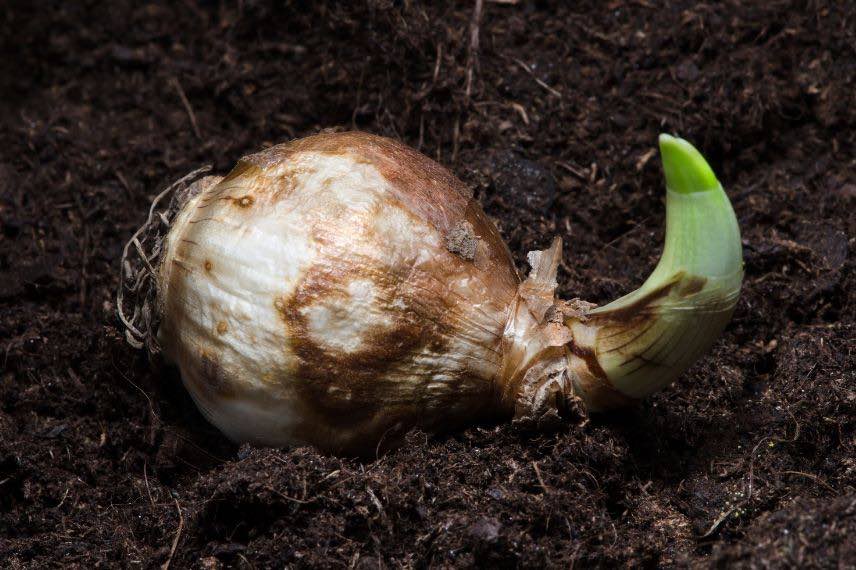
Plant the swollen base downward and the point upward
We need to translate French to British English with the provided glossary, HTML preservation, WordPress shortcodes preserved, etc. The user provided text containing headings
La sélection des bulbes
etc. Should translate. We must apply the glossary: “bourgeon”:”bud”, “cep”:”vine-plant”, “composé”:”compound”, “fermé”:”closed”, “fleur”:”flower”, “floraison”:”flowering”, “nu”:”naked”, “pendant”:”pendulous”, “plant”:”young plant”, “port”:”habit”, “racine”:”root”, “septé”:”septate”, “sol”:”soil”, “talle”:”tiller”, “variété”:”variety”, “taille”:”pruning”, “plante”:”plant”. Wait careful: “plante” as French is “plant” in glossary; but we must not translate botanical names; but here “bulbes” “narcisses” etc. “bulbe” is used; not in glossary. “bulbe” is not in glossary. The glossary includes “plant” meaning “plante” as a generic noun “plant” vs “bulbe”? It says use glossary terms for common names of products; but “bulbe” isn’t in glossary; “plante” is. But ensure to not translate botanical names; keep original for “Narcissus tazetta” etc.
We must also adjust “shortcodes” inside caption: There is a caption with inside. The instruction says do not add tags to product names; but here there is Plant base turned downward and tip up. We should translate the text inside but not the HTML tag or the code. They included a shortcode with an image inside. They previously used functions.validate_shortcode_tags to validate caption. They returned same “[caption id="..."]” So our translation should preserve the shortcodes exactly, including the caption markup, alt attribute of image: currently alt=”bulbe de printemps” Should translate to British English alt text: “daffodil bulb”? The alt attribute text must be translated as well (inside attributes) per “traitement des attributs: translate alt and title contents”. They require all fields translated to British English. We’ll translate alt to “spring bulb” or “bulb of spring”? The original alt is “bulbe de printemps” (spring bulb). So in English: “spring bulb”. The screenshot shows the image of a narcissus bulb. We’ll translate to “spring bulb” or “daffodil bulb”? The guideline says translate inside attributes; use British English. The image alt can be “daffodil bulb” which is common. The French is “bulbe de printemps” – not necessarily “daffodil” because Narcissus includes daffodils. But many Brits call “daffodil” common. The translation should maintain “daffodil” as common name? Hmm “Narcissus” includes Narcissus; common name “daffodil” or “narcissus”. The original says narcisse; alt could be “spring bulb”. Could be “spring bulb” more generic. They say translate all fields; choose natural British English. “Spring bulb” is likely fine.
Also the heading “La sélection des bulbes” -> “Bulbs selection” or “Selecting bulbs”? In English we would say “Selecting bulbs” or “Bulb selection”. The style in British: “Bulb selection” or “Selecting bulbs”. The original uses “La sélection des bulbes” which is a noun phrase; translation to “Selecting bulbs” or “Bulb selection”. The rest content should adapt to grammar.
We must ensure to use consistent grammar: The earlier assistant produced a translation with “Bulbs selection” which is odd. We should fix: “Bulb selection” would be more natural as a heading? The heading “Bulb selection” or “Selecting bulbs”. It’s a heading; both plausible. The rest sections: “Quand les planter ?” -> “When to plant?” Good.
“Les bulbes des narcisses se plantent en automne” becomes “Daffodil bulbs are planted in autumn” or “Narcissus bulbs are planted in autumn”? Use British English: “autumn” spelled; “September to November” as date range; keep.
We must apply: “The text can contain HTML and shortcodes; preserve HTML; translate text outside shortcodes; within shortcodes, keep.” We must translate “Narcissus tazetta” etc. The shortcodes: [caption id="attachment_236683" align="aligncenter" width="856"] … The content inside includes an with alt text; the HTML code includes the closing tag; The “[/caption]” closing tag must be preserved. Our earlier translation preserved the caption code. They want to ensure no missing. We’ll translate the text outside. The closing caption includes italic “Plant the swollen base downward and the point upward“. Should translate to “Plant the swollen base downward and the point upward” as italic; yes.
Important: The “Narcissus tazetta” and “Narcissus triandrus” are italicized in original with around them? The text shows “Narcissus tazetta et Narcissus triandrus” There is a spacing issue; We’ll translate within preserving italicization and the two species both with tags around the names. The instruction says do not translate botanical names. They are within tags; keep them as is. Good.
We must use British English vocabulary for “bulbs”, “autumn”, “soil”, “well-drained”, “clay soil” etc. The user must also avoid adding “the” articles unnecessarily; there is a instruction to remove unnecessary articles. We’ll adjust: In translation, avoid “the” where not needed. Eg “The bulb is composed of a bud” -> “The bulb is composed of a bud” vs maybe “A bulb is composed of a bud”? The French: “Le bulbe est composé d’un bourgeon …” Could be “The bulb comprises a bud that forms a point and a flatter part from which the roots extend.” Or we can keep “The bulb consists of a bud that forms the tip and a flatter part from which the roots emerge.” It’s okay.
We also must ensure terms from glossary used: “plant” is a glossary term; but do we have to replace “plante” with “plant”? The text includes many uses like “these plants” “plants”? The instruction says: “The glossary terms should be used for common names of products; The botanicals, but “plante” the general French word for “plant” should be translated to “plant” if it’s the general term; The instruction says to use “plant” (from glossary) for the word “plante”. So we should replace occurrences of “plante”/”plantes” with “plant”/”plants” maybe? But ensure not to use the glossary term inside a longer word. The content has “Ces plantes s’installent dans tout type de sol…” That would be “These plants establish” or “These plants thrive in…”. The term “plant” is allowed to be “plant” or “plants” depending on number. The French “plantes” plural would become “plants”. So we should translate as “These plants will establish in…” But the phrase “Ces plantes s’installent dans tout type de sol drainé ou argileux et lourd” -> “These plants establish in any well-drained soil or heavy clay soil” Good.
“plante” used in “Le bulbe est composé…” doesn’t appear; there is “bulbe”, “fleur”.
The excerpt includes “” the caption bottom includes “Plantez la base renflée vers le bas et la pointe vers le haut“. This is a directive: “Plant the swollen base downward and the tip upward.” We should translate but keep as present.
We need to ensure to include punctuation and readability.
Let’s craft final translation:
Title: “Bulb selection” or more natural “Bulb selection” not “Bulbs selection”. The heading should be “Bulb selection” or “Selecting bulbs”. It may be “Selecting Narcissus bulbs” but keep general. The original is “La sélection des bulbes” so “Selecting bulbs” is most direct. We’ll choose “Bulb selection” or “Selecting bulbs”. Brits often use “Choosing Narcissus bulbs” – base.
To be safe: “Bulb selection” might be used on WordPress as H3. Another possibility: “Selecting bulbs” is more UI friendly. We’ll pick “Bulb selection” or “Selecting bulbs”? The instructions say to translate content not to adapt too much; so “Bulb selection” is a direct translation. The first line: “Bulbs selection” from earlier translation is not idiomatic; we should fix to “Bulb selection”. So I’ll choose “Bulb selection” as H3.
Next paragraph: “Choosing Narcissus bulbs is very important because it is thanks to the nutritional reserves stored in the bulb that daffodils will be able to bloom.” We can refine: “Choosing Narcissus bulbs is important, as the nutrient reserves stored in the bulb enable the daffodils to bloom.” The British style might prefer “daffodils” as common name; “Narcissus” is the genus; both used; The text uses “narcisses” and “jonquilles” as synonyms; We’ll unify to “daffodils” or “narcissi” but the glossary does not include “daffodil” as a term; It’s not necessary to use the glossary since these are common names; The translation should preserve the intent; “narcisses” widely accepted as “daffodils” in English. We’ll use “daffodils” or “narcissi”? The heading uses Narcissus bulbs; The body uses “narcisses” plural. In English, “daffodils” is common; “narcissi” is more botanical. We should balance: Use “daffodils” to be accessible. The instruction says preserve tone; The glossary doesn’t cover these terms; So use natural English; I think “daffodils” is best. We’ll rewrite as: “Choosing narcissus bulbs is important because it is thanks to the nutrient reserves stored in the bulb that daffodils will be able to bloom.” The subject mismatch though; “daffodils” and “narcissus bulbs” refer to same. The sentence becomes: “Choosing Narcissus bulbs is important, because it is thanks to the nutrient reserves stored in the bulb that daffodils will be able to bloom.” This is acceptable; maybe better: “Choosing Narcissus bulbs is important, because it is the nutrient reserves stored in the bulb that enable the daffodils to bloom.” Good.
“Un bulbe de narcisse sain présente un aspect ferme, dur et non friable, sans moisissure blanche et n’est pas trop petit.” -> “A healthy narcissus bulb looks firm, hard and not crumbly, with no white mould, and is not too small.” British: “mould” spelled with ‘ou’, we convert to “mould”. The original uses “moisissure blanche” – “white mould” also “funga? In UK English “mould”. We’ll use “white mould”. The phrase “non friable” translates to “not crumbly” or “not friable”? We’ll choose “not crumbly” as natural.
“Solution: choisissez bien vos bulbes avant de les planter.” -> “Solution: choose your bulbs carefully before planting.” We should maintain the “Solution:” label as it’s part of the content; Use “Solution:” capital? The left uses “Solution :“. In translation, we can keep “Solution:”.
Next “Quand les planter ?” -> “When to plant?” Good.
“Les bulbes des narcisses se plantent en automne, de septembre à novembre, voire décembre.” -> “Narcissus bulbs are planted in autumn, from September to November, or December.” We may write “or December”. Good.
“Les planter en automne leur laisse le temps de bien s’installer en terre pour donner le meilleur d’eux-mêmes au printemps suivant.” -> “Planting them in autumn gives them time to establish in the soil to perform at their best the following spring.” Good.
“Plus les bulbes sont plantés tôt en automne, plus la floraison sera précoce au printemps.” -> “The earlier the bulbs are planted in autumn, the earlier the flowering will be in spring.” We’ll adjust to British.
“Solution : planter les bulbes pendant la période idéale : en automne.” -> “Solution: plant the bulbs during the ideal period: in autumn.” Good.
“Où les planter ?” -> “Where to plant them?” Good.
“Les narcisses se plantent au soleil ou à la mi-ombre.” -> “Daffodils should be planted in sun or partial shade.” Alternatively “in sun or partial shade.” We’ll choose “in sun or partial shade.” The British phrase.
“Une exposition qui se trouverait trop à l’ombre peut les empêcher de fleurir.” -> “An exposure that is too shaded may prevent them from flowering.” Good.
“Ces plantes s’installent dans tout type de sol drainé ou argileux et lourd, à l’exception des Narcissus tazetta et Narcissus triandrus, et des variétés de petite taille, qui préfèrent les terrains drainés.” -> “These plants will establish in any well-drained soil or heavy clay soil, with the exception of Narcissus tazetta and Narcissus triandrus, and of small-sized varieties, which prefer well-drained soils.” British uses “soil” as singular; “well-drained soils” at end; We’ll keep as: “These plants will establish in any well-drained or heavy clay soil, with the exception of Narcissus tazetta and Narcissus triandrus, and small-sized varieties, which prefer well-drained soils.” However “any well-drained soil or heavy clay soil” might be more natural as “any well-drained or heavy clay soil” or “any well-drained or heavy clay soil.” Also there is “à l’exception des Narcissus tazetta et Narcissus triandrus” inside italics; We’ll keep the names in italic; we should not translate them; The phrase “and of small-sized varieties” “des variétés de petite taille” -> “and small-sized varieties” Good.
“Solution : choisir un emplacement au soleil ou à l’ombre et respecter le type de sol qui convient le mieux à la variété que vous plantez.” -> “Solution: choose a sunny or shaded spot and respect the soil type that best suits the variety you are planting.” Might adjust to “a sunny or shaded spot” earlier “sunny or shade” Already used “partial shade”; We’ll use “sunny or shaded” but the phrase “au soleil ou à l’ombre et …” We’ll translate to “a sunny or shaded location” and “respect the soil type that best suits the variety you are planting.” Good.
“Comment les planter ?” -> “How to plant them?” Good.
“Le bulbe est composé d’un bourgeon qui prend la forme d’une pointe et d’une partie plus plate d’où partent les racines. Le bulbe se plante la pointe vers le haut.” -> The translation: “The bulb is composed of a bud that takes the form of a point and a flatter part from which the roots extend. The bulb should be planted with the point upwards.” We’ll adjust to more natural: “The bulb consists of a bud at one end and a flatter part from which the roots emerge. The bulb should be planted with its point facing up.” Good.
“Creusez un trou de 10 à 15 cm de profondeur, soit 3 fois la taille du bulbe.” -> “Dig a hole 10 to 15 cm deep, about three times the size of the bulb.” Might adjust to “three times the bulb’s size” to be natural: “three times the bulb’s depth”? Hmm “size of the bulb” is correct; We say “three times the bulb’s size.” We’ll say “three times the bulb’s size.” But we want to specify “depth” vs “size”; The original says “depth” equal to 10-15 cm, three times the bulb size; We’ll translate literally: “Dig a hole 10 to 15 cm deep, about three times the size of the bulb.” That is a bit odd; better to “three times the bulb’s size” but “size” is length; We’ll keep “three times the size of the bulb” as direct.
“Placez-y le bulbe dans le bon sens et recouvrez-le de terre.” -> “Place the bulb in the correct orientation and cover with soil.” Use “the correct orientation” or “in the right orientation.” We’ll choose “in the correct orientation.” British uses “soil” not “earth” (UK sometimes uses both). We’ll use “soil.” Nice.
“Tassez la terre pour évacuer les éventuelles poches d’air et arrosez.” -> “Firm the soil to expel any air pockets and water.” Great.
“Respectez une distance de 10 cm entre chaque bulbe afin qu’ils puissent bien se développer.” -> “Maintain a spacing of 10 cm between each bulb so they can develop well.” Good.
Then the caption.
The caption: The image alt attribute we will translate to “spring bulb” or “daffodil bulb”? The user asked to translate the alt text; The French alt is “bulbe de printemps” which is “spring bulb.” The translation would be “spring bulb.” We’ll implement as alt=”spring bulb”. The italic text: “Plantez la base renflée vers le bas et la pointe vers le haut” -> “Plant the swollen base downward and the point upward” But perhaps “swollen base” is a direct translation; Brits might say “base swollen”? Better: “Plant the swollen base downward and the point upward.” That seems okay; We’ll keep “swollen base” as “renflée.” Could also be “bulb base” or “swelled base.” The instruction says replace with natural equivalents; “renflée” could be “swollen” or “bulb base is swollen”? I’ll use “swollen base.” So: “Plant the swollen base downward and the point upward”
But the phrase “base renflée” is the bottom of the bulb; Good.
Now ensure to maintain all shortcodes exactly: The [caption ...] tag remains exactly as originally except for the content inside; We’ll ensure to keep closing tag “””“””. The content inside includes a closing
We will translate alt: alt=”spring bulb” We’ll put: alt=”spring bulb” with the British English.
The caption inside: “Plantez la base renflée vers le bas et la pointe vers le haut” -> “Plant the swollen base downward and the point upward” But “renflée” would be “swollen” or “renflée”? We’ll choose “swollen”.
Thus final caption remains same structure.
Also ensure not to include extra spaces or lines; The translation should match the original HTML structure. We’ll present the translation as a block preserving the HTML.
We must ensure to not include any extra text outside. The previous assistant message included the translation but with “Bulbs selection” heading rather than “Bulb selection”. We’ll adjust.
Also ensure that there are no weird characters like non-breaking spaces; The translation should preserve the readability.
Let’s craft final:
Bulb selection
-> Change to “Bulb selection” or “Bulb selection”. The text should be “Bulb selection” or “Bulbs selection”? I’d use “Bulb selection” as physical noun phrase.
But maybe better “Selecting bulbs” for better English. The French “La sélection des bulbes” -> “Selecting bulbs” is more natural. I’ll choose “Selecting bulbs”.
Ok:
Selecting bulbs
Then paragraphs:
“Choosing Narcissus bulbs is very important, as the nutrient reserves stored in the bulb enable the daffodils to bloom.” I’d rephrase to “Choosing Narcissus bulbs is important because the nutrient reserves stored in the bulb enable daffodils to bloom.” British style uses “because” not “as”.
Ok:
“Choosing Narcissus bulbs is important because the nutrient reserves stored in the bulb enable the daffodils to bloom.” Might mention ‘the’ before daffodils; “the daffodils” maybe not necessary to keep indefinite; We’ll use “the” to be natural “the daffodils”.
Let’s craft:
“Choosing Narcissus bulbs is important because it is the nutrient reserves stored in the bulb that allow daffodils to bloom.” The phrasing “it’s the nutrient reserves stored in the bulb that allow” is okay.
“Un bulbe de narcisse sain présente un aspect ferme, dur et non friable, sans moisissure blanche et n’est pas trop petit.” -> “A healthy Narcissus bulb looks firm, hard and not crumbly, with no white mould, and is not too small.” Good.
Next: “Solution: choose your bulbs carefully before planting.” We’ll write “Solution: choose bulbs carefully before planting.” But the instruction says keep “Solution :” label; We’ll keep “Solution: choose bulbs carefully before planting.”
But the previous translation used “Solution: choose your bulbs carefully before planting.” Good.
“When to plant?” we will include the heading “When to plant?” The translation uses “When to plant?” not “Quand les planter ?” This is a heading.
Paragraph: “Narcissus bulbs are planted in autumn, from September to November, or December.” But “or December” indicates 4-month.
“Planting them in autumn gives them time to establish in the soil to perform at their best the following spring.” Good.
“The earlier the bulbs are planted in autumn, the earlier the flowering will be in spring.” Good.
“Solution: plant the bulbs during the ideal period: in autumn.” “Solution: plant the bulbs during the ideal period—autumn.” We’ll keep colon. The original uses colon. We’ll use “Solution: plant the bulbs during the ideal period: autumn.” Slight change.
“Where to plant?” -> “Where to plant them?” We should use “them” to refer to bulbs.
” Narcissi should be planted in sun or partial shade.” Brits call “daffodils” or “narcissi” but “Narcissi” capital? Usually italic; We’ll choose “Daffodils should be planted in sun or partial shade.” Variation: “Narcissi” is spelled with capital; We’ll choose “Daffodils should be planted in sun or partial shade.” But “narcissi” is not capitalized; We’ll keep “Narcissi” maybe.
However the sentence mentions “Ces plantes s’installent dans tout type de sol drainé …” We’ll set: “These plants will establish in any well-drained soil or heavy clay soil, with the exception of Narcissus tazetta and Narcissus triandrus, and small-sized varieties, which prefer well-drained soils.” This uses “Narcissus tazetta” italicized; The names should remain.
“Solution: choose a sunny or shaded spot and respect the soil type that best suits the variety you are planting.” Good.
“Comment les planter ?” -> “How to plant them?” Good.
Paragraph about bulb structure.
“Dig a hole 10 to 15 cm deep, about three times the bulb’s size.” We’ll ensure grammar.
“Place the bulb in the correct orientation and cover with soil.” Good.
“Tamp down the soil to remove any air pockets and water.” We’ll use “firm the soil” or “water”. The French says “arrosez.” We’ll split: “Firm the soil to remove any air pockets and water.” We’ll ensure “air pockets” is natural.
“Maintain a distance of 10 cm between each bulb so they can develop well.” Good.
Caption:
Plant the swollen base downward and the point upward
Ok.
Let’s ensure to preserve all tags exactly; We’ll replicate the
We will convert to:
Plant the swollen base downward and the point upward
Note: The image src path: “bulbe-narcisse.jpg” as the host; We keep same path or maybe changed to “bulbe-narcisse.jpg” We must preserve exact path; The French path uses “bulbe-narcisse.jpg” We’ll preserve.
Potential issues: The sentence “Bulbs selection” earlier; We’ll use “Selecting bulbs” with heading tag.
Let’s craft final block.
Additionally: The content should mention “promessedefleurs.com” content; It’s okay.
We must ensure there are no extraneous characters like double quotes that would break WordPress: The content will be posted as Markdown? It’s inside HTML; It’s okay.
Now produce final answer with just the translated text.
Let’s assemble:
Selecting bulbs
P1:
“Choosing Narcissus bulbs is important because it is thanks to the nutrient reserves stored in the bulb that daffodils will be able to bloom.” Maybe unify “chosen Narcissus bulbs” The case.
I propose:
“Selecting Narcissus bulbs is important, because it is the nutrient reserves stored in the bulb that enable the daffodils to bloom.” The usage of “narcissus” capital ‘Narcissus’ is fine.
P2: “A healthy Narcissus bulb looks firm, hard and not crumbly, with no white mould, and is not too small.” The word “crumbly” is fine.
P3: “Solution: choose bulbs carefully before planting.” We’ll:
“Solution: choose bulbs carefully before planting.” Great.
Next:
Quand les planter ?
->
When to plant?
Paragraphs:
“Narcissus bulbs are planted in autumn, from September to November, or December.” We’ll reword to “Narcissus bulbs are planted in autumn, from September to November or December.” The comma style parted.
Next:
“Planting them in autumn gives them time to establish in the soil to perform at their best the following spring.” We’ll produce:
“Planting them in autumn gives them time to establish in the soil and to perform at their best the following spring.” We’ll consider to avoid run-on.
Next:
“Solution: plant the bulbs during the ideal period: autumn.” -> “Solution: plant the bulbs during the ideal period: autumn.” Fine.
Next:
Où les planter ?
->
Where to plant them?
Paragraph:
“Daffodils should be planted in sun or partial shade.” We’ll ensure British: “Daffodils should be planted in sun or partial shade.” Could be “in full sun or partial shade” but original “au soleil ou à la mi-ombre” means “in sun or half-shade” so “partial shade” is correct.
“Une exposition qui se trouverait trop à l’ombre peut les empêcher de fleurir.” -> “An exposure that is too shaded may prevent them from flowering.” Good.
“These plants will establish in any well-drained soil or heavy clay soil, with the exception of Narcissus tazetta and Narcissus triandrus, and small-sized varieties, which prefer well-drained soils.” Let’s fix:
“These plants will establish in any well-drained soil or heavy clay soil, with the exception of Narcissus tazetta and Narcissus triandrus, and small-sized varieties, which prefer well-drained soils.” Might be okay though it’s a little repetitive.
“Solution: choose a sunny or shaded spot and respect the soil type that best suits the variety you are planting.” -> “Solution: choose a sunny or shaded spot and respect the soil type that best suits the variety you are planting.” Fine.
Comment les planter ?
->
How to plant them?
Paragraph:
“The bulb is composed of a bud that takes the form of a point and a flatter part from which the roots extend. The bulb should be planted with the point upwards.” -> We’ll phrase:
“The bulb consists of a bud at one end that forms a point and a flatter part from which the roots extend. The bulb should be planted with the point upwards.” Good.
“Dig a hole 10 to 15 cm deep, about three times the size of the bulb.” -> “Dig a hole 10 to 15 cm deep, about three times the bulb’s size.” Good.
“Place the bulb in the correct orientation and cover with soil.” -> “Place the bulb in the correct orientation and cover with soil.” Good.
“Firm the soil to remove any air pockets and water.” -> “Firm the soil to remove any air pockets and water.” The phrase “and water” maybe ambiguous: It means “or water” Actually original “arrosez” meaning “water”. The instruction says “arrosez” means water. We’ll phrase as “water.” We’ll adjust: “Firm the soil to remove any air pockets and water.” Could be “Water well.” Hmm “and water” unnatural. We could rephrase to “Firm the soil to remove any air pockets, and water.” The Oxford style: “Firm the soil to remove any air pockets and water.” It’s ambiguous; We’ll do “Firm the soil to remove any air pockets, and water.” The comma clarifies.
“Respectez une distance de 10 cm entre chaque bulbe afin qu’ils puissent bien se développer.” -> “Maintain a distance of 10 cm between each bulb so they can develop well.” Good.
Then caption:
Plant the swollen base downward and the point upward
Be careful: The closing tag for caption is “[/caption]” The code uses “[/caption]“. We’ll keep.
Ok.
Now the “Noms botaniques” The content includes “Narcissus tazetta” in italics; We keep.
Now ready to present.
Let’s craft final answer. Ensure no other text or formatting. Provide just the translation block.
Selecting bulbs
Choosing Narcissus bulbs is important because it is the nutrient reserves stored in the bulb that enable the daffodils to bloom. Thus, if you plant damaged, mouldy, or unhealthy bulbs, you are unlikely to see your narcissi flowering next spring. A healthy Narcissus bulb looks firm, hard and not crumbly, with no white mould, and is not too small.
Solution: choose bulbs carefully before planting.
When to plant?
Solution: plant the bulbs during the ideal period: autumn.
Where to plant them?
Solution: choose a sunny or shaded spot and respect the soil type that best suits the variety you are planting.
How to plant them?
The bulb consists of a bud that forms a point and a flatter part from which the roots extend. The bulb should be planted with the point upwards. Dig a hole 10 to 15 cm deep, about three times the size of the bulb. Place the bulb in the correct orientation and cover with soil. Firm the soil to remove any air pockets, and water. Maintain a distance of 10 cm between each bulb so they can develop well.
Plant the swollen base downward and the point upward
Maintenance mistakes
Watering
Bulbs need watering, especially during flowering, as well as afterwards, because that is the period when they replenish their reserves and water contributes to this regeneration. During the dormancy period from summer to winter, bulbs do not need watering.
Solution: remember to water during flowering as well as afterwards.
Fertilising
If you wish to help daffodil bulbs replenish their reserves, you can apply a fertiliser rich in potash and low in nitrogen during flowering and just after.
Cutting spent flowers and leaves
After flowering, it is advised to cut the flower stems to avoid unnecessarily depleting the bulb’s reserves. For the leaves, you should wait until they have withered and dried before cutting them, as they are an important element for restoring the bulb’s reserves.
Solution: do not cut leaves until they are completely dry.
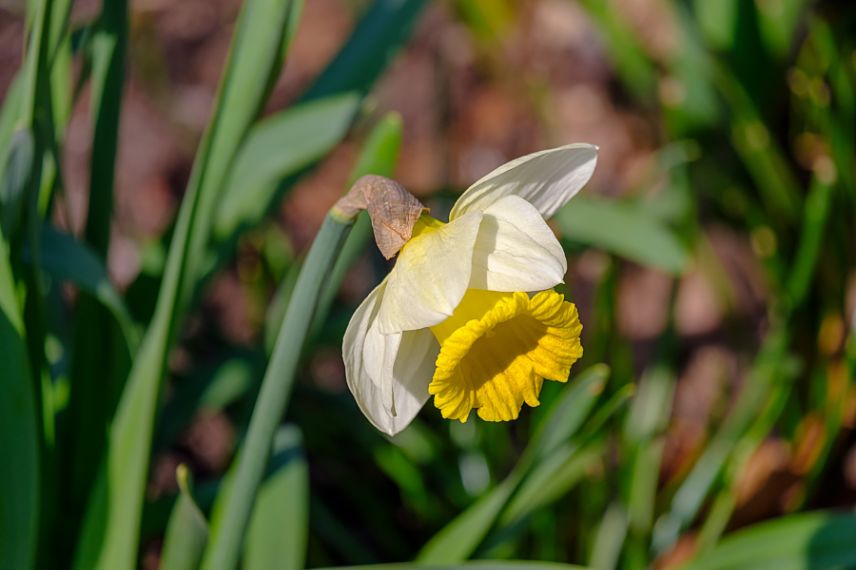
Wait until the foliage turns yellow before cutting it
Dividing the bulbs
Bulbs multiply by forming offsets that are small bulbs. To again avoid exhausting the bulbs’ reserves, it is advisable to regularly divide the bulbs of your narcissus.
Solution: remember to divide your bulbs every 3 or 4 years. This operation takes place during the plant’s dormancy period, i.e. in summer.
Regeneration of the bulbs
For good flowering, jonquil bulbs must have sufficient nutrient reserves. If they have not received enough water after flowering or if you have cut the leaves too early, before they are completely dry, this may prevent the bulb from flowering.
Storage of the bulbs
There is no need to dig up the bulbs to shield them from the cold, as jonquils are hardy plants. Leave them in the soil all winter, especially since they need this cold period to flower well in spring.
Crop rotation
Check from time to time that your bulbs are not exhausted or old, as that could explain why they do not flower or only produce leaves. In that case, replace old or exhausted bulbs with new ones.
Other possible reasons
The Weather
Daffodils are hardy plants that require a cold spell to flower in the following spring. If winter has not been cold enough in your region this year, it may be the reason for the lack of flowering of your daffodils.
Pests
Daffodil bulbs are toxic, so they are not eaten by rodents. Sometimes slugs nibble the petals of the flowers. But more formidable is the narcissus fly (Merodon equestris). This small villous fly resembles a small bumblebee and feeds on the pollen of the narcissus, on which it can lay eggs. The larvae, when they hatch, bore galleries into the bulb and devour it, which compromises the flowering.
Solution: Mulching the base of the daffodils in autumn to hinder the egg-laying of narcissus flies. Against slugs, see our article on 7 ways to fight slugs naturally.
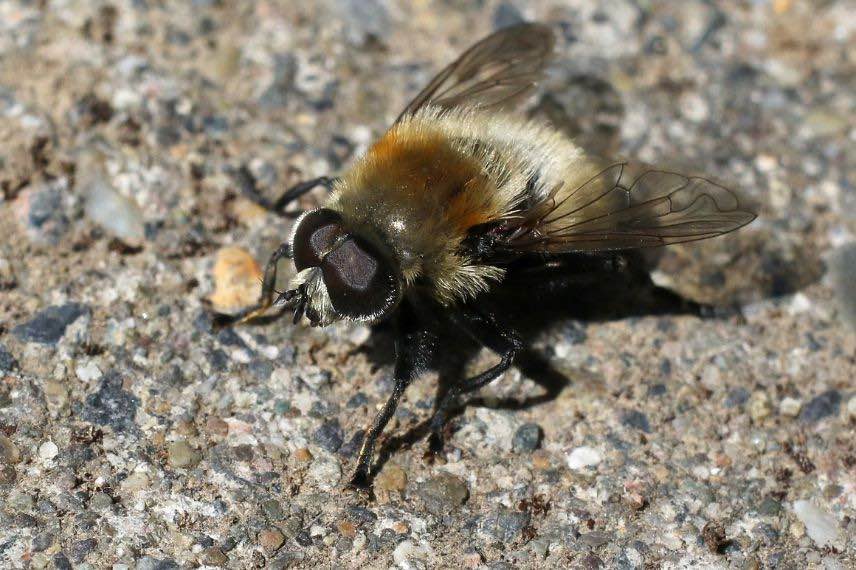
The narcissus fly
Diseases
Daffodils are relatively resistant to diseases. In soil that is too wet, however they may be affected by cryptogamic diseases that cause the bulbs to rot.
Further reading
Discover our comprehensive guide to growing and planting narcissi, as well as our narcissi planting tips and browse our full range of narcissi.
- Subscribe!
- Contents
Comments