





























The best late potatoes
Our selection of late potato varieties
Contents
Potato is a staple in the vegetable garden. Its planting requires careful consideration and planning! Because, from the beginning of the year, you can start finding tubercles that need to sprout before being planted in the soil.
Potato planting occurs once the soil has reached 7 to 10 °C. This temperature will be reached at different times depending on the region you live in, the associated climate, and the current weather… Consequently, depending on the climatic zones and the risk of late frosts, potato planting spans from March-April to May. However, another equally important factor comes into play: the variety of potatoes you have chosen. Potatoes can indeed be early, semi-late, or late. These criteria necessitate adjusting the planting schedule based on the required growing period.
Today, we will focus on late potatoes with my selection of the best varieties.
What is a late potato?
Late potatoes are those that are harvested at least 120 days after planting. The growing period can last up to 150 days. After this long cultivation period, the tubercles have reached their full ripeness, unlike early potatoes which are harvested before they reach full ripeness.
As a result, late potatoes benefit from better storage. They can thus be kept for consumption throughout the winter, provided they are stored on shelves or in crates under optimal conditions: a cool, ventilated space, free from moisture, and completely dark to limit sprouting.
Depending on the regions and the climate, late potatoes are planted between mid-March and mid-April, as soon as the risk of frost has passed. The harvest will take place from mid-July to the end of August, or even September.
Read also
Potatoes: planting, growing, harvestLate firm-fleshed potatoes
Firm-fleshed potatoes are melt-in-the-mouth delicious and particularly tasty as they contain less starch and more water. This is evident when cut, as they are moist.
These potatoes do not break apart during cooking; they remain firm and whole. They are perfect for:
- Boiling
- Steaming
- Preparing as sautéed or roasted potatoes
- Cooking in parchment.
However, they are not ideal for purées, soups, or fries.
Discover our selection of the best late firm-fleshed potato varieties.
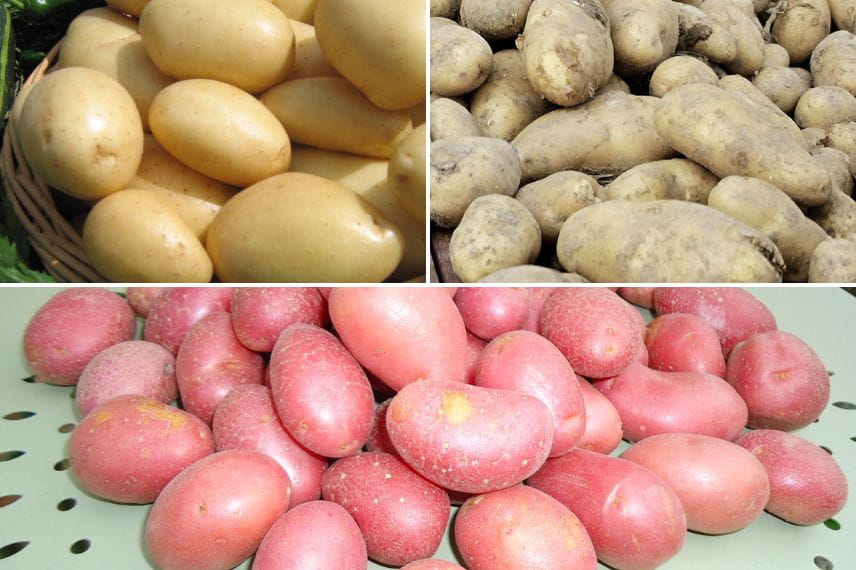
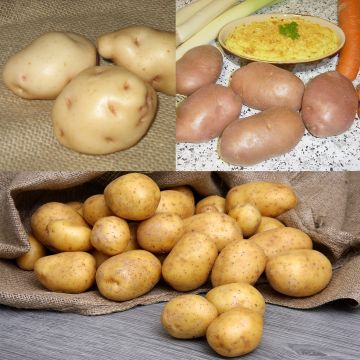
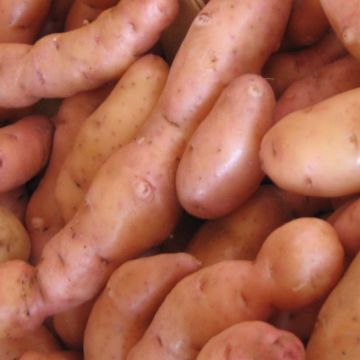
‘Roseval’
The ‘Roseval’ is a potato with yellow flesh and red epidermis, originating from Brittany, born from the cross-breeding of ‘Rosa’ and ‘De la Vale’. Its flesh sometimes features fine red streaks. The tubers are elongated and club-shaped. It is a vigorous variety that benefits from a good yield. The tubers are medium-sized but numerous. It can be somewhat sensitive to blight.
‘Nicola’
The ‘Nicola’ is a potato of German origin, catalogued since 1983. The produced tubers are rather elongated and of medium size, but numerous. It is an oblong potato with yellow skin and flesh. This variety has a very good yield and a fairly good storage ability.
‘Pompadour’
The ‘Pompadour’ is a potato of French origin, listed in the French Catalogue since 1992. These elongated oblong tubers have yellow skin and flesh. They are of medium size but the harvest is abundant. The produced potatoes have excellent taste quality. Its only drawback is a certain sensitivity to diseases and viruses.
Discover other Seed potatoes
View all →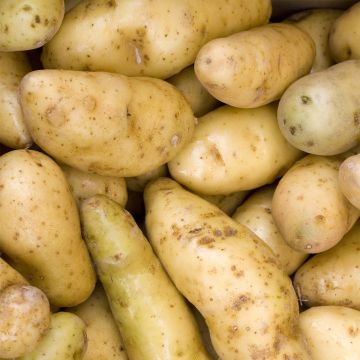
Available in 2 sizes
Available in 0 sizes
Available in 1 sizes
Available in 0 sizes
Available in 1 sizes
Available in 2 sizes
Available in 1 sizes
Available in 1 sizes
Available in 3 sizes
Available in 1 sizes
Late floury potatoes
Floury potatoes have a coarse flesh that easily breaks down. They disintegrate easily when boiled, but absorb less oil than waxy or buttery potatoes.
These are perfect potatoes for:
- Mashed potatoes
- Soups
- Chips
Our selection of late floury potatoes
‘Désirée’
The ‘Désirée’ is a high-yielding variety that produces large, oblong tubers, fairly regular, with red skin and yellow flesh. Of Dutch origin, this variety has been listed in the French Catalogue since 1971. It has a very good storage ability. Resistant to blight, it is, however, sensitive to common scab.
‘Blanche’
The relatively recent variety ‘Blanche’ is the result of cross-breeding between ‘Dali’ and ‘Eden’. Its very large tubers have yellow skin and flesh. It is disease-resistant, easy to grow, and has an excellent yield. It also stores very well. The ideal potato for the amateur gardener.
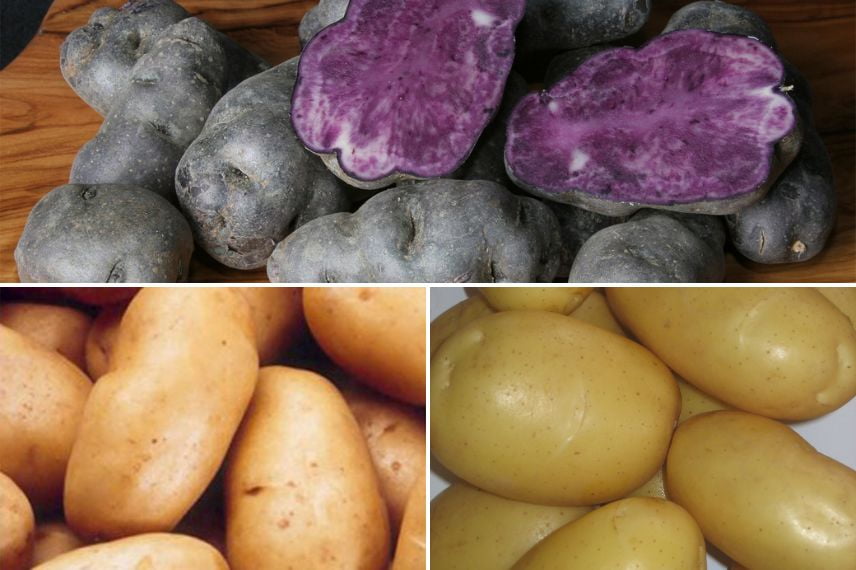
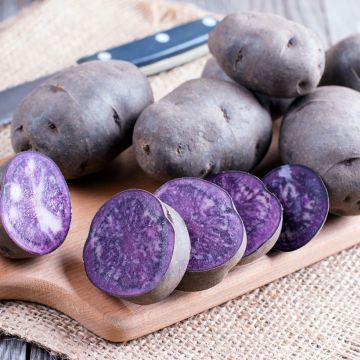
The ‘Vitelotte’, the ‘Désirée’ and the ‘Blanche’
‘Vitelotte’
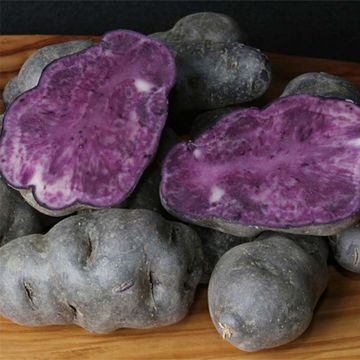
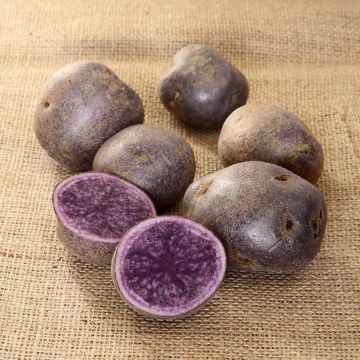
The ‘Vitelotte’ is hard to miss with its dark purple skin and flesh, a colour that holds well during cooking. Perfect for making unique mashed potatoes, chips, or crisps. Its tubers are oblong and knobbly. The yield is lower than other potato varieties, but the flavour quality is exceptional. It stores very well.
We can also mention ‘Manon’, ideal for chips.
Late-flowering potatoes with a melting flesh
Tender potatoes are easily infused with a multitude of flavours. Their flesh is often pale, and they are generally quite large. These potatoes are intermediate between waxy and floury varieties. They hold up well during cooking while offering a melting texture.
Tender potatoes are perfect for:
- Baking (gratin and stuffed potatoes)
- Stews
However, they are not suitable for frying. They can also be boiled or steamed, or incorporated into soups. They are versatile potatoes.
Our selection of late-harvest tender potatoes
‘Samba’
The ‘Samba’ is a variety of potato that is very well suited for storage, considered more of a semi-early variety as it is harvested at 110 days. Its tubers are oblong and elongated, with a dark yellow skin and pale yellow flesh. It is a productive variety that yields numerous tubers with a beautiful appearance and excellent taste quality. It is also resistant to blight.
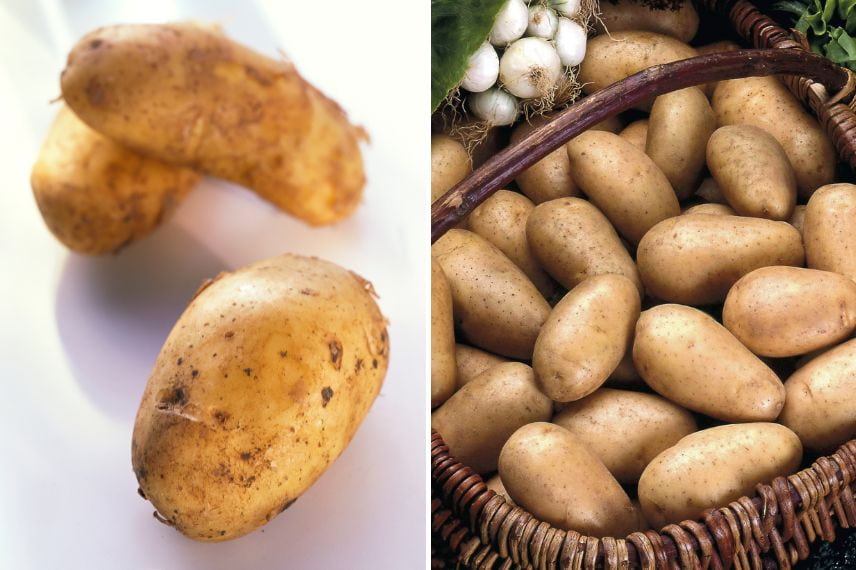
‘Spunta’
The ‘Spunta’ is also a semi-early variety that is harvested from 110 days. It stores easily for 3 to 4 months. Its tubers are of good size and have yellow skin and flesh. It is a highly productive variety whose potatoes are delicious when baked, sautéed, fried, or even in soups.
I could also mention ‘Prospère’ and ‘Monalisa’.
- Subscribe!
- Contents
Comments