





























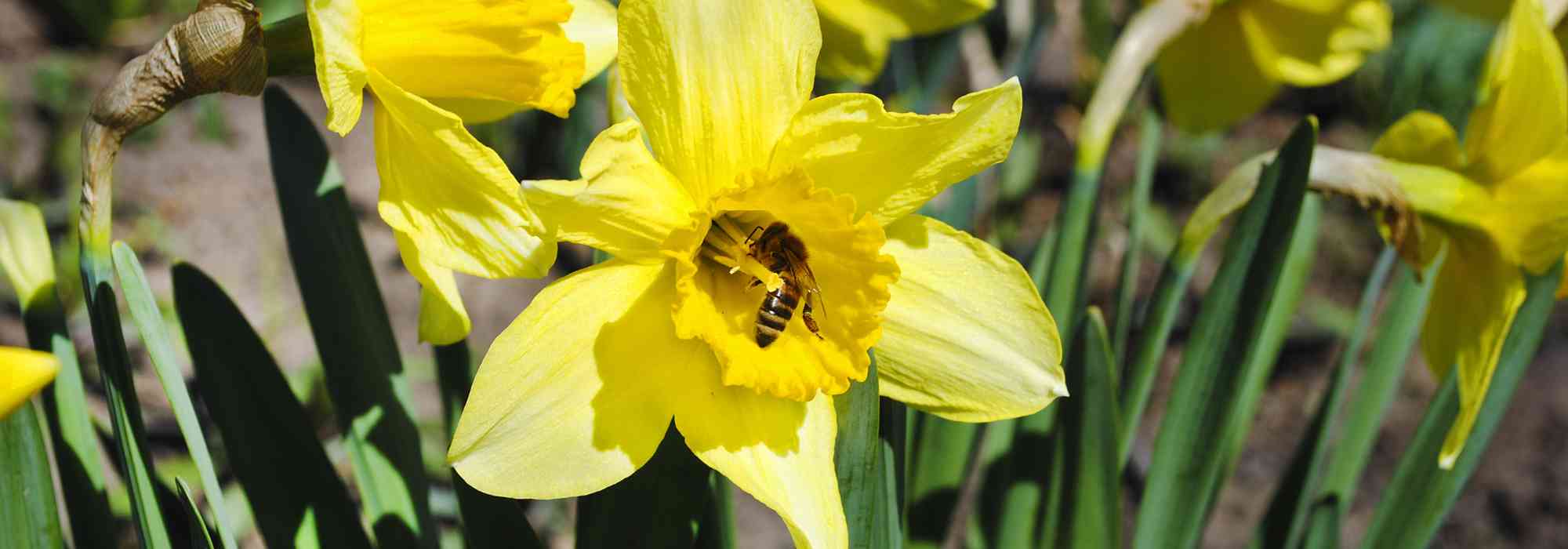
Spring bulbs: pollinators love them!
The importance of melliferous bulbs in spring
Contents
As winter ends, foraging insects and pollinators gradually resume hovering over the garden in search of food. They are, in fact, emerging from a period of lethargy during which they have been less active. During this time of year, blooms they feed on mainly come from bushes and from certain early spring-flowering bulbs. These first blooms of the season are essential to the garden’s ecosystem.
We explain why it is useful to plant certain spring-flowering bulbs in the garden, contributing, thanks to pollinators, to biodiversity and the persistence of plant species.

Why is spring pollination important?
We know this well, many insects play a role as pollinators, because they transfer pollen located on the stamens (male reproductive organs) onto their bodies and their tiny legs, to carry it unwittingly onto the female reproductive organs (the pistil) of other visited flowers. They thus ensure the pollination of plants, a key aspect of plant reproduction, and for this reason these insects are described as flower-visiting insects. If we think of Hymenoptera (bees, bumblebees, wasps, ants…) and Lepidoptera (butterflies), we must not forget in this large family of pollinators the Diptera (flies, midges, hoverflies…) and the Coleoptera, but also lacewings or earwigs which, too, feed on all or part of the flowers. Bats and birds also form part of this broad cohort of animals performing an essential ecological function in natural ecosystems.
Nectar rich in sugars and pollen rich in proteins, carbohydrates and lipids, are indispensable for powering the flight of all these small winged creatures, as they provide them with the energy necessary for their activity, all the more so after winter, which has been a period of dormancy. Flowers therefore need insects, but insects also need flowers.
As soon as it gets warm enough, bees resume work, and early flowering will be of great benefit to them to recharge their batteries and ensure their survival. It is at this time of year that flower-visiting insects most need access to food. They will thus be able to build their nest and ensure their own reproduction, essential to the garden’s life cycle. They thus contribute to the garden’s overall ecosystem by providing food for small mammals, spiders and birds.
→ Pascale explains the differences between melliferous plants and nectariferous plants.
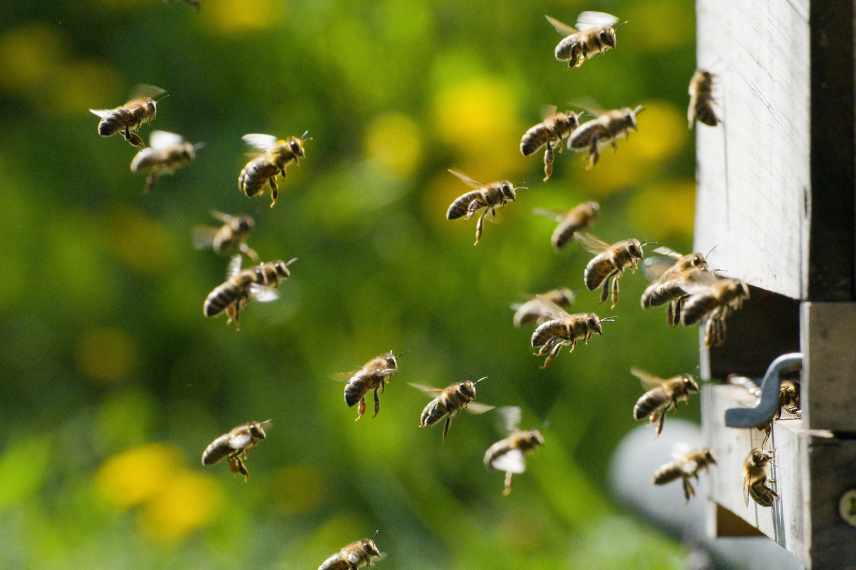
It’s spring! Domestic and wild bees and all the foragers are back in action
Which spring bulbs are the most melliferous?
There are around twenty bulbous plants that are particularly interesting for the early flowering and their melliferous or nectariferous qualities. Note that the blue, purple and yellow flowers are more readily spotted by bees and other pollinators, and the bright flowers (red, orange) by butterflies. But also that the wild-type species (which exist as they are in nature, as opposed to horticultural varieties) will always be more attractive to them. Finally, by diversifying the shapes of flowers to suit the morphology of the different pollinators, you increase pollinator diversity. Here are some of the most recommended bulbs:
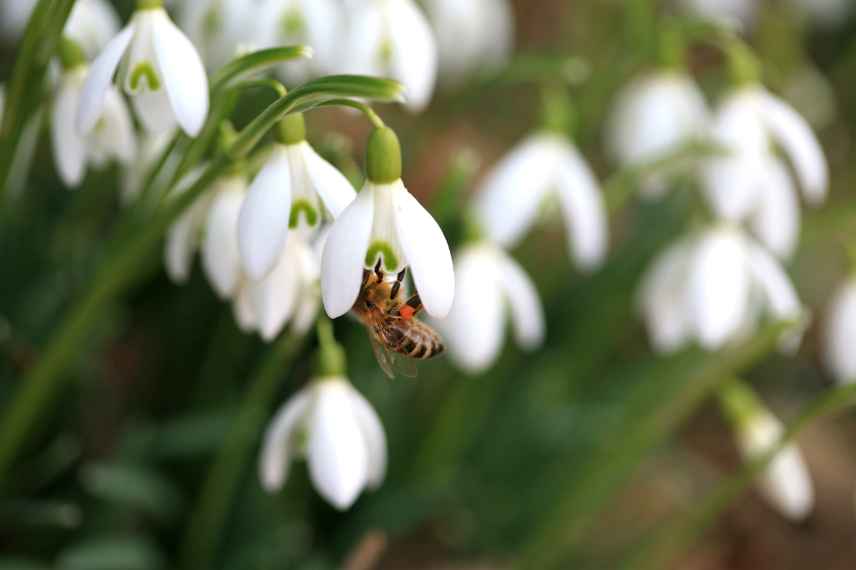
- Galanthus nivalis : this tiny bulb, the famous snowdrop, is the first to bloom between February and March. Planting it in bulk is advised.
- the Corydales: blue tubular flowers (Corydalis flexuosa and its varieties) and Corydalis elata which flower from April, or mauve-flowering such as Corydalis solida (between March and May) or Corydalis lutea. The milkflower Corydalis (Corydalis ochroleuca), all white, also delights butterflies.
- Uvularia grandiflora (the fairy bell) with a charming lemon-yellow flowering, one of the first to provide pollen and nectar to bees and bumblebees in particular.
- Muscari armeniacum with intense blue flowering, flowering from late February to March–April depending on the region.
- The botanical hyacinths, notably the Wood hyacinth (Hyacinthoides non-scripta) which flowers from April and is nectariferous, useful to bumblebees and bees, but also the Spanish hyacinth (Hyacinthoides hispanica) with blue-tinged campanulate flowers, the Oriental hyacinth (Hyacinthus orientalis), and Bellevalia romana, the Roman hyacinth with white flowers.
- Botanical narcissi such as Narcissus pseudonarcissus ‘Obvallaris’ which flowers in April, Narcissus bulbocodium from February–March, the Narcissus triandrus, or Narcissus tazetta canaliculatus (Narcissus tazetta), very nectariferous.
- Ornamental alliums, with also the chives and wild garlic (Allium ursinum) which offer flowers generally very melliferous and nectariferous, a little later, from May to June, greatly increasing the pollinators’ pantry. The Allium aflatunense ‘Sensation Purple’ and the Allium moly (golden garlic) are particularly nectariferous.
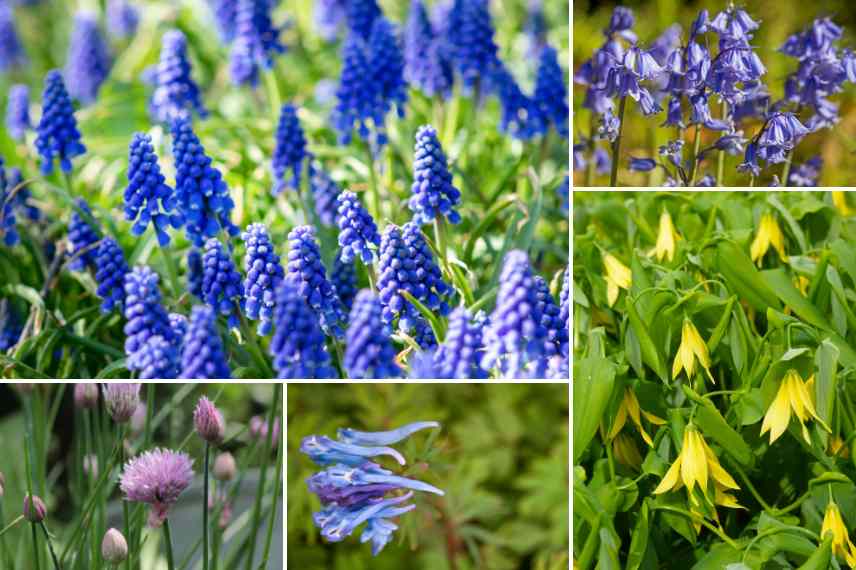
Muscari armeniacum, Hyacinthoides non-scripta (wood hyacinth) Allium schoenoprasum (chives), Corydalis flexuosa et Uvularia grandiflora
Tips for creating a pollinator-friendly garden
Beyond planting a large number of melliferous flowers in spring, it is also important to set up a wildlife-friendly playground that will further boost biodiversity, notably by creating a habitat for all pollinators. Several options are available to us:
- Plant with native species, wildflowers and local flowers that are beneficial to native bees
- Promote nesting and habitat areas for small wildlife and insects, for example by creating a natural pond without fish, by installing small water features, by preserving areas of deadwood or piles of leaves, by also setting up drystone walls, by planting multispecies hedges (comprising several types of bushes) or groves of trees and shrubs, by installing insect hotels, bat shelters, etc.
- Preserve fallow areas in the garden or in late mowing to provide year-round habitat for many insects
→ Also read: Native plants: let’s take stock, Plant native species to attract pollinating insects, How to rewild your garden?, Cottagecore: the trend combining countryside garden and loose living.
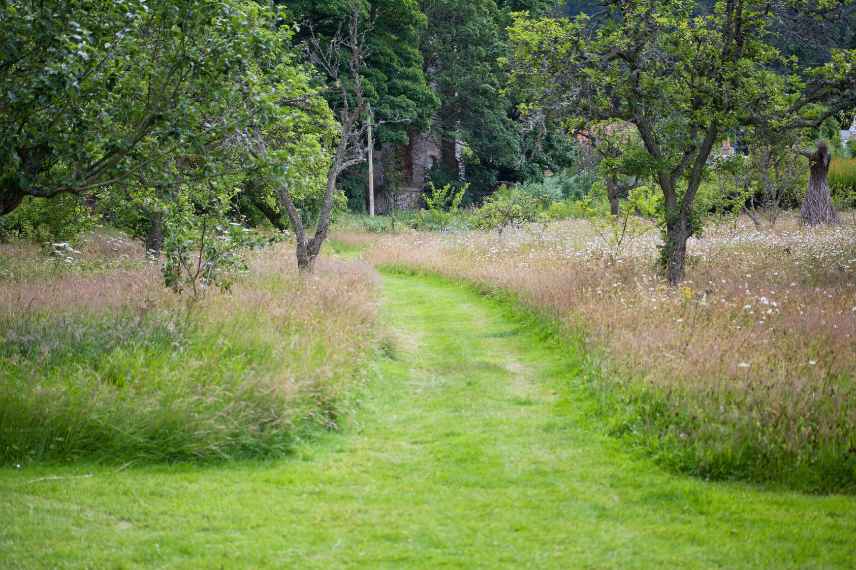
Letting certain areas of the garden become wilder is important for biodiversity
Read also
7 melliferous treesImportance of plant diversity and spreading flowering periods.
While it is important to provide food for pollinators from the end of winter as temperatures begin to rise, it is essential to diversify melliferous and nectariferous plants to prolong flowering over time. For insects and garden allies to complete their life cycles, they often need food across several seasons. We will therefore plan to plant additional bulbs, as well as perennials, shrubs and trees that are useful for enjoying staggered flowering, sourced from a variety of plants. The activity of pollinators will thus be maintained throughout the year.
Among late-spring bulbs following those mentioned above, it will mainly be ornamental alliums that are attractive, or Camassia, then Galtonias candicans for the start of summer.
Choose a wide variety of melliferous bulbs, perennials, shrubs and trees, whose flowering spans the seasons
Pollinator-friendly gardening practices
Of course, avoid pesticidal products and choose organic gardening methods to protect pollinators. Also practise crop rotation and companion planting for a balanced garden ecosystem.
→ See our article on Biological control in the garden and the vegetable patch: beneficial insects, and our tutorials on the manufacture of manures and decoctions, for example nettle manure.
- Subscribe!
- Contents
Comments