




























Purple Berberis: The Most Beautiful Varieties
Discover our selection of purple-leaved berberis.
Contents
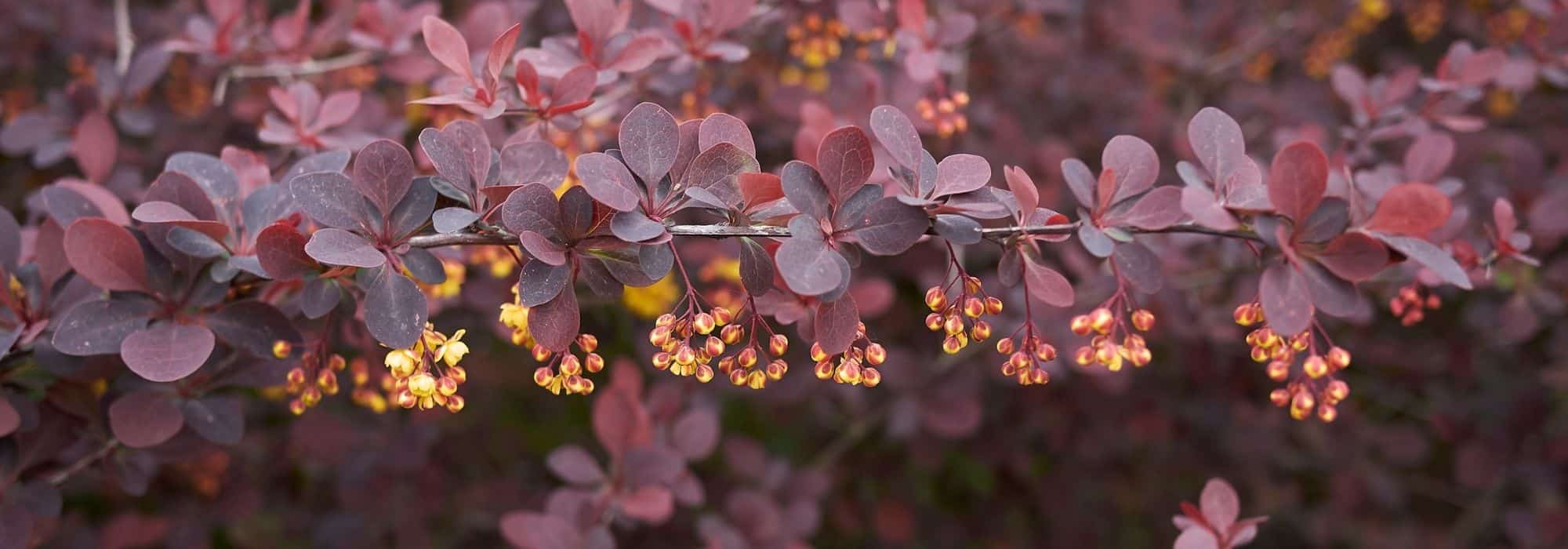
The barberries are lovely little bushes, with a bushy and dense habit, highly valued for their colourful foliage, golden green, purple, pink, or orange depending on the variety. Widely used to create defensive hedges, they also add a splash of colour to shrub borders, rockeries, or as groundcover, and even in pots. The shades of the thorny barberries are actually more intense when exposed to full sun rather than shade. Discover our selection of 5 Purple Barberries that will bring a touch of colour to your garden.

Berberis thunbergii 'Atropurpurea'
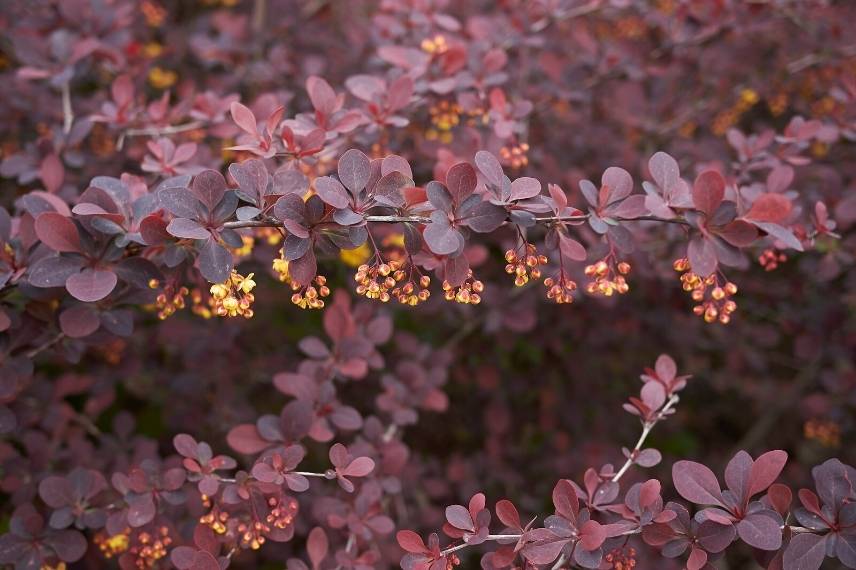
The Berberis thunbergii ‘Atropurpurea’ forms a dense, rounded bush, typically measuring 1.5 m in all directions at maturity. Its thorny stems bear lovely purple foliage, which turns bright red in autumn before falling under the winter chill. In April-May, they produce a multitude of small yellow flowers striped with purple. This abundant flowering will be followed by the production of small, oval, bright red berries. This round and bushy shrub will be perfect in a free or trimmed hedge, in a shrub border, or even as a standalone feature.
This beautiful barberry is very accommodating regarding soil, as long as it remains well-drained. Provide it with a sunny or partially shaded location, knowing that the sun will enhance the colour of its foliage. Once well-established, it will easily withstand occasional drought and intense cold down to -29 °C. For a lovely contrast in a border, it can be planted alongside forsythia, a Kolkwitzia, and Abelia.
Read also
When and how to prune barberry?Berberis thunbergii 'Red Dream'
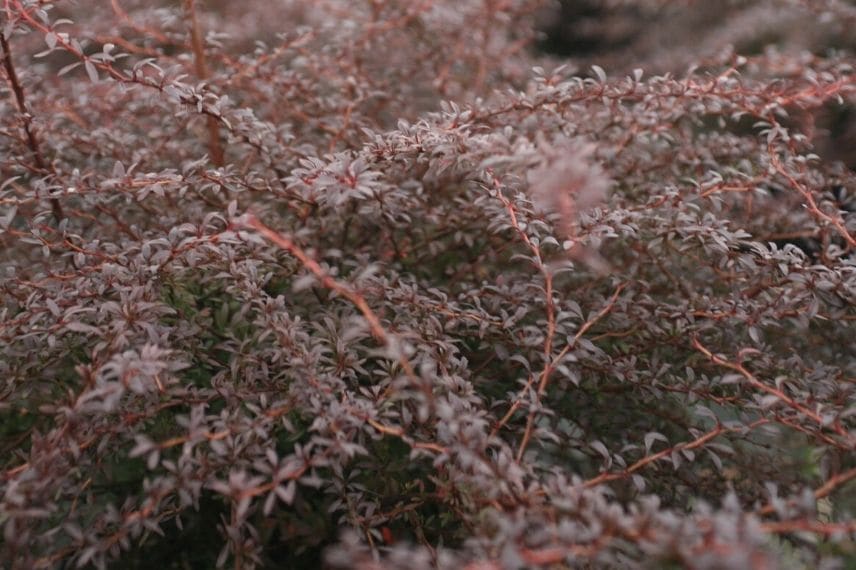
The Berberis thunbergii ‘Red Dream’ forms a beautiful low, spreading bush with mildly aggressive thorns. Its slightly curved branches give it a very graceful appearance, particularly as groundcover or in a small informal hedge. Its beige to light brown branches contrast beautifully with its tiny, very dark purple leaves, almost brown. Usually deciduous, its foliage can be evergreen in the southern regions of the country. Small yellow flowers brighten the dark foliage in spring, before giving way to bright red berries at the end of the summer season.
With a height of 90 cm and a spread of 1.20 m, this barberry will naturally find its place in a mixed hedge, as groundcover, on a bank, or even in a pot. Low-maintenance, it can be planted in all types of well-drained soils, in full sun or light shade. Very hardy, it withstands frosts down to -29° C. In a shrub border, its dark hue enhances the colours of neighbouring plants’ flowers. It can be placed in front of a Kolkwitzia, an Abelia, a rose, or a Weigelia. For a beautiful contrast, it can also be paired with the grey foliage of a Silver Bindweed or a Shrubby Wormwood.
Discover other Berberis - Barberries
View all →
Available in 2 sizes
Available in 1 sizes
Available in 2 sizes
Available in 3 sizes
Available in 2 sizes
Available in 1 sizes
Available in 1 sizes
Available in 1 sizes
Available in 1 sizes
Available in 2 sizes
Berberis thunbergii 'Inspiration'
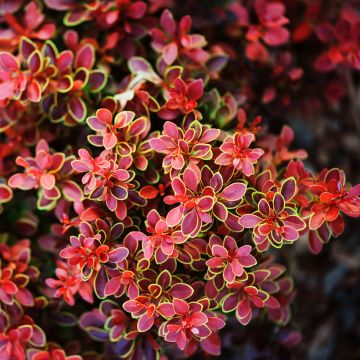
The Berberis thunbergii ‘Inspiration’ stands out with its young purple foliage, delicately marbled with pink and white. Its leaves then become entirely purple as they reach ripeness. Finally, they turn bright red and orange in the autumn season before falling with the cold. Its compact and dense habit gives it the appearance of a lovely cushion, 60 cm in all directions, perfect for a rockery, a flowering bed, as groundcover, or in a container. From May to June, discreet pale yellow flowers, marked with red, appear.
Low-maintenance and easy to grow, it can be planted in any well-drained soil. Although it tolerates partial shade, it is best to plant it in full sun to achieve intense leaf colour. This colourful barberry will be enhanced when placed in front of pink or red flowering bushes, such as an Abelia, a rose, a Japanese quince, or yellow-orange flowering plants like a Kerria japonica and a Broom ‘Lena Orange’.
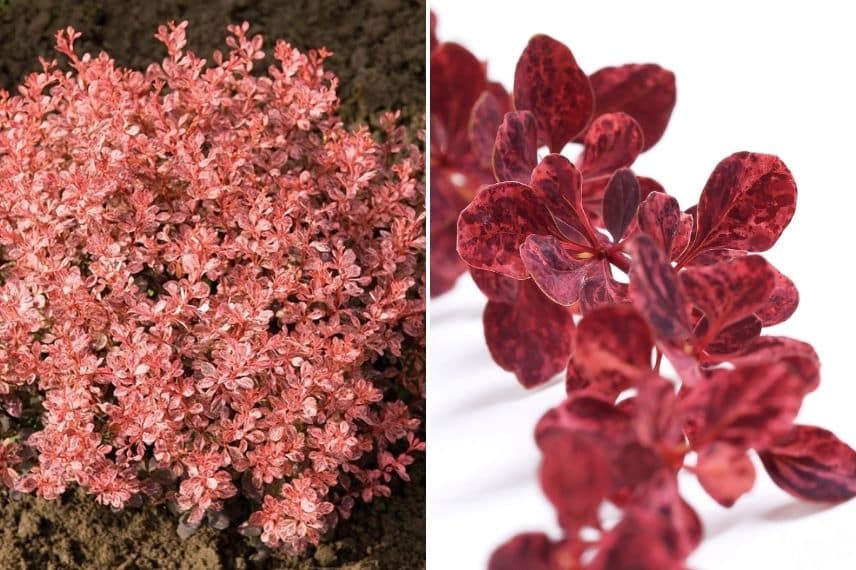
The young foliage of the Berberis thunbergii ‘Inspiration’ is marbled with pink and white before becoming entirely purple at maturity.
Read also
How to pair Berberis?Berberis thunbergii 'Lutin Rouge'
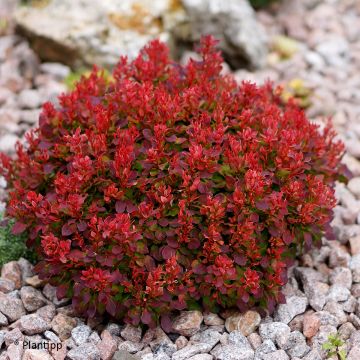
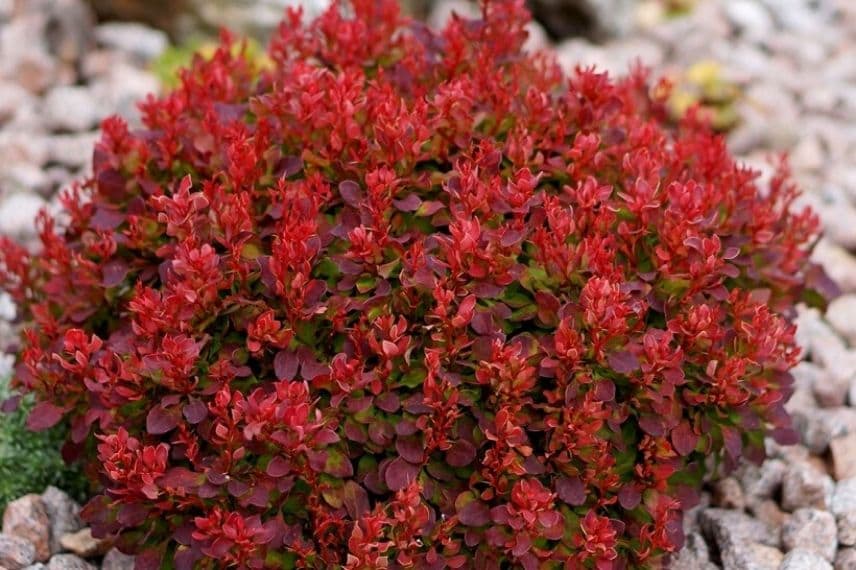
The Berberis thunbergii ‘Lutin Rouge’ is a very interesting dwarf variety due to its lovely small rounded and dense ball shape. Its deciduous foliage appears in spring in bright red tones, then turns to shiny purple-red. The lower leaves, less exposed to sunlight, will partly take on a green hue, providing a beautiful contrast. Its small size of 60 cm in all directions at maturity makes it a magnificent subject for decorating a rockery, the front of a flowerbed, a border, or a pot. From May to June, its slightly thorny stems bear small yellow flowers, followed by bright red fruits in autumn.
This miniature barberry can be planted in all types of soil, as long as it remains well-drained. Plant it in full sun or light partial shade to achieve beautiful scarlet foliage. In the shade, its foliage will be less spectacular, taking on a light green hue at bud burst, then glossy dark green at maturity. Don’t be fooled by its small size; this bush is very hardy and withstands frosts down to -29° C, as well as occasional drought. Its original colour will perfectly complement perennials and shrubs with pink, red, or purple flowers, such as roses, Alchemilla, Heuchera, and Euphorbia griffithii ‘Fireglow’.
Berberis thunbergii 'Red Rocket'
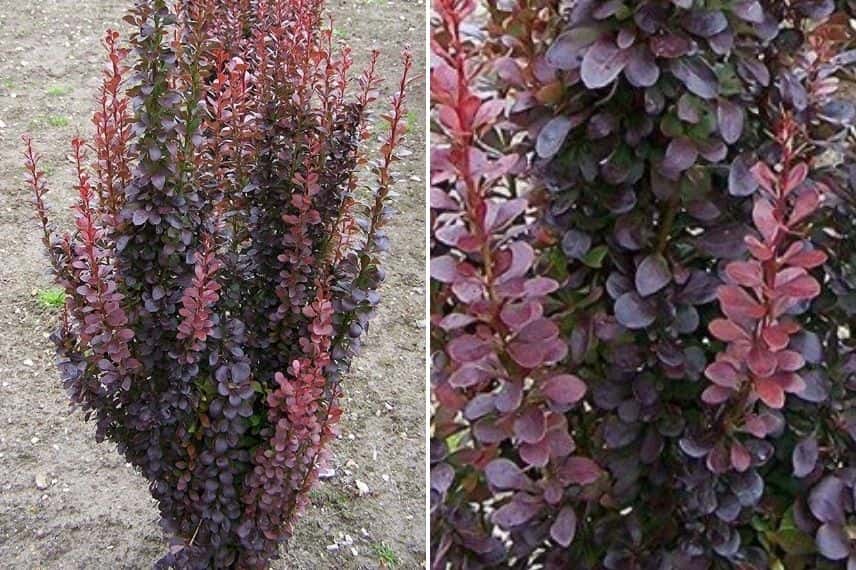
The Berberis thunbergii ‘Red Rocket’ is a variety with purple foliage that stands out for its upright and not spreading habit. This beautiful bush grows up to 1.5 m in height, reaching 2 m with only 1 m in width. Its narrow shape will widen and become denser over time. Its young deciduous leaves emerge red, then take on a dark purple hue, almost brown. In spring, this lovely colour contrasts wonderfully with its small pale yellow flowers striped with red. In autumn, the foliage takes on cherry red hues before falling.
This beautiful barberry will thrive in all types of well-drained soil, in full sun or light shade. It is worth noting that its colours will be more vibrant when in full sun. Once well established, this bush will withstand drought and cold down to -23° C. The beautiful dense and vertical silhouette of this barberry is perfect for creating a defensive hedge or adding colour to shrub borders. It can be planted alongside varieties with yellow or orange flowers, such as a Kerria japonica, a Mahonia, or a Broom. It can also be paired with shrubs that have pink or red flowers, such as a Japanese quince, a Kolkwitzia, and an Abelia.
For further reading
- Discover all our varieties of Barberries
- Find our article to learn all about barberries: planting, pruning and maintaining
- Subscribe!
- Contents
Comments