






























Pine bark: uses, advantages and disadvantages
All You Need to Know About Pine Bark Mulch
Contents
Although it is a production waste resulting from wood exploitation, the maritime pine bark has been valued as mulch and is now appreciated for the decorative touch it brings to landscaping. However, this mulch is also a victim of a widely held misconception among gardeners: it significantly acidifies the soil and can only be used at the base of plants that prefer acidic soils. Yet, recent studies have not confirmed this information.
In this article, we invite you to discover in more detail the characteristics, advantages, and disadvantages of this mulch. You will also find our tips on how to choose the right pine bark mulch and use it in the garden.

The characteristics of pine bark mulching
Brown-orange in colour, pine bark mulch primarily comes from maritime pine (Pinus pinaster). Pine forest operations are numerous in the southwest of France (Landes department). During logging, the pines are debarked using a debarker before being transported to sawmills. Rather than discarding the bark pieces, they are collected for use in green spaces. Once cleaned and sorted, the bark is packaged.
In garden centres, pine bark is typically sold in bags of 5 to 100 L. Easy to transport, this packaging is particularly suited for individuals wishing to mulch small areas. Landscape professionals, on the other hand, purchase large quantities in bulk.
There are different grades of bark that vary slightly depending on the suppliers: 0/5, 5/10 mm or 5/15 mm, 10/20 mm or 10/25 mm, 20/40 mm or 25/40 mm, and 40/60 mm. The choice of grade depends on the plant you wish to mulch.
The decomposition of pine bark is slow (between 5 and 7 years), unlike other mulches (for example, cocoa shells or mulches in the form of flakes). Maritime pine bark is structured in several overlapping layers. This organic mulch is heavy, even when dry. It is therefore best used to mulch the base of robust plants. The pH of pine bark ranges from 4 to 8.
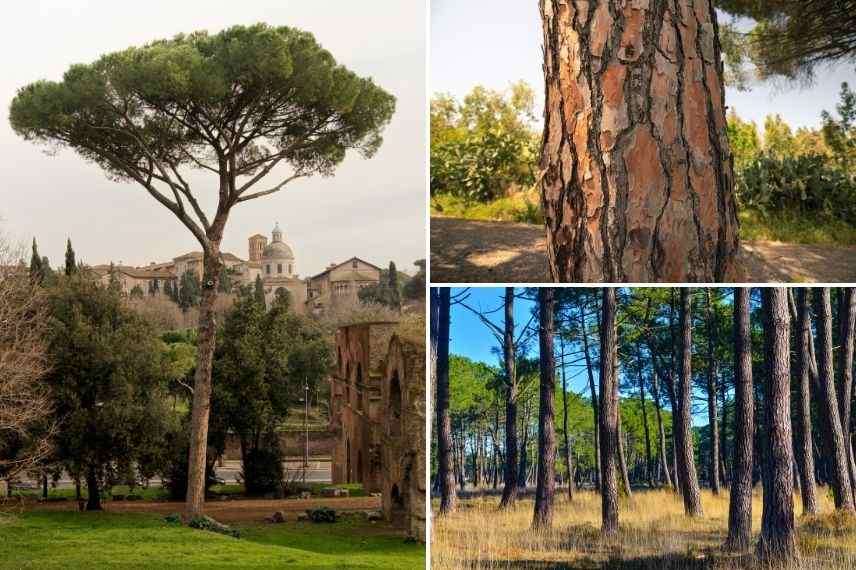
The brown-orange bark of Pinus pinaster
Read also
Mulching: Why? how?The benefits of pine bark
Using pine bark as mulch in the garden has many benefits:
- This mulch prevents the development of adventive plants (weeds).
- When applied in a thick enough layer, the bark helps plants better withstand cold and drought.
- Pine bark mulch has a high capacity for absorbing water from rain or watering, which it gradually releases to the plants. The soil remains slightly moist, reducing the frequency of watering.
- By limiting water evaporation, no crust forms on the surface of the soil (a hard, dry soil crust), and there is no soil compaction. Water easily infiltrates well-draining soil, preventing erosion during heavy rains.
- The airy structure of the bark promotes gas exchange. Air circulates well, which is essential for the microbial life of the soil.
- Unlike fine and light mulches such as hemp or flax, pine bark does not blow away at the first gust of wind due to its weight.
- Aesthetically pleasing, the brown-orange colour and texture of the bark slabs enhance the foliage of plants.
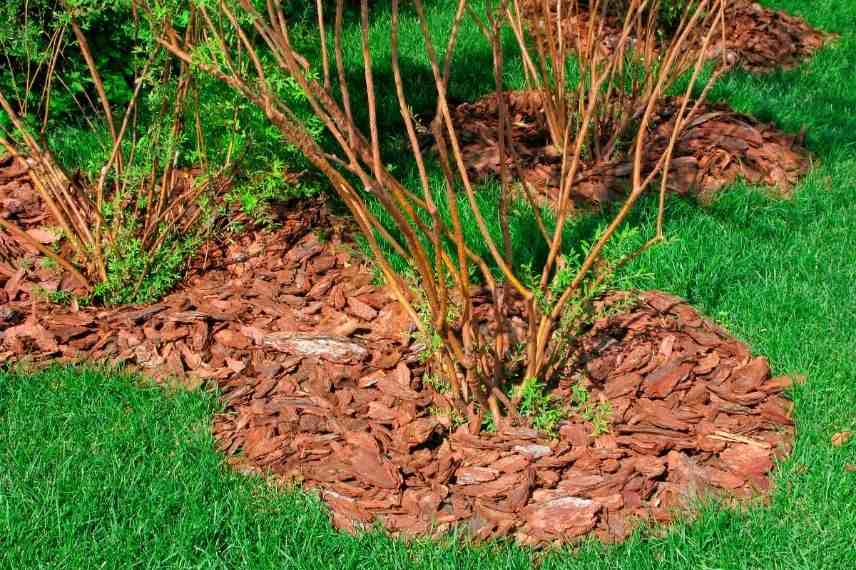
Pine bark is very decorative in flower beds and provides a beautiful finish
The disadvantages of pine bark
- On already very acidic soil (pH between 4.5 and 5.5), using a pine bark mulch will increase the acidity of the soil, which can disrupt the growth of existing plants. In contrast, when freshly applied to neutral or chalky soil, pine bark does not cause significant acidification that could harm crops. Moreover, this slight acidity gradually diminishes over time.
- Pine bark is not recommended for improving soil quality as it decomposes slowly. Humus will only form in the long term.
- In flat beds, pine bark may not stay in place during foot traffic from children, animal passage or in heavy rain. If necessary, you can install borders to hold the bark in place and prevent it from spreading onto your lawn. However, pine bark is not recommended for sloped beds or banks.
⇒ Find out everything you need to know about Garden Edging: Solutions, Advantages, Disadvantages
⇒ Also check our advice sheet Which Mulch for a Slope or Sloping Bed?
Uses of Pine Bark in the Garden
Where to Use Pine Bark?
First of all, the soil you wish to mulch should be weeded, tilled, and aerated before being covered with mulch.
Pine bark mulch is primarily used on ground surfaces that do not require regular maintenance: in ornamental gardens (beds, borders) and in planters and pots. The vegetable garden is not the ideal place for this mulch.
Due to its acidifying effect, pine bark is often used in beds of acidophilous plants, known as ericaceous plants (azaleas, camellias, Japanese maples, hydrangeas, rhododendrons…).
However, this mulch is also suitable at the base of roses, ornamental shrubs, perennial or annual plants.
You can use small-calibre pine bark to make your own potting mixes. Note that maritime pine bark is included in the composition of potting substrates for orchids (ready-to-use mixes). Bonsai enthusiasts also use composted pine bark in the preparation of their potting mix.
It is also possible to cover paths and walkways with a good thickness of pine bark to limit the growth of weeds.
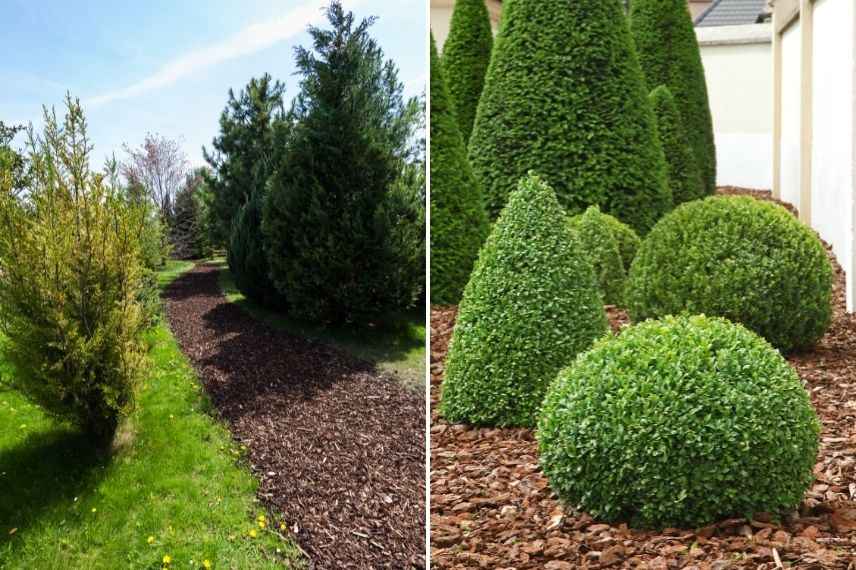
Pine bark used as mulch on a path or at the base of shrubs.
What Thickness of Pine Bark is Needed?
For mulch to be effective, it is important to apply a sufficient thickness. This depends on the calibre you have chosen and its use. Here are our tips on how much pine bark to apply at the base of your plants:
- For window boxes and pots, prefer a bark calibre of 5/10 mm at about 3 cm thick.
- In hedges, perennial beds, or roses, opt for a medium calibre of 10/20 mm at approximately 5 cm or 20/40 mm at a thickness between 5 and 10 cm.
- Large calibre bark 40/60 mm is used in a layer of 10-12 cm thick for mulching trees and shrubs. Generally, a lower calibre underlayer is spread first to enhance the anti-weed barrier effect.
Pine bark can fade over time. To restore a nice appearance to your mulch, you can add a layer of pine bark every year (a thin layer of 1 or 2 cm thick is sufficient).
Tip: We recommend choosing pine bark that complies with the NF 142 quality certification. Well cleaned and free of liber (the internal bark of the tree, fibrous and degrading faster than the outer bark), this mulch is guaranteed to be free of fine particles and toxic compounds for plants (tannins, phenols…).
- Subscribe!
- Contents
Comments