





























How to pair Chasmanthes?
A beautiful African plant to try in the garden
Contents
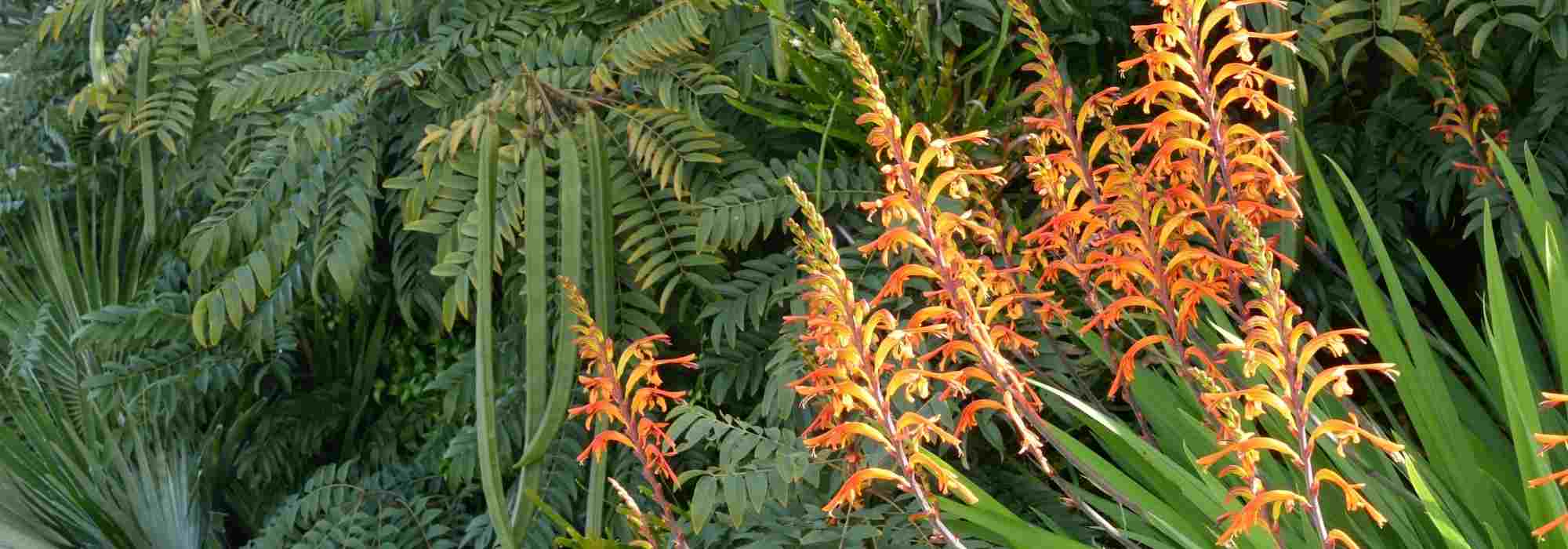
The Chasmanthe floribunda is a plant native to South Africa that somewhat resembles a crocosmia in its overall appearance. Like it, the “Flag of Africa” develops a beautiful clump of dense, upright leaves from which sturdy flower stems emerge, adorned with orange or yellow flowers depending on the varieties. However, the flowers of the chasmanthe are finer and they appear in spring. Much better suited to Mediterranean-type climates than Crocosmias, the Chasmanthe floribunda can be easily grown in open ground along the Mediterranean coast, in borders, combined with other plants that have staggered flowering. Elsewhere in France, it can be used to create beautiful pots that should be protected from frost in winter.
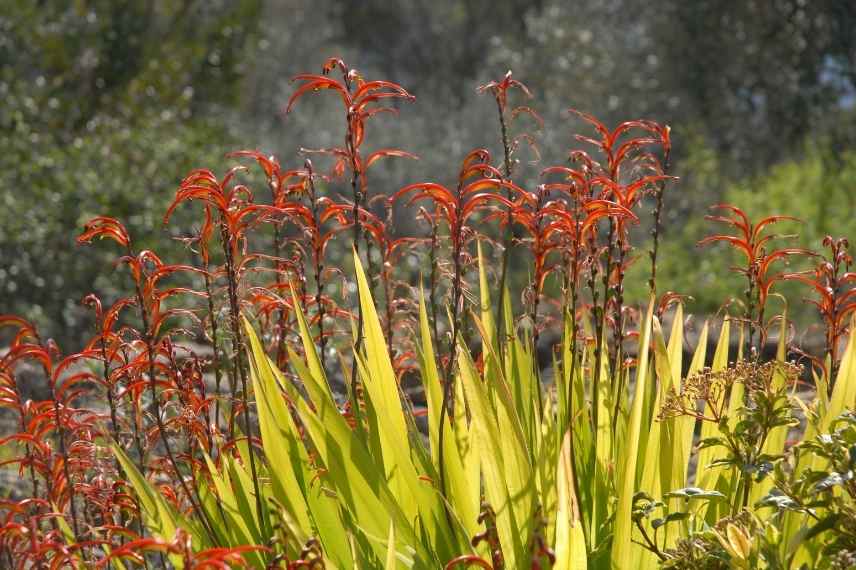
The Chasmanthe floribunda: a superb perennial to discover… and to combine in the garden!

In open ground: 'Out of Africa' atmosphere
In regions with mild winters (no lower than -4 °C in winter), chasmanthes can be grown in the ground in well-drained soil. As this plant hails from South Africa, why not create a bed with other perennials, bulbs, or even bushes from this part of the world?
The Chasmanthe floribunda will pair beautifully with some Thulbaghia violaceae, small bulbous plants with green-grey foliage whose pink-mauve flowering will follow that of the chasmanthes. The well-known agapanthus, such as compact agapanthus ‘Charlotte’, will also find its place and bloom throughout the summer.
Kniphofias (formerly Tritomas) are making a grand return to gardens, like the stunning Kniphofia ‘Tawny King’ with its soft orange flowers. We will complete the picture with some crocosmias (formerly Montbretias), botanical cousins, with bright orange flowering like the Crocosmia ‘Babylon’. The flowering of crocosmias will continue that of the chasmanthes.
On the shrub side, the spring red-orange flowering of the remarkable Leucospermum ‘Carnival Red’ will perfectly accompany the orange inflorescence of the chasmanthes. This small tender shrub has evergreen foliage that is somewhat glaucous.
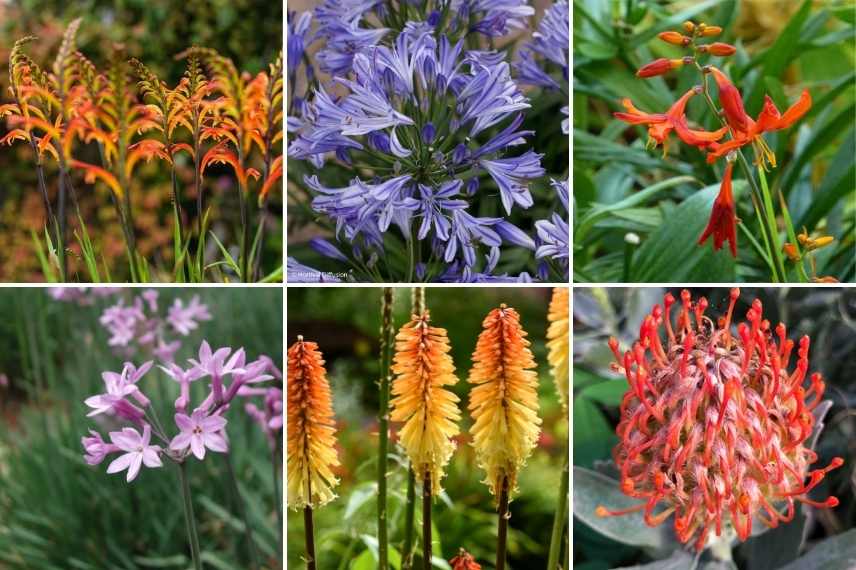
Chasmanthe floribunda ‘Saturnus’, Agapanthus ‘Charlotte’, Crocosmia ‘Babylon’, Tulbaghia violaceae, Kniphofia ‘Tawny King’, Leucospermum ‘Carnival Red’
In open ground: long live the blue orange!
It may seem challenging to associate Chasmanthe floribunda as these plants bring a strong presence to the garden with the size and colour of their flowers. However, we will attempt to mix them with other plants that enjoy the sun, fresh but well-drained soil, and bloom in March-April. Ideally, we should stick to warm tones with a touch of contrasting whimsy: blue!
Let’s start with a few Chasmanthe floribunda ‘Saturnus’ with bright orange flowers. To accompany this atypical spring bloom, we will focus on reliable bulbs with orange flowers: Fosteriana tulip ‘Orange Emperor’ and Crocus chrysanthus ‘Orange Monarch’.
For contrast, we will try a Peruvian Squill (Scilla peruviana), a tender bulbous flower native to the Mediterranean basin (contrary to what its name suggests!) that produces a stunning bloom in the shape of a wide, flattened cone, in ultramarine blue to bright violet-blue. If you wish to accentuate the blue to highlight the warm colours of the chasmantes, you might opt for a (very) large blue-flowering perennial: Madeiran Bugloss (Echium candicans). It forms an impressive clump of 1.5 m high and 3 m wide in a few years, adorned with villous green-grey foliage, from which magnificent blue spikes emerge in spring. Not very hardy, it enjoys warmth, full sun, and well-drained soils.
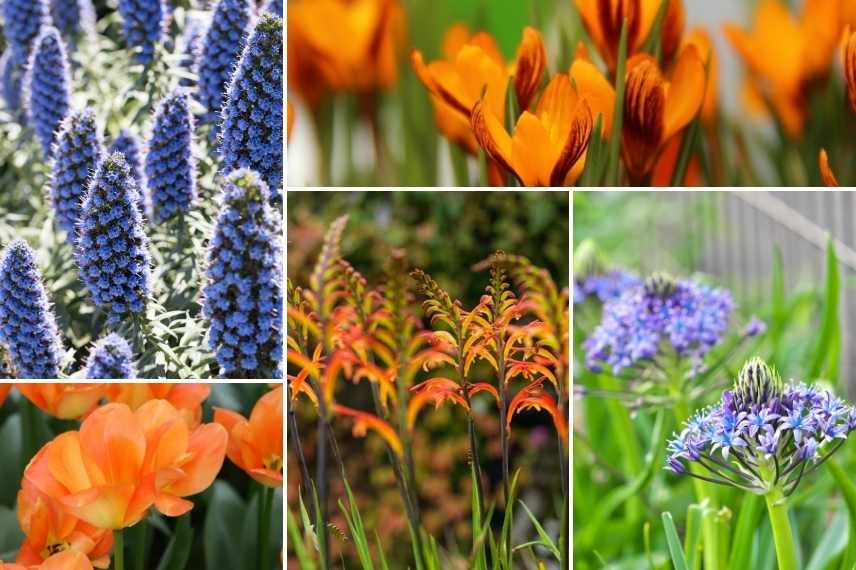 In the centre, Chasmanthe floribunda ‘Saturnus’, accompanied by Echium candicans, Crocus chrysanthus ‘Orange Monarch’, Tulip ‘Orange Emperor’, and Scilla peruviana.
Discover other Chasmanthes
View all →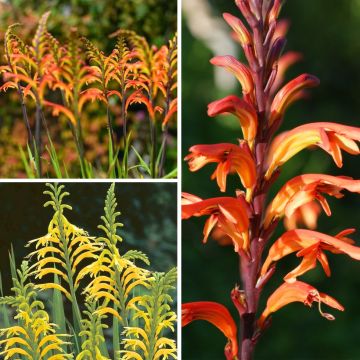
Available in 0 sizes
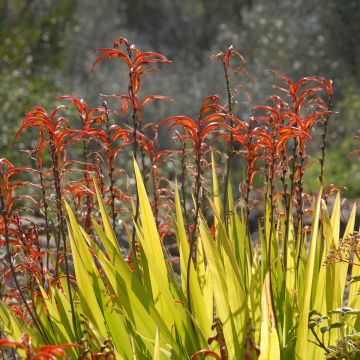
Available in 1 sizes
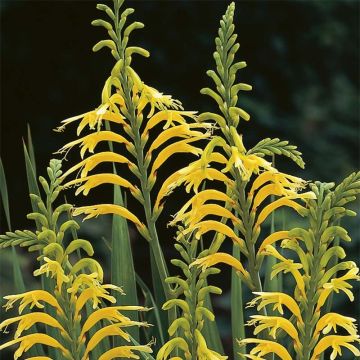
Available in 1 sizes
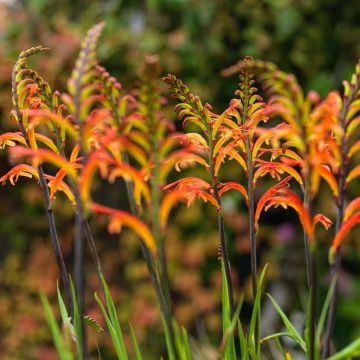
Available in 1 sizes
In pots: a burst of colour for the terrace or balcony
In spring, we need bright colours. And we need them quickly! To forget the dreariness of the winter months. The chasmanthes, sometimes called African Flag, can be perfectly grown in pots outdoors, even in regions with harsher winters (just keep them frost-free in winter).
The Chasmanthe floribunda ‘Duckitii’ produces a beautiful spring flowering of a very bright yellow. To accompany it, one might choose the Euphorbia ‘Whistleberry Garnet’, which has a compact growth and is remarkable for its young shoots of a burgundy red emerging from winter. These emerge from beautiful bronze-green foliage, just before its spring flowering of a lovely acid green. Attractive throughout the year, it is a plant well-suited for pot cultivation and looks stunning alongside blue and yellow flowers. The Narcissus ‘Tête à Tête’ is a charming little daffodil with an early (from February-March) but long-lasting flowering of a very cheerful yellow. Dwarf varieties of daffodils are particularly suited for growing in containers or pots. To add a touch of blue and soften the overall look, the Ipheon uniflorum ‘Jessie’ is a small bulb that offers a long, star-shaped, fragrant flowering of a very bright blue, from late winter to spring. Feel free to place them randomly in the pots of other plants.
After the bright flowering of the chasmanthes, do not forget the rest of the year and continue with similar tones if possible.
For blue flowers, one might consider a pot or two of Agapanthus, particularly the Agapanthus ‘Flower of Love’, which produces an abundance of deep blue umbels in summer. Little known yet delightful, the Cape Aster (Felicia amelloides) is an evergreen undershrub, not very hardy, flowering from late spring to autumn. It is covered in extraordinary sky-blue daisies, enhanced by a yellow centre. Meanwhile, a pot of Crocosmia ‘Buttercup’ with bright yellow flowers will recall the flowering of the chasmanthes a few months later.
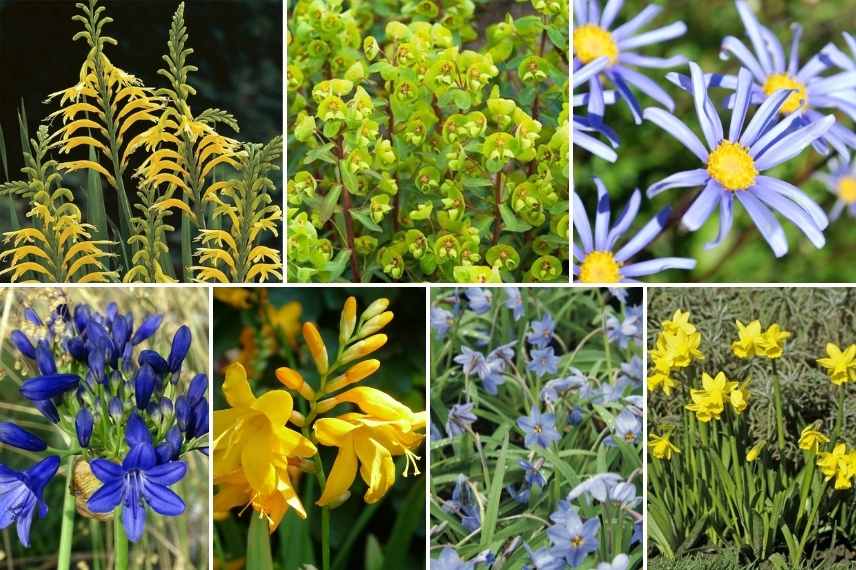
Chasmanthe floribunda ‘Duckitii’, Euphorbia ‘Whistleberry Garnet’, Felicia amelloides, Agapanthus ‘Flower of Love’, Crocosmia ‘Buttercup’, Ipheion uniflorum ‘Jessie’ and Narcissus ‘Tête à Tête’
In open ground: a 'Mediterranean' mixed border
This involves creating a mixed border for Mediterranean gardens with plants that thrive in mild winters and dry summers, featuring succulents, lesser-known bulbs, and even a cousin of pineapples.
Chasmanthes ‘Saturnus’ will once again be the stars of this small mixed border. A quick and simple definition of a mixed border could be: “a large bed where plants naturally intermingle without competing with each other”. But, of course, it’s easier said than done!
To accompany our chasmanthes, we will choose another African bulb: Cape Cowslips or Lachenalia (X) aloides ‘Namakwa’, which enjoy the typically Mediterranean climate: humid and mild in winter and dry in summer. In bloom, in early spring, Lachenalia ‘Namakwa’ reaches a height of no more than 25 cm and offers floral spikes adorned with tubular, bicoloured yellow and purple-red flowers.
The centrepiece of our mixed border, standing at 1.50 m tall and 2.50 m wide, the arborescent aloe or candelabra aloe is unfortunately not very hardy. It will only withstand temperatures down to -4 °C in very well-drained soil. Otherwise, it will need to be grown in a pot and brought indoors in winter. However, this aloe surprises with its unusual silhouette of a large bush formed by a framework of rosettes gathering long, evergreen, fleshy leaves, finely dentate at the edges. Its spring flowering is abundant, taking the form of long spikes of small, narrow tubular flowers, most often red, sometimes yellow.
Some clumps of Astelia nivicola ‘Red Devil’ will add iridescent reflections with its evergreen foliage. This beautiful perennial, resembling a small Phormium, forms a very dense clump of broad, linear, slightly arching leaves, covered in bristles and tinged with purple.
Finally, the astonishing Puya venusta, locally known as Chagualillo, is a succulent perennial related to pineapples and relatively hardy in dry soil (down to -8 °C). The Puya forms a compact rosette of spiny, grey-blue leaves and produces a stunning floral spike that can reach 1 m in height. This spike, pink-red in colour, branches into inflorescences resembling pine cones, adorned with flowers of a metallic blue-violet with bracts of the same pink-red tone. As surprising as it is beautiful! The blue of these flowers will provide a contrasting colour among the warm tones of the other plants.
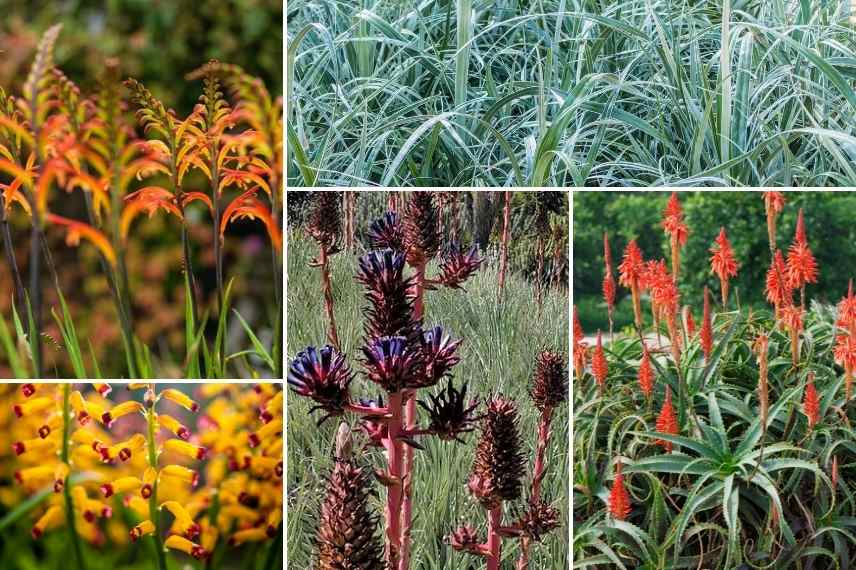
Chasmanthe ‘Saturnus’, Astelia, Lachenalia ‘Namakwa’, Puya venusta, and Aloe arborescens
In pots or in the ground: the exoticism of 'Welcome to the jungle'
Flowering is lovely, but it must be acknowledged that it lasts only a short period. Let’s focus on perennials and exotic bushes with remarkable foliage, creating a tropical atmosphere with colourful, opulent, or unusual leaves.
We will choose from the chasmanthes, particularly Chasmanthe ‘Duckitii’, which has the most subdued flower colour (compared to the other flamboyant chasmanthes).
To accompany them, we will opt for two bushes with long, narrow leaves. Phormium ‘Jester’ is a variety of New Zealand flax with moderate growth, but it stands out in the garden thanks to its brightly coloured foliage, dominated by shades of pink, copper, red, and bronze, tempered by the soft green that edges each ribbon-like leaf. And the Cordyline australis ‘Torbay Dazzler’ eventually forms a sort of small palm with a sometimes branched trunk, topped with very long leaves striated in cream yellow and green, gathered in dense tufts.
A banana plant always adds an exotic touch. We are familiar with Musas, but very few know the Musella lasiocarpa, or dwarf banana plants with a compact, bushy habit (no more than 1.65 m) and its magnificent golden yellow inflorescence, which can last several months in summer. This remarkable banana plant is quite hardy, tolerating -12 °C in well-drained soil.
Two small trees with astonishing foliage will complete the picture. The Tetrapanax papyrifera ‘Rex’, also known as the Rice Paper Plant, is an exotic and exuberant plant that can form a small tree in mild climates with a minimally branched trunk topped by a large umbrella of immense, beautifully cut leaves, a velvety grey-green. Pseudopanax ‘Bronze Eagle’ is an unusual evergreen shrub with a narrow habit and vertical stems that bear thin, cut foliage, a very dark bronze colour, almost black, with a nearly metallic appearance.
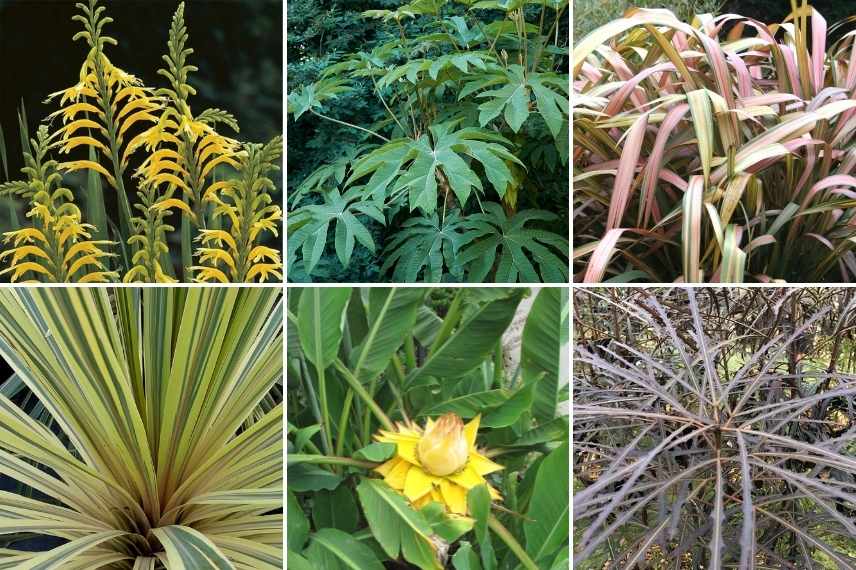
Chasmanthe, Tetrapanax papyrifera, Phormium ‘Jester’, Cordyline ‘Torbay Dazzler’, Musella lasiocarpa, and Pseudopanax ‘Bronze Eagle’
- Subscribe!
- Contents
Comments