





























How to design a garden in a garrigue area?
Practical tips and a plant palette for a garden with character in garrigue soil.
Contents
In southern France, in garrigue country, establishing a garden requires a few particular conditions to thrive. The typical garrigue vegetation, composed of shrubs and small shrubs, grows on calcareous and nutrient-poor soils. The climate there is harsh, with scorching summer heat, but winters are often cold and windy. Garrigue regions nevertheless allow for beautiful gardens, ultimately very on-trend as they require no irrigation: these are scented gardens that celebrate the wild beauty of garrigue plants.
How to design a garden in these challenging growing conditions, taking account of soil and climate specifics? We explain how to succeed with your garden if you live in these southern regions, by choosing suitable plants and arranging the spaces.
→ Find our garrigue garden range in our online catalogue.
Garrigue: an exceptional territory to be cultivated in gardens

Characteristics and constraints of garrigue
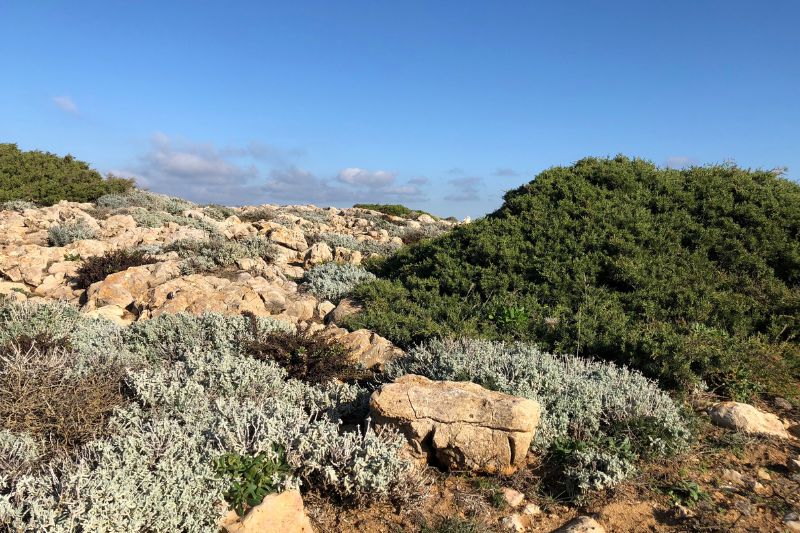
Garrigue is a typical landscape across several regions of southern France, from Alpes-de-Haute-Provence to the Pyrénées-Orientales: the Provençal hinterland at the foot of the Languedoc and the Cévennes, up to the edge of the Pyrénées-Orientales. It is found mainly in the Gard and Hérault departments, but also in Vaucluse, southern Ardèche and Drôme. The gardens located in these zones inherit calcareous karst soils, poor and shallow, often peeking out at rock, which makes it particularly challenging, as vegetation must be able to develop there properly, especially at the root level.
Another characteristic of these garrigue and causses areas is that they experience a very particular climate within the southern regions: not only is the climate very hot and dry in summer, enduring heatwaves repeatedly and over time in recent years, but it receives very little water. The temperature swing there is greater than elsewhere, with cold winters and temperatures regularly below zero, unlike areas closer to the coast. To add to this, violent gusts blow in bursts, hot (Autan wind, foehn effect) which enhance dryness in summer, or cold in winter and spring, such as the mistral, tramontane or the Cers, and the Grec in Provence and Roussillon.
Garrigue and its stony hills thus form an arid land considered unforgiving. These are mountainous terrains up to 1000 m above sea level, rugged and stony, reputed to be difficult and inhospitable at first glance, because they become as hard as rock in summer.
NB: Garrigue differs from maquis by its calcareous soil, maquis soil being acidic.
→ Everything you need to know about garrigue, its etymology, geology and history on the site wikigarrigue.
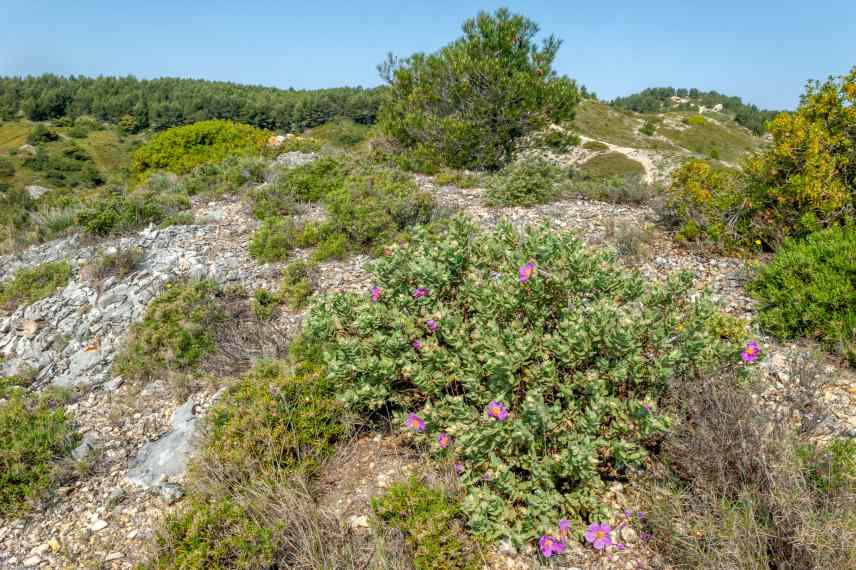
Garrigue in spring: a landscape of small hills or plateaus covered with low, fragrant vegetation, where rock is ever-present.
Read also
10 perennial plants for calcareous soilGarrigue-style garden
On dry, calcareous and outcropping soils of the garrigue, two things must be prioritised: choosing calcicolous and xerophilous plants that manage to grow spontaneously in these arid media and that will withstand the climate (see below), but also adapt the styling you give to your exterior. For it would be unthinkable to turn this garden into a space where lawn and lush borders share the spotlight. Instead, you should envisage a local, distinctive garden style in which the mineral element will create a strong visual impact, in perfect harmony with the sober plant palette, playing on the grey tones and a few flowering displays, as well as a sparse low-growing carpet of vegetation.
Depending on the region, your garden sits on a plateau, on hills of varying steepness, or in a flat landscape. A sloping garden will be more easily laid out as restanques garden, these stone terraces typical of the south. You will thus be able to create a dry garden, or even a gravel garden on flat areas. Finally, take advantage of the presence of dry stones to create here and there a few rockeries and sunlit slopes.
Always try to keep the idea of a garden open to the landscape: in the spirit of a Mediterranean or Provençal garden, but in a much more natural style that integrates the surrounding views.
→ Also read our piece on how to create a Garrigue ambience How to create a Garrigue ambience? and our articles on designing a restanque garden and the gravel garden, and creating a rockery; our tips for success.
The perfect plants for a garrigue garden.
Your garden will be in bloom in spring, calmer in summer where the plants go into a kind of dormancy to withstand drought, “repeat-flowering” often in autumn thanks to the seasonal rains. They must be robust, resistant to cold, drought and the blazing sun as well as to the large temperature swing. On these shallow calcareous soils, you will almost everywhere find a evergreen vegetation (persistent foliage), leathery leaves, numerous low woody shrubs, bulbous plants and aromatic herbs…
The trees: they provide shade
Trees must be able to withstand prolonged drought and stony soils. But in these interior lands, as you walk around, there is no trace of olive trees, often not hardy enough for these very open landscapes, exposed to the cold winter winds. The olive tree is the king of Provence when evergreen oaks are those of the garrigue. You will use them as focal pieces that will form focal points and structure, while providing the necessary shade: the kermès oak (the most emblematic, its name deriving from the old Provençal garric which gave the word garrigue), the green oak and pubescent oak. Among the trees hardy to both cold and heat, also count the Provence hackberry (Celtis australis) or the Italian cypress.
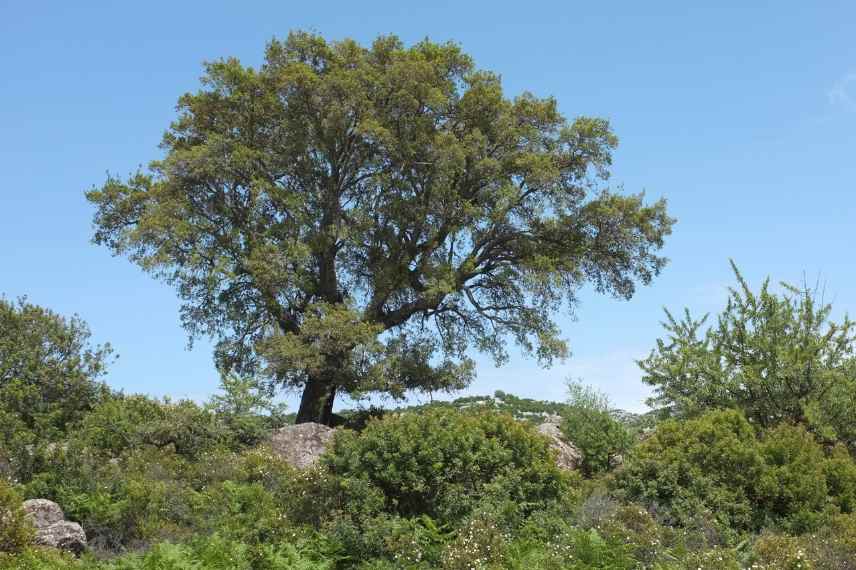
Quercus ilex (the evergreen oak)
The shrubs: simplicity, colours and scents
These are the ones that give the garigue its essential touch! A lower vegetation layer will indeed dominate the rest of the garden, these shrubs and small shrubs with evergreen foliage having developed strategies to draw the resources they need to grow in this poor, rocky milieu. Here you will naturally find all garigue plants such as myrtle, but also bay laurels and Portuguese laurels. We’ll favour aromatic plants, all the thymes, sages and rosemarys which can alone create stunning displays with their foliage and growth habits, and their garigue companions, the rockroses –Cistus albidus (cotton rockrose), Cistus populifolius, Cistus salviifolius-, not forgetting the lavenders, king here too when well sheltered, the Phlomis shrubs and the Teucriums. Also part of the landscape are the savine and the santolines.
Among the taller specimens that cope with thinner soil, also include the hawthorn, the strawberry-tree, the Montpellier maple, the Rhamnus alaternus, or the Phyllirea (Phyllirea).
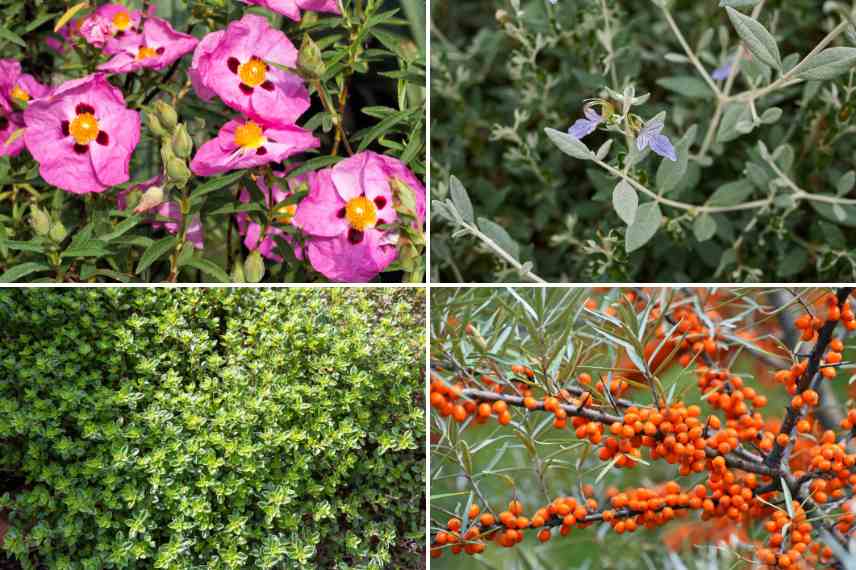
Cistus, Teucrium, thyme and hawthorn
The perennials and grasses: a wild edge
Priority goes to plants suited to dry terrain, but the first instinct here again is to draw inspiration from local flora that can resist both heat and cold. Native plants are indeed those that will thrive best in the harsh conditions of poor, rocky soil, and they will stand out for their wild and natural character: Narcissus assoanus or garigue narcissus, Iris lutescens of garigue, Aphyllanthes monspeliensis (Aphyllanthes from Montpellier, a small blue anemone growing in tight clumps), Saponaria ocymoides for wall-tasting, Lupinus micranthus, Anthericum ramosum (phalangère), Aster lynosyris. Naturally, euphorbias such as the shrub euphorbia or the Euphorbia characias, achillées and cupidones will also have their place.
Amidst the often low, mat-forming and prostrate plants, it is interesting to see a few taller plants rise, vertical due to its flowering stalks of giant fennels or Asphodelus fistolus or Asphodelus ramosus, but also dye- and medicinal-plants such as Anthemis.
As for the lawn, it is easily understood that it’s best to limit it to its simplest expression. If you want to try it, it will be a little around the house, but our aim will mainly be to replace it with lawn alternatives, these groundcovers far less thirsty: read our articles on the subject such as Alternatives to grass: 10 ground covers to replace the lawn and alternative to lawn: plant creeping thyme.
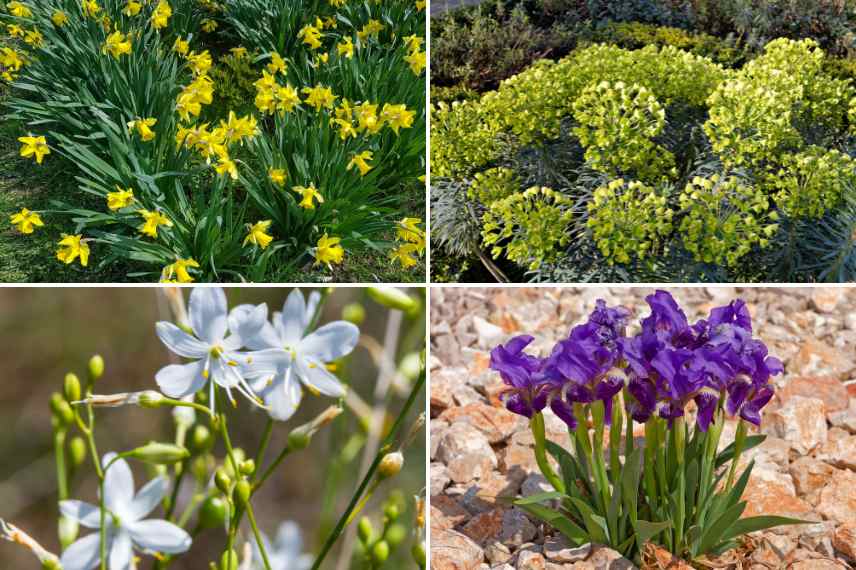
Narcissus assoanus, Euphorbia characias, Anthericum ramosum and Iris lutescens
→ See also : the garigue must-have plants, 5 shrubs for rocky soil, and trees for rocky soil.
Landscaping
Incorporating a few decorative elements is more than useful in this garden, now planted with suitable plants. The finishing touch to harmoniously integrate outdoor spaces with the Garrigue ambience.
We spotlight, as the sun blazes, some shaded relaxation zones.
A shaded mineral courtyard adorned with handsome terracotta jars or pots (not frost-proof!), a wrought-iron pergola under which one can dine to blend with the ochre hues of the stones. Bear in mind the Garrigue codes: drystone walls, ochre and grey tones.
Explore the dry-stone walling technique! Base your approach on an existing stone shelter or ruin in the garden, or, using scree and stones recovered from the ground, raise a low wall a small wall or restanques on which you can plant trailing plants, or, on a large plot, a regional typical building (mazet Cévenol recouvert de tuiles, caselle du causse…) that you will use as a shed or outbuilding.
In the same mineral spirit, make use of the abundance of stones found on your site to lay a calade, a kind of tapestry made from small flat stones, sometimes two-toned. It will look stunning in the areas closest to the house.
Finally, gravel paths will subtly weave between the plants, which will soon begin to encroach on the edges of the layout.
Also read, my tips on Terracotta in the garden: our ideas and inspirations.
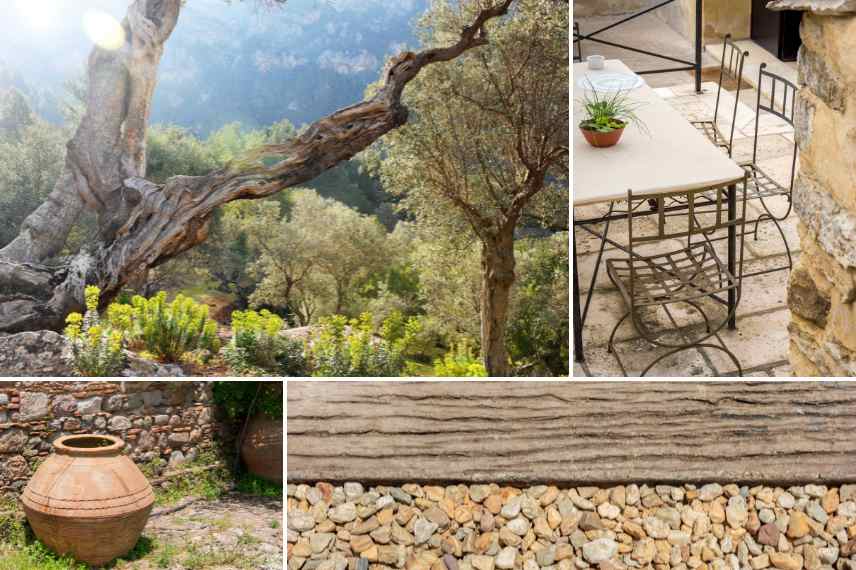 Neutral tones reminiscent of limestone: to be used on paving slabs, paths and pots.
Some planting tips and recommendations.
- The ground preparation is less onerous than one might imagine. Indeed, the rocky soil in which the depth of soil is thin isn’t the easiest to work (you may sometimes need a pry bar), but you obviously won’t replace the entire soil of a future garden. Depending on the proportion of bedrock in the ground, you will base your plantings on the thin layer of existing arable soil. Your soil must be, once decompacted, sufficiently well-draining to accommodate xerophilous plants, and in all cases, it will remain essentially rocky, with a poor structure. However, backfill with a little soil to create a minimum planting basin. Do not amend it, the plants that can grow there will be satisfied with it.
- With the largest stones removed, create a clapas, or a dry-stone wall.
- You will compose a garden with character… and a drought-tolerant garden, requiring less maintenance. This does not mean that you should not water in the first year, on the contrary: read Sophie’s advice, who knows the subject well in Designing a garden with minimal watering (or almost none).
- Plant in autumn allows garrigue plants to better develop their root system and to better withstand heat episodes the following summer. Autumn and winter rains are indeed plentiful and ensure good establishment. The only exception being plants that would be at the edge of hardiness for your area.
- Plant densely, forming cushions of plants that will considerably limit the “weeds”.
- Choose plants in small pots, much easier to establish correctly in these challenging soils.
- More than elsewhere, mulch your plants, but here with mineral mulches to avoid enriching the soil and to protect the plants from moisture in winter.
- In this dry garden, be vigilant about maintenance at the margins of the site, sometimes neglected, highly flammable during heatwaves. See our article Fire risk: 10 plants to avoid in the garden and 15 pioneer plants for a garden better able to cope with climate fluctuations.
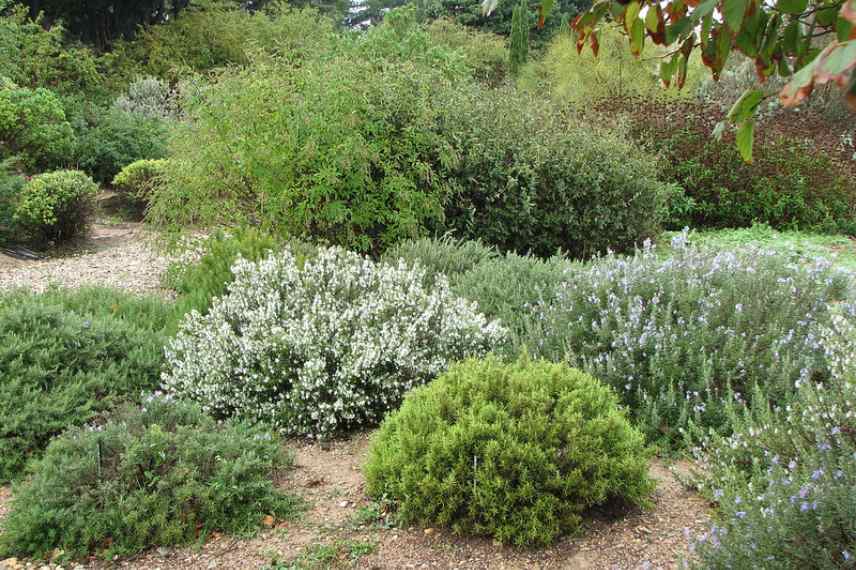
Collection of thyme at Filippi Nurseries’ trial garden (© Sean A O’Hara)
- Subscribe!
- Contents
Comments