





























How to choose a Japanese quince?
Our buying guide to finding the ideal Japanese quince
Contents
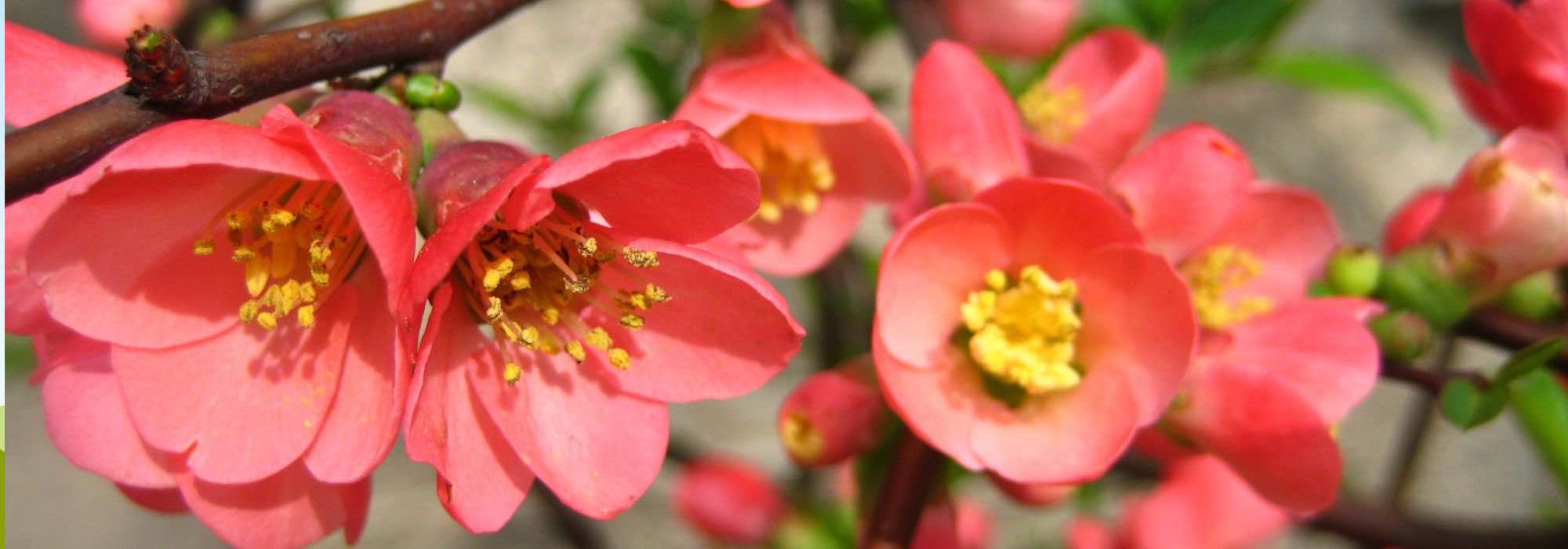
With its brightly coloured flowers and decorative fruits, the Japanese quince Japanese quince is a shrub full of appeal. Easy to grow and hardy, it offers early flowering from the end of winter, at a time when the garden and vegetation are still asleep. The red, pink, orange, coral or white flowers appear in small clusters on the bare shoots, even before the leaves appear. The flowering branches are used in the making of cut flower arrangements, especially in ikebana. In autumn, it’s the turn of the fruits, which resemble small apples or small quinces, to develop. They are fragrant and are delicious in jam. This deciduous shrub is usually thorny and can be planted in a defensive hedge or a shrub border. There are four species: the Japanese Chaenomeles japonica, and three Chinese Chaenomeles cathayensis, Chaenomeles speciosa and Chaenomeles thibetica, as well as two varieties: Chaenomeles superba with smaller, but more abundant flowers and smaller in size, and Chaenomeles speciosa with larger flowers and larger in size and later flowering. How to choose your Japanese quince? Discover our buying guide to choose a Japanese quince according to various criteria and to select the one that will suit you best.
Choosing a Japanese quince according to its size
There are Japanese quinces of all sizes, including small 1 m-tall shrubs that can be used as groundcover for shrubs up to 3 m tall, such as Chaenomeles cathayensis. Thus the Chaenomeles speciosa ‘Mango Storm’ reaches 1 m at ripeness, while the Japanese quince ‘Fire dance’ – Chaenomeles speciosa will reach 2 m, and the Chaenomeles cathayensis – Chinese quince will grow to 2.5 m. If you would like a larger quince, you can choose the Japanese quince ‘Toyo-Nishiki’ – Chaenomeles speciosa which can reach 3 m tall, or the Pseudocydonia sinensis – Chinese quince which can go up to 5 m tall.
Choosing a Japanese quince according to the colour of its flowers
Japanese quinces are prized for their striking, vibrant flowering. The bare shoots are covered with small clusters of waxy flowers in single or double forms, in attractive colours.
Red flowers
If you like red-coloured flowers, you’ll have a choice of several shades. You can choose the bright, scarlet red of Chaenomeles superba ‘Nicoline’ or the deep, velvety red of Chaenomeles speciosa ‘Scarlet Storm’, whose large flowers resemble camellias. Other shades are offered, such as the bright, vivid red of the Chaenomeles x superba ‘Texas Scarlet’ or the deep scarlet red of the Chaenomeles x superba ‘Etna’.
→ Read also: Japanese quinces with red flowers: a splash of colour in the heart of winter.
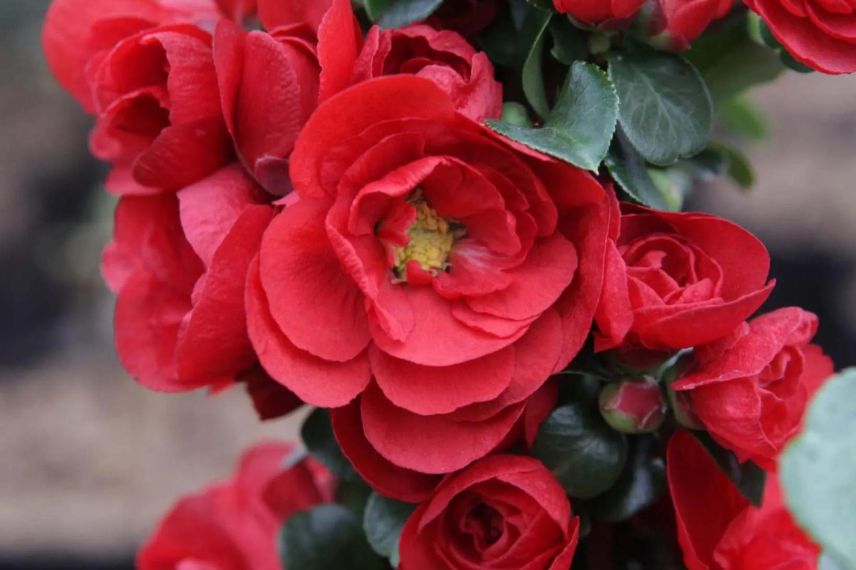
The ‘Scarlet Storm’ variety
Pink flowers
If you favour softer, pastel colours, you can opt for a pink-flowered Japanese quince. Be tempted by the range of pink shades in the single flowers from Chaenomeles speciosa ‘Toyo-Nishiki’. Or perhaps you prefer the bright pink of the single flowers of Chaenomeles speciosa ‘Pink Lady’ or the double flowers of Chaenomeles speciosa ‘Pink Storm’. There is also the carmine pink of Chaenomeles speciosa ‘Eximia’.
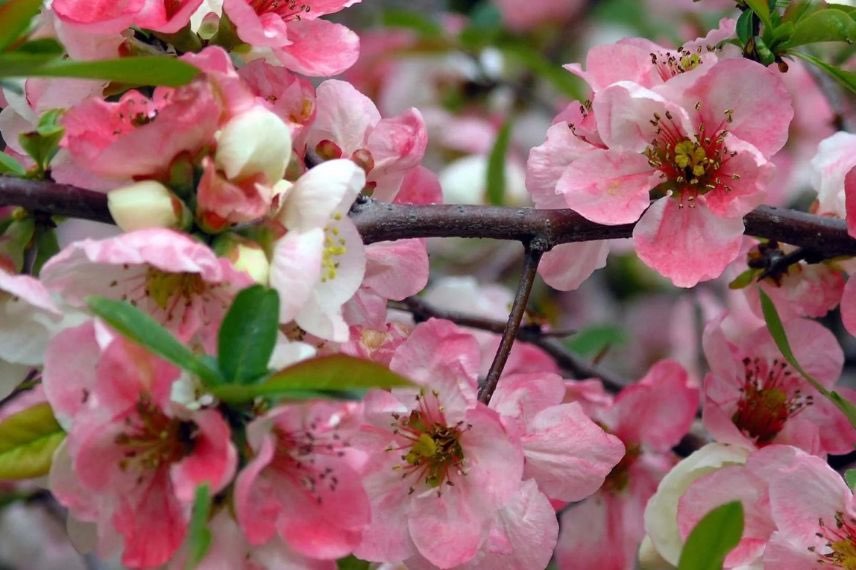
The pink flowers of Chaenomeles ‘Tokyo-Nishiki’
Orange or salmon flowers
Orange ranges from the brightest to the softest. The Japanese quince ‘Cameo’ offers salmon-pink single flowers while the Chaenomeles speciosa ‘Orange Storm’ yields double flowers reminiscent of camellias in brilliant orange.
White or green flowers
Some Japanese quinces produce white flowers, such as Chaenomeles speciosa ‘Yukigoten’, with double cream-white flowers, or green flowers such as Chaenomeles speciosa ‘Kinshiden’.
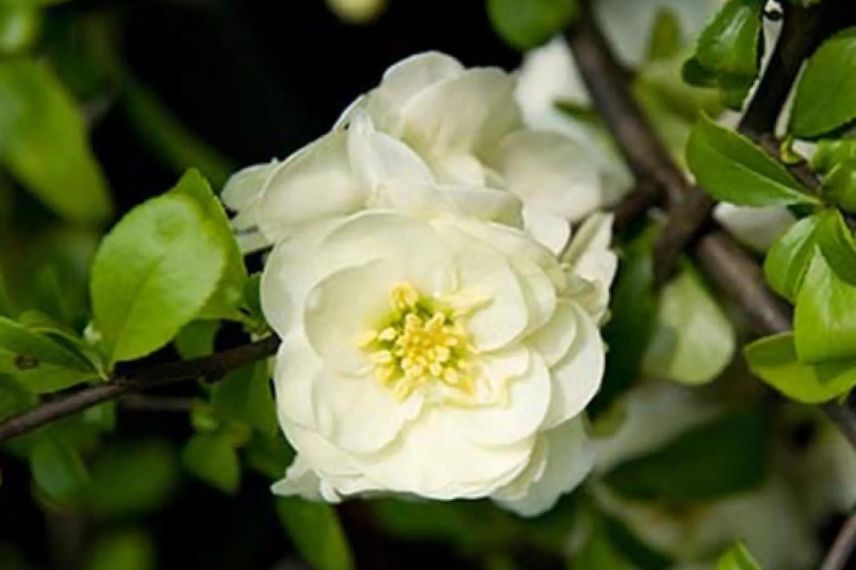
The Japanese quince ‘Yukigoten’
Choosing a Japanese quince according to its flowering period
Early-flowering Japanese quinces begin to bloom as early as February. This is the case for the Japanese quince ‘Toyo-Nishiki’ – Chaenomeles speciosa, Chaenomeles japonica – Japanese quince and the Japanese quince ‘Flocon Rose’ – Chaenomeles speciosa. Other Japanese quinces begin flowering from March, such as the Japanese quince ‘Jet Trail’ – Chaenomeles superba or the Japanese quince ‘Friesdorfer’ – Chaenomeles speciosa.
The flowering lasts 3 to 4 weeks and may extend as late as April, May or June. For example, the Japanese quince ‘Sargentii’ – Chaenomeles japonica, which can bloom from March to April, the Japanese quince ‘Rubra’ – Chaenomeles speciosa, whose flowering can occur from April to May, or the Japanese quince ‘Colour Trail’ – Chaenomeles x superba, which can bloom from March to June.
Choosing a Japanese quince according to its fruiting
You can choose your Japanese quince based on whether it bears fruit. Japanese quinces generally bear fruit in autumn, fragrant and edible for jams or jellies. They are, however, less palatable than ordinary quinces.
The Japanese quince ‘Cido’ produces large fruits that can be harvested from late August to October. They are yellow, with a tart flesh rich in vitamin C, which earned this bush the nickname ‘Lemon of the North’. Some Japanese quinces are purely decorative and do not bear fruit, as with the Japanese quince ‘Orange Storm’
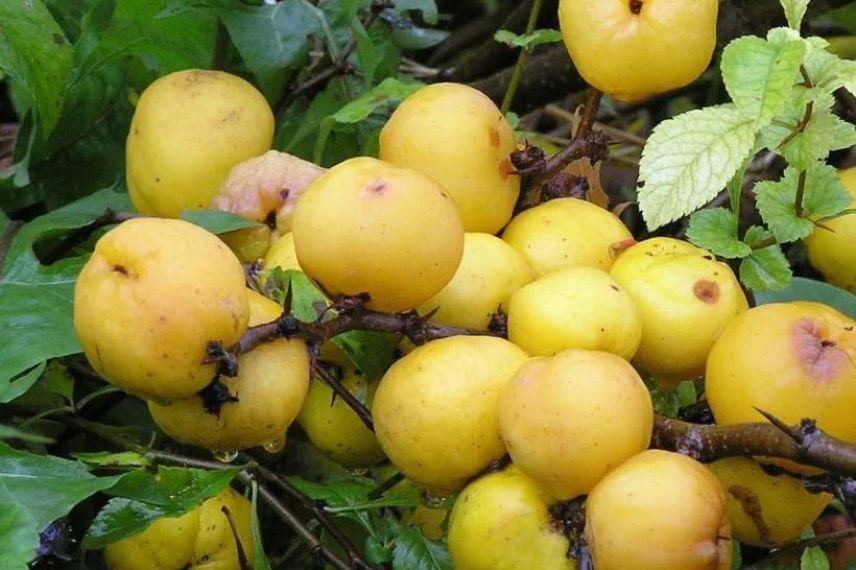
‘Cido’ produces large edible fruits in autumn
Choosing a Japanese quince according to its habit
Japanese quince shrubs display different growth habits. If you prefer a shrub with a compact, slightly twisted habit, opt for the Chaenomeles superba. For a slightly larger shrub, turn to the Chaenomeles speciosa.
In general, most Japanese quince shrubs form a dense, compact, rounded and upright habit. Chaenomeles japonica shows, for its part, a more prostrate habit.
Choosing Japanese quince according to its uses
The Japanese quince is suitable for a variety of uses in a garden or on a terrace. The more compact ones can be grown in pots or as groundcover, and all can be planted as standalone plants, inserted into a border or hedge. They can also be trained against a wall if they are tall enough.
As most Japanese quinces are thorny, they can also be used to create a defensive hedge and which will protect local wildlife and birds. There are, however, thornless Japanese quinces, such as the Japanese quince ‘Orange Storm’ – Chaenomeles speciosa. This advantage can also be useful if you want to use the shrub for cut flower arrangements.
For further reading, you can consult our comprehensive guide to planting and maintaining the Japanese quince.
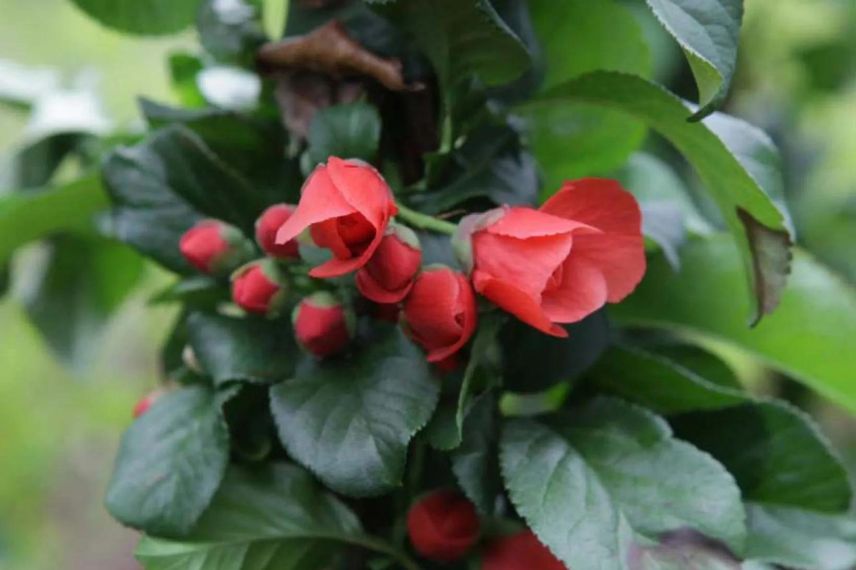
‘Orange Storm’ is thornless
- Subscribe!
- Contents
Comments