




























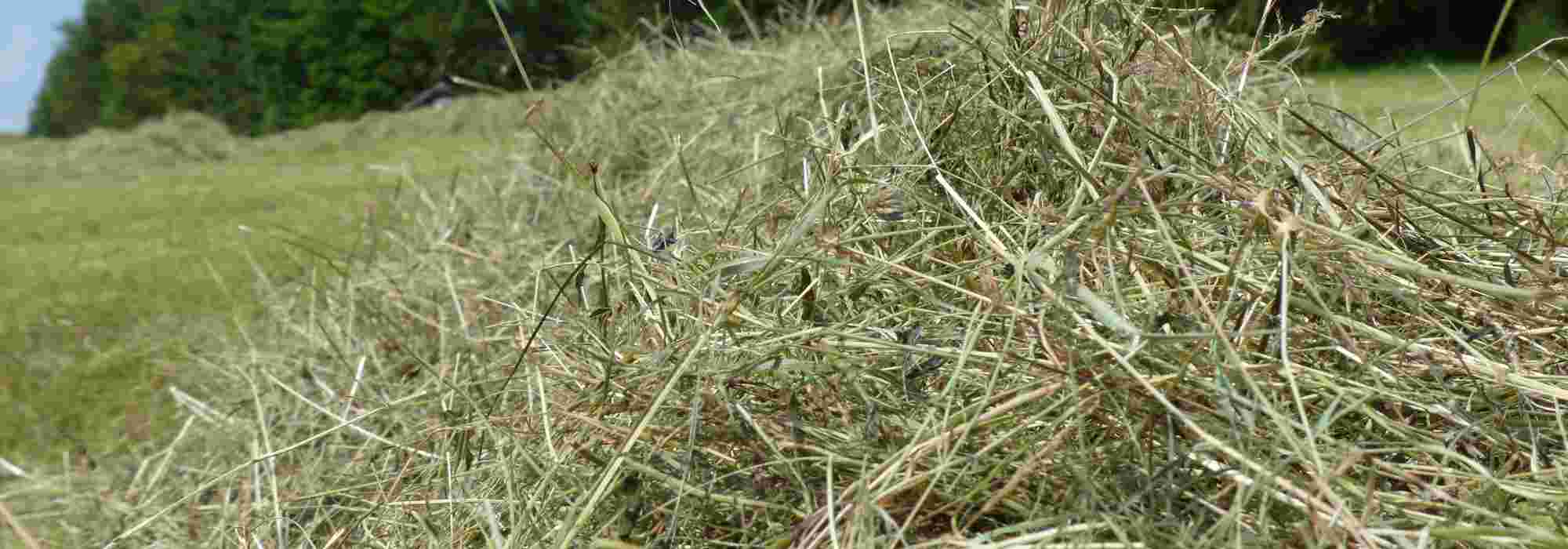
Hay: the natural solution for a productive vegetable garden
Discover all the advantages and disadvantages of hay in a vegetable garden.
Contents
As a gardener attentive to soil health, you consistently mulch your vegetables and soft fruits to prevent soil from becoming bare. Many types of mulch are available to choose from, with their advantages and disadvantages. All have the advantage of reducing watering frequency, feeding the soil and limiting the proliferation of weeds. Straw, lawn clippings, wood chips and dead leaves… are therefore common in the vegetable garden.
Your neighbour, just as skilled a gardener as you, uses hay to mulch his crops. Naturally, you wonder about its effectiveness. In appearance, hay may resemble straw, but it is a completely different material.
Let’s explore the uses of hay as mulch, but above all the advantages and disadvantages of this natural organic material.
What exactly is hay?
Hay is simply the herb found in meadows and prairies. It therefore contains all the common grasses and legumes that are ryegrass, fescue, orchard grass, sainfoin, clover, lucerne…to which wild plantss are added such as dandelion, plantain… When these herbs have reached an optimal growth stage, just before heading, they are mown and dried, then laid in windrows or in sheaves. Consisting of leaves and non-lignified young stems, hay is light. Hay must be kept sheltered from the weather. It is fodder used to feed herbivores, whereas straw is only used as litter.
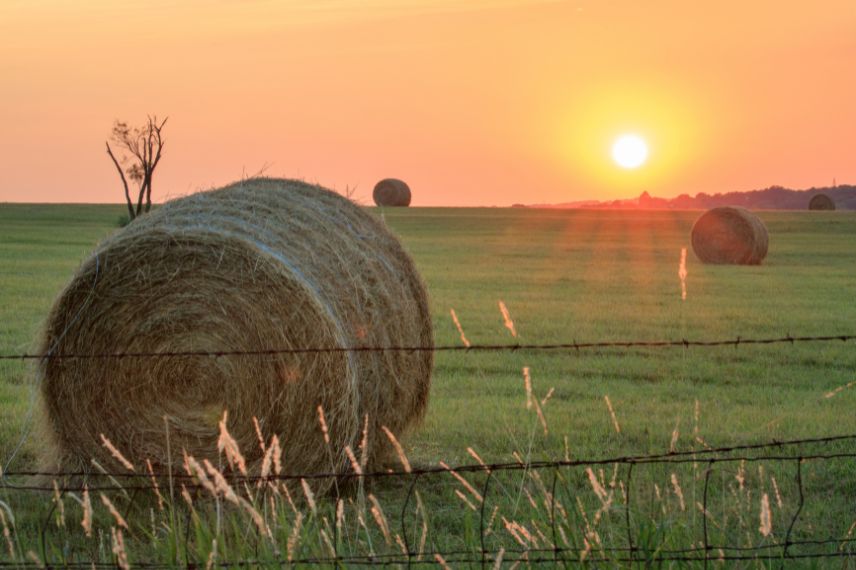
Hay consists of grasses, legumes and wild plants
As this hay is made up of herbs, it offers a perfect balance between carbon and nitrogen. In comparison, straw is very rich in carbon. During the decomposition of hay, the soil will be nourished in a perfectly balanced way. Whereas during the decomposition of straw, soil nitrogen is mobilised for this process, to the detriment of crops. This can cause nitrogen deficiency in vegetable crops, which can be offset by the addition of dry lawn clippings, urine, compost… With hay, no risk since it contains just the right amount of carbon without retaining too much nitrogen. Provided that the hay is of excellent quality and stored in good conditions…
Hay enriches the soil without placing demands on it as straw would. As it decomposes, it turns into humus while nourishing micro-organisms. Hay is therefore mainly beneficial to the soil, not to the crops.
Read also
What mulch for the vegetable garden?Benefits of hay
The main advantage of hay lies in its ability to enrich the soil and provide humus over time. Indeed, hay breaks down over several months. Its bioavailability is therefore relatively slow but very interesting for the soil due to its carbon/nitrogen balance.
That’s why using hay as mulch presents all the advantages of mulching. It is an effective soil cover at several levels:
- It helps to space out watering as it retains moisture in the soil and limits water evaporation
- It limits the proliferation of adventive weeds by depriving them of light, it prevents weeds from establishing themselves permanently
- It promotes soil biological activity by enabling micro-organisms to develop and feed
- It acts as insulation against cold in winter and against heat in summer
- It reduces soil erosion caused by wind or rain
- It prevents the formation of a surface crust caused by the weather
- It keeps vegetable crops clean
- It slows the development of diseases as vegetables are not in direct contact with the soil.
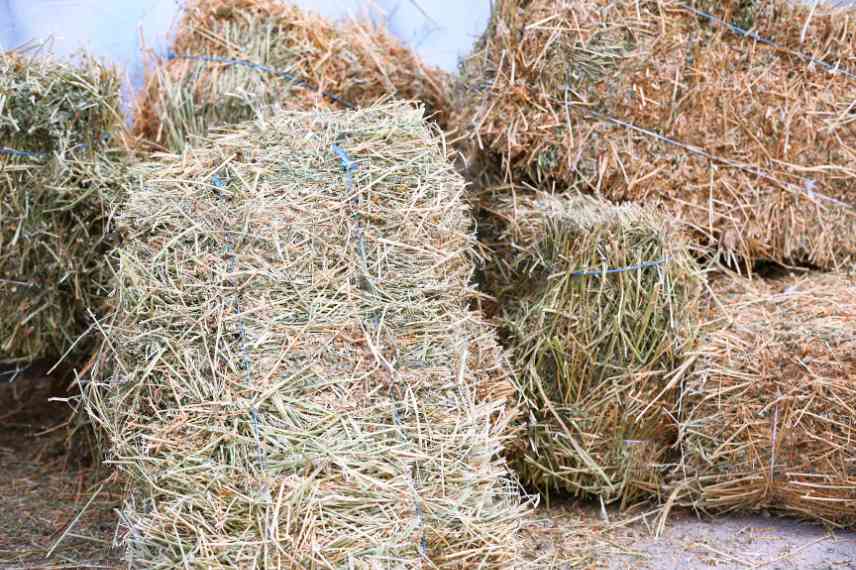
Hay makes an excellent mulch for vegetable crops
Of course, these advantages apply only if the soil is dug and loosened, well-aerated and structured, sufficiently moist and already warmed. Mulching with hay on dry, compacted soil will be completely counter-productive.
Limitations and disadvantages of hay
Hay is therefore as good a mulch as other mulches, but it also has some non-negligible drawbacks. To start with the constraints it imposes in terms of transport and handling. Indeed, a bale of hay is heavy and difficult to move. Not to mention that you need ample space to store it under cover. Moreover, obtaining it can be quite tricky. As hay is a preferred supplementary feed for cattle, sheep and horses, your neighbouring farmer will always prioritise his animals. And, in these periods of recurring drought, hay becomes a highly sought-after feed in summer. So, if a farmer supplies you with hay, the bales are likely to be damaged, or of poorer quality because stored in poor conditions. As for hay sold by garden centres, it often commands high prices!
Beyond these very practical aspects, hay can attract or harbour dreaded pests. More than other mulches. Indeed, for slugs and snails, hay is a boon as they find a refugium of choice against their predators, warm and snug. Mole-rats and other garden rodents are likely to thrive and proliferate under this luxury shelter.

Hay, used as mulch, also has drawbacks
Some gardeners find that hay mulch is not compatible with sowing. Indeed, sowing under this protective layer is not easy, especially for small seeds. To overcome this difficulty, simply open a furrow by pushing the hay to the sides, or simply remove the hay for sowing. It can then be laid back once the seedlings have grown tall enough.
Hay can also be criticised for being too insulating, especially in spring. When laid in thick layers, it prevents the soil from warming up. This drawback is not specific to hay and can be attributed to all other mulches! Again, simply uncover the mulch in spring.
Finally, the main drawback lies in hay’s propensity to germinate. Indeed, hay consists of grasses, but also of annual, biennial or perennial plants, potentially rich in seeds, which can easily germinate and become tenacious adventive weeds.
Read also
The different organic mulchesHow and when to use hay?
If you have hay for free, you can still test its use as mulch. With a few precautions:
- Spread your hay in autumn so that it has enough time to decompose before spring. It will thus feed your soil evenly over the winter. Then, in early spring, allow the soil to warm up before sowing and planting your first crops. You will lay hay mulch when the seedlings are sufficiently developed and temperatures begin to rise.
- Install your hay mulch on well-worked and decompacted soil, and, most importantly, weeded
- Use hay in a thick layer of at least 20 cm and renew it during the season (it may decompose in two to three months).
- Subscribe!
- Contents
Comments