





























Harvesting and consuming tree sap: our tips
How to harvest tree sap yourself?
Contents
Tree sap is frequently cited in herbal medicine as beneficial to health. Its harvest and use date back to ancient times, and were practiced in many Nordic countries and by Native Americans, before spreading to our latitudes. Birch is the tree most commonly used for its sap, but there are a few others. A nourishing liquid at heart, let us uncover the secrets of sap harvesting and its benefits.
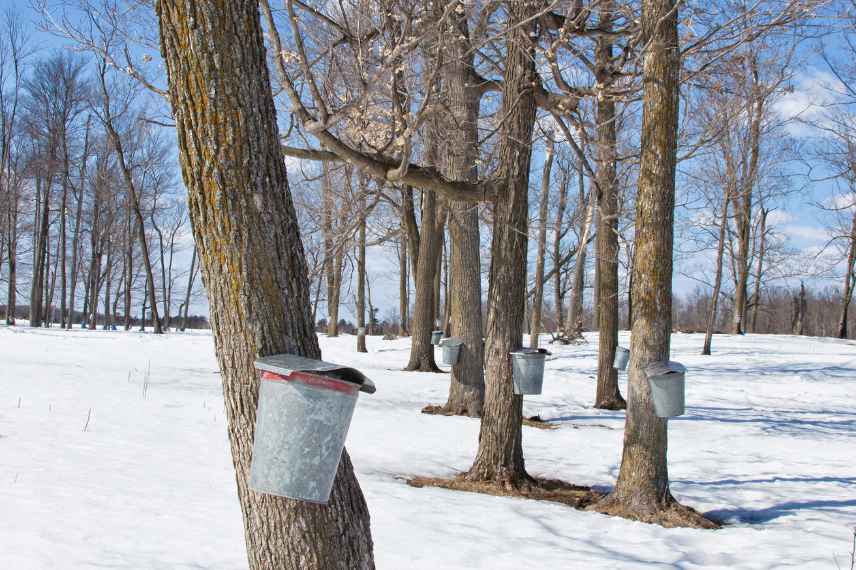
Maple sap harvest in Wisconsin

Sap: its role and mode of action
Sap is the lifeblood of a plant. It is a little like the blood that runs through our veins, transporting water, nutrients, minerals, proteins, amino acids and sugars, essential to the development of trees and plants. But the comparison ends there, for sap follows a closed circuit: it is the tree’s source of nourishment, which, static, cannot move to find food. And then, it does not circulate in winter, when plants enter a resting phase.
The ascent of sap takes place at the start of spring, at the moment when young shoots form. It circulates again, from base to top, drawn up by the roots: this is crude sap that contains only water and mineral salts drawn from the soil, thanks to the absorbent root hairs. It flows up through the tree’s sapwood via a network of vessels (the xylem), to the twigs, and will feed the growth zones and the buds, turning them into leaves and flowers. How can such a phenomenon occur? Simply by what is known as osmotic pressure, a complex process that could be summarised as an effect of suction and pressure at the level of the roots (combined with evapotranspiration when the leaves have unfurled), enabling water to be drawn up from the roots and an upward tension.
The sap that descends is elaborated sap: by the mechanism of leaf photosynthesis and gas exchange, it has been modified and enriched with sugars (carbohydrates), starch, nitrogenous matter and nutrients. This elaborated sap follows another path, via the tree’s phloem: it is a nutrient-rich sap, feeding all parts of a plant (trunk, leaves, stems, twigs, buds, flowers and fruits) but also the storage organs that are bulbs and rhizomes.
It is crude sap that is tapped from trees.
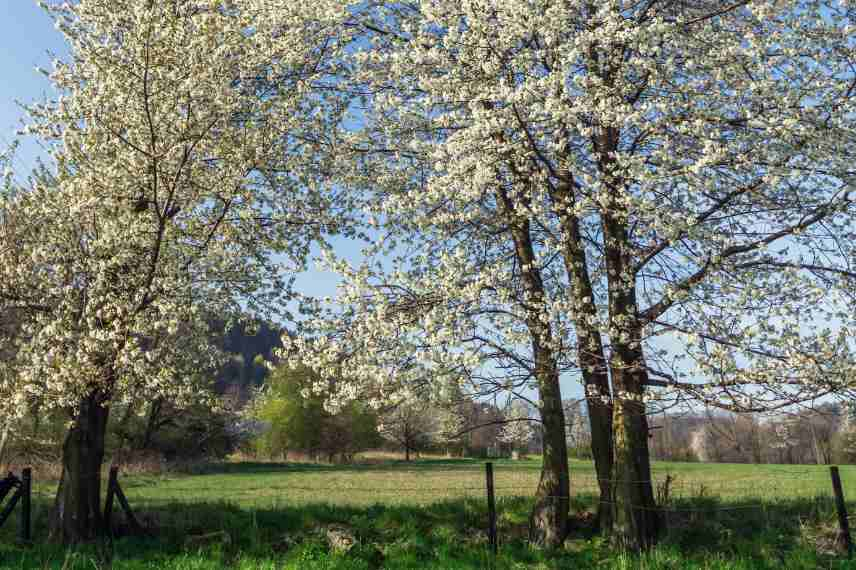
The trees come back to life in spring thanks to the sap that circulates once again
Read also
Birches: planting, pruning and careWhich trees have their sap harvested?
If sap flows in all trees, only some are traditionally recognised and used for their regenerative properties, and are easy to harvest.
We use different species of trees, and it varies according to the sugar content in the sap (those with a high sugar content are most often processed into syrup). Trees growing in colder regions and countries will produce sweeter sap.
Note that mature trees produce less than young trees, however overly young trees will not be suitable. So, which are the best tree saps?
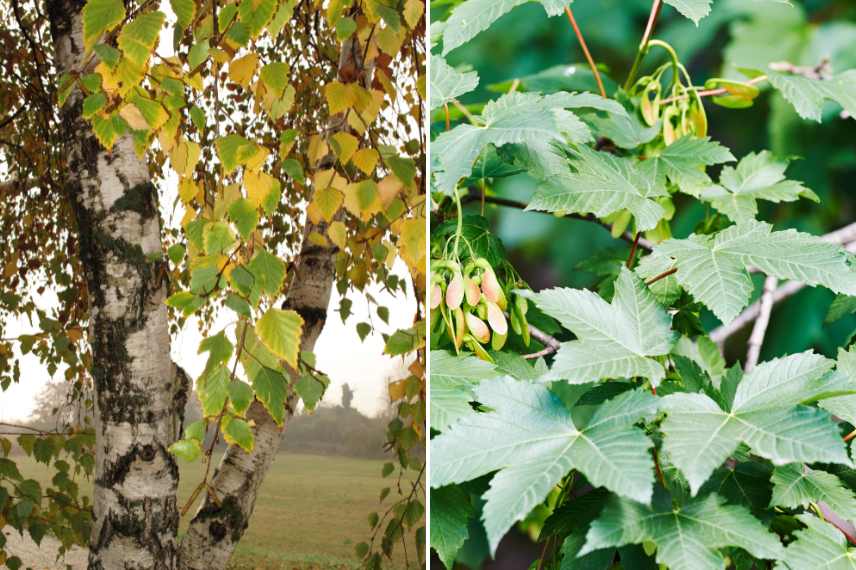
- birch : the undisputed star for this use, birch is the tree from which sap is most often harvested. Two species are particularly suited: Betula pubescens and the Betula pendula (verrucous birch).
- sycamore maple : among the maples, it is the one most often used to harvest sap. In Acer saccharum or the sugar maple, emblem of Canada, it is indeed the sap that will be harvested, but it will, for its high sugar content, be transformed by cooking into maple syrup afterwards. In these trees, it is the cold that engenders a sap that is very sugary, as they protect themselves against freezing temperatures.
- linden : it possesses fewer therapeutic properties than birch, but is nevertheless interesting for its draining and antispasmodic effect. It is often the Tilia cordata or small-leaved lime and the Tilia sylvestris that are used
- alder : another edible sap from this tree used frequently with buds in gemmotherapy.
N.B.: In pines, resin is collected, called gemma or gum in botanical terms. For this, the bark is incised: it is the famous gemmage, widespread mainly in heathland with maritime pines, where one can observe pots of resin hanging from the trunks. For Pistacia lentiscus, it is a resin called mastic that oozes from the tree once incised, very widely used in Greece on the island of Chios in pastry making.
When and how to harvest?
The harvest period
We harvest the sap at the moment of sap flow, which will vary with the mildness of your climate and with a winter that may be milder or harsher. It is at the end of winter that we begin to tap trees to let the water run out.
The harvest lasts about a month, from late February to late March. The trees are just starting to bud. The amount of sap extracted from a healthy, mature tree will always be small compared with the volumes of sap transported by the tree. We could compare this sap uptake to a blood sample taken from humans!
The gap between day and night temperatures is also important, especially if you intend to harvest sap for turning into syrup: in that case choose the day after a very cold night (-5°C) and a day that is milder and very sunny (at least 5°C).
Finally, the optimal period coincides with a rising moon, when sap flows are ever more substantial.
→ Read: Phenological indicators: what is it?
Different harvesting techniques
There are several harvesting techniques, which vary according to the type of tree.
In all cases, you will need to be careful and respectful of the tree in order to harvest the sap without damaging it. The equipment should therefore be clean and disinfected, to guarantee good sap quality and optimal protection of the tree. The tree on which you proceed must be healthy and have a trunk with a circumference of at least 25 cm.
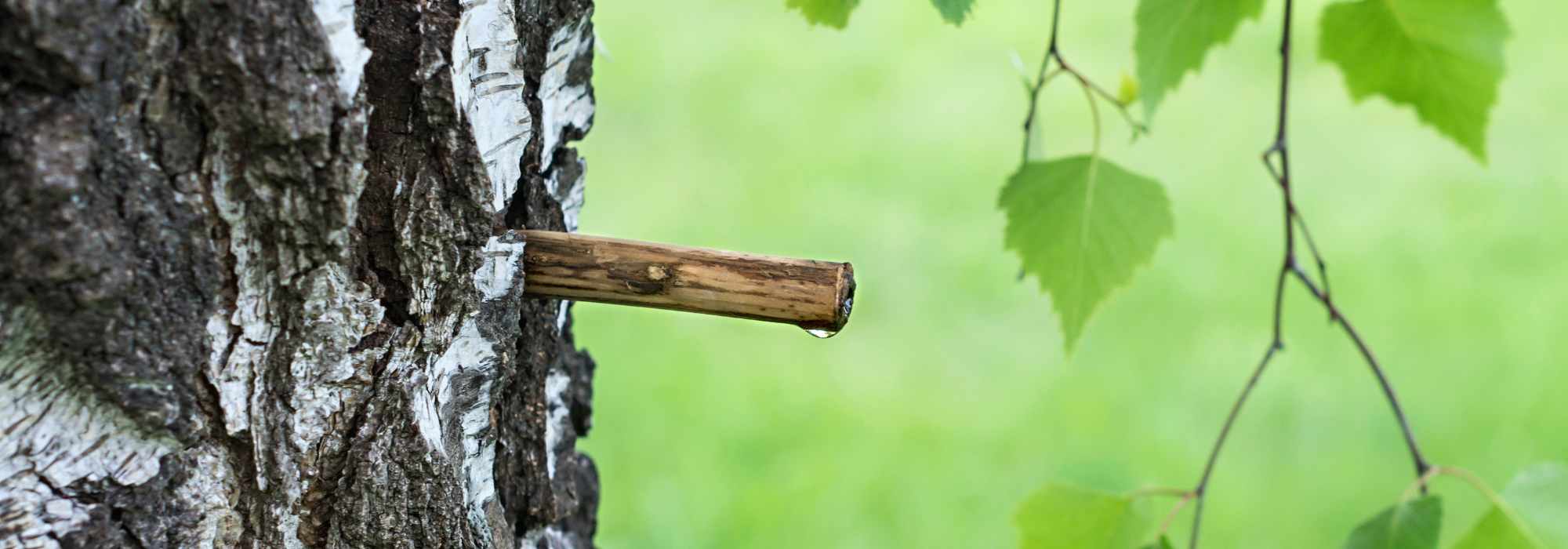
For birches, the technique most commonly used is to bore a hole to collect the precious sap : you will need an auger and a 3–5 mm drill bit (or a hand auger), a tube and a bottle or container to collect the sap.
Start by drilling to a depth of 1–2 cm, at a bevel and at the base of the trunk (between 50 cm and 1 m above the ground), as close as possible to its base which is richer in trace elements.
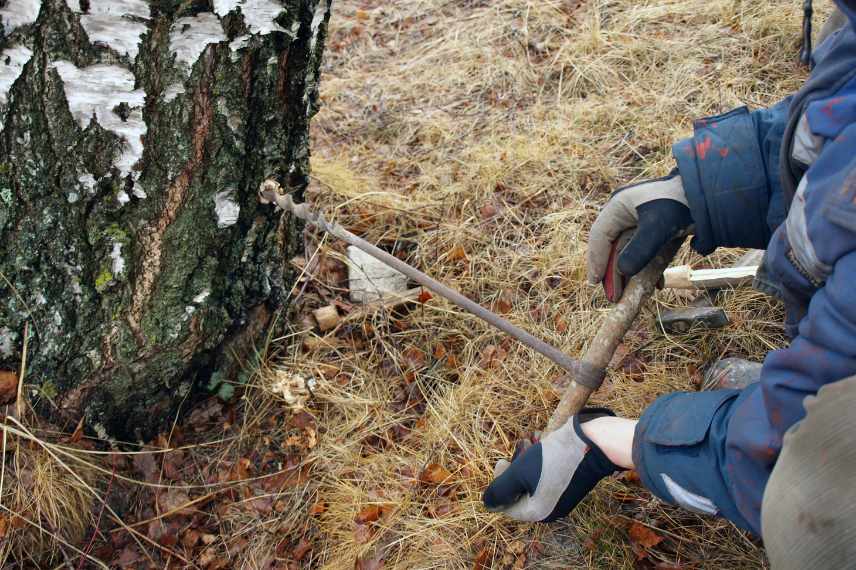
Drilling a small hole with an auger or a drill
Have a small tube prepared: ideally made from a branch of non-toxic wood – hazel, for example – whose centre has been bored along its length (or shaped into a groove), and the end bevelled to insert into the bark. You can also use a food-grade plastic tube, which will likewise be the same diameter as the drill bit. This plastic or wooden tube measures between 15 and 20 cm in length. Push it into the trunk, then secure its stability with a mallet if it is wooden.
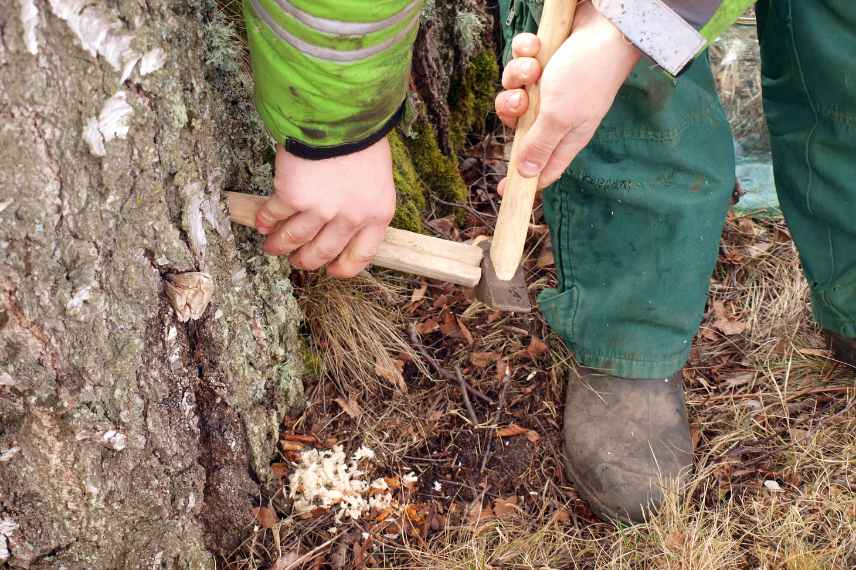
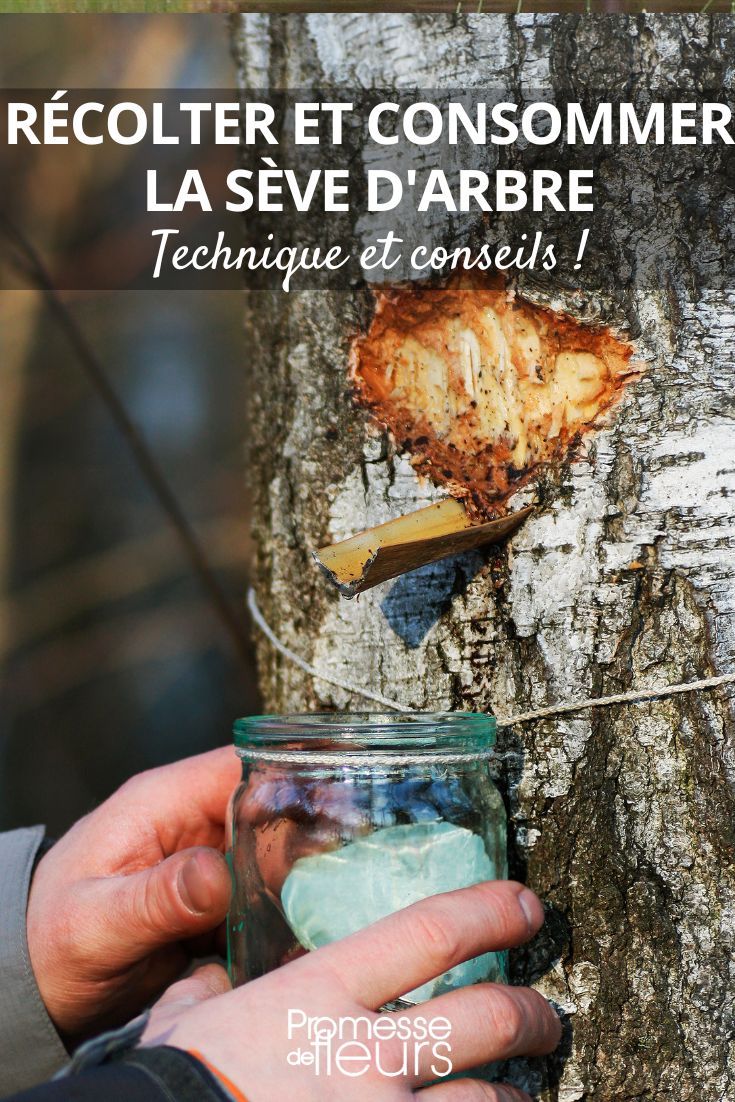
The sap starts to flow drop by drop. All that remains is to suspend a bottle or a glass jar, also perfectly clean, preferably opaque, and large enough to hold the sap (1–3 L): fasten its neck with a sturdy string around the trunk, just below the sap outlet. A small filter (type muslin or coffee filter) placed over the opening of your collection container will yield a liquid free of impurities. At home, decant this water into a clean, sterilised bottle.
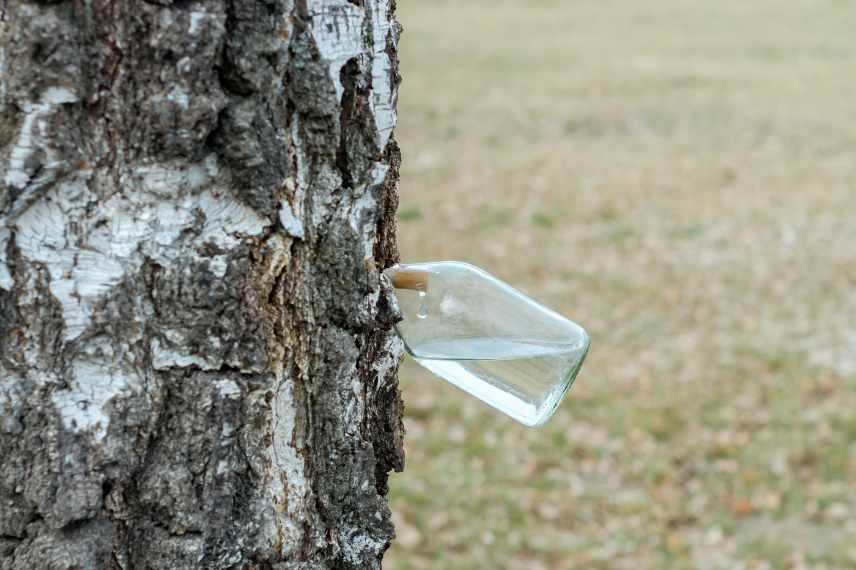
Once the quantity harvested is collected (on average 1 litre of sap in 3–5 hours, and up to 5 L of sap per day), you will seal the hole to help the tree heal: either with clay, or with another piece of hazel stem if that is the wood you used, to close the hole as tightly as possible. Cut the stem flush with the bark; it will form a kind of stopper or plug, which can be sealed further with green clay.
Another technique involves arching a branch of the tree, weighting it down with a weight, and suspending, once the end is cut (on a branch about 3 cm in diameter), a bottle that will serve as the collection container. Choose one of the lower branches for this.
Finally, a last technique concerns resinous trees: you notch and incise to make the resin flow.
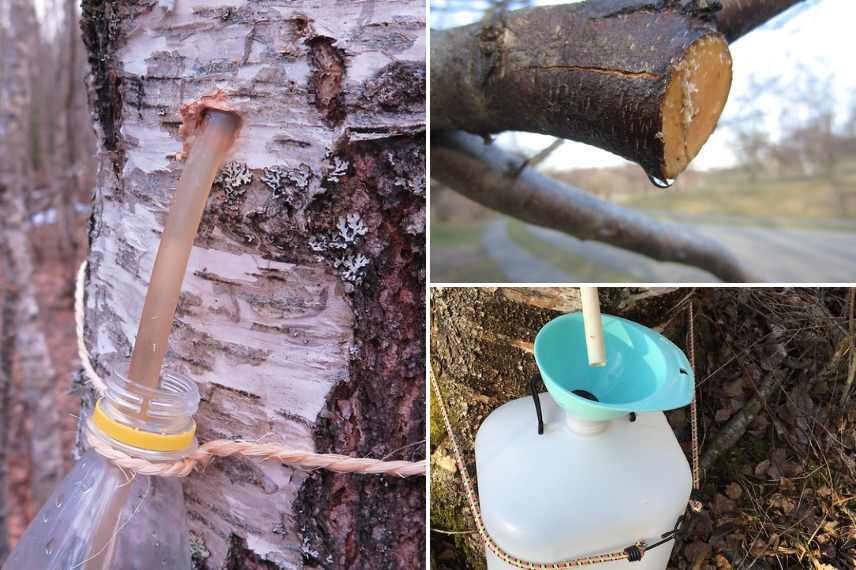
Birch sap extraction: by a bottle suspended, at the end of a branch or with a jerry can placed on the ground
Read also
How to dry birch leaves?Consuming tree sap: benefits and precautions
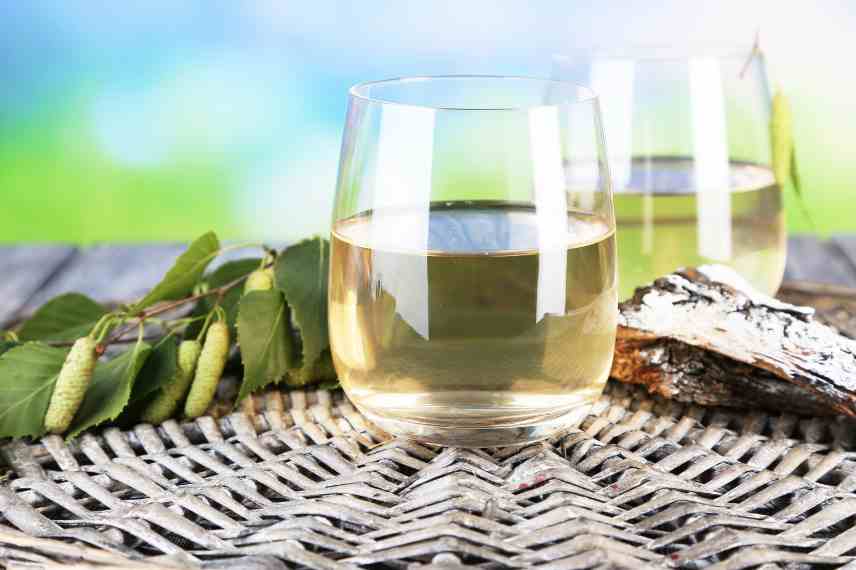
Tree sap contains minerals and trace elements, but also vitamins and antioxidants. It typically appears as a colourless liquid, resembling clear, opalescent water. Birch water, for example, is sometimes used to refer to this tree (not to be confused with birch juice, obtained from boiling its leaves).
Composed mainly of water (95% or more), sap generally has no taste, or a slight woody and sweet taste in birch. It has nutritional properties and health benefits. It is said to be draining, purifying and detoxifying.
Tree sap harvested at home should be consumed fresh to retain all its benefits. So, take only what you need (1–2 litres is sufficient), which you will use for your course. Store it in an airtight glass bottle in the fridge. This sap is consumed on an empty stomach, neat or diluted in juice. Ideally, collect sap for 3–4 days, and restart the process.
Regarding the various transformations of sap, we have discussed syrups. This is the most common use, which requires boiling to achieve a syrupy consistency (but with maple-like sweetness). The saps can also be fermented to obtain meads or sparkling drinks.
Birch sap cures are often recommended after winter, for three weeks, to be taken in the morning on an empty stomach. It is indeed a major seasonal shift when our body could do with a little boost. The advice of a health professional (your GP, a pharmacist or a herbalist) is nevertheless essential before starting such detoxifying cures, which can have deleterious effects on the kidneys and other excretory organs such as the liver or intestines. The amount that can be consumed and the duration of the cure will also be determined by a doctor.
Finally, we are talking here about a harvest in a private setting. Harvesting in a forest would indeed be interesting for soil quality, rich in humus, beneficial to the sap, but it is strictly forbidden (even if some do so unscrupulously!). In the event of a flagrant breach in state forests, forest wardens may issue a penalty notice and a fine. The best is to collect from trees on your own property, in an area left unmanaged, or on land where the owner has given you permission to do so.
- Subscribe!
- Contents
Comments