






























Growing Bidens in pots for vibrant flowers
Our planting and care tips
Contents

Why grow Bidens in pots?
Bidens grow very quickly and are very floriferous. They require little water and are particularly suited to container growing or hanging baskets, and are fairly tolerant of heat and occasional drought.
As they are very frost-prone, growing them in pots allows you to bring them indoors before the first frosts, in a bright, heated space where the temperature does not fall below 5°C to preserve their delicate foliage. You can put them back outside during the warmer months.
Their endless flowering from May through to the first frosts makes them a top choice for quickly brightening up beautiful container plantings, window boxes or hanging baskets to adorn sunny windowsills, balconies or terraces.
Read also
Bidens: planting, growing and careWhat type of pot? What size?
Bidens requires sufficient space for the development of its root system. A pot that is too small will limit its growth and may lead to water stress, whereas a pot that is too large may retain excess water, thereby promoting root diseases. As a general rule, choose a pot with a diameter and depth of at least 20 to 30 centimetres to allow healthy plant growth.
Terracotta pots are often recommended for growing Bidens due to their ability to absorb excess moisture, thereby reducing the risk of root rot. However, plastic or resin pots can also be suitable, provided they have adequate drainage holes.
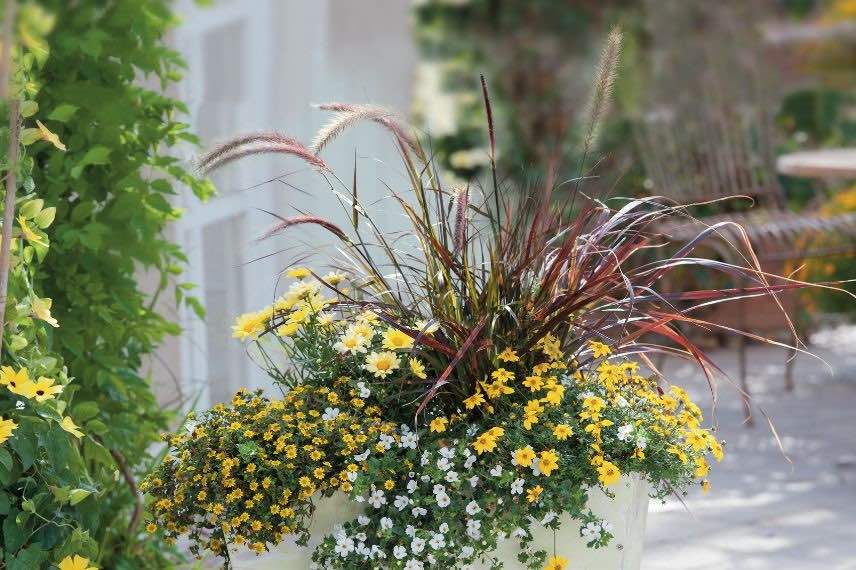
Create a planter with a variety of plants including Bidens
Which substrate?
Bidens need a light, humus-bearing soil, not too calcareous, but especially well-draining. They thrive in a substrate rich in organic matter that will supply them with the essential nutrients for their growth and long-lasting flowering. Choose a high-quality potting compost for flowering plants, enriched with compost or well-rotted manure to feed the plant throughout its growing season.
Good drainage is crucial to prevent excess moisture around the roots. Add perlite or sand to improve the substrate structure and promote adequate drainage. Also include clay balls or gravel for the bottom of the pot.
Use an organic mulch to keep the substrate fresh between waterings.
Read also
The ABC of Pot PlantingWhen and how to plant?
Plant your Bidens in pots after the last frosts, around May or earlier in mild climates. You can also plant them indoors, in a bright, lightly heated room, while waiting to move them outdoors, to speed up flowering.
Here’s how to proceed:
- Place a layer of gravel or expanded-clay pellets a few centimetres deep at the bottom of the pot before adding the substrate.
- Add the prepared substrate, filling the pot to about halfway.
- Gently remove the Bidens from its original container, taking care not to damage the roots.
- Gently loosen the roots if they are wrapping around or compacted.
- Place the Bidens in the pot, ensuring the top of the root ball is about 4 cm below the rim.
- Fill the spaces around the plant with the substrate, gently firming to remove air pockets and ensure good contact between the roots and the soil.
- Water.
- Fill any remaining air pockets with potting compost and water again.
Exhibition
This plant needs plenty of light to thrive. Bidens is a plant that thrives in full sun or in partial shade. Direct sun exposure for at least 6 to 8 hours a day is ideal to stimulate abundant flowering. However, in very hot and sunny regions, protection from the afternoon sun can be beneficial to prevent water stress and leaf discolouration.
Watering and fertilisers
Watering
Bidens is not particularly thirsty for water, but like any potted plant it needs regular help to rehydrate the substrate, which dries out more quickly than in the open ground. Its flowering will be more prolific if the substrate stays uniformly moist. However, too frequent or excessive watering can lead to root rot. Let the substrate dry slightly between waterings, then water thoroughly until water drains from the pot’s drainage holes. During hot, dry months, monitor the substrate’s moisture closely, as potted plants can dry out quickly. During the active growth period, regular watering is necessary, while in winter, reduce the frequency to accommodate the plant’s slower metabolism.
Fertiliser
To support its vigorous growth and generous flowering, Bidens will benefit from regular fertiliser applications. Use a balanced liquid fertiliser for flowering plants, applied every two to four weeks during the growing season (spring and summer). Follow the manufacturer’s instructions to dose the fertiliser correctly and avoid over-fertilising, which could be detrimental to the plant.
Care
Pruning and tidying
Bidens can sometimes become unruly or sprawling, especially after a heavy flowering. To encourage new growth and further flowering, feel free to prune the spent or overly long shoots. This will prompt the plant to produce new shoots and flowers. Additionally, regularly remove spent flowers to keep the plant looking neat and promote ongoing flowering.
Monitoring for diseases and pests
Although Bidens is relatively hardy, it can occasionally be affected by fungal diseases or parasites, such as aphids. Inspect your plant regularly for any signs of trouble, such as leaf spots, distortions or the presence of small insects.
Winter protection
Below 5°C, Bidens can be brought indoors into a sheltered space such as a conservatory or a bright, lightly heated room. Reduce watering and suspend fertilising during this rest period.
Repotting
If you have overwintered your Bidens, annual repotting may be necessary to give the plant enough space for growth and a fresh growing medium. Choose a pot that is slightly larger. This operation is also an opportunity to divide overcrowded clumps, thereby propagating your Bidens.
- Subscribe!
- Contents

Comments