





























Growing a Serviceberry in a pot
The best varieties and our tips for planting in a large container
Contents
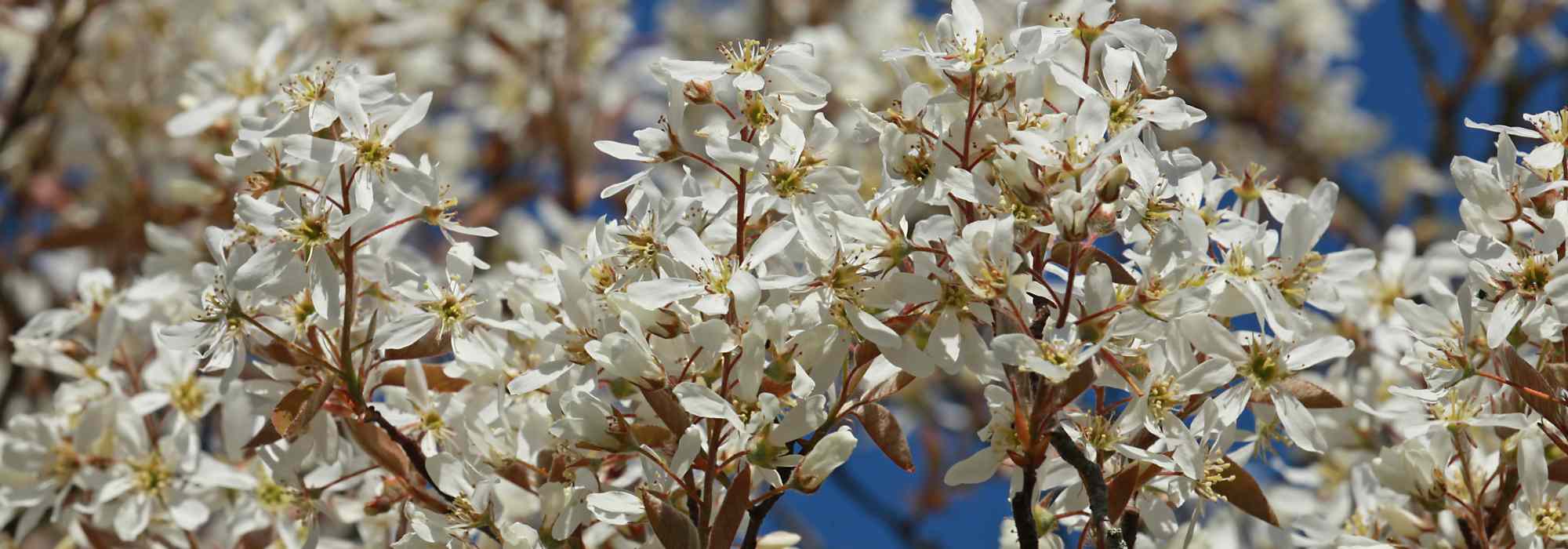
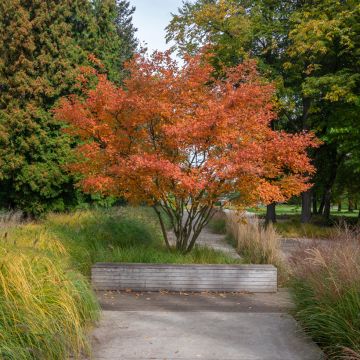
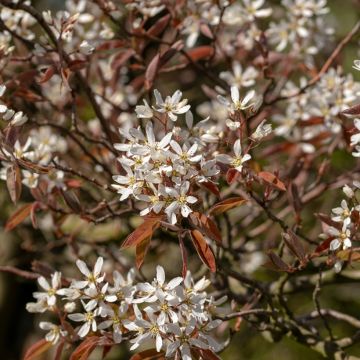
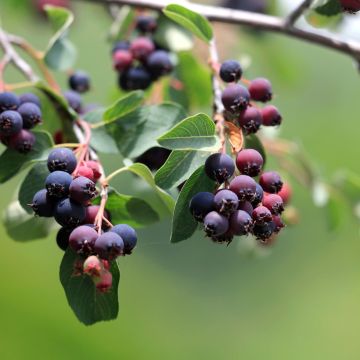
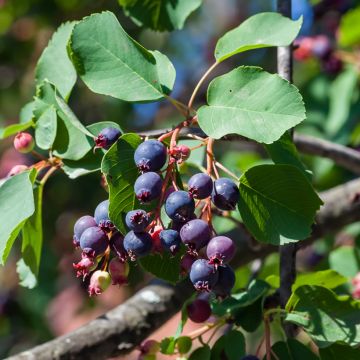
Amelanchier or serviceberry is one of those ornamental bushes that shine across multiple seasons and boasts numerous qualities: enchanting white flowering in spring, edible summer fruit, deciduous spring foliage that turns stunning orange-red hues in autumn, and excellent hardiness.
Belonging to the rose family, from which it derives its graceful star-shaped flowers, there are about thirty species, with the most common in our region being Amelanchier lamarckii and Amelanchier canadensis.
Typically planted in gardens as hedges or in shrub borders, it is possible, provided you choose the right variety, to grow an Amelanchier in a pot: for instance, in a city garden, as it tolerates urban pollution well, or on a large terrace.
Varieties, planting and care tips… We’ll tell you everything you need to know to adopt the serviceberry on your terrace!

Amelanchier canadensis

Which varieties?
Canada serviceberry (Amelanchier canadensis) is often mentioned and used for pot planting, as it is one of the smallest, featuring an upright habit, and is readily available in the market. It is therefore more advisable than Amelanchier lamarckii, which has a too open silhouette and is larger in size. However, the habit of the serviceberry, initially upright, broadens with age, the crown becomes looser, and the bush takes on wider than tall proportions…
New upright cultivars are therefore more suitable: the most relevant variety for this container use is undoubtedly the Amelanchier alnifolia ‘Obelisk’. This is a narrow-leaved serviceberry particularly well-suited for pot cultivation, due to its slender form and density. It will be suitable for the smallest balconies and terraces. The Amelanchier canadensis ‘October Flame’ with a columnar habit is another interesting option for its very fastigiate appearance (2 m tall with a spread of less than 2 m).
Finally, if you have a rooftop terrace or a very large terrace, you might consider two slightly more spreading serviceberries:
– Amelanchier spicata, less commonly seen in nurseries and garden centres, which remains a recommended species, as it will not exceed 2 m in height in a pot, and features upright branching.
– Amelanchier ovalis, or common serviceberry, of European origin (syn. Aronia rotundifolia), is another possibility, as it remains small (2 m) with its golden foliage in autumn and narrow silhouette. It is advisable for a large terrace, even if a bit windy, with enough space as its habit remains spreading. Additionally, this variety is particularly productive.
→ Read our article: Choosing a serviceberry
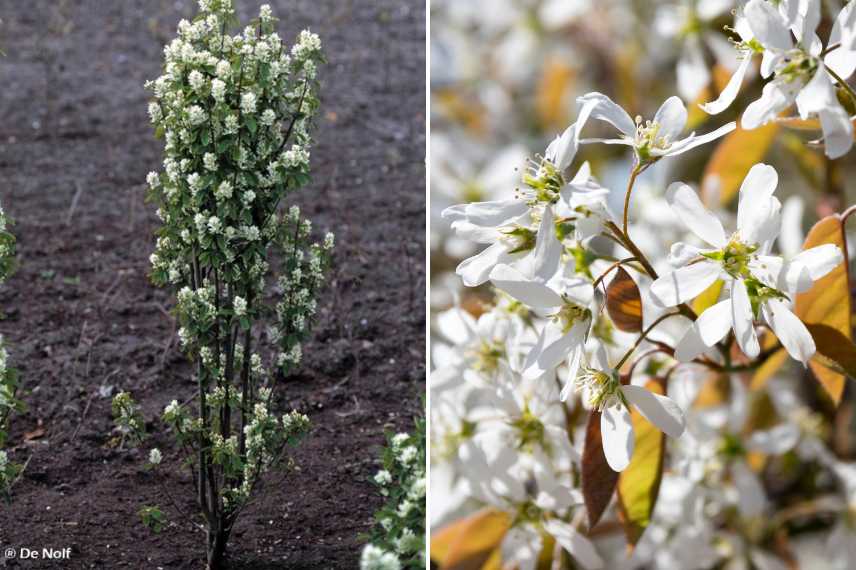
Canada serviceberry ‘Obelisk’ on the left and the flowering of a serviceberry spicata on the right
Read also
Amelanchier: planting, pruning, growingWhat type and size of pot?
We are dealing with Amelanchier, a very beautiful bush that reveals all its splendour in the ornamental garden. It is nonetheless a large bush or rather a small tree, and for it to develop properly in a container, the choice of pot will be crucial.
In this case, we will rather refer to a trough: do not skimp on the purchase of this container, and choose one of at least 600 L, with a diameter of at least 80 cm for a depth that is the same or ideally greater. The container must have drainage holes at the bottom to allow watering or rainwater to escape: drill several holes at the bottom of the trough, at the base of the walls which often do not have any.
As for the material, adapt it to the style of your terrace: terracotta or synthetic for a classic or more modern ambiance. Plastic and synthetic materials have the advantage of being lighter for rooftop terraces, where you will need to consider the final weight. On a house terrace, pots are always very ornamental, although expensive for this type of volume, and allow for good root aeration.
Amelanchier will normally grow 10 to 15 cm in height each year.
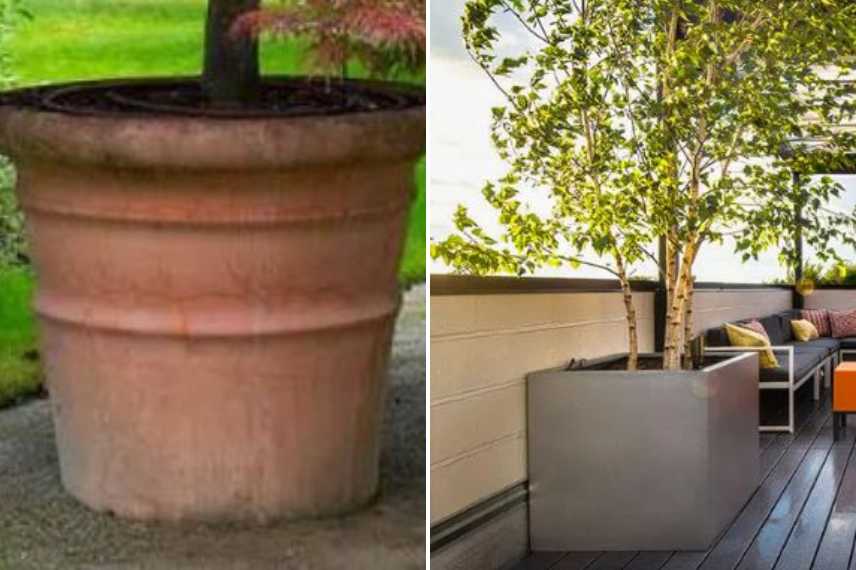
The volume of the trough must be significant, or you risk seeing your bush stagnate
Discover other Saskatoon - Juneberry
View all →
Available in 5 sizes
Available in 2 sizes
Available in 1 sizes
Available in 2 sizes
Available in 1 sizes
Available in 1 sizes
Available in 1 sizes
Available in 1 sizes
Available in 1 sizes
Where to place your Amelanchier?
Amelanchier needs sunlight to produce an abundant flowering, but it also thrives in partial shade.
When planted in a container, a south or west-facing position where it receives afternoon sun is preferred, but it can also be placed in an east-facing position where it will flower a little less. In northern France, a full south position is preferable.
Amelanchier is well resistant to urban pollution, making it perfectly suited for planting in a small city garden, as well as on a terrace or rooftop terrace.
Read also
8 very hardy shrubs resistant to frostWhat kind of substrate?
Amelanchier thrives in its natural environment with fresh, humus-bearing, and well-drained soil. When grown in a pot, it is essential to replicate its ideal growing conditions. The substrate should therefore remain fresh, without being too wet or too dry (see the maintenance/watering section).
If you wish to plant an Amelanchier in a pot, it is likely that you live in an urban area, and consequently often only have commercial potting soil available. To enrich the soil at planting, a bit of compost or leaf mould is more than welcome; try to obtain some, or if not, use a good quality bush potting soil. The substrate should not dry out too much. As with any potted planting, especially for a bush, and particularly for Amelanchier, summer watering will need to be particularly attentive, especially during the first two years, while establishing and developing its root system.
→ Learn more about substrates in our article: “Balcony, terrace and small gardens: potting compost and fertilisers perfect for small spaces – The latest innovations”
When to plant?
The best time to plant a container-grown Amelanchier is from November to early March. Wait until March if you are in a region with cold winters, as although hardy, planting a young plant in a pot is always preferable when the soil is warming up and severe frosts are no longer a concern.
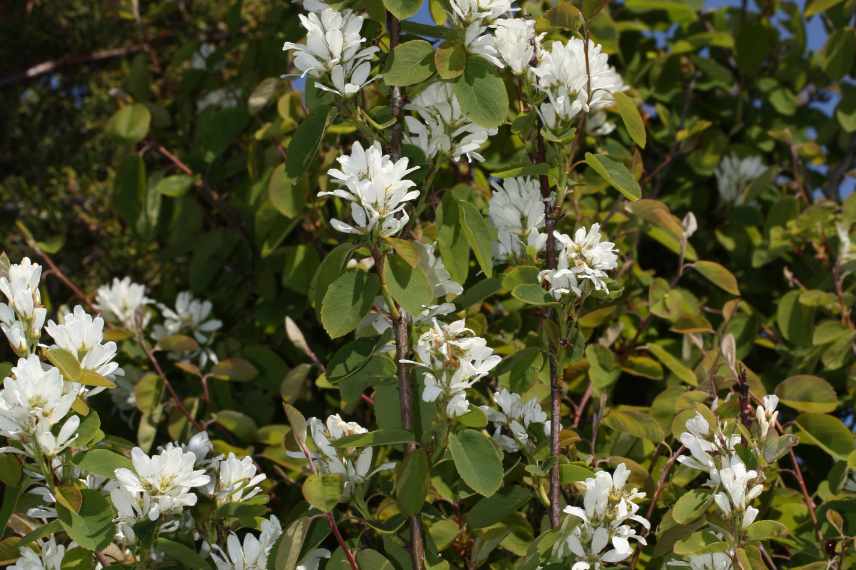
Amelanchier alnifolia
When and how to plant?
- Soak the root ball for 30 minutes in a large bucket of water to rehydrate it
- Spread a thick layer of pumice, clay balls, or gravel at the bottom of the container (about 15-20 cm), ensuring to drill drainage holes beforehand. You can also use a lighter draining material like pumice stone (sold as gravel) or, although less eco-friendly, expanded polystyrene drainage boards to reduce the weight of your container if it is placed on a high terrace or rooftop
- Pour the substrate into about half of the container, and make a large hole in the middle
- Remove the Amelanchier and gently untangle the root hairs, removing some of the substrate from the pot
- Place the bush in the centre of the hole: keep the Amelanchier upright and fill the container with potting soil without burying the collar
- Firm the soil by hand around the trunk
- Water generously at planting (15 to 20 L)
- Finish with a layer of mulch to retain moisture at the base of the bush
- Follow up with regular watering in the first few weeks
Maintenance, pruning and care
Originating from North America, the Amelanchier is appreciated for its good hardiness, allowing it to withstand winter even in pots without concern.
When it comes to maintenance, the Amelanchier also makes life easier, as it is robust and not particularly susceptible to diseases or pests.
Watering
The care of a potted Amelanchier mainly involves watering. Firstly, because it is a potted plant, watering is more frequent than for those in the ground, and secondly because it prefers soil that remains moist. However, the soil should not be waterlogged…
Be vigilant during the first two years, especially in the event of forecasted drought. Depending on your region and the ambient rainfall, you should water thoroughly once every two weeks. To determine if you need to water more or less, probe the soil with your finger to see if the substrate is already dry.
→ Learn more about watering potted plants in our article!
Pruning
Pruning is not necessary and would even alter the natural habit of the bush, which is why it’s important to choose the right variety. However, if your Amelanchier becomes too large, you can lightly prune it just after flowering. In this case, you will miss out on the delicious berries it produces after a few years.
Remove dead branches as it grows.
Fertilisation
In pots, the substrate quickly loses its nutritional qualities, as nutrients deplete and leach away faster. Remedy this by providing a fertiliser each spring that will act as a nutrient boost. Opt for a slow-release fertiliser like ground horn, incorporating it by lightly scratching the soil at the beginning of spring. A liquid fertiliser such as organic humus fertiliser for bushes is also beneficial.
Repotting
If you have carefully chosen your container, ensuring it is large enough for the Amelanchier to develop properly, you won’t need to worry about repotting. However, if you notice that the bush becomes disproportionate to its planting pot, you should consider planting it in the ground in your garden, where it will gain real size and develop optimally.
- Subscribe!
- Contents
Comments