




























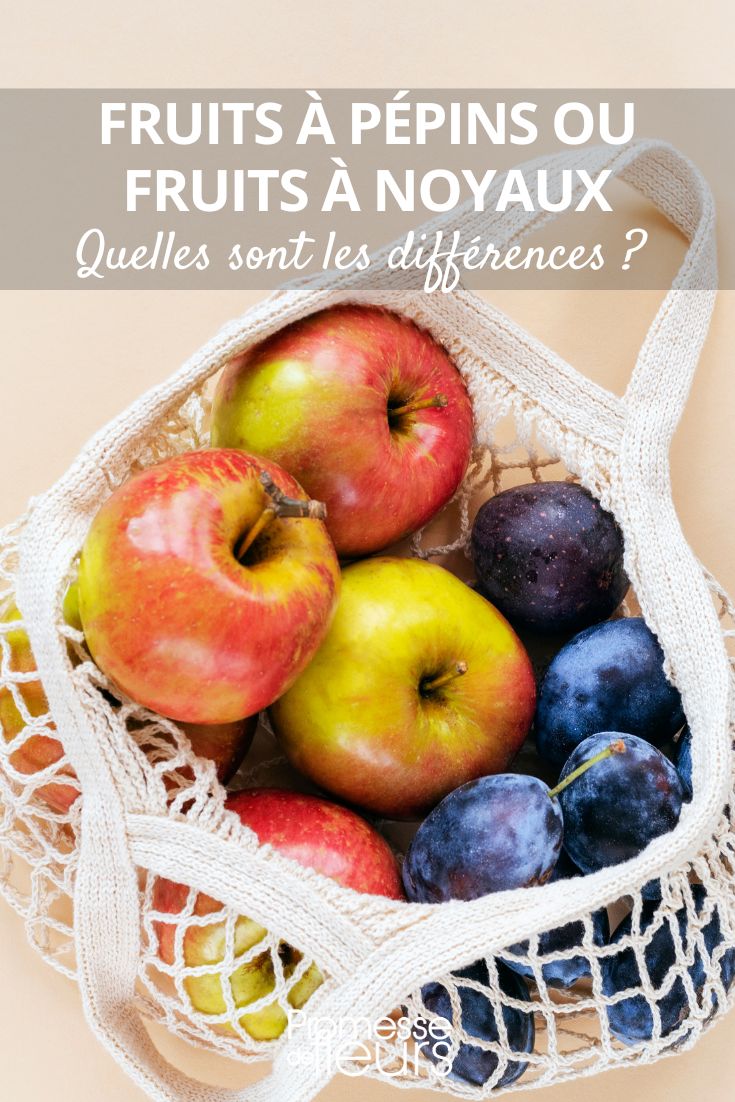
Fruits with pips or stone: what are the differences?
So alike and so different at the same time.
Contents
The world of fruit is as diverse as it is delicious, encompassing a variety of flavours, textures and types. In the world of fruit, two distinct categories catch our attention: fruits with pips and stone fruits. But what exactly is the difference between these two groups of fruits? Is it really that simple to classify them into one or the other category? This article reveals the secrets of their botany characteristics, with representative examples, as well as the fundamental differences in their cultivation and consumption.
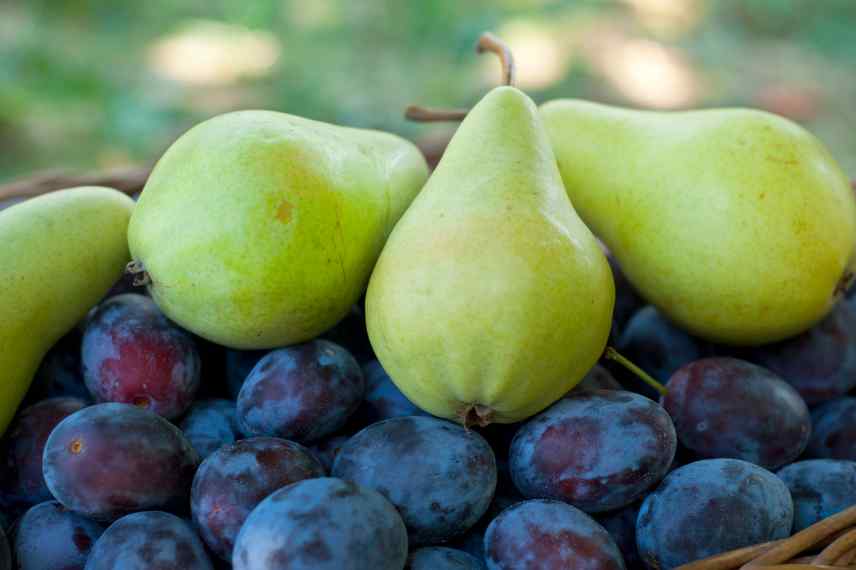
Pears and plums: autumn fruits with pips and stones
Here is a concise explanation in British English: - Fruits à noyaux - Translation idea: stone fruits (also known as drupes in botanical terms). - What it means: fruits that contain a single hard seed encased in a hard inner layer, the “stone” (noyau). - Examples: peach, nectarine, plum, cherry, apricot. Olives are also considered stone fruits (a drupe). - How it helps in gardening/culinary contexts: these fruits have one large seed and a distinct stone inside, which affects how you prune, propagate, and sometimes how you process the fruit. - Fruits à pépins - Translation idea: seeded fruits (often described as fruits with pips). - What it means: fruits that contain multiple seeds or small seeds (pips) dispersed within the flesh or on the surface. - Examples: apple, pear, grape, melon (cantaloupe), citrus fruits (orange, lemon), kiwifruit. Note that in some cases, seeds may be on the outside (as with strawberries), but they are still considered fruits with seeds. - How it helps in gardening/culinary contexts: these fruits typically have many seeds or smaller seeds rather than a single stone, which influences seed collection and propagation strategies. Glossary notes (as used in translations) - noyau → stone - pépin → pip (plural pips) - When translating into natural British English, use stone for noyau and pip/pips for pépin, depending on singular/plural. If you’d like, I can convert this into a short WordPress-friendly blurb with an example paragraph and bullet points for a post.
In botany, what we call a “fruit” is the plant organ that develops after fertilisation of a flower and that encloses one or more seeds. These seeds may then exist in the form of pips or a stone.
Fruits with seeds
Fruits with seeds are characterised by their unique internal structure. These fruits arise from the transformation of one or more ovules of the flower into seeds, surrounded by edible flesh. The peculiarity of fruits with seeds that, botanically, we should name “berries”, lies in their compartmentalised core, containing one or more pips. These pips, or seeds, are coated with a protective layer and nestled within the pulp. The pip is considered a naked seed (envelope not rigid) while the stone has a hard lignified envelope (the principal component of wood). The pip can be very large and solitary, as is the case for the avocado (yes, botanically speaking, the avocado is a large berry with a single pip!).
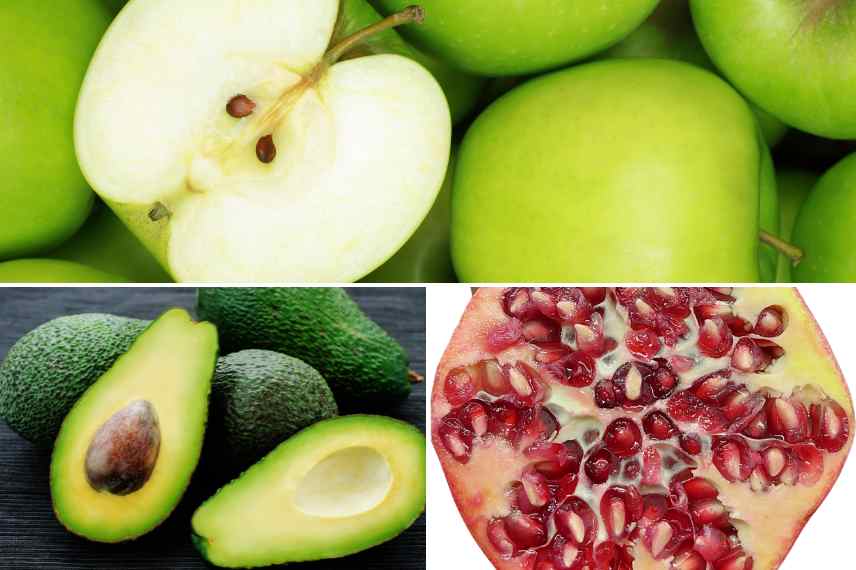
Apple, avocado and pomegranate: they contain pips
Stone fruits
Conversely, stone fruits (or drupes), are distinguished by their single and large central stone. This hard stone is surrounded by flesh that is typically juicy and tasty. The stone is the central hard part, in lignin, which contains the seed or almond. The stone thus comprises two parts: the sclerified envelope which results from the transformation of the inner epidermis of the ovary or endocarp, and the almond or seed, which lies inside the stone, resulting from the transformation of the ovule after fertilisation.
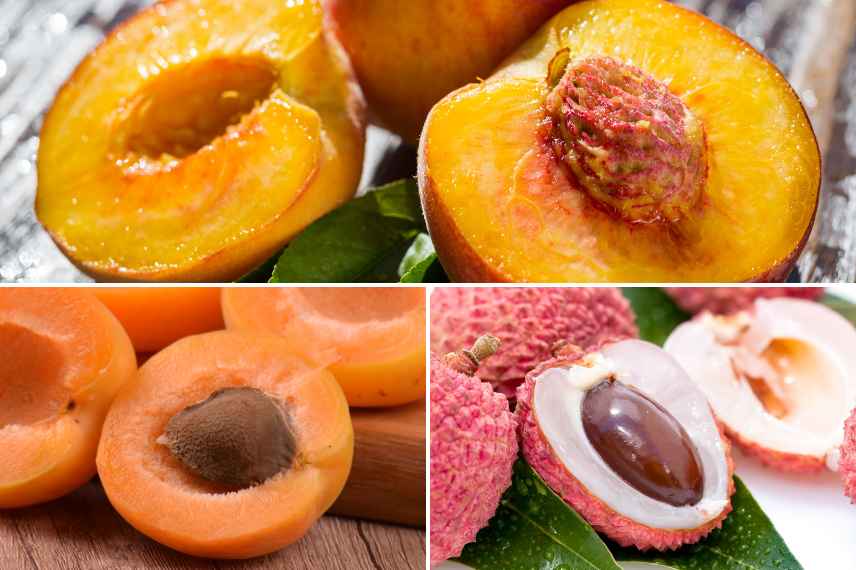
Peaches, apricots and lychee contain a stone in their centre
Read also
10 dwarf fruit trees to grow in potsWhy are there seeds in fruit?
The evolution of these fruits is closely linked to the need to attract animals for seed dispersal.
The pips are surrounded by a juicy, sweet flesh that attracts animals. When an animal eats the fruit, it disperses the seeds contained in the pips, either by dropping them or by excreting them elsewhere. This helps the plant to propagate its seeds over greater distances, thereby increasing its chances of survival and reproduction. Additionally, the sturdy structure of the pips protects the seeds as they pass through the animal’s digestive system.
Stone fruits have evolved similarly, but with a different strategy. The hard central stone protects the single seed inside the fruit. As with pips, the flesh of stone fruits is often sweet and attracts animals, who eat the fruit and disperse the seeds. However, in the case of stone fruits, the seed is generally quite large and protected by a hard stone, which may require larger or different animals for its dispersal. This feature may also prevent the seed from being damaged if the animal attempts to eat it.
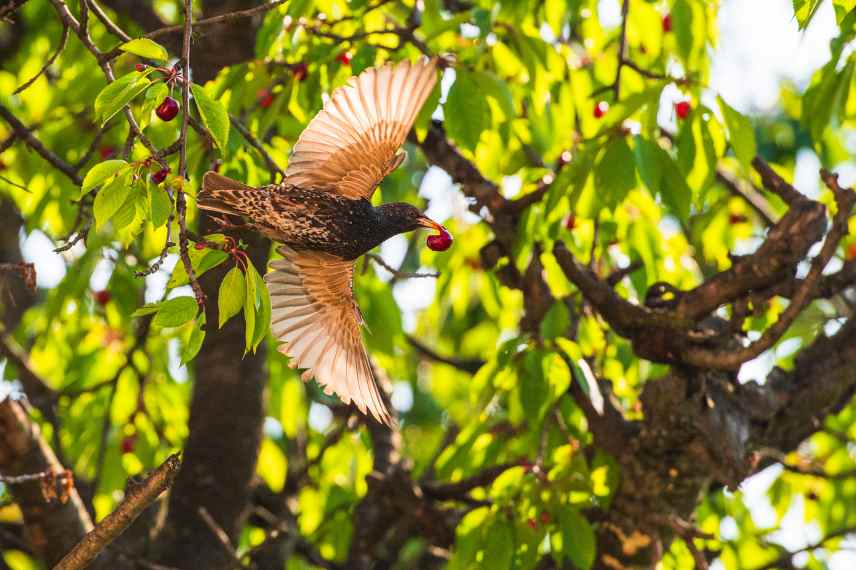
Birds disperse many stone fruits, including cherries
Fruit with pips or stones: which is which?
Examples of seed-bearing fruits
Apples and pears are the best-known representatives of this group. But there are also nashi pears, quinces, medlars (Mespilus germanica), the grape, the melon, the watermelon or even citrus fruits (lemons, grapefruits, mandarin, orange, yuzu…). Let’s not forget guava, passion fruit and even the tomato or the chilli pepper (yes, yes, they are fruits!).
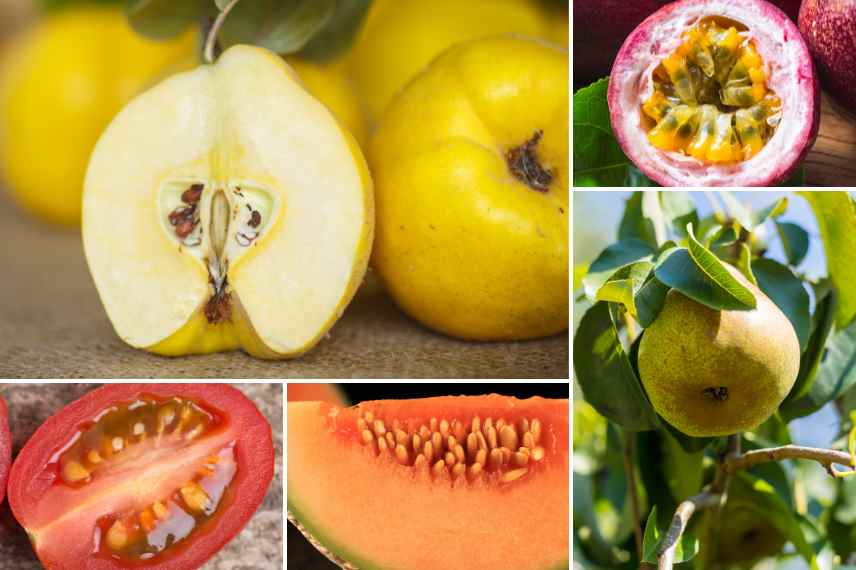
Quince, passion fruit, tomato, melon, pear: these are all seed-bearing fruits
Examples of stone fruits
Cherries, apricots, plums, mirabelles and peaches illustrate this category perfectly. But we will also mention pluots, nectarines, mango, the jujube, the lychee and of course the olive. Within stone fruits, the drupes, you will also find most of the nuts: almond, walnut, hazelnut…
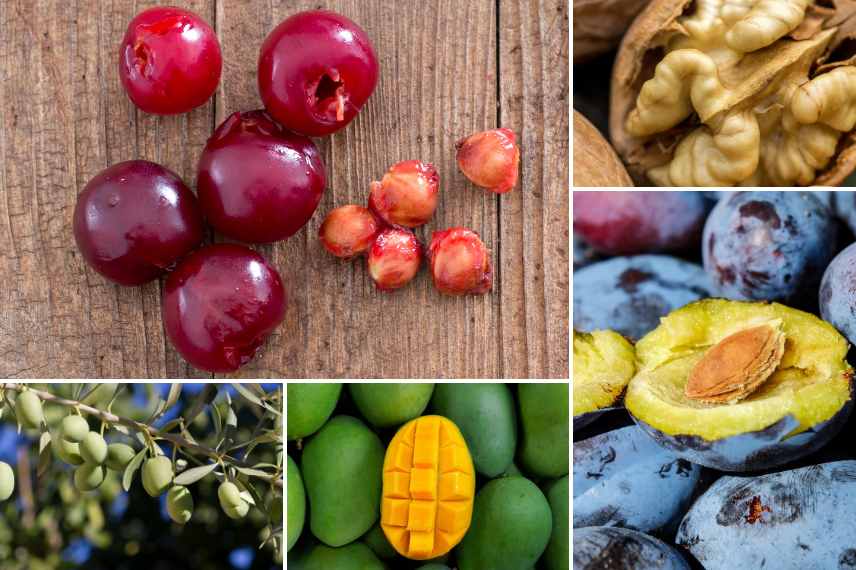
Among stone fruits: cherries, walnuts, olives, mangoes and plums
Read also
7 columnar fruit trees for small gardensTricky questions to help you shine in social situations.
Attention, here are a few tricky questions:
- Is a date a stone fruit? Answer: no, because what is called the stone is merely the sclerified seed, but without a coat. A date is therefore a berry with a single pip.
- Raspberry? It’s a berry, right? Answer: still no, a raspberry (or blackberry, the fruit of the bramble) is an aggregate of drupelets (polydrups). Each drupelet is formed as a drupe, i.e. there is a tiny stone surrounded by flesh. We eat these tiny stones without really noticing. Except when these little grains get stuck between our teeth…
- But then, clementines, mandarins, lemons… Are these berries? Answer: absolutely, citrus fruits produce hesperidium-type berries, the endocarp being split into locules.
- And nutshell fruits in all this? Berry, drupe or… ? Answer: the majority of nutshell fruits are drupes. For example, a simple walnut (coming from a tree of the genus Juglans) is a drupe. There is a green fleshy part (mesocarp) surrounding the stone (the walnut). We crack this stone, the walnut, then eat the seed, the kernel.
- Coconut, then? Answer: oh, a very good example! It is a drupe composed of an outer shell (green-yellow), a fibrous mesocarp and finally the “nut”, the lignified endocarp that we must break to reach the “almond”, the white edible part.
- Figs and the strawberries : seed fruits or stone fruits? Answer: neither! Both are “false fruits”, the true fruits being the achenes, i.e. the small grains inside the fig or around the edge of the flesh of the strawberries.
You thought that defining and classifying “seed fruits” and “stone fruits” would have been easy, wouldn’t you? It isn’t that simple, you’ll agree.
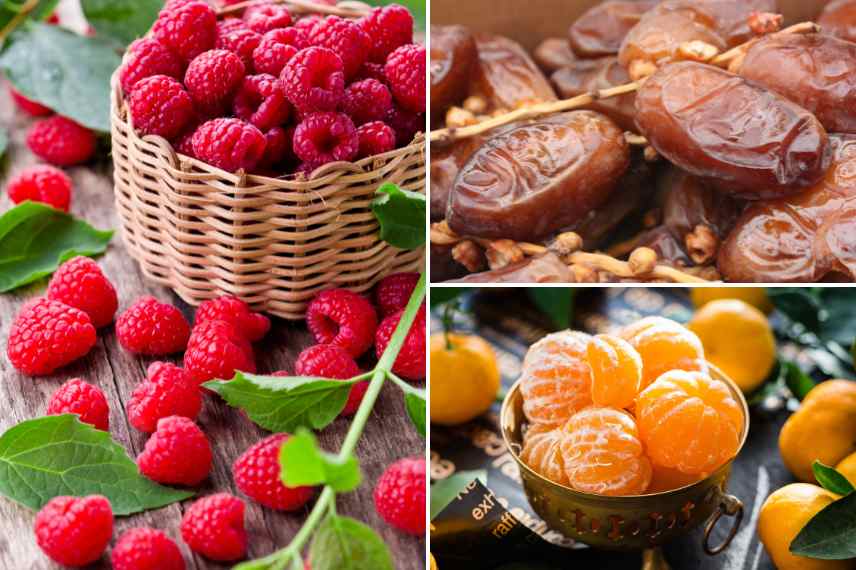
Some fruits can be confusing at times…
Fruit Trees and Humankind
It is difficult to generalise about the differences in cultivation, harvests and consumption for the two types of fruit trees. Nevertheless, a few facts can still be stated, which will undoubtedly need to be nuanced.
- Subscribe!
- Contents
Comments