





























Fighting Ticks in the Garden
Beware of Lyme disease!
Contents
The tick is a mite that should not be taken lightly, as it is a vector for several diseases including Lyme disease or Lyme borreliosis in humans. This small parasitic creature can be found in nature, as well as in our gardens. Indeed, a large number of people bitten by a tick are bitten in parks or their gardens. Without falling into paranoia, it is important to be aware of the dangers and to take all necessary measures to prevent a potential infection. What good habits should be adopted to avoid being a host to ticks? What can be done to limit their proliferation in the garden? We cover all of this in our advice sheet.

What is a tick?
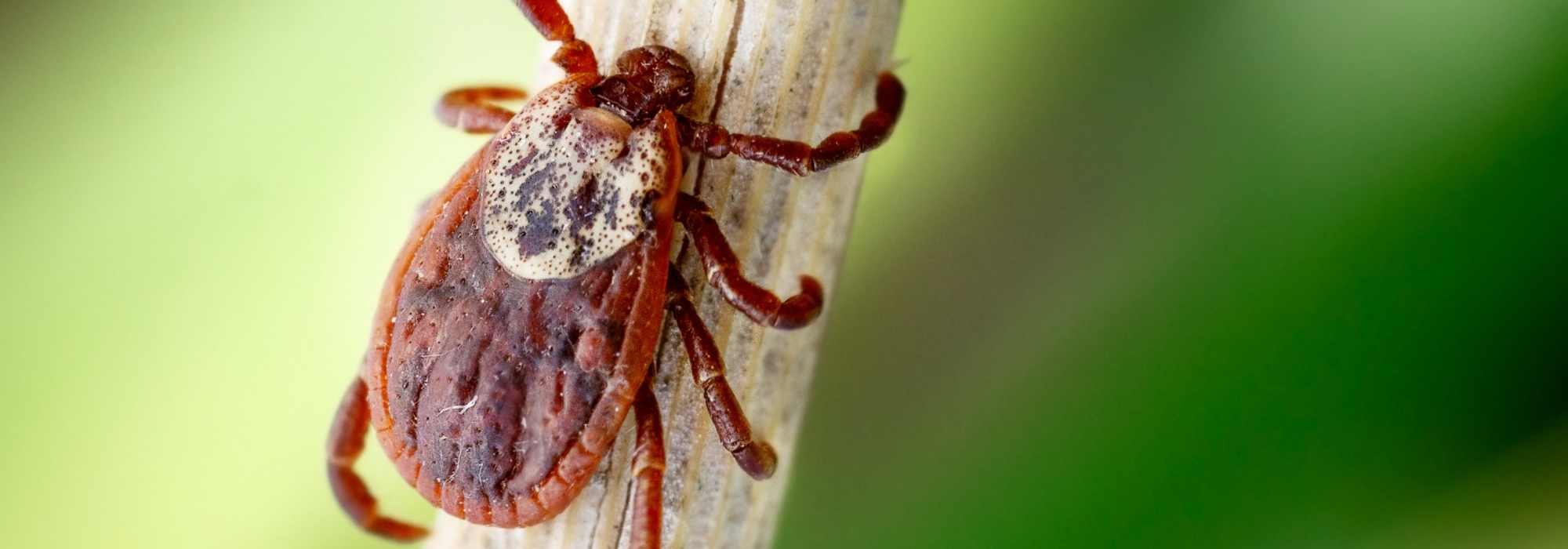
Ticks, classified under the order Ixodida, constitute a group of mite species: nearly 900 different species worldwide, with around forty species in France. They lack antennae, do not fly, do not jump, and have 4 pairs of legs.
Ticks are ectoparasites: that is, a parasite that lives on the surface of living beings. They can parasitise mammals (including humans) and birds, as well as reptiles. Ticks carry diseases through various pathogens (viruses, bacterium, nematodes, or protozoa) and allergies. Diseases transmitted by tick species are grouped under Tick-Borne Diseases or TBD, the most famous of which is probably Lyme disease.
They are all large mites: ranging from a few millimetres to several centimetres. The female is significantly larger than the male. Ticks are particularly recognisable, especially when they are engorged with the blood of their host, revealing a characteristic abdomen: large and white, even bluish.
Ticks prefer humid and wooded environments. They hide in grass and foliage waiting for an animal or… a passerby. They cling to hair or clothing and then move to a warm spot. After a few minutes to a few hours, the tick attaches to the skin using its chelicerae and releases an anaesthetic substance. Unnoticed, the tick begins to parasitise you and suck your blood.
Not all tick species are parasitic to humans, and not all transmit Lyme disease. In Europe, the most dangerous and widespread for humans is Ixodes ricinus. Ticks were once referred to as “tiquets” or “Ricinus”.
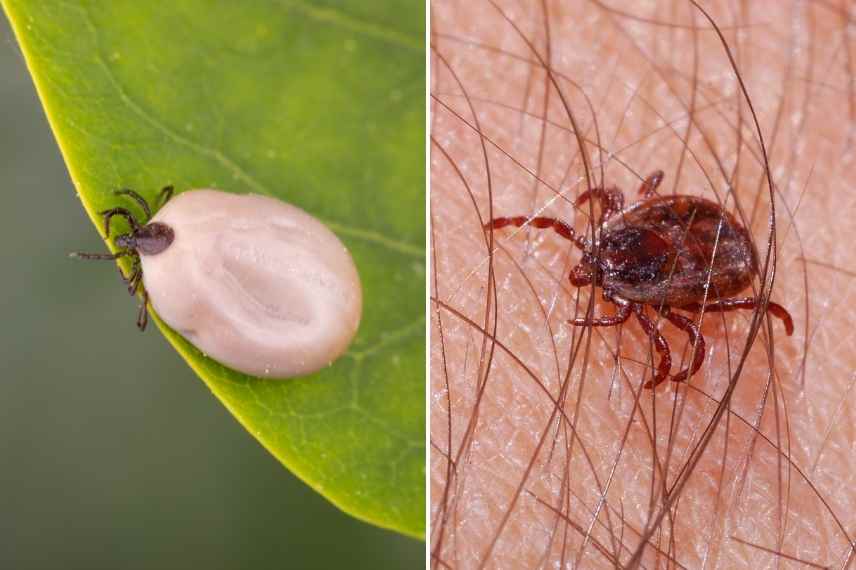 Engorged tick; on the right, Ixodes ricinus
Read also
10 effective mosquito-repellent plantsThe lowdown on Lyme disease
Lyme disease is a vector-borne disease named after the town of Lyme in the United States, where it was first detected in 1975. Lyme disease is caused by a bacterium of the genus Borrelia, transmitted by ticks. This is why the term Lyme borreliosis is a synonym for “Lyme disease”. It is the most common vector-borne disease transmitted to humans in the Northern Hemisphere.
The disease is complicated to diagnose as the bacterium can affect various organs; it is said to be multivisceral and can impact multiple systems (multisystemic): joint, neurological, and skin disorders.
The first sign of an infection is the presence of a migrating erythema: a sort of red skin patch around the bite. This may go unnoticed if the tick is located on the scalp or back. Six months after the bite, one may observe cardiac, neurological, ophthalmological issues, or joint pain. Some patients may develop a persistent syndrome with general pain, intense fatigue, and cognitive disorders. The concern is that doctors do not always consider Lyme disease.
Unfortunately, screening tests are not yet entirely reliable. There are many cases of false negatives. Based on a blood sample, the first laboratory test is conducted in the form of an Elisa test (search for antibodies and antigens), followed, if positive, by a second test in the form of a Western Blot test (gel electrophoresis test that separates the different types of proteins present in the blood).
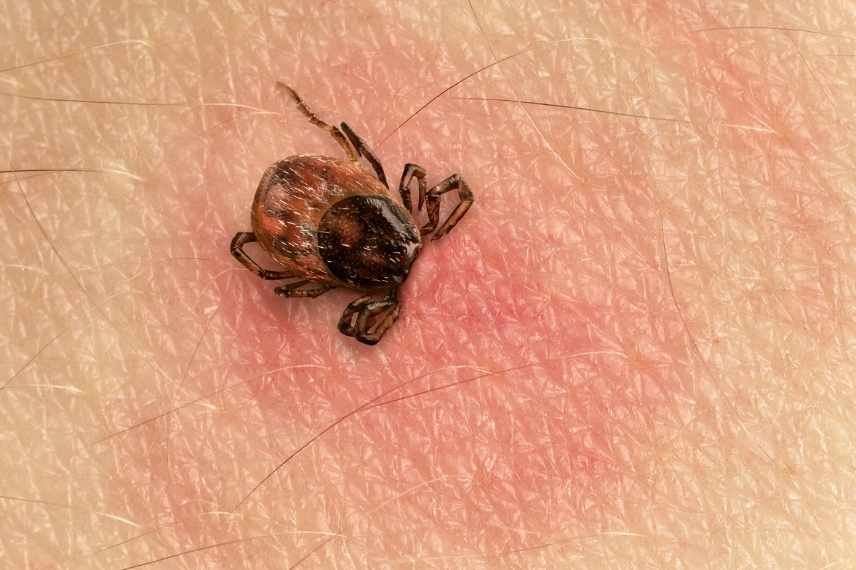
Tick bite
Treatment
As soon as the migrating erythema appears, your doctor will prescribe a course of antibiotics for 14 to 28 days. In the case of a diagnosed persistent syndrome, a 28-day antibiotic treatment will be administered. Even though broad-spectrum antibiotic treatment eliminates the Borrelia bacterium (and the good bacteria in the process…), this does not always resolve all the symptoms of Lyme disease. New curative and preventive treatments, particularly related to a specific antimicrobial and even a type of vaccine, are currently in testing as we write these lines. Stay tuned!
Please note: Lyme disease affects approximately 50,000 people per year in France. Symptoms vary significantly between individuals.
How to protect yourself from ticks?
It is difficult to be certain of completely avoiding a bite from a tick infected with the bacterium Borrelia. However, there are several measures you can take to limit the risks:
- Risk seasons are mainly spring and early autumn: mild temperatures and humidity. However, the season practically extends from March to October;
- Avoid walking in tall herbs or in bracken ferns: stick to marked paths;
- If you feel an irresistible urge to throw yourself on the ground or have a picnic on the ground: do it on a sheet or a blanket;
- Wear long clothing that covers your arms and legs. These should be light-coloured to easily spot the tick. Wear closed shoes (and generally forget open shoes in nature!);
- Use really effective repellents: DEET, IR 3535, icaridin, and lemon eucalyptus extract or Citriodiol. Ask your pharmacist for advice!
- Check your entire body after an outing for any eight-legged squatters: especially the axils, the backs of the knees, the scalp, the neck, behind the ears, the navel, and the pubis. Check again a few days later for the presence of a migrating erythema.
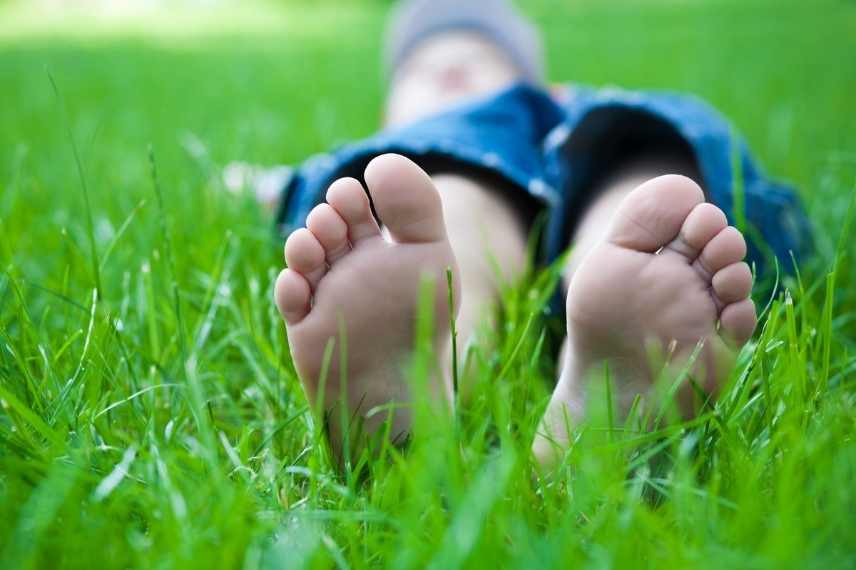 Forget about lunches on fresh grass… without a blanket
What to do if you have a tick on you?
Categorically forget folk techniques like putting a drop of alcohol, oil, or petrol (given the price of oil, too!) on the tick’s head to make it let go. This does not work! You risk the tick leaving part of its head in your skin.
Instead, use a certified tick removal tool available at pharmacies and some large retailers.
- Grab the tick close to the skin by placing the tool (or tick remover) at the level of the head;
- Pull gently while turning to avoid tearing the tick (and leaving part of it in the skin);
- Flush the tick down the toilet or place it in a sealed bag for potential identification in case of problems;
- Rinse the bite with soapy water or a little medical alcohol to disinfect;
- At the slightest sign of infection (migrating erythema) in the days that follow, consult your doctor.
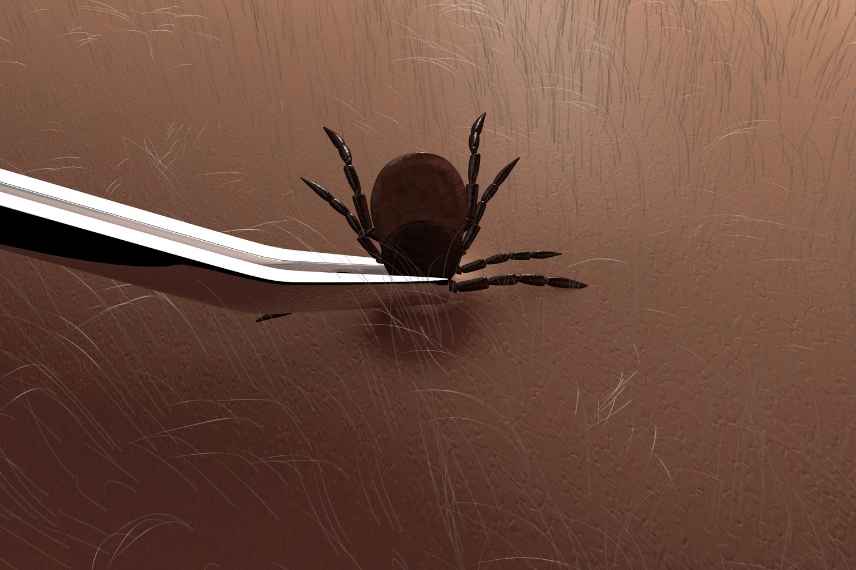 Proceed carefully to catch the entire tick
Read also
5 plants that repel waspsWhat to do in the garden to limit the number of ticks?
It’s astonishing! Between 30 to 50% of tick bites in Europe occur not in nature, but in parks and gardens.
Where do ticks find themselves in nature and in the garden?
Ticks prefer humid, somewhat wild, shaded environments that are rich in animals on which they feed and reproduce.
How to design your garden to avoid ticks?
- Mow the lawn to eliminate tall herbs and create large sunny, dry areas;
- Prune the bases of trees;
- Apply a dry mulch at the base of plants (wood chips, RCW, bark mulch…): in addition to protecting the soil and plants, this creates dry, warm areas that repel ticks;
- Avoid overwatering, especially in already humid areas of the garden;
- Collect piles of dead leaves and use them to make compost;
- Plant naturally repellent plants against ticks: rosemary, lavender, lemon balm, thyme, wormwood, citronella geranium. Avoid certain plants that seem to attract ticks, such as gorse or bracken ferns;
- If you live on the edge of a forest, creating a one-metre-wide buffer zone with dry mulch (bark or gravel) is a good solution;
- Install a fence to prevent wild animals carrying ticks from roaming freely in your garden.
But… what if we want a natural garden that welcomes wildlife?
This is not incompatible! Rest assured! In reality, only the heavily frequented parts of the garden need to be designed to repel potential ticks. It is advisable to mow the lawn, keep paths clean, distance hedges and flower beds, and place dry mulch in high-traffic areas. For the rest, your hedges, pond, or flowering meadow will always be welcome for biodiversity in the garden. Moreover, mowing paths in your meadow will allow you to stroll without too much risk of ticks.
You can also encourage the natural enemies of ticks, such as insectivorous birds (great tits, dunnocks, as well as starlings), shrews, and… chickens that are fond of these large, unappealing mites.
The fox and the marten also help limit rodent populations around your garden, which significantly reduces tick invasions. As always, a zone rich in biodiversity allows for population regulation, without the risk of invasions by a single species.
Please note: Remember to check your companions (dogs and cats) after each outing in the garden. They can also be infested with ticks. Remove any ticks present with a tick removal tool and treat your animals against parasites if possible.
- Subscribe!
- Contents
Comments