





























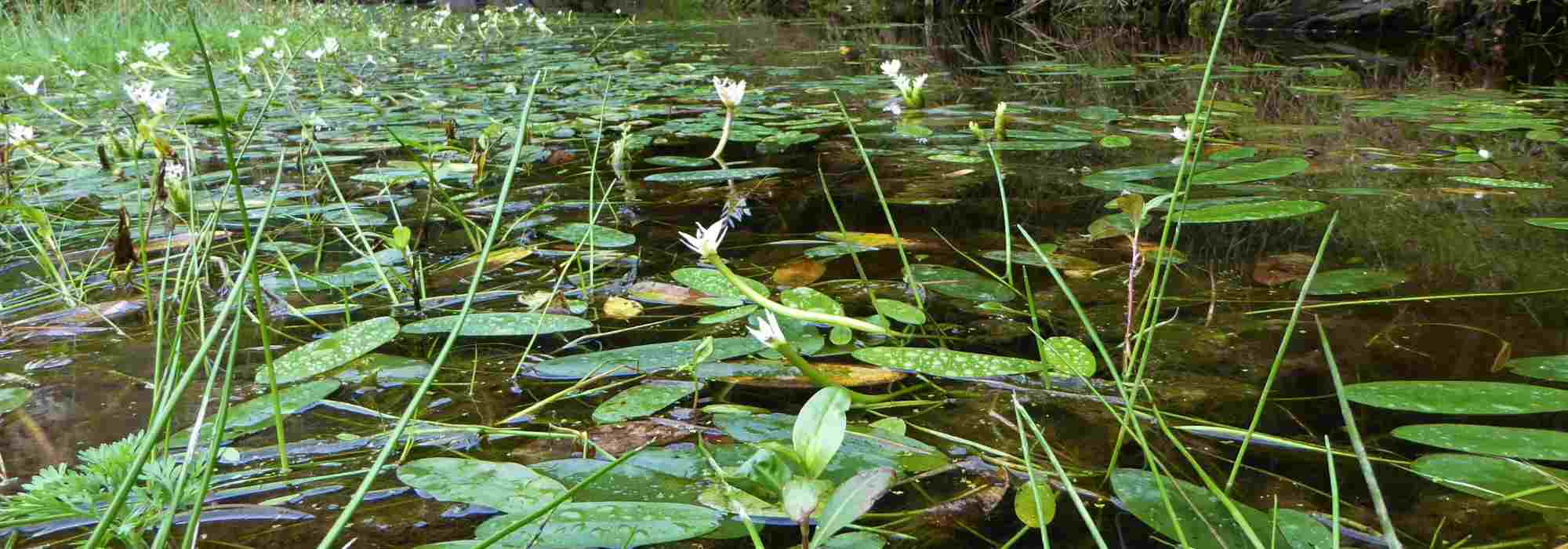
Evergreen aquatic plants: they beautify ponds all year-round
Discover the best evergreen plants for water features and pond banks.
Contents
Aquatic plants group various categories enabling the layout of water features, whether it’s a basin, a pond or a water feature… but also their margins. We distinguish emergent plants, floating-leaved plants and free-floating plants. Some plants will dress your basin with their flowering and lush foliage, while others will merely hide the edge of the basin with their more carpet-like habit. Each plant will find its ideal position depending on where your basin is installed in the heart of the garden, in a damp area, in full sun or in shade.
If there are many aquatic plants with evergreen foliage in the tropics such as water lilies and lotuses, some have evergreen or semi-evergreen leaves in our latitudes, useful for ornamenting water features during the off-season. We present to you the finest species in this guide.

Acorus
Rather semi-aquatic, growing in up to 20 cm of water, the Acorus closely resemble sedges (Carex sp.): they feature narrow, linear, ribbon-like and upright leaves, which render them perfect companions for water features in a contemporary garden. Their standout attribute is, besides evergreen foliage year-round, an interesting hardiness enabling them to be used in many regions. They can indeed withstand temperatures down to between -20°C and -10°C. Growing often in 10-15 cm of water, Acorus are suited to edging ponds or pools, but are also sought after for pot planting.
We frequently use Acorus gramineus, also known as Japanese sweet flag (and its lovely cream-variegated variety, Acorus gramineus ‘Variegatus’), as well as Acorus calamus with elongated yellow-green spadix flowers (this one is much taller, around 80 cm). Both species prefer a sunny or partial shade exposure, but not too hot.
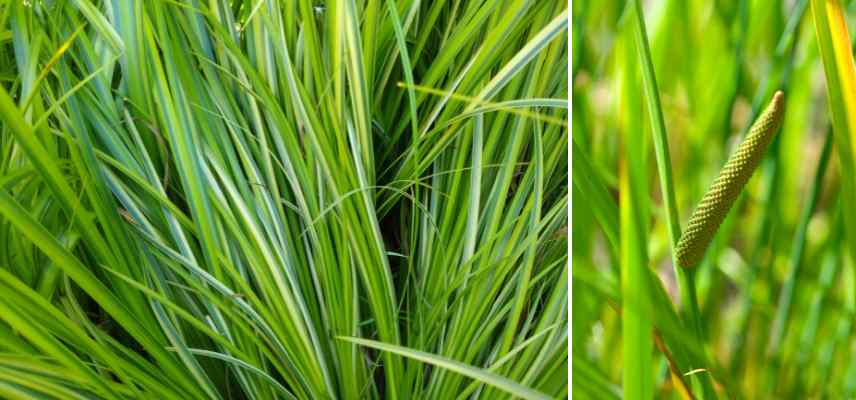
Acorus gramineus ‘Ogon’ and Acorus calamus
Aponogeton distachyos
Also known as Cape hawthorn or water hawthorn (originating from South Africa), the Aponogeton distachyos is a remarkable aquatic perennial.
Its evergreen foliage, dark green to reddish, is formed of long elliptical leaves that float on the water and cover large swathes. It displays a remarkable flowering that lasts quite a long time, from June to the approach of winter depending on the region, a rarity among aquatic plants. Not only does this flower resemble that of an orchid, but it is fragrant, hence its nickname of water vanilla, frequently used to designate this beautiful aquatic plant. The flowers appear as they emerge on a stem up to 10 cm long, thus staying at the water’s surface. They are white and adorned with bracts forming a Y shape. This flowering has the advantage of being nectariferous.
The Aponogeton distachyos requires warmth, and its stump should be submerged deeply (in 30 to 60 cm of water) to withstand frosts down to -10°C. A partly shaded to shaded exposure is preferable for good flowering. We particularly recommend it for southern gardens of France. It is perfect in a large pond, but also adapts to smaller areas.
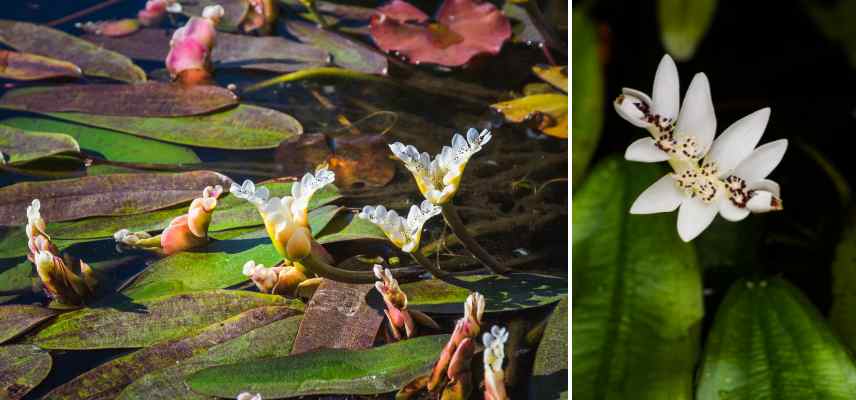
Aponogeton distachyos
The Butomus umbellatus
Undoubtedly the aquatic plant that is the standout charm of this selection. Why? Because the flowering rush (Butomus umbellatus) has a wonderfully graceful flowering in midsummer (June to August), presenting to the eye its umbels of white to pink, borne on bare stems.
The Butomus umbellatus is a perfect perennial for edging all aquatic scenes, whether a marsh or a shallow pond: it can be submerged up to 30 cm in water. This perennial is widely used in lagoon planting, just like Acorus. It grows to a height of 80 cm to 1.2 m in flower, in light-green tufts, the leaves being linear and upright. With good hardiness (-17°C), the flowering rush is a particularly ornamental choice for very sunny positions.
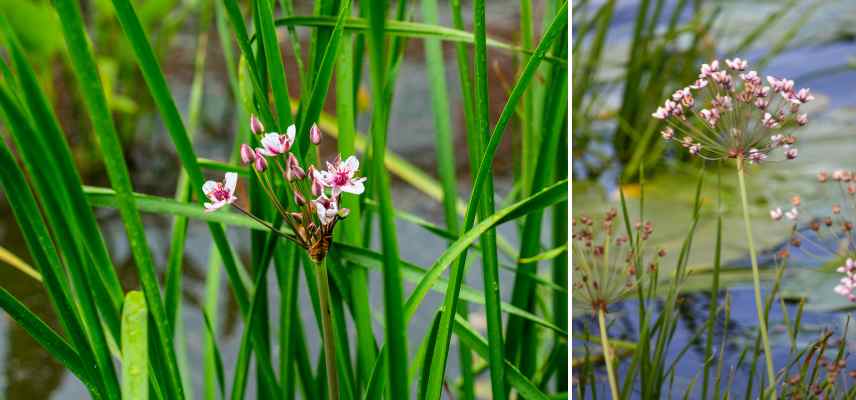
Butomus umbellatus
Read also
5 aquatic plants for a mild climateThe Stratiotes aloides
Here’s an Aloe that’s not quite like any other, with its roots in water: the Stratiotes aloides, also known as water aloe! The whole plant overwinters surprisingly at the bottom of the water, giving it excellent hardiness, and then re-emerges on the surface in early spring, forming small tufts that float on the water. It’s a pretty plant, notable for its rigid and dentate foliage, like terrestrial aloes, but also for its oxygenating properties. The cup-shaped flowers are small (3 cm in diameter) and white, appearing from May to June. This aquatic perennial is prolific, densely colonising the waters. It is mainly used in still waters. To be planted in full sun.
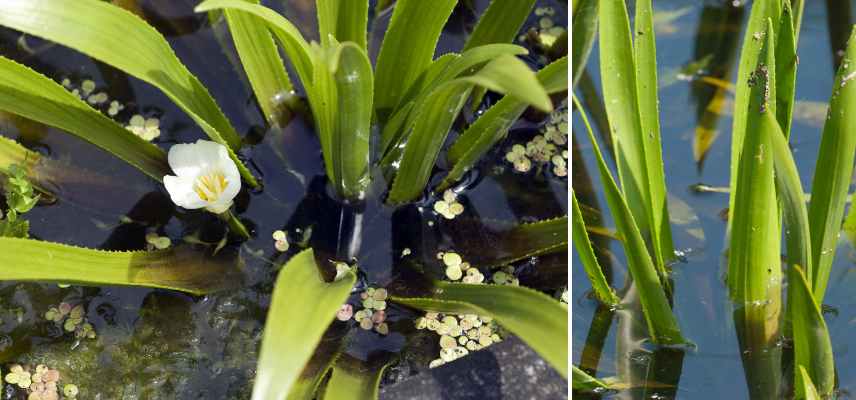
Stratiotes aloides
Pistia stratiotes
Water lettuce, or Pistia stratiotes under its botanical name, is one of the common evergreen plants for warm-climate ponds, frosts that the plant cannot tolerate (it is tropical in origin). From the same family as arums, it features thick leaves arranged in a rosette, and indeed (much prettier!) resembles a salad laid on water. It floats thanks to its roots (not anchored in soil) and has no visible stem, i.e. stemless perennial. It is its evergreen foliage that is particularly interesting, not least because it is slightly bluish with graphic venation, and nicely undulating; its summer flowering remains discreet as a miniature spadix reminiscent of arums. Emergent leaves do not exceed 10 cm in height, giving a similar spread.
Given its rapid growth and lack of hardiness, treat it as an annual in a small pond or a large basin that will warm up quickly on a terrace, for example. Overwinter it in an unheated conservatory or in a bright space from September or October (keep at around 12°C), then move back outdoors in May.
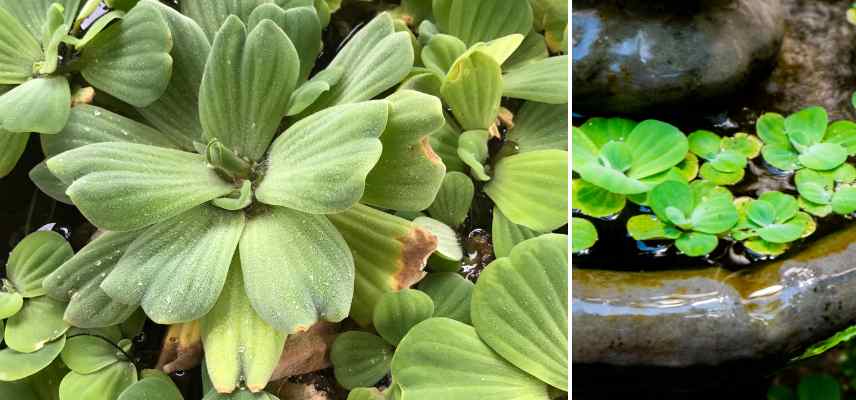
Pistia stratiotes
But also...
We must not forget:
- emergent plants with ornamental foliage, semi-aquatic, considered shoreline plants such as rushes (Juncus sp.), for example the Juncus effusus ‘Spiralis’, evergreen in mild climates, the Juncus effusus or the Juncus inflexus, all very hardy; horsetails (Equisetum sp.) for their sculptural quality, the Scirpus as the elegant Schoenoplectus lacustris, and the reeds (Phragmites).
- Tender exotic plants for Mediterranean regions and mild winters, where they stay evergreen, such as nutgrasses or Cyperus, notably the Cyperus longus and the Cyperus papyrus.
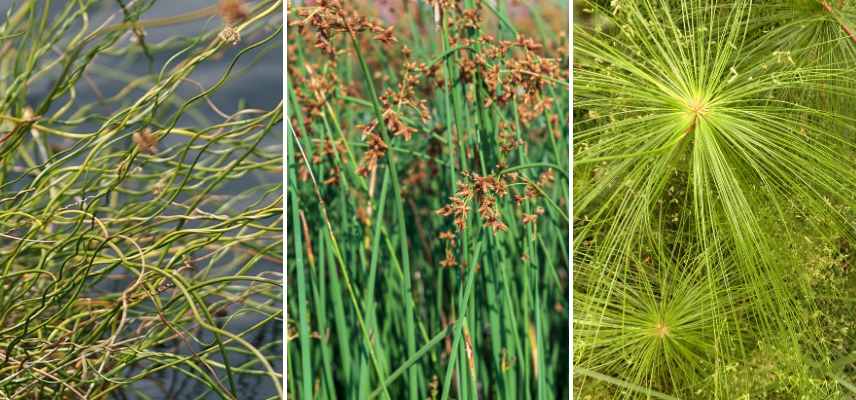
Juncus effusus ‘Spiralis’ (© David J. Stang-Wikimedia Commons), Scirpus lacustris and Cyperus papyrus
- Subscribe!
- Contents
Comments