





























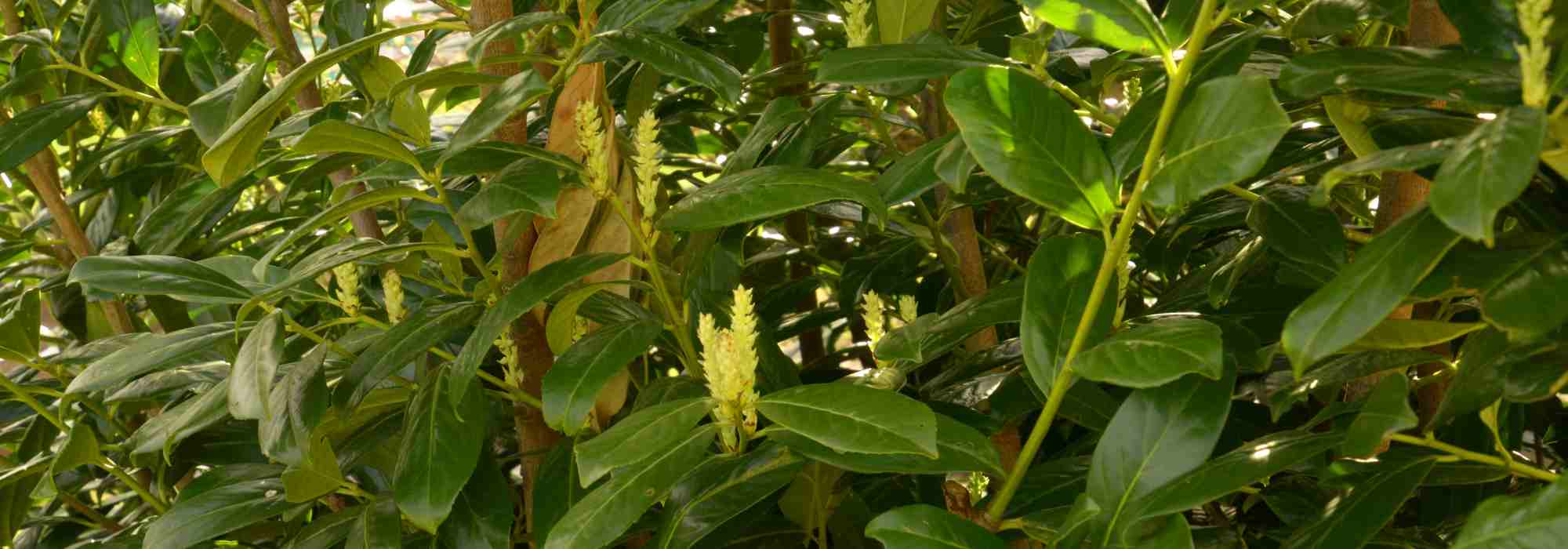
Diseases and Pests of the Palm Laurel or Cherry Laurel
pests, fungal and bacterial diseases
Contents
The Prunus laurocerasus or Cherry Laurel has been widely planted as a hedge. And for good reason, it is a hardy bush that grows quickly in almost any soil, has evergreen foliage, tolerates pruning well, and flowers (if not pruned too much). It is also a bush particularly resistant to diseases and pests, which does not mean it is never affected by a little something. This is what we will discuss in this advice sheet: the diseases and pests of Cherry Laurel.
→ Warning, the term “laurel” can be confusing!: cherry laurel, oleander, bay laurel, Laurustinus… Some are edible, while others are toxic! To clarify, read: Laurel: a catch-all name that can be confusing.
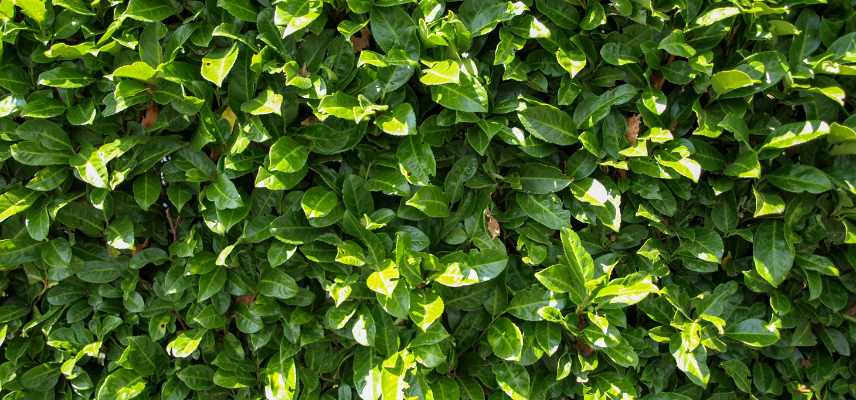
Cherry laurel is generally a very robust bush

Fungal diseases
Fungal Scorching
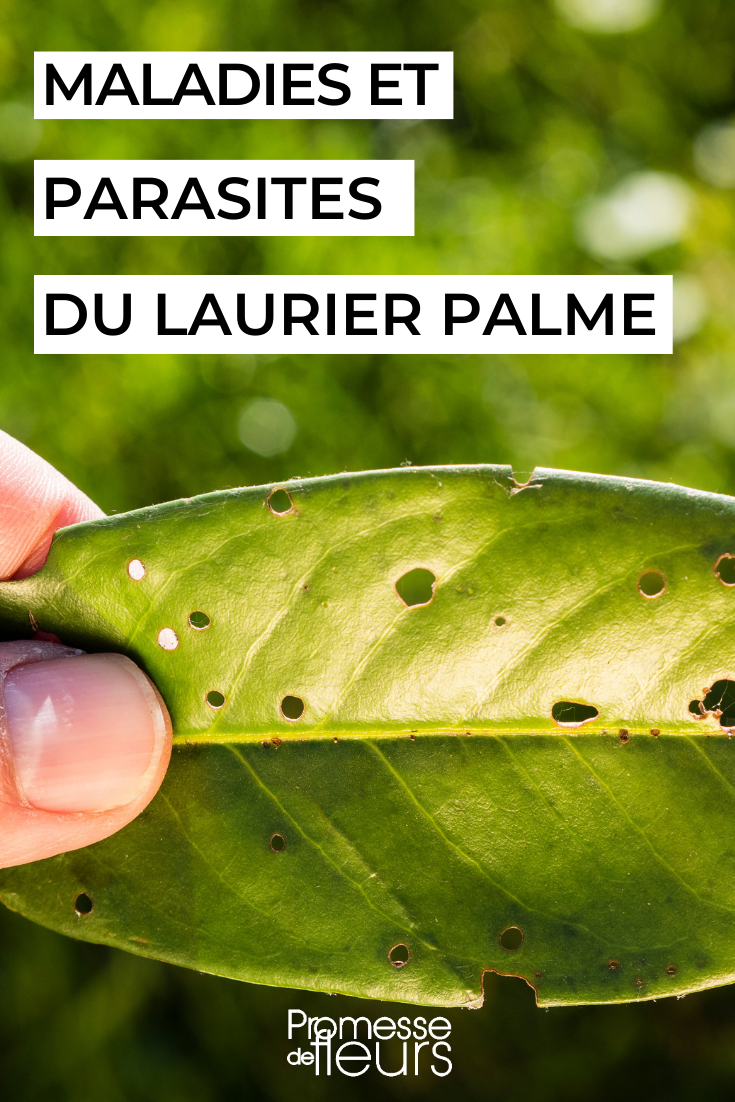
Fungal scorching is caused by several fungi: Coryneum beijerinckii, Stigmina carpophila, Eupropolella britannica, Cercospora circumscissa, or Microgloeum pruni. This disease appears in spring under mild and humid conditions. It manifests as small circular black spots perforating the leaves, which then yellow and fall off. This disease does not endanger the plant but causes particularly unsightly damage and will spread to the entire cherry laurel hedge.
However, be aware that another type of “scorching” exists, caused by a fungus (see point 2).
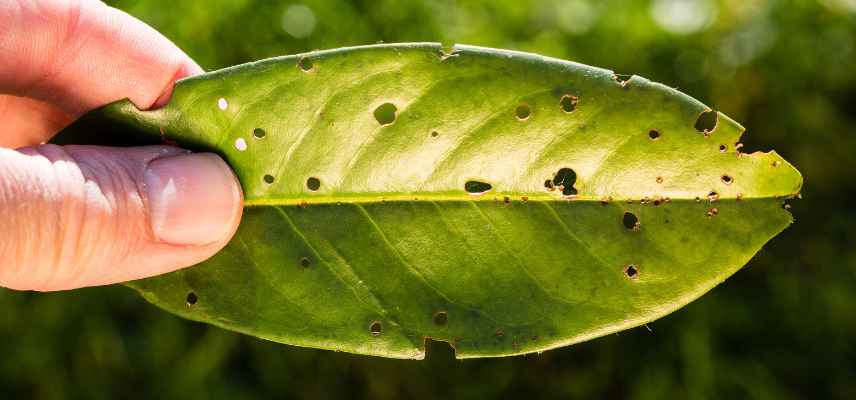 Leaf affected by Stigmina carpophila
Perforating Powdery Mildew
The perforating powdery mildew (caused by fungi of the Podosphaera genus) occurs in warm weather in early spring or early autumn. This powdery mildew leads to a whitish deposit on the leaves, followed by deformations and then perforations, which result in leaf drop.
Bicarbonate of soda has an alkaline pH that allows it to inhibit the development of fungi. Even at very low doses, it is effective against all types of powdery mildew. In 5 litres of water, add 5 teaspoons of bicarbonate of soda with 3 tablespoons of black soap. Spray as soon as the first symptoms appear, preferably in the evening, once a week.
→ To combat powdery mildew effectively and ecologically, read Virginie’s advice in Powdery Mildew or White Disease: Treatment and Prevention.
Also, avoid monospecific hedges: vary the plants within your hedges!
Bacterial diseases
There is another type of leaf spot, caused by a bacterium called Pseudomonas syringae. This disease mainly occurs when the weather is very changeable: dry periods interspersed with storms, for example. Glassy spots appear, the centre of which quickly becomes necrotic, taking on a brownish hue. A clear halo then surrounds the necrotic area.
To prevent this type of leaf spot: avoid pruning during periods favourable to this disease!
In very low doses, a treatment based on copper, such as Bordeaux mixture, may be applied. However, be cautious, as copper sulfate is toxic to aquatic life, harmful to humans, and can accumulate in soils. So, use it sparingly!
Discover other Laurels
View all →
Available in 3 sizes
Available in 3 sizes
Available in 5 sizes
Available in 1 sizes
Available in 4 sizes
Available in 1 sizes
Available in 1 sizes
Available in 1 sizes
Available in 1 sizes
Available in 1 sizes
Parasites and pests
Although they pose little threat to the survival of cherry laurels, infestations of aphids and mealybugs can be observed. Don’t worry!
However, if you wish to learn more about these two types of insects, read:
→ Aphids: control, treatment and prevention
and
→ Mealybugs: identification and treatment
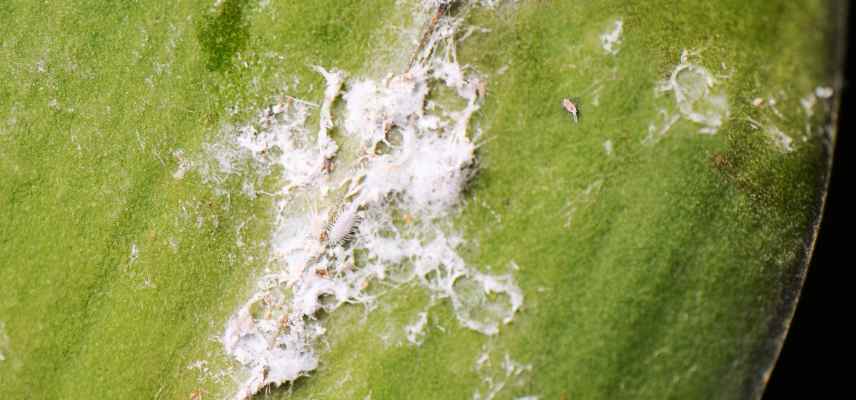
Mealybug
Problems related to poor growing conditions
Poor growing conditions can also affect the overall health of your Palms Laurels. Remember that these laurels thrive in deep, well-drained soil, even dry, but without excessive lime and preferably in partial shade. Lime in the soil makes the foliage lighter, potentially leading to chlorosis.
Please note that late frosts can sometimes affect the young shoots of Prunus laurocerasus, although new growth quickly compensates for this minor inconvenience.
Nota bene: slightly less hardy than Prunus laurocerasus (Palm Laurel), the Prunus lusitanica or Portuguese Laurel is not sensitive to lime, powdery mildew, or leaf spots. Additionally, this bush tolerates drought well and prefers full sun.
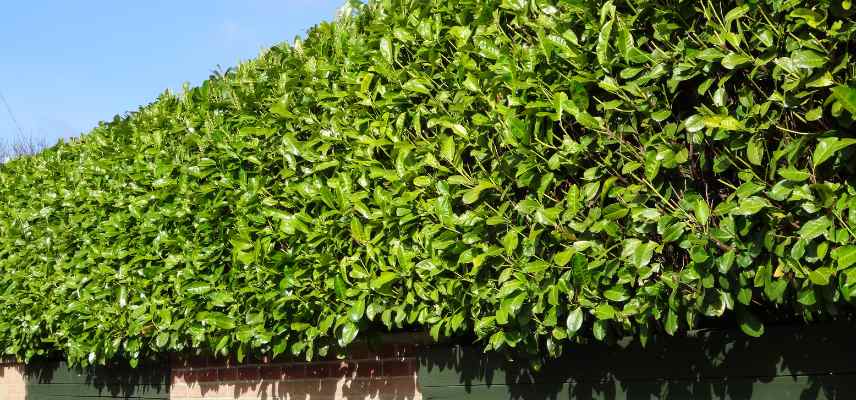
When well-positioned and growing in suitable soil, the palm laurel will pose no issues… except for its pruning if planted in a long linear fashion!
- Subscribe!
- Contents
Comments