





























Clematis with bell-shaped flowers: our top 5!
Discover the most spectacular varieties.
Contents
Among the 400 clematis varieties, there are clematis that offer, not large star-shaped flowers, but small bell-shaped flowers. Thus Clematis integrifolia, Clematis alpina, C. macropetala, or C. diversifolia offer, depending on the varieties, from April to October, an elegant and graceful flowering in the form of bell-shaped flowers. They come in a wide range of colours and shapes, elongated, reflexed, pendulous, with the look of small tulips or lilies. Some of them will be able to climb anywhere up to 4 m tall on old walls, trellises, fences or a small tree, while others will be grown as perennials forming pretty bushy tufts or even creeping, very useful for borders, banks or growing in pots. As with all clematis, they prefer their heads in the sun and their feet in the shade in soil that is deep, humus-rich, cool but well-drained. We have selected some of the finest clematis varieties with bell-shaped flowers; discover them!

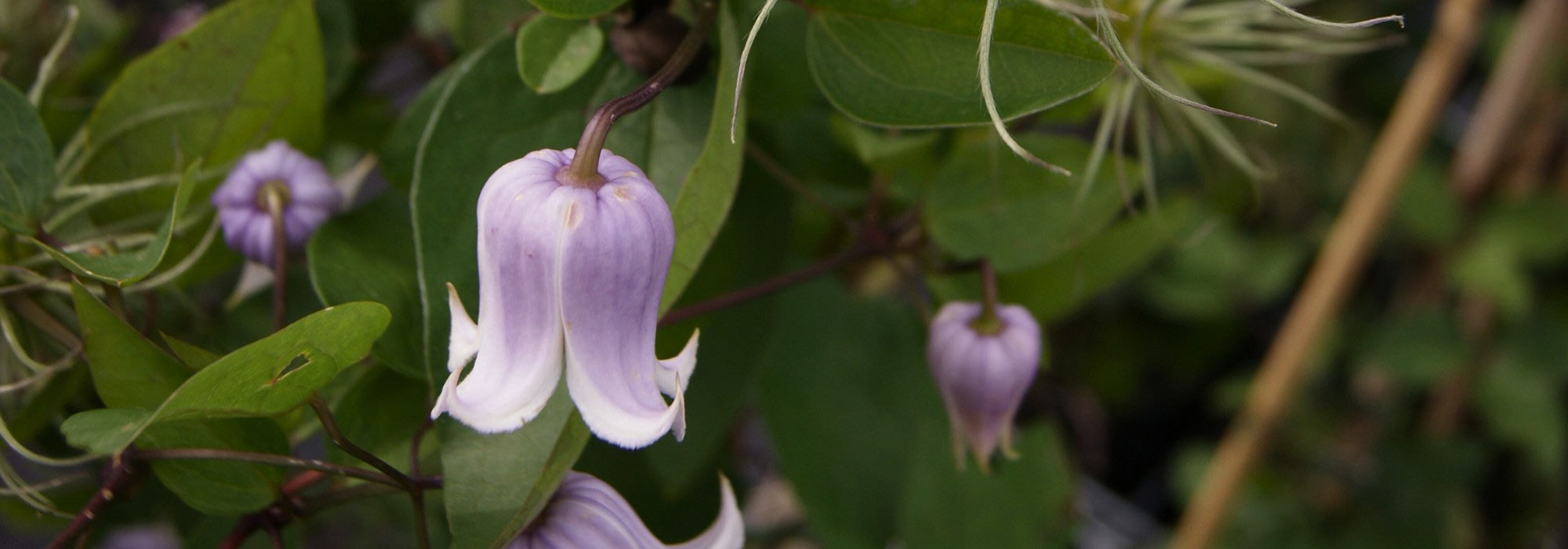
Clematis 'Annabella'
Quite charming, Clematis ‘Annabella’ is a modern hybrid variety, introduced in 2016, belonging to the Clematis viorna group. Throughout the summer, it will adorn the garden with its unique, romantic colour. From June to September, its stems clad with mid-green leaves, are crowned by delicate, reflexed, fleshy bell-shaped flowers, pale blue, slightly tinged with mauve, measuring 3 cm in diameter. The flowering is followed by fruits, silky, helical achenes, silver-grey in colour, giving them exceptional lightness. This deciduous climber, not exceeding 2 m in height and 1 m in width, will fit in anywhere: among a bush, on a small trellis or in a large pot on the patio. Hardy to -15°C, it is easy to grow in sun or partial shade, in any good, well-drained garden soil, but it should stay moist. It dies back completely in winter to re-emerge each spring. For a good flowering, in March, prune all the previous year’s stems to 25 cm above the soil. You can easily pair it with climbing roses and plant at its base phlox, or a few hardy geraniums that will provide the shade it enjoys.
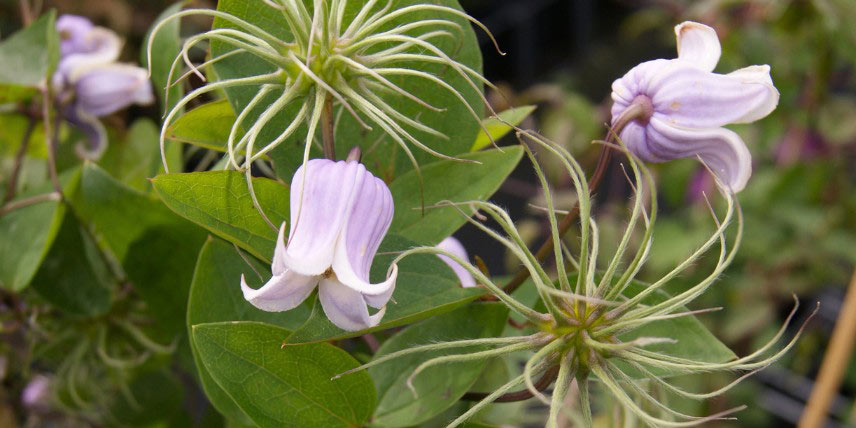
Clematis diversifolia 'Rooguchi'
The Clematis ‘Rooguchi’ is a true blue gem at the heart of the garden! This recent Japanese cultivar is a semi-climbing, semi-herbaceous variety, featuring spectacular flowering. It grows to about 1.5 m tall and is distinguished by its elegant, bushy habit. From June to September, a multitude of small indigo-blue bells, touched with lighter silver-blue on the tips of the curled petals flood the deciduous, glossy green foliage. These campanulate flowers emit a light fragrance.
Robust and hardy to -23°C, Clematis ‘Rooguchi’ adapts to different soil types, provided they are well-drained. It prefers a sunny position to fully thrive. Easy to grow and requires no special maintenance. Regular watering, especially in summer, and an application of organic fertiliser in spring will keep it healthy. It is an ideal plant for small gardens or patios. It can be trained against a trellis, a pergola or a wall, but above all, an excellent perennial for sunny beds and borders. It blends easily at the front of a planting of herbaceous perennials or shrubs, where it will form a striking colour echo with the deep-purple flowering spikes of a Buddleja ‘Camberwell Beauty’.
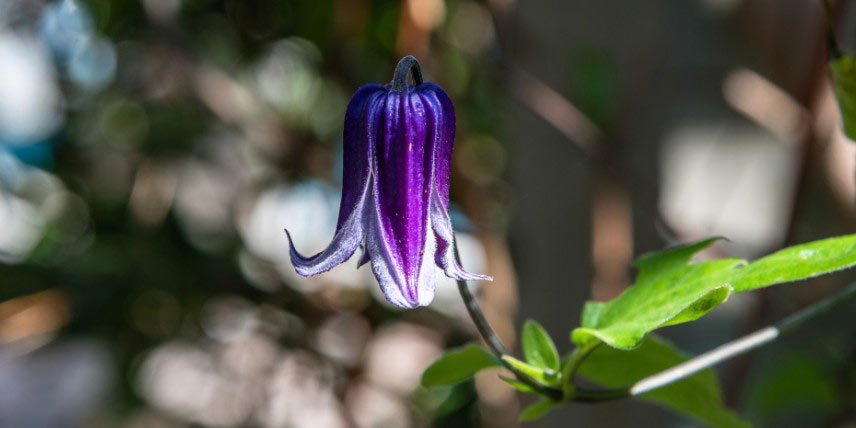
Clematis viticella 'Etoile Rose'
Born from the crossing of a Texensis group clematis (which brings together climbing deciduous species with late flowering) and a C. viticella, ‘Etoile Rose’ is a liana that grows like a perennial, with flowering as ravishing as rewarding. It combines the qualities of both parents: hardy to -15°C, water-wise and disease-resistant. It is striking for its abundant flowering in the latter part of summer and its ease of cultivation. Its generous and long flowering extends from July–August to October. It then offers charming pendant bell-shaped flowers with petals curled back. In a vibrant cherry red outlined with pale pink, these flowers, a touch tousled, bloom in successive waves as long as the soil stays moist. It can reach up to 3 metres in height with a 1 metre spread; it will be easy to find it a place in the garden, in well-drained soil, to adorn a trellis, a fence or a wall, in sun or in partial shade. Pair it with a climbing rose ‘Paul’s Scarlet Climber’ with cherry-red flowers or an old-fashioned rose, such as ‘Ballerina’ which also flowers pink and white simultaneously, to bring a splash of cheer to the late-season garden.
Read also
7 Original Flowering ClematisClematis 'New Love'
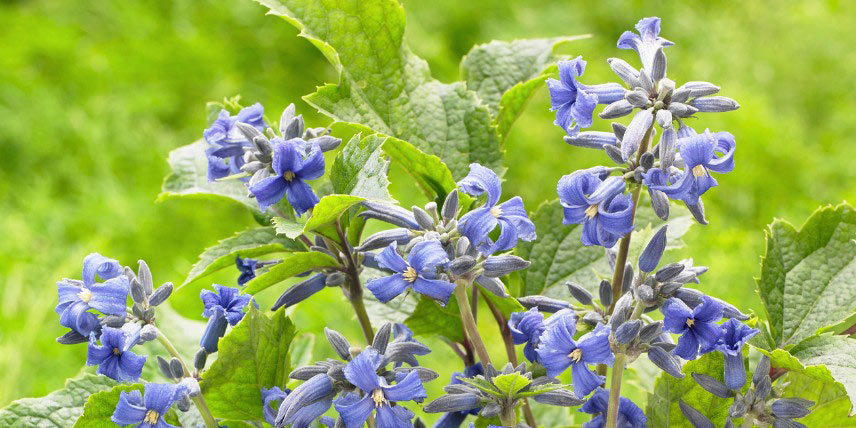
Clematis ‘New Love’ stands out for its bushy habit and prolonged flowering. Unlike most climbing Clematis, this variety does not require support and naturally adopts a compact, rounded habit. Not overly large, it forms a tuft of large leaves in a deep, slightly velvety green, turning greyish in winter, about 80 cm tall by 50 cm wide, adding a bright touch even when not flowering.
But from June to September, Clematis ‘New Love’ truly comes into its own, becoming a true flowering globe. Bunches of blooms, striking in their blue colour, emerge from the foliage. Bell-shaped flowers with long, curved petals bloom in ultramarine blue, washed lighter toward the centre, and each displays a spray of stamens. They diffuse a delicate fragrance, attracting pollinators and enhancing the garden with their delicacy.
Hardy and very hardy (to -29°C), this Clematis thrives in rich, cool, well-drained soil, in sun that is not scorching. Plant it with a Miscanthus sinensis ‘Adagio’ which will provide a graceful backdrop in a border of perennials, along a path with small-flowered periwinkles, or even in a pot on your terrace to enjoy its beauty and its delicate fragrance. Its compact habit and long flowering make it a perfect choice for small shaded gardens.
© Plantipp
Clematis integrifolia 'Hakuree'
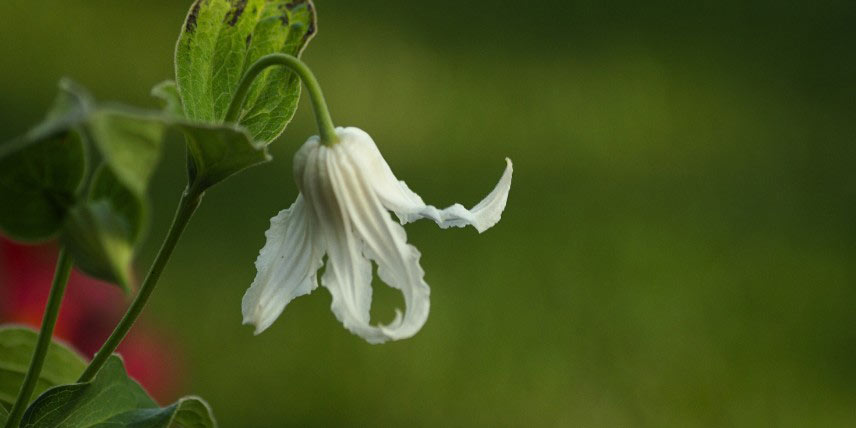
Clematis ‘Hakuree’ also stands out for its bushy habit and its summer flowering, as graceful as it is abundant. It offers an alternative to traditional climbing Clematis, transforming into a true carpet of bright bell-shaped blooms. Never taller than 75 cm, ‘Hakuree’ forms a bushy tuft of deciduous leaves, deep-green and glossy. From June to August, it produces, on its long stems, a cloud of small pendant bell-shaped flowers with petals slightly twisted and undulating, pure white, which may tilt slightly toward mauve-blue. Their colour varies with temperature. They emit a soft, slightly sweet fragrance, reminiscent of gardenia. The flowers are followed by downy seed heads of a silver-grey in autumn, adding decorative interest.
Hardy to -23°C, easy to grow, a late-winter pruning is all that’s needed for it to come into bloom. It prefers partial shade, as it dislikes direct and scorching sun. Clematis ‘Hakuree’ lends itself to multiple uses: as groundcover to dress a patch of the garden, in a border to bring colour and lightness, for hanging or in pots on a terrace or balcony to enjoy its close-up flowering and fragrance. At its base, plant clumps of Variegated Hostas, perfect for brightening a shady corner.
- Subscribe!
- Contents

Comments