





























Choosing a Penstemon
Our tips to find the ideal variety
Contents
The Penstemon is a generous summer-flowering perennial that lasts for many months until autumn. It is native to the United States and thrives in sunny conditions with well-drained soil. It produces tubular flowers on a bushy clump, in shades of pink, purple, mauve, red, white, and exceptionally yellow. There are many varieties, each with quite different appearances. Discover how to choose the Penstemon of your heart based on height, colour, flower appearance, foliage colour, or according to its use in the garden. Embrace this prolific, light, and charming perennial without delay!

According to their size
Penstemon is a rapidly growing perennial. While most varieties reach an average height of 50 cm, size variations range from 35 cm for the shortest to 1 m for the tallest in our gardens. In the wild, the tallest species can reach 3 m, while the smallest only grow to 10 cm.
- Among the smallest are Penstemon digitalis ‘Dakota Burgundy’ and Penstemon pinifolius ‘Mersea Yellow’, which reach 35 cm in height. The Penstemon glaber reaches 40 cm in height.
- The majority of Penstemons measure between 50 and 70 cm in height.
- The tallest can reach up to 1 m: this is the case for Penstemon barbatus ‘Coccineus’ and Penstemon ‘Garnet’. Also noteworthy is Penstemon digitalis ‘Pocahontas’, which is nearly as tall.
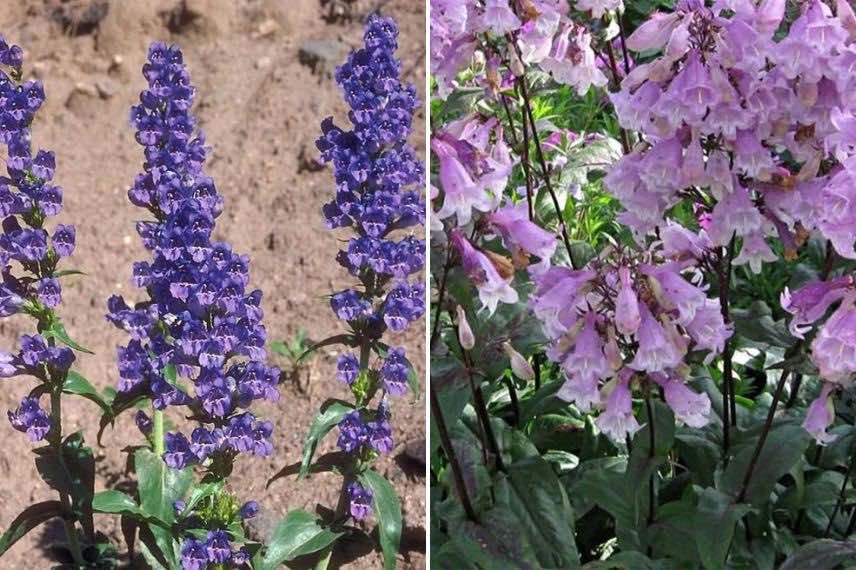
A Penstemon glaber, 40 cm in height on the left, and Penstemon digitalis ‘Pocahontas’ on the right, standing at 90 cm
Read also
Penstemon: planting, pruning and careAccording to the colour of the flowers
The tubular or elongated bell-shaped flowers of Penstemons are gathered in paniculate or terminal clusters. Most often, they are available in shades of violet, almost blue, bright pink and salmon pink, or red, burgundy, and even purple. They can sometimes be entirely white and very rarely, yellow. They can be solid or bicoloured. They are frequently shaded with a white throat, either gradually or separated by a clear line, creating a distinctly bicoloured effect. At other times, the throat is adorned with fine lines forming patterns, resulting in delicate and highly successful displays.
- Violet flowers: the beautiful Penstemon ‘Russian River’, a striking violet, is accompanied by Penstemon strictus, which leans towards blue. Softer, more mauve are the Penstemons ‘Sour Grapes’ or ‘Pensham Czar’, although the latter, with its pure white throat and large flowers, is bright and luminous.
- Pink flowers: soft and gentle, respectively tender pink and salmon pink are the Penstemon ‘Apple Blossom’ and ‘Hewell Pink Bedder’. ‘Polaris Rose’ features a white throat, while Penstemon digitalis ‘Dakota Burgundy’ contrasts its pink flowers with dark purple foliage. ‘Souvenir d’Adrien Régnier’ bears beautiful flowers of a fresh pink with a more discreet white throat, marked with bright carmine veins.
- Red flowers: Penstemon ‘Harlequin Red’ and Penstemon barbatus ‘Coccineus’. The Penstemon ‘Le Phare’ is clearly bicoloured, with its distinctly marked white throat, like ‘Rubicundus’.
- Purple flowers: The Penstemons ‘Blackbird’, ‘Rich Ruby’, and ‘Garnet’ range from washed-out purple to rich, dark purple.
- Blue flowers: Penstemon mensarum
- All white flowers: Penstemon ‘White Bedder’ or nearly white: Penstemon ‘Husker Red’
- Yellow flowers: Penstemon pinifolius ‘Mersea Yellow’
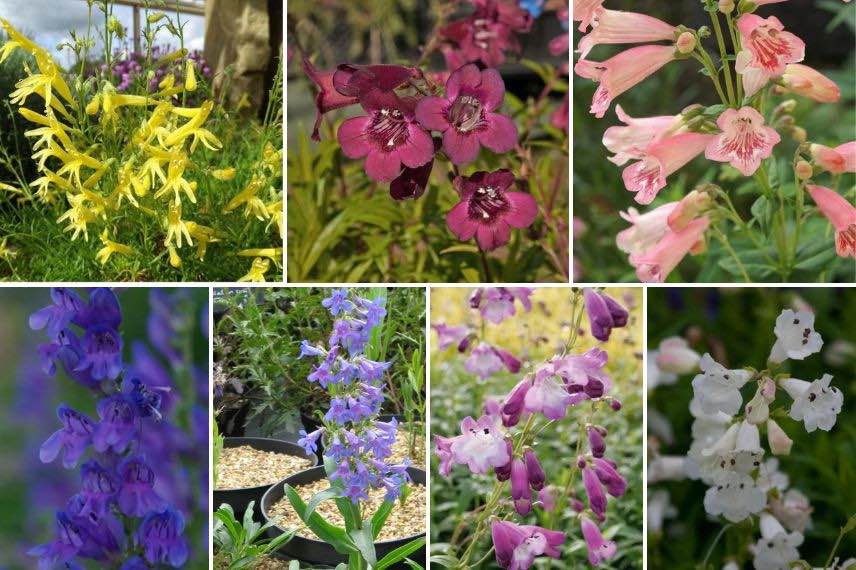
Clockwise from top: Penstemon pinifolius ‘Mersea Yellow’, ‘Rich Ruby’, ‘Hewell Pink Bedder’, ‘White Bedder’, ‘Alice Hindley’, Penstemon mensarum, ‘Russian River’
According to the appearance of the flowers
Depending on the species and varieties, Penstemon flowers can be small or larger, slender or broad. They measure between 2 and 7 cm in length and can be slightly or widely open.
Large-flowered open Penstemons, sometimes featuring a marked white throat, have a “horticultural” appearance. They are very different from small-flowered Penstemons and botanical penstemons, which have a more natural look. The former are perfect for adding colour and vibrancy to highly floral perennial borders and mixed borders. The latter are more suited to naturalistic or cottage gardens.
Thus, Penstemons, due to the appearance of their flowers, will appeal to gardeners in different ways and for different reasons. More than any other criteria, this is what differentiates them the most, even if this criterion may not seem spectacular compared to the differences that can exist between Dahlia flowers, for example. Depending on their horticultural or natural appearance, they are integrated into the garden in different ways: they will find their place in different garden styles.
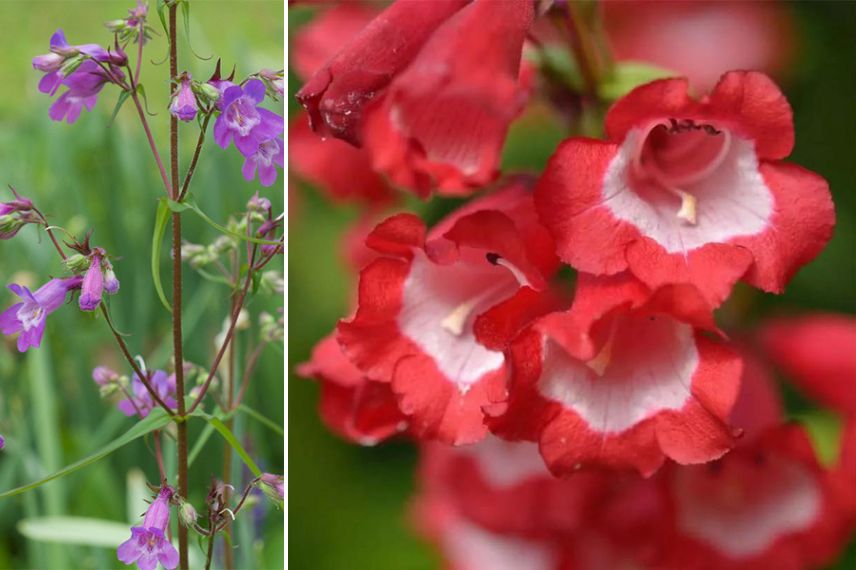
A Penstemon ‘Sour Grapes’ on the left, with small flowers, and on the right, the large bicoloured flowers of Penstemon ‘Le Phare’
Read also
5 lovely ideas to pair PenstemonsAccording to the flowering period
Penstemons bloom in summer, often lasting until autumn.
The earliest varieties produce their flowers as early as May, such as Penstemon mensarum, or in June, like the Penstemon ‘Alice Hindley’, ‘Gloire des Quatre Rues’, and ‘Souvenir d’Adrien Régnier’.
Some late varieties wait until August, such as Penstemon ‘Countess of Dalkeith’.
According to the colour of the foliage
When the foliage of Penstemon does not express itself in green, light, medium, or dark, it expresses itself in purple. While the result may be less natural, it is often striking, contrasting beautifully with white to pink flowers. Notable examples include Penstemon ‘Husker Red’, Penstemon digitalis ‘Dakota Burgundy’, ‘Dark Tower’, and ‘Pocahontas’. These varieties showcase very dark purple foliage and burgundy to nearly black stems.
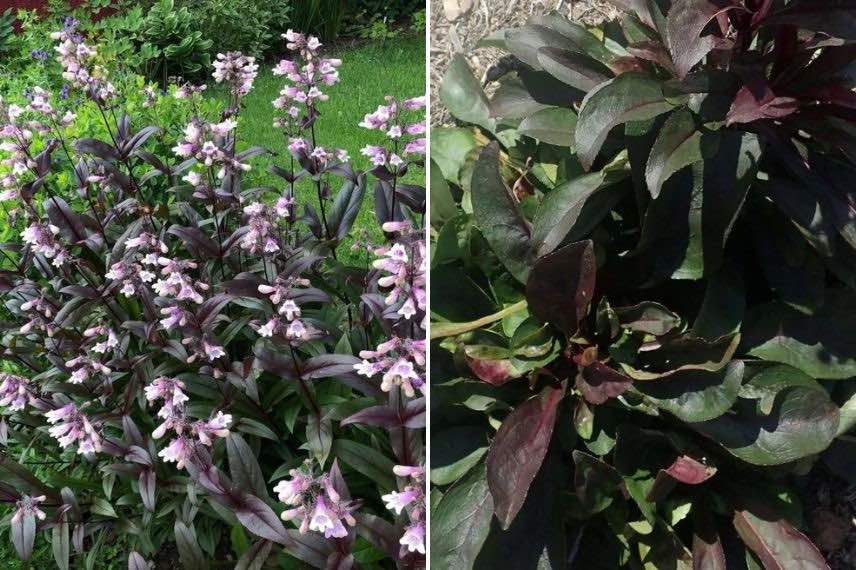
Penstemon ‘Dark Towers’ with purple foliage
According to the habit and uses
Some small penstemons form a spreading carpet, such as Penstemon pinifolius ‘Mersea Yellow’. Some have a very upright habit. This is the case for Penstemon mensarum, Penstemon barbatus ‘Coccineus’, Penstemon strictus and ‘Rubicundus’. The others form a bushy clump, with more or less woody stems.
Penstemons can fit into various garden styles (see paragraph on flower appearance). As they prefer well-drained soil, in full sun or possibly partial shade, they can be planted:
- In a perennial border, choosing varieties with large, brightly coloured, bicoloured flowers.
- In a wildflower garden, with a natural look, for botanical penstemons and those with small flowers, alongside grasses.
- In a dry or gravel garden.
- In a dry rockery or on a wall for the smaller, spreading varieties.
- In a modern garden, selecting a variety with white flowers and contrasting purple foliage.
- In pots.
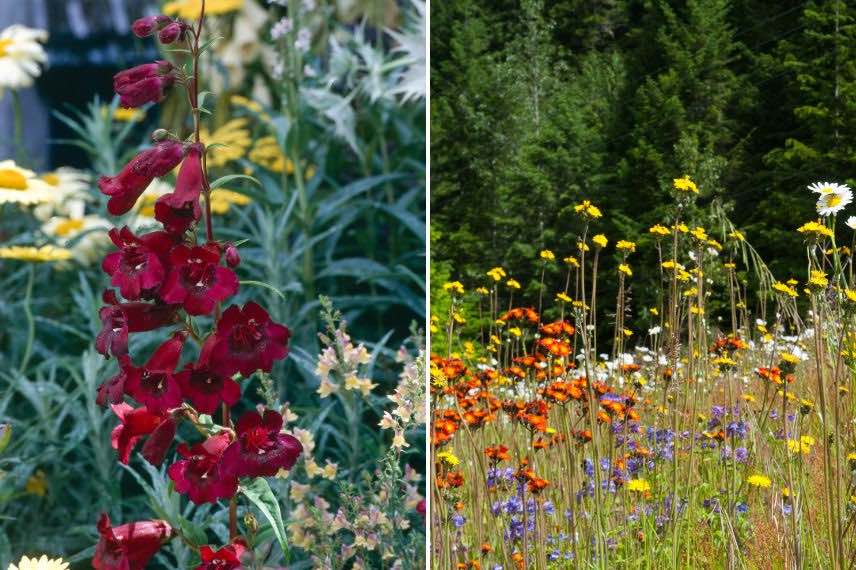
A Penstemon in a colourful perennial border and another in a naturalistic meadow
- Subscribe!
- Contents
Comments