





























Choosing a Paulownia: our Buying Guide
Choose a Paulownia variety best suited to your garden, climate and preferences
Contents
Planting a Paulownia is already an excellent choice! Indeed, this tree holds a multitude of ornamental, utilitarian, ecological or economic benefits. Absolutely stunning with its spring flowering in violet or mauve clusters, but also for its heart-shaped foliage of exceptional size, Paulownia is also prized for the quality of its wood. Admittedly, this argument may not interest you much if you wish to plant this majestic tree, native to Asia, in your garden… On the other hand, if I tell you that it’s a tree with very rapid growth, able to provide shade in under ten years, and moreover a ‘carbon capture champion’, the argument is more convincing. One could add that it has the ability to stabilise soils, fix atmospheric nitrogen… In short, how could one do without a Paulownia in one’s garden?
Nevertheless, the question inevitably arises of choosing the best species or variety. Which Paulownia is best suited to the climatic and cultivation conditions in my region? Which Paulownia species grows the fastest? Which one has the finest ornamental qualities? I invite you to discover our Paulownia buying guide to make your choice with full knowledge of the facts.
For everything you need to know: Paulownia, Empress Tree: Planting, growing, and Care.

According to the rate of their growth
Paulownia belongs to this category of trees with very rapid growth. Some say it’s the fastest-growing tree in the world. It can thus grow 2 to 3 metres per year in the early years! Or, more plainly, 2 centimetres per day. To reach ripeness 5 to 7 years after planting. That’s why it’s a perfect tree to quickly give a mature look to a large garden or park. It’s also thanks to this rapid growth that Paulownia is widely used for reforestation in certain regions of the world. But let’s get back to your garden…
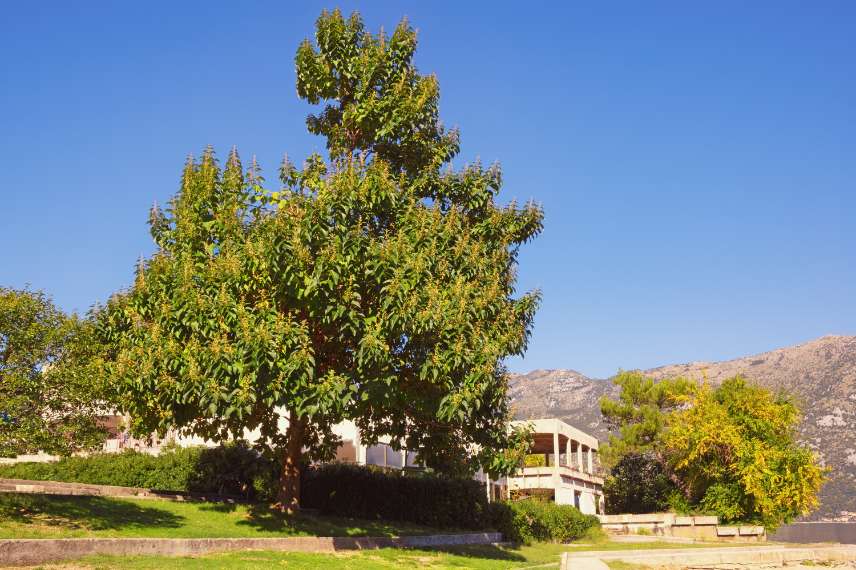
In the wild, the imperial tree, another name for Paulownia, can reach 20 m. In our gardens, depending on the varieties, it will reach a height of 7 to 12 metres with a spread of 5 to 10 m. That said, Paulownia needs space and is only suited to gardens that are sufficiently spacious.

The Paulownia is a fast-growing tree
Paulownia offers three different species, easy to grow: Paulownia tomentosa, Paulownia fortunei and Paulownia elongata. And the champion of the fastest shoot growth is certainly the Paulownia elongata, the species most used for wood production and reforestation, but also as a shade and ornamental tree in parks and large gardens. In its natural medium, it can reach 28 m but in our latitudes, a height of 12 to 13 m remains reasonable. And in less than 10 years, it does so easily.
According to its ornamental qualities
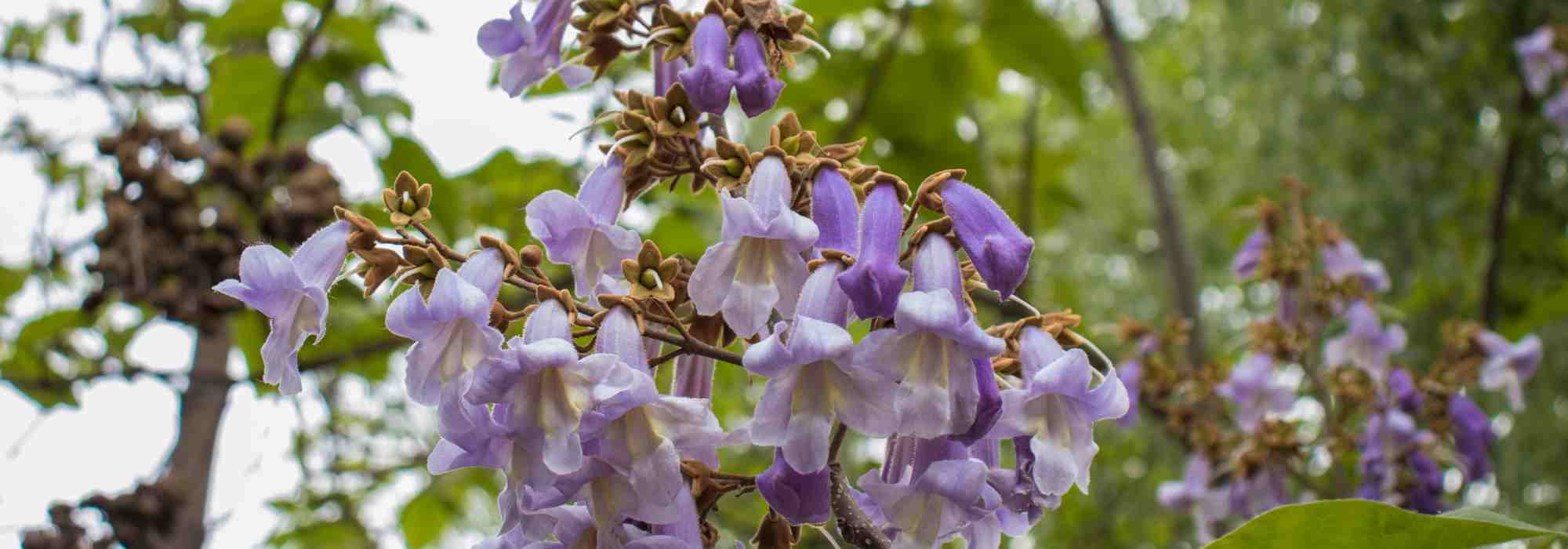
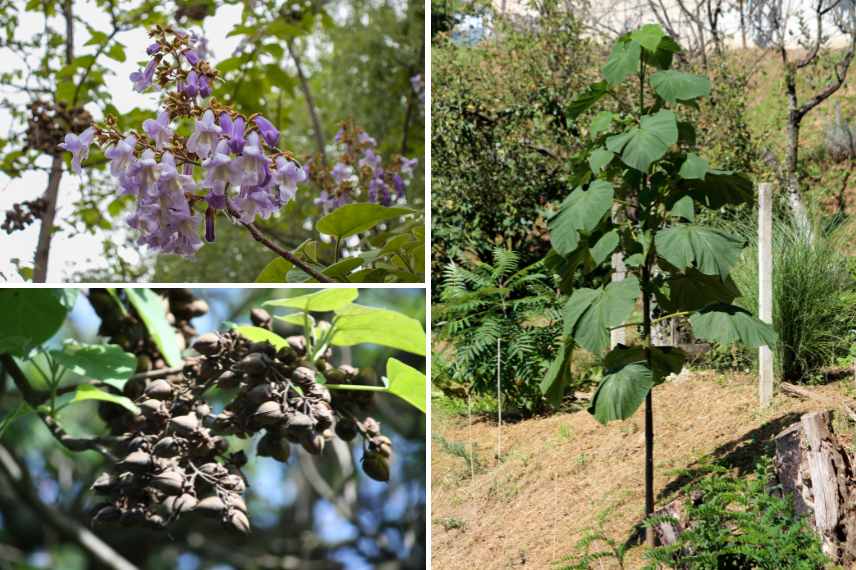
Remarkable, splendid, spectacular… adjectives abound to describe the paulownia’s spring flowering. Between May and June, at the tips of the previous year’s shoots, usually bare, upright panicles, made up of fairly large bell-shaped flowers. Beyond their beauty, these flowers emit a sweet fragrance and attract foraging insects and pollinators with their melliferous and nectariferous virtues. Depending on the variety, these flowers offer slightly different shades, from mauve to pink. Thus, the Paulownia tomentosa offers mauve-to-blue-violet flowering with a pleasant violet scent. And if you’re eager to see your paulownia in bloom, choose the cultivar ‘Hulsdonk’ which provides flowering much faster than the type species. Its flowering is also notably generous in mauve violet.
The flowers of the Paulownia elongata often appear a little earlier, in April, in profusion. Depending on region and climate, their colour can range from very pale mauve to darker mauve, enhanced by a yellow throat. As for Paulownia fortunei, it offers interesting cultivars: ‘Fast Blue’ blooms in lilac-blue with yellow-spotted throats from April, while ‘April Light’ also offers blue-lilac to lavender flowers with throats tinged purple and yellow.
 The paulownia has numerous ornamental merits
The foliage is not to be outdone for adding charm to your garden. The leaves display a very handsome span of around 25 cm, they are broad and glossy, cordate, with a silky reverse. In autumn, they turn yellow. The Paulownia fortunei has leaves larger and thicker than the Paulownia tomentosa, and Paulownia elongata leaves are narrower and longer.
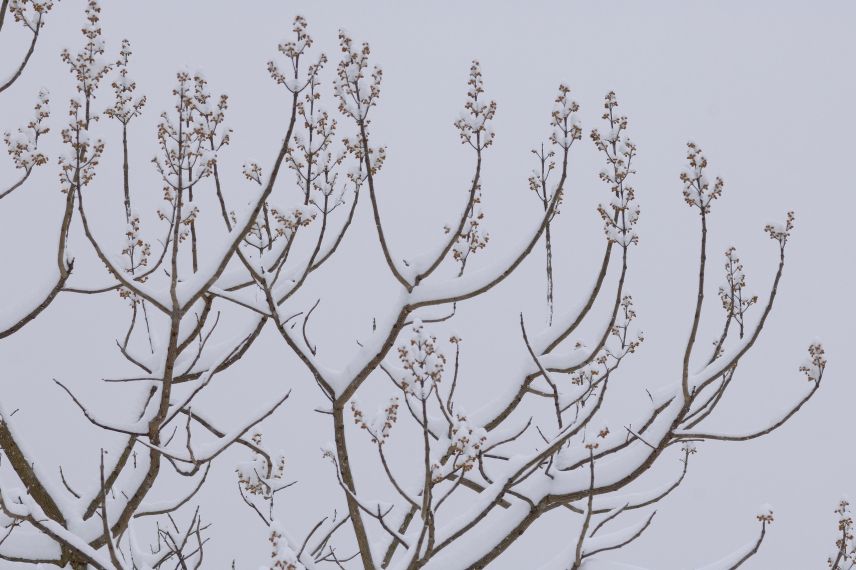
The ornamental qualities of the paulownia also lie in the presence of fruits: the capsules that open to release numerous seeds stay on the tree all winter.
Depending on weather conditions
Paulownia is a highly adaptable tree that grows in all climate zones. Hardy and drought-tolerant, they can withstand frosty winters and very hot summers, with temperatures ranging from -20 to +45 °C. It is therefore perfectly suited to our temperate climate, although it does have a slight preference for areas where summers are fairly hot and humid and winters are mild. Ideally, it requires annual rainfall of around 600 to 1000 mm. However, winters with very cold temperatures over an extended period are not suitable for Paulownias. Nevertheless, there are some small differences between the different species.
Paulownia is capable of adapting to temperatures ranging from -20 to +45 °C
Thus, Paulownia fortunei seems to be the most frost-hardy, while the Paulownia elongata thrives more in warmer climates. It is more drought-tolerant. As for Paulownia tomentosa, it may be more sensitive to extreme temperatures.
Regarding required maintenance
Although it grows very quickly, paulownia does not require extensive maintenance. Nevertheless, it needs to be pruned from time to time to remove diseased or damaged branches, or those that distort its habit, to shape it and balance its branches. This pruning takes place just before vegetation resumes, between February and March. It is advised not to prune large branches.
Some species, however, require more regular pruning. Thus, Paulownia tomentosa requires more regular pruning for shaping, while the Paulownia elongata needs minimal maintenance.
Note that the variety of Paulownia tomentosa ‘Fast Blue’ stands out for its spreading habit, almost as wide as tall. It reaches 7 m in height with a 5 m spread. It is therefore a tree particularly suitable for shading in a garden. As for the Paulownia tomentosa ‘April Light’, it has been selected for its naturally rounded habit. It stands 7 m tall with a width of 10 m.
Paulownia needs a few pruning cuts to balance its branches
- Subscribe!
- Contents
Comments