



























Choosing a Brunnera: our buying guide
Choose from among the many varieties
Contents
Brunneras or Caucasian forget-me-nots are beautiful perennials with deciduous foliage. They are often characterised by strongly silvery tones, but there are also golden or variegated leaves. Brunnera offer in spring a lovely, airy flowering in panicles of small blue flowers like those of the Caucasian forget-me-not. They are robust groundcovers that are low-maintenance, in partial shade and moist soil. They bring a lot of light to shaded areas.
→ Read our guide Brunnera, Caucasian forget-me-not: planting, growing and care to learn more.
According to the size
Brunneras are fairly consistent and homogeneous in terms of size and height, generally forming clumps that reach 30–50 cm tall, with a width to match. Thus, it is neither the Brunneras’ dimensions nor their habit or growth in spreading clumps that are the distinguishing criteria.
Of course, one exception: the Brunnera ‘Alexander’s Great’ : the largest, adorned with large leaves, it reaches 60 cm in height and spreads to 80 cm.
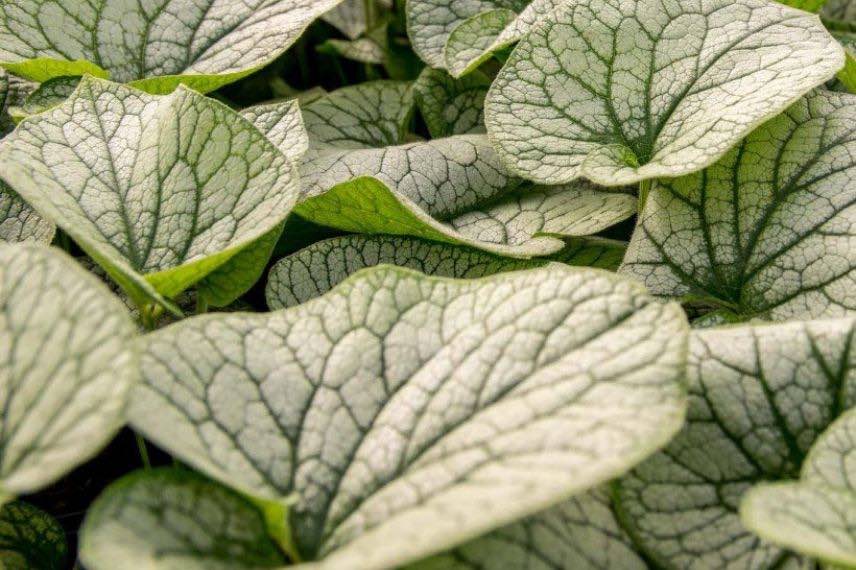
The large leaves of the great Brunnera ‘Alexander’s Great’
According to the colour of flowers
There too, it is a homogeneous young plant, since Brunneras usually bear small blue flowers, reminiscent of forget-me-not flowers. A pale, soft blue, nuanced by a small white circle at the centre. These flowers are small, measuring between 4 and 8 mm in diameter, and have a very delicate appearance. They are star-shaped, divided into five relatively broad and rounded segments, corresponding to five fused petals. Gathered in panicles, they reach around twenty centimetres in length. The flowering has a very light appearance, it floats above the foliage.
Some variations, however:
Some Brunneras bloom white. This is the case for Brunnera macrophylla ‘Betty Bowring’, ‘White Zebra’ and ‘Mr Morse’. The flowers are then a pure, dazzling white.
Also mention the variety ‘Starry Eyes’, with blue-and-white bi-coloured flowers, in stars of six white petals bordered by a vivid gentian blue.
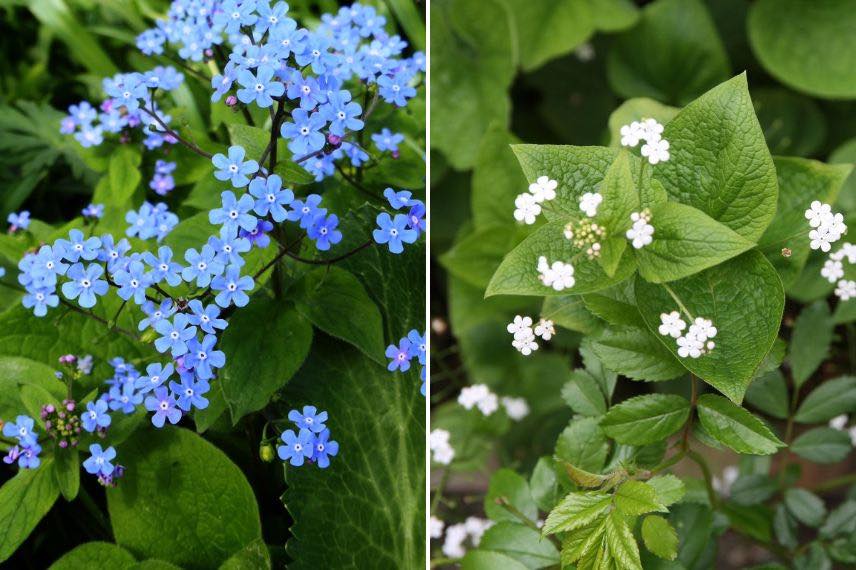
The beautiful forget-me-not blue flowers of Brunneras, and a very bright white-flowered form, ‘Betty Bowring’
According to the colour of the foliage
Here is the real difference between Brunnera. These perennials stand out for their foliage, highly ornamental. The lamina is adorned with colours and decorative patterns, and appears particularly dense.
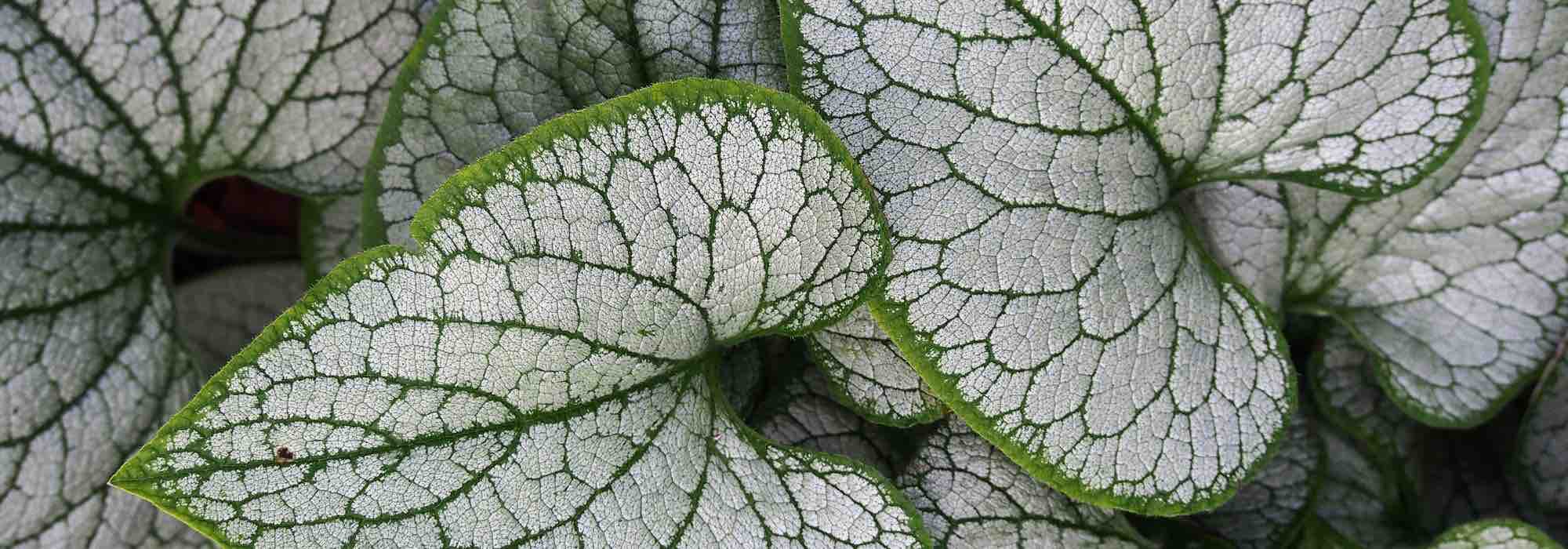
Leaves are large and broad, heart-shaped (cordate), and measure up to 15–20 cm in length. They are simple, entire, undivided, with fairly rounded margins. The foliage has a rough, hairy texture. The veins are clearly visible, raised, and give the leaf a quilted appearance.
Leaf colour is based on a fairly dark green, on which silver-grey markings are drawn. It is common for the veins to stand out in green against the rest of the silver lamina, forming superb, very fine patterns, like lace.
But there are different leaf types, ranging from more or less silvered to light green, golden-yellow or variegated.
Leaves simply speckled with silver
Some varieties have only grey spots, such as Brunnera ‘Langtrees’ or Brunnera ‘Emerald Mist’.
Leaves completely silvered
Others are almost completely silvered. This is the most represented category. The veins are more or less marked. The silver colour is more or less intense. Look at the following varieties; leaf sizes also vary.
- Brunnera ‘Looking Glass’, the brightest, the most silvery
- ‘Jack Frost’
- ‘Jack of Diamonds’
- ‘Silver Hearts’
- ‘Alexander’s Great’, mentioned above, the largest, with the largest leaves
- ‘Queen of Hearts’
- ‘Jack’s Gold’
- ‘Mr Morse’
Light-green foliage
There are also a few varieties with light-green foliage such as the Brunnera macrophylla ‘Silver Wings’, very slightly speckled with silver.
Golden-yellow foliage
Leaves variegated with white
The Brunnera Brunnera ‘Dawson’s White’ and the Brunnera macrophylla ‘Variegata’ have leaves broadly margined with cream-white.
Leaves variegated with yellow
Brunnera ‘Hadspen Cream’ features leaves irregularly splashed with creamy yellow.
Finally, Brunnera Brunnera ‘King’s Ransom’ has the peculiarity of combining cream-edged leaves on a silvery background with green veins. A striking mix that makes the foliage very pale, like frosted.
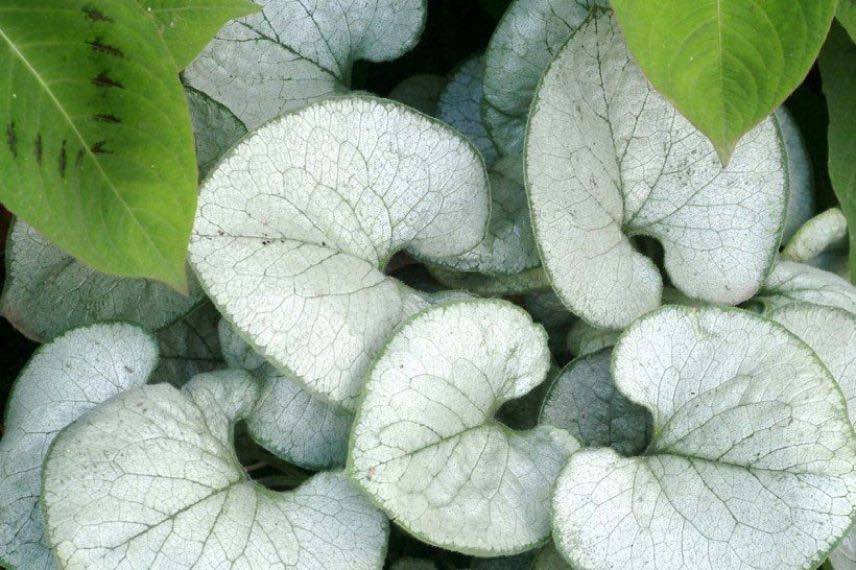
Brunnera ‘Looking Glass’ — the most silvery of them all!
According to size and foliage shape
Cordate leaves of Brunnera, when draped with a silvery sheen, as with the impressive variety ‘Looking Glass’, add considerable aesthetic value to the plant, but are better reserved for polished garden styles, even contemporary, in contrast to foliage.
For a more natural and wild ambience, favour botanical species with smaller leaves and less extravagant colour, such as Brunnera macrophylla or sibirica… or, optionally, ‘Langtrees’.
According to the flowering period
Brunneras form flowering stems that emerge in spring, alongside new foliage. Flowering typically occurs in April and May. However, depending on climate and variety, it may begin in March or last until June.
In late summer and autumn, a second flowering can be observed, after cutting the faded flowers from the first flush.
So, if the flowering window of Brunnera spans a four-month period, that is not yet a criterion for choosing.
Depending on usage
Brunnera naturally thrives in woodland understory on cool, moist soil.
To create a natural look, plant Brunnera in this edge-of-wood or woodland-understorey setting in the garden, in partial shade or light shade, with other plants that thrive under the same conditions. It will form a spreading groundcover, a uniform clump that steadily broadens without becoming invasive. Its silvery foliage stays bright in shade, as does its blue or white flowering.
As Brunnera prefers cool, moist soils, it can also accompany water-edge plants by a water feature.
If you have a north-facing border, for example at the front of the house, Brunnera will establish itself there with ease.
In a border, avoiding full sun, it blends with the flowering plants of cottage gardens and is enhanced by its cordate, colourful foliage.
- Subscribe!
- Contents
Comments