





























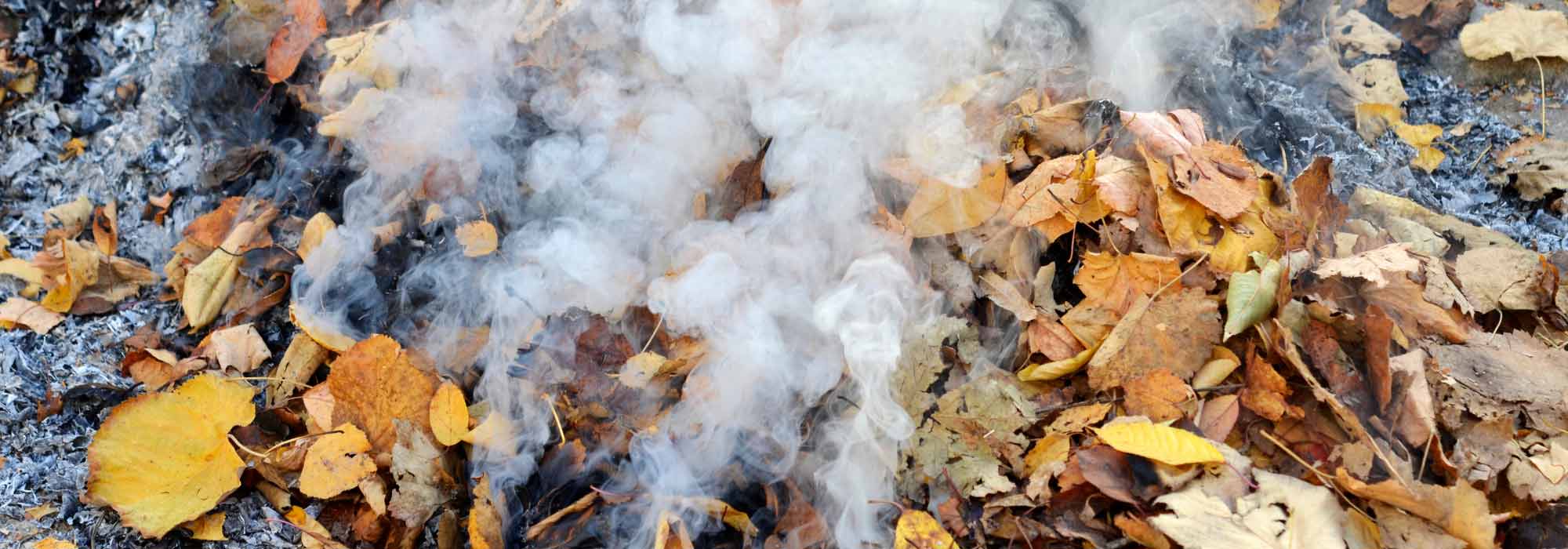
Burning green waste: what does the law say?
Why you should not burn anything in the garden
Contents
Branches, weeds, dead leaves, lawn clippings… while gardening, we all generate significant amounts of “green waste” estimated at around 17 million m3 in France, which averages 0.3 m3 or 160 kg per person per year. If your garden is large and you are the “meticulous gardener” type, this amount can be much higher.
As summer comes to an end and autumn cleaning begins, or when spring arrives and we want to give our outdoor space a fresh look, we produce substantial volumes of plant waste… which some are tempted to burn to dispose of quickly and easily. However, this is a very bad idea for several reasons. What does the law say about burning garden waste? Follow our explanations.

Burning green waste: it pollutes
The first (false) reflection one might have regarding the burning of plant material is that these are natural substances and therefore not toxic… However, burning plant material, especially when wet, emits a lot of atmospheric pollutants that release toxic substances harmful to both living beings and the environment. Among these are fine particles, nitrogen oxides, polycyclic aromatic hydrocarbons (which are persistent organic pollutants), carbon monoxide, volatile organic compounds, and dioxins.
All of this adds to the already significant air pollution; it is therefore unwise to exacerbate it while gardening, knowing that in France, air pollution from fine particles is responsible for the premature death of 48,000 people each year, according to figures from Public Health France. Numerous diseases also stem from this pollution: certain cancers, cardiovascular diseases, asthma, premature births, fertility issues, and strokes.
According to the Air Quality Observatory in Auvergne-Rhône-Alpes, burning 50 kg of green waste would be equivalent to:
- 13,000 km driven by a recent diesel car, 14,000 km by a recent petrol car, or 18,000 km by an old diesel car
- 12 months of heating for a house equipped with a high-performance oil boiler
- 3 weeks of heating for a house equipped with a high-performance wood boiler
- 700 times more particles than a 20 km trip to the tip

The figures speak for themselves, and we understand why it was essential to put an end to burning in gardens. Moreover, the toxicity of emissions was further increased when these green waste materials were burned alongside other garden waste such as plastics or treated wood.
It is therefore prohibited by law.
On 10 February 2020, Law No. 2020-105 concerning the fight against waste and the circular economy amended the Environmental Code, and it is now prohibited to burn green waste at home (hedge trimmings, tree and bush cuttings, grass clippings, fallen leaves, fruit and vegetable peelings), whether dry or wet, either in the open air or with a garden incinerator.
The sale and use of garden incinerators have also been banned in France since February 2020.
In addition to reducing pollution, this ban aims to limit the risks of accidental fire outbreaks, as garden fires can quickly spread and reach nearby buildings or wooded areas. This provision also reduces the risk of neighbourhood disputes due to smoke.
ADEME estimates that 9% of gardeners continue to dispose of their plant waste by burning it. Besides being irresponsible, failure to comply with this ban can result in a fine of €450. If you witness a violation of the ban on burning green waste, you can report it to the municipal hygiene services if you wish. If you are disturbed by the odours, you can also hold your neighbour liable for odour nuisances.
Alternative and eco-friendly solutions exist for recycling green waste.
Sure, here’s the translation:
—
So all this is well and good, but what to do with green waste? The alternatives are plentiful, much more ecological, as this waste is biodegradable, meaning it decomposes over time. So rather than viewing these organic materials as waste, let’s see them as green gold!
- First, you can use this green material to make compost. You can add all sorts of nitrogenous waste (peelings, grass clippings, weeds) and carbonaceous waste (branches, dead leaves, sawdust, straw).
The heap composting method allows you to produce compost in large quantities for larger spaces generating a lot of green waste. For smaller spaces, a composter or compost bin may suffice, and it’s possible to use several. The natural transformation process will recycle green waste into high-quality compost, rich, 100% natural… and 100% free! It will lighten your soil and save you money on compost, fertiliser, and water. - It is also possible to use garden waste to cover bare soil: grass clippings, prunings from bushes and perennial and annual plants, dead leaves—almost everything can be turned into mulch! This helps limit evaporation and erosion, protects plant roots from heat in summer and cold in winter, slows the growth of “weeds,” and enriches the soil with nutrients. It would be a shame to deprive our gardens of all these benefits. If you have a shredder or wish to buy one, even branches can be turned into RCW (ramial chipped wood). Discover what it is and how to use it in the garden.
- If you have enough space, you can create a pile of branches or dead wood for garden wildlife that will serve as shelter for some birds, reptiles, amphibians, a few mammals like hedgehogs, and various arthropods like woodlice: a way to invite biodiversity and help your garden.
- You can also take your green waste to a recycling centre. Some municipalities also organise home collections of green waste. Check with your local council for possible collection days.
- To reduce your garden waste (and save yourself!), you can simply decide to let weeds grow! Olivier provides no less than 10 good reasons to adopt this approach.
- Ingrid guides you towards Zero waste (or almost) in the garden, a way to apply the adage: “The best waste (even green) is the one that is not produced.”
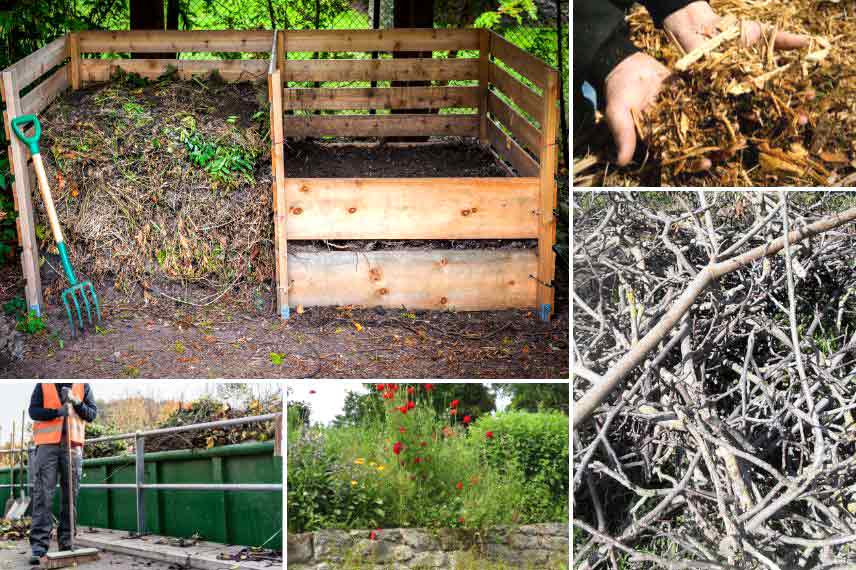 Composting, mulching, taking to recycling centres… there are plenty of solutions to recycle green waste. Embracing wild herbs and leaving piles of wood as shelter for small wildlife are also smart solutions.
Exemptions may exist in your municipality if there is no recycling centre or organised collection of green waste. Contact your local council to find out what to do with green waste in your area or if an exemption applies.
—
Read also
Mulching: Why? how?To find out more...
→ Consult the environmental code if you wish to learn about the legal provisions on this subject.
→ Follow Olivier’s advice to make good use of fallen leaves in the garden and find out Can you compost “weeds”?
→ Jean-Christophe helps you navigate through garden shredders: usefulness, different models, choice

- Subscribe!
- Contents
![[no_burning_garden_waste]](https://www.promessedefleurs.ie/blogwp/wp-content/uploads/2022/10/Bruler-les-dechets-verts-que-dit-la-loi-.jpg "[faq id=\"bruler-dechets-verts\" question=\"Qu'est-ce que dit la loi sur le brûlage des déchets verts en France ?\"]")
Comments