





























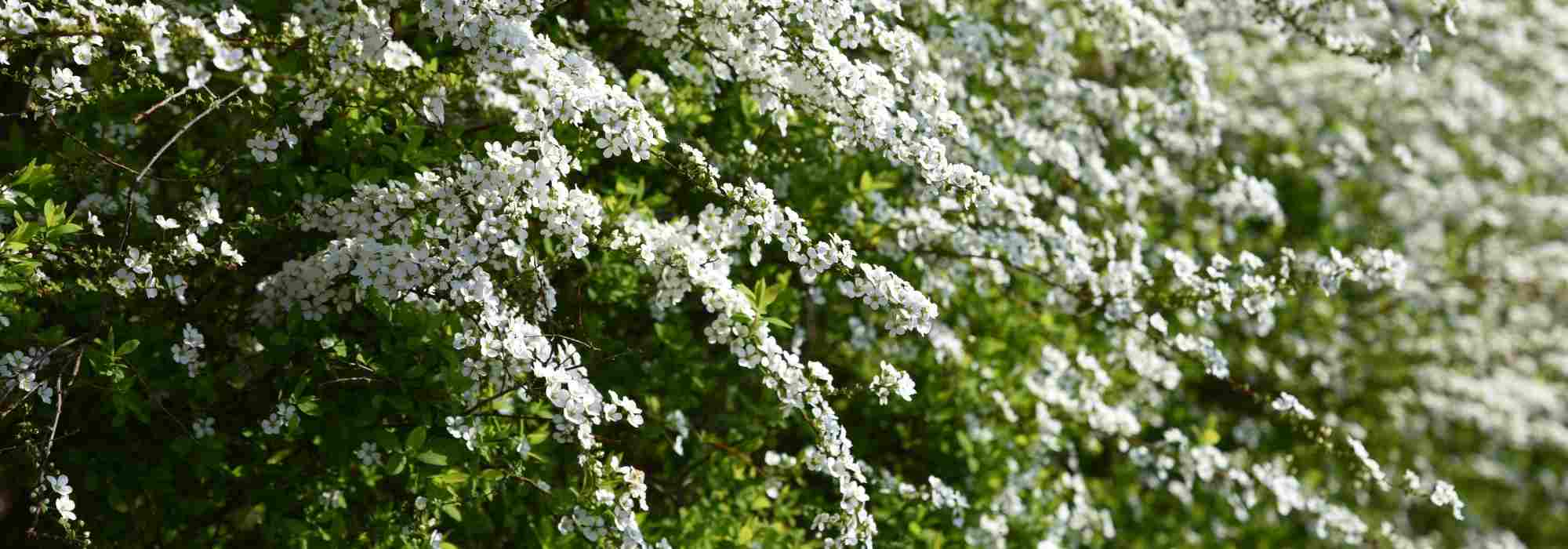
Arching and weeping habit shrubs
A romantic abundance for all gardens
Contents
The arching branches displayed by certain bushes give them a laid-back and languid appearance, a quaint and very natural charm. These bushes with an arching habit possess a flexibility that makes them suitable for use in hedges, but they can also enhance a lush flowerbed with their shape and curves.
Cascading like winter jasmine, dripping with flowers like Kolkwitzia or spireas, they all have an obvious charm that makes them popular in many garden styles. Often bowing under the weight of their spreading flowering along the branches, the appearance they project with just their foliage is enough to make them useful along a path or to dress a flowerbed.
Here is our selection of bushes with an arching habit, a wonderfully weeping and harmonious silhouette!
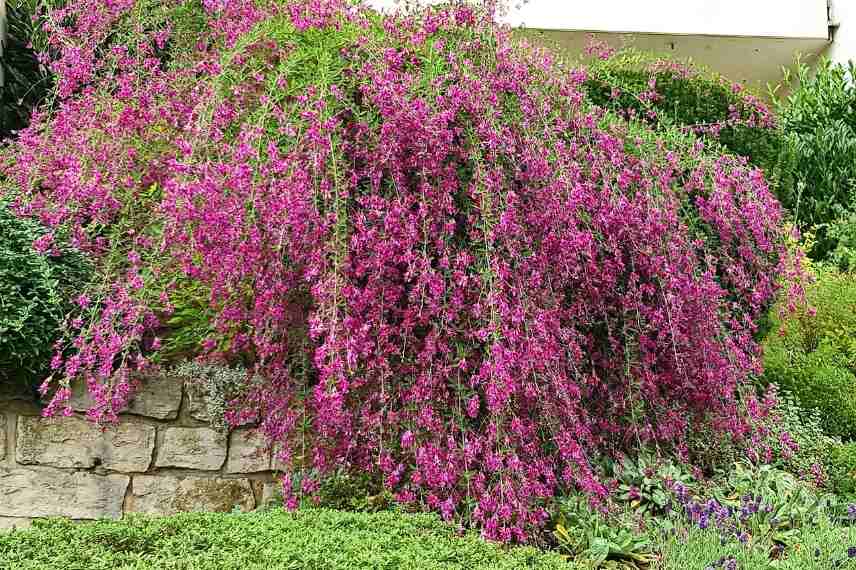
Lespedeza, an arching bush, impressive above a low wall

Kolkwitzia amabilis
Would it be the most beautiful of arching shrubs? The Kolkwitzia amabilis could certainly claim this title with its particularly loose and trailing structure, overflowing with pink flowers in late spring. It takes on this arching habit after a few years, and what a joy it is to see it burst forth with its reddish stems and a cascade of bell-shaped pink flowers with orange throats, clustered in crowns along the branches.
The beauty bush, as it is also called, is the star of informal hedges, where it can be paired with weigelias that will take over or bloom at the same time. It is a deciduous shrub, growing up to 3 m tall with a similar spread. Its bark also beautifully exfoliates over time. Plant it in full sun or light shade, in well-drained soil.
♥ Its advantages: a spectacular generous flowering in May-June, good resistance to cold and drought, and adaptability to all types of soil.
→ Learn all about Kolkwitzia amabilis in our complete guide: Kolkwitzia, planting, pruning, and maintenance
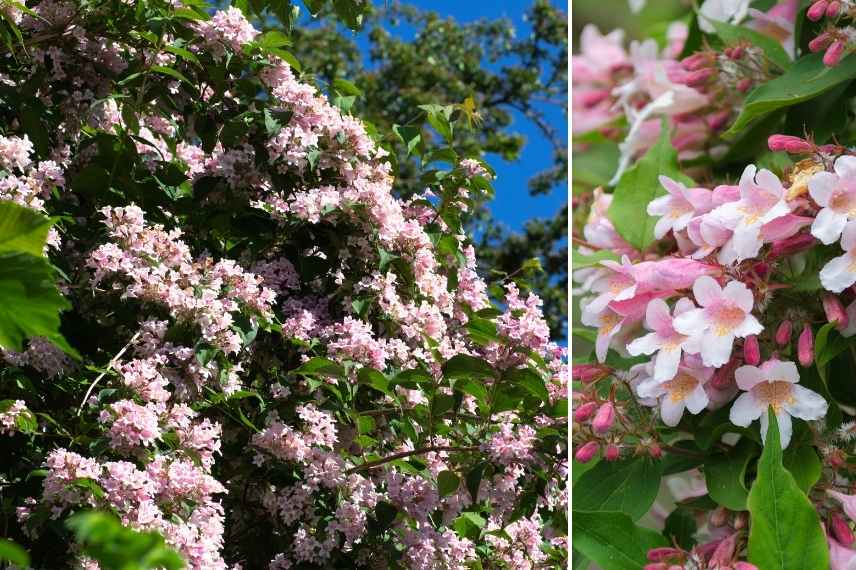
Kolkwitzia amabilis
Read also
Trees and bushes: different habitsSpiraeas
In the ranking of arching habit shrubs, spiraeas reign supreme. These are wonderful small deciduous shrubs with flattened, feathery spring flowering, some species particularly drooping their branches to form completely arching subjects.
Among these is the Spiraea thunbergii, whose white flowers, gathered in bouquets, appear before the leaves, the popular Spiraea vanhouttei or Vanhoutte spiraea, which can grow up to 2 m tall with very flexible and well-arching branches when young, and the Spiraea arguta, known as the dentate spiraea, with white flowers clustered on arching and slender branches.
These three spiraeas bloom from late March for Spiraea arguta to early May, in delicate small umbels. They should be planted in deep, rich soil, in full sun or very light shade. They delight in free hedges, romantic pathways, and other flower beds.
♥ Their advantages: a brilliant white flowering in spring and their ease of cultivation.
→ Learn all about Spiraeas in our comprehensive guide: Spiraea: planting, pruning, and care.
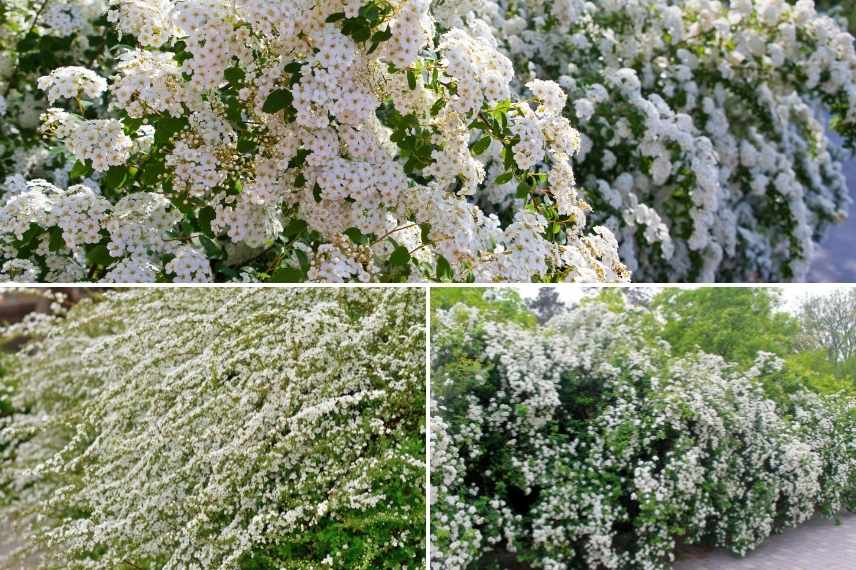
Spiraea vanhouttei at the top, bottom left Spiraea thunbergii, and bottom right Spiraea arguta
Buddleia alternifolia
Who doesn’t know the butterfly bush, a shrub with high ornamental and ecological value? While it attracts butterflies, bees, and bumblebees in large numbers, it has many other qualities and comes in a wide variety of species and horticultural varieties, often derived from Buddleia davidii.
The one we are particularly interested in within this selection of arching shrubs is Buddleia alternifolia, a butterfly tree that is somewhat different, especially in the arrangement of its leaves and the shape of its flowers: they do not resemble the usual panicles, but rather charming pom-poms scattered along the branches. As for its appearance, the main stems are erect, but the lateral branches droop in a soft, highly arching mass, covered in June-July by rounded clusters of lilac-pink flowers. Like other Buddleias, the narrow, deciduous leaves have a beautiful greyish colour on their underside, and it thrives in sunny locations.
Be careful, with this Buddleia flowering on old wood, pruning is optional or limited, unlike Buddleia davidii. The Buddleia alternifolia ultimately reaches nearly 3 m in height with a lovely spread of up to 4 m.
♥ Its advantages: the beauty of its flowering like a string of pearls, its rapid growth, and its ability to thrive in poor soils.
→ Learn all about Buddleia or Buddleja in our comprehensive guide: Buddleia, butterfly tree, planting, pruning, and care
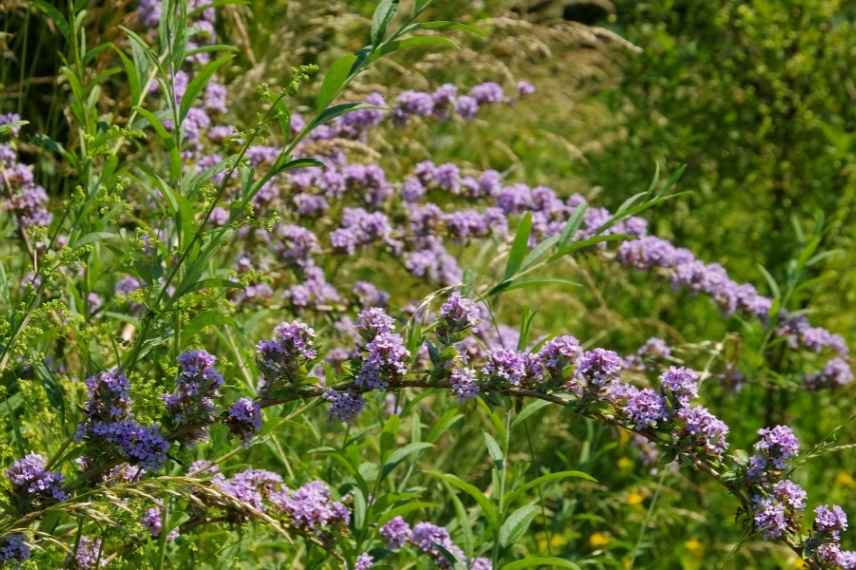
Buddleia alternifolia
Read also
7 weeping shrubsDeutzias
Just like a number of shrubs in this selection, Deutzia with a rather upright habit become slightly arched over time, adding to their incomparable charm. These ultra-romantic deciduous shrubs delight us in late spring with their incredible flowering, in panicles, like a vapourous avalanche.
Several species have this trailing habit, bowing under the weight of white or pink flowers depending on the variety, such as Deutzia gracilis, Deutzia crenata, or Deutzia scabra. They are well-suited for use in hedges, borders, and even on a terrace for the more compact varieties.
♥ Their advantages: an unparalleled romantic charm, the grace of their flowering, their use in various garden styles (countryside, natural, English…), their single or double flowers depending on the cultivars.
→ Learn all about Deutzia in our complete guide: Deutzia: planting, pruning, care.
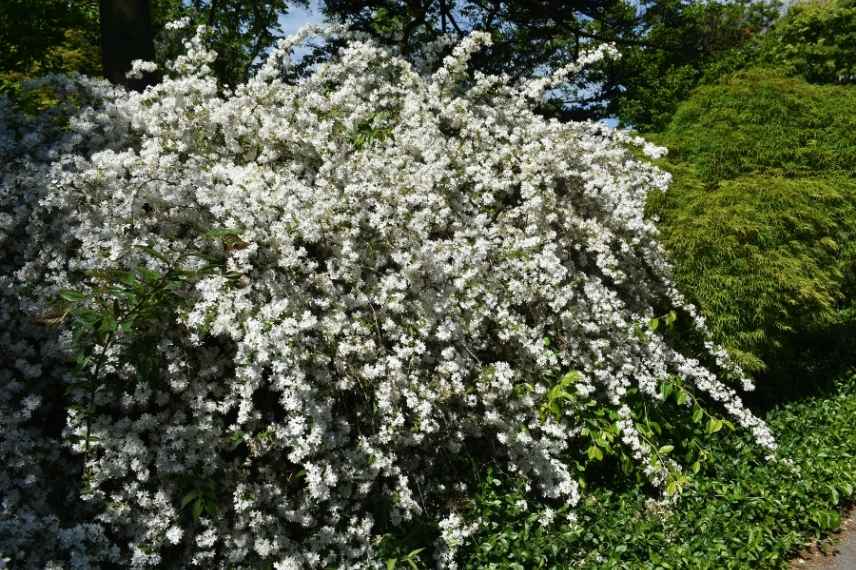
Deutzia gracilis ‘Nikko’
Jasminum nudiflorum
The bright winter jasmine or Jasminum nudiflorum is a ray of sunshine brought to gardens by its long, dripping lemon-yellow flowering from December to April, depending on the climate. While the stems of this shrub are rather stiff and chaotic, they nonetheless create a cascade taking on a more or less arching shape. Winter jasmine is a beautiful non-fragrant shrub, unlike other jasmines, but of great interest for its bright flowering in mid-winter and its trailing habit forming quite a unique cascade. Growing slowly in the first few years, it becomes magnificent later on, especially along a low wall where it can cascade down to 3 m in height. Full sun is necessary to ensure beautiful flowering, but it also grows in partial shade. Completely hardy, it can be planted anywhere.
♥ Its advantages: a unique cascade of small yellow flowers in winter, adaptability to wind and heat.
→ Discover pairing ideas with winter jasmine!
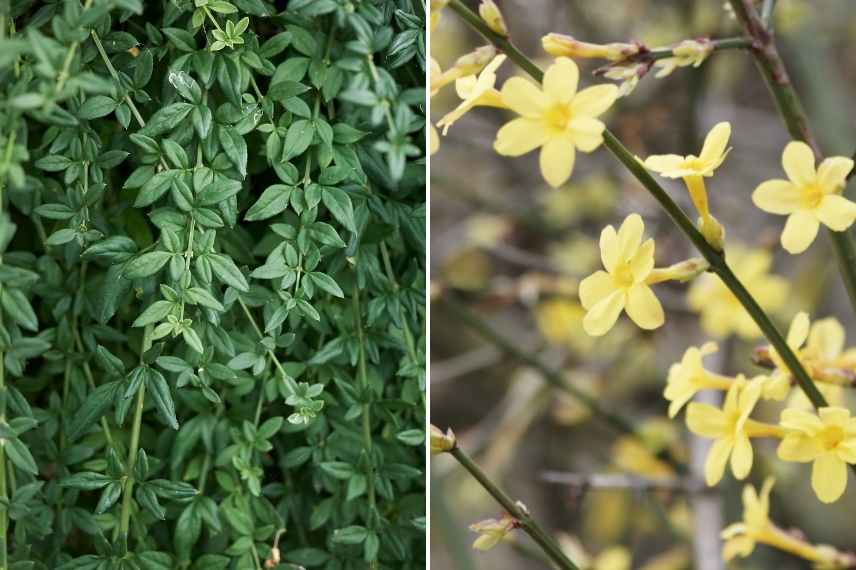
Jasminum nudiflorum
Exochorda
The pearl tree, a lovely vernacular name for the Exochorda, is not always easy to remember. It is a shrub that truly lives up to its name and is one of those shrubs whose silhouette gracefully elongates in the garden, much to our delight!
Elegant, the Exochorda displays supple branches that incline as they grow. The foliage, small and ovate, turns yellow in autumn, but it is the flowers—abundant, often semi-double, and pearly like beads—that captivate in April or May. Exochorda adapt well to small and medium gardens thanks to their medium size (between 1.5 m and 3 m). They thrive in full sun or partial shade, in humus-bearing, well-drained, non-calcareous soil.
Among the most beautiful arching specimens are: the Exochorda macrantha ‘The Bride’ and the Exochorda racemosa ‘Niagara’.
♥ Its advantages: the beauty and brilliance of its spring flowering, its hardiness, and its ease of cultivation.
→ Learn more about Exochorda in our comprehensive guide: Exochorda, pearl tree, planting, growing and pruning.
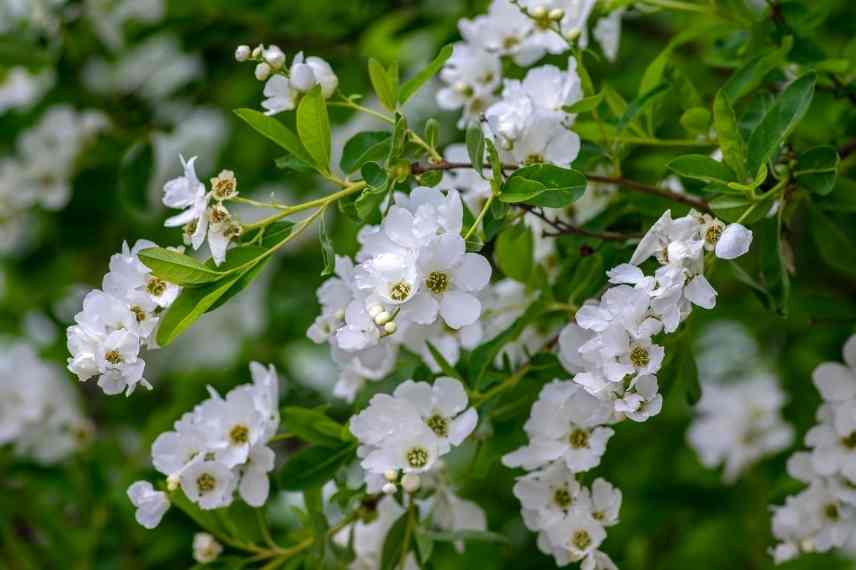
Exochorda racemosa
Lespedeza thunbergii
Yet another shrub with a beautifully arched habit: it is the Lespedeza, not so common in our gardens. However, for those seeking a strongly weeping silhouette in a shrub , the Lespedeza stands out with its heavily trailing stems that bend down to the ground. The deciduous leaves are small and light. This is a small shrub of Japanese origin, reaching about 1.5 m in height. Its flowering from late summer to September is delightful: it belongs to the legume family, characterised by bilabiate flowers similar to those of sweet peas, displaying a vibrant magenta pink almost purple hue.
This compact little shrub is charming along a hedge, beside a low wall, or showcased alone where its fountain-like habit will shine. It should be planted in full sun or partial shade, in any soil that does not dry out.
♥ Its advantages: an elegant late flowering from late summer to autumn, ease of cultivation, and very good hardiness.
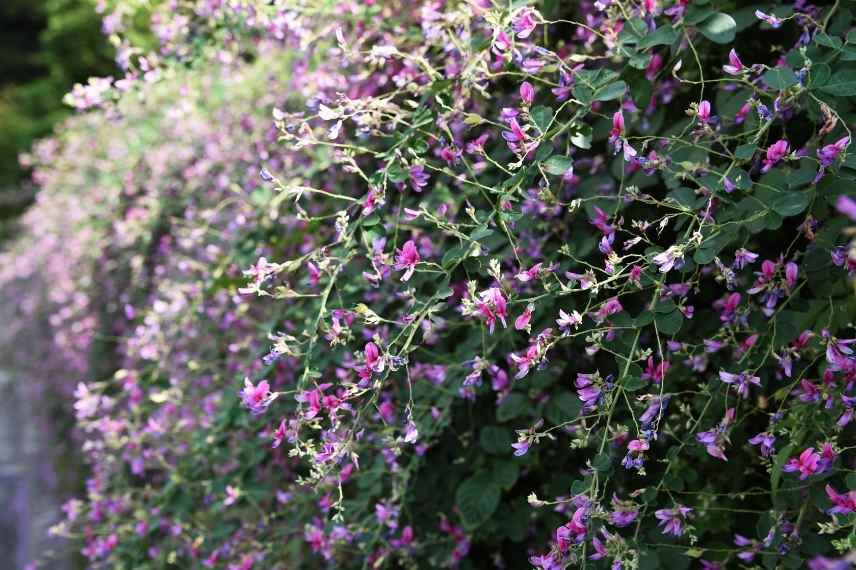
Lespedeza thunbergii
Tamaris
Here is one of the most iconic and recognisable shrubs with an arching habit: Tamarisk, as there are varieties that flower in spring and others that flower in summer.
Familiar in coastal gardens, where it is used as a free-standing hedge or as a windbreak, it is also very attractive when grown in isolation. Its often leaning silhouette is graceful, and its very light temperament is due to its spreading and flexible branches and its glaucous scale-like leaves. The flowers always bloom before the leaves appear, making it one of the most impressive shrubs in full floral display. It boasts a flowering composed of tiny bright or pale pink flowers, delightfully feathery: a true cuddle plant.
The tamarisk is a large shrub that requires full sun. It thrives very well in sandy, even poor soils.
♥ Its advantages: its lightness, its magical silky flowering, its resistance to sea spray and salty soils.
→ Learn more about the Tamarisk in our comprehensive guide: Tamarisk, planting, pruning, and care.
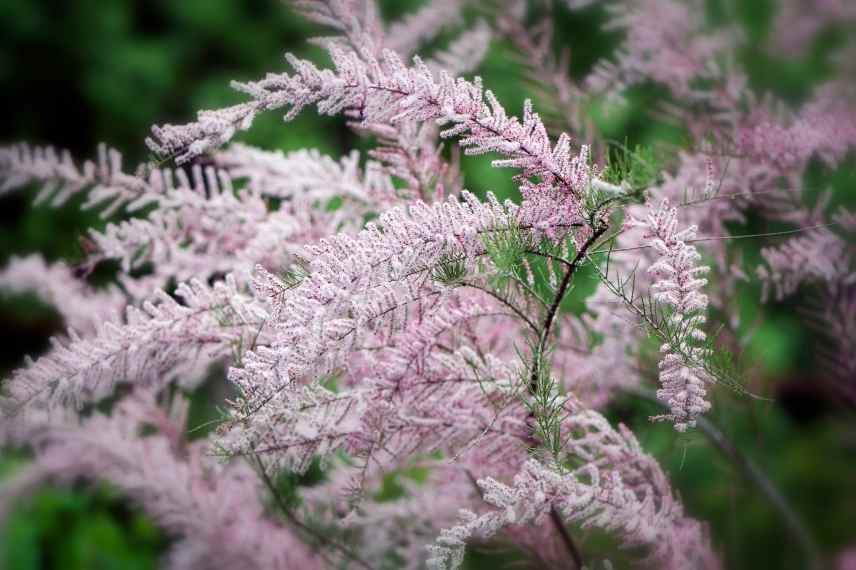
Tamarisk
The Japanese rose
More commonly known as Japanese Kerria, the Kerria japonica is a somewhat vintage shrub that was widely planted in gardens in the past. This small shrub (1.5 – 2 m in height on average) becomes very arching with age and provides a charming, airy silhouette. Its stems remain green and bear simple or pompom-like golden-yellow to orange flowers in April, along with dark green deciduous foliage. It is ideal for country gardens, but also suitable for urban settings due to its modest size. It can adorn the back of a spring border in yellow and blue tones or blend into a hedge in partial shade. The Japanese rose requires fresh, well-drained soil.
♥ Its advantages: the vibrancy it brings in spring with its myriad of orange-yellow flowers and its excellent hardiness.
→ Learn more about the Japanese rose in our comprehensive guide: Kerria japonica, plant, prune, care.
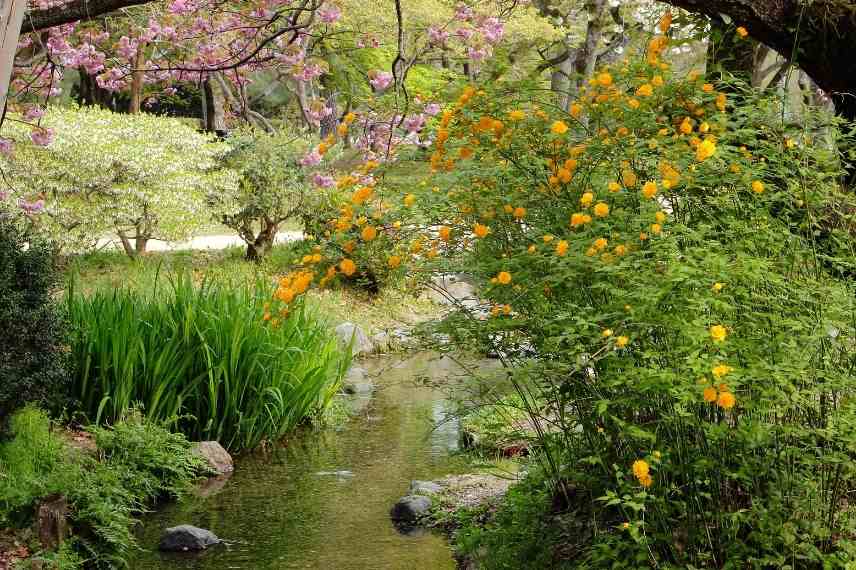
Kerria japonica
Cotoneaster lacteus
Once unloved, the milky cotoneaster is now being rediscovered for its beautiful arched habit, but that’s not all! This lovely evergreen shrub has multiple qualities, including its melliferous flowering in cream corymbs (clusters) in spring, which transforms into bright red berries that are highly sought after by birds as the first frosts arrive. Don’t be put off by its appearance, which some may deem common. Left to its own devices, it forms a lovely rounded shrub with a trailing habit, but it can also be trained on a stem to modernise it and further highlight its naturally arched character. The ovate leaves, a medium green with strong veins, are also very attractive in their own right! When mature, the milky cotoneaster adopts a wider than tall size (2 to 3 m in height and nearly 4 m in width).
♥ Its advantages: an “eco-friendly” shrub ahead of its time, very hardy and well-suited to drought, with its colourful winter fruiting.
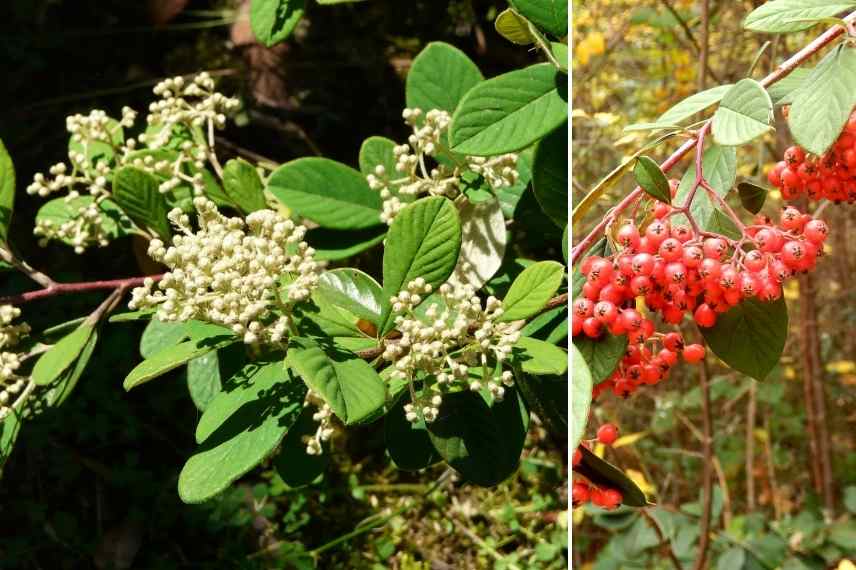
Milky Cotoneaster
Sarcococca saligna
Here is another shrub that is still relatively uncommon but interesting for various reasons in shaded situations: Sarcococca saligna, or willow-leaved sarcococca, also displays a lovely arched habit thanks to its very flexible and curved branches. It differs significantly from other sarcococcas due to its narrow, elongated foliage, and it does not have as fragrant a flowering as most of them. Therefore, it is sought after more for its beautiful foliage and cascading trailing habit, whether in small gardens (compact, it measures 1 m in all directions), in shady rockeries, or in a low evergreen hedge…
♥ Its advantages: its winter flowering, persistence, hardiness, and ability to thrive in shade.
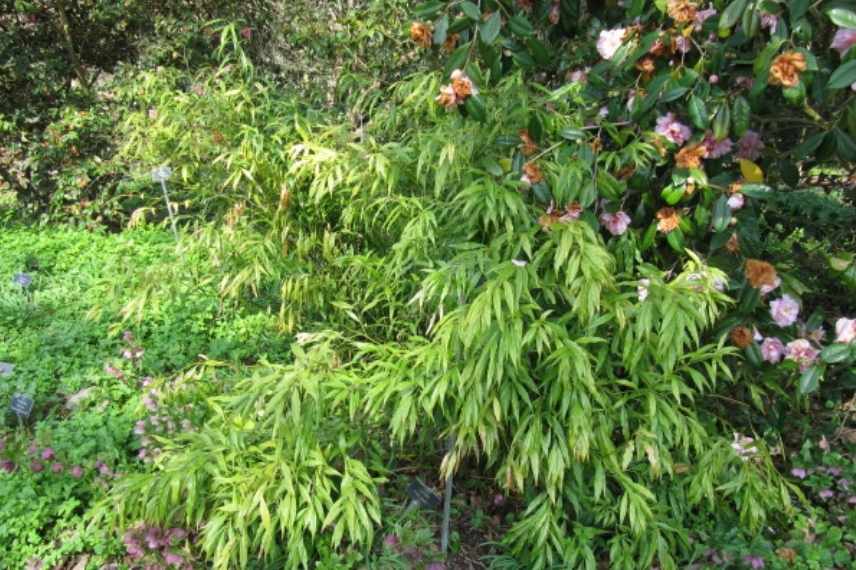
Sarcococca saligna (© Leonora Enking)
- Subscribe!
- Contents

Comments