





























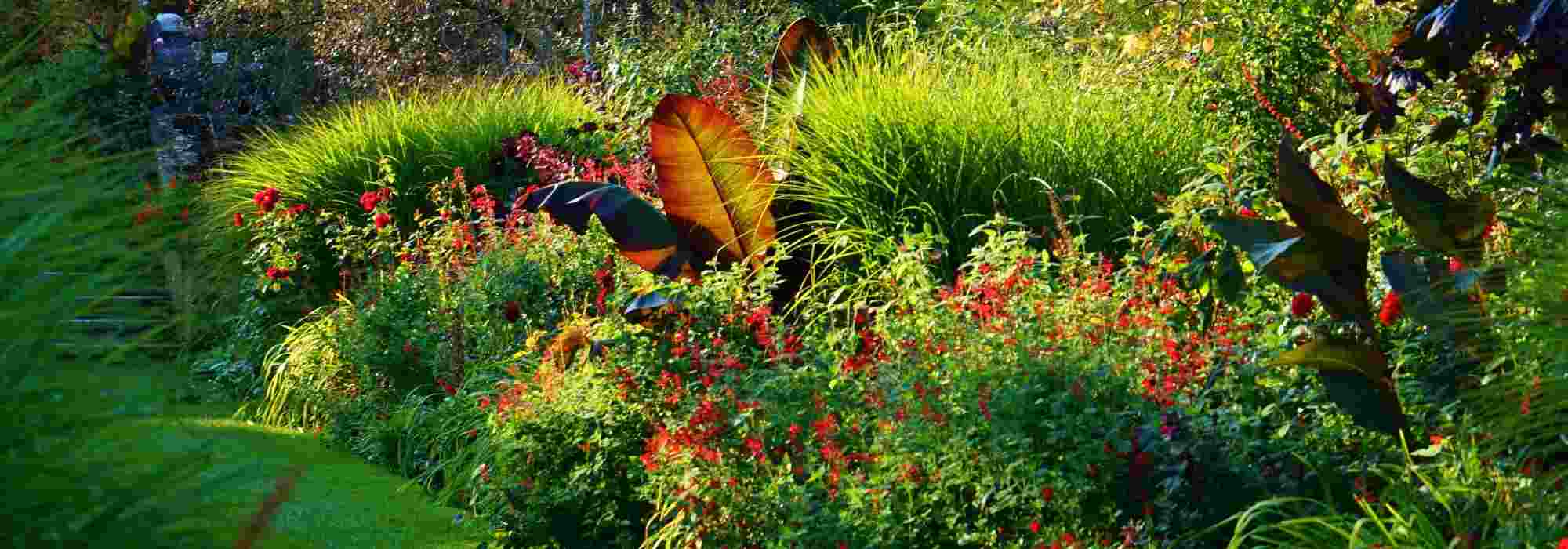
8 landscaping tips for red gardens
How to successfully create a red monochrome garden?
Contents
In the trend of monochrome gardens, the red garden is not the most common, and for good reason; it is risky to attempt this flamboyant colour as the sole chromatic touch. The red, warm and fiery, evokes admiration, but red and purple flowers or foliage are often combined with nearby shades and plenty of greenery.
The monochrome red garden plays with this colour through both flowering and foliage. While the exotic garden is best suited for a profusion of red flowers and purple foliage, other gardens or scenes can also be envisioned in imperial red.
How can you create a red garden without falling into the trap of bad taste? We offer you some ideas and tips for creating a red tableau in a part of the garden or over a larger area.

Red in the garden
- Red, one of the three primary colours alongside blue and yellow, is undoubtedly the strongest colour in the garden along with black tones.
- The symbolism of red immediately evokes passion and exuberance. In the garden, red is so vibrant that it plays a central role in summer scenes. But beware of red or purple flowers and foliage: they draw attention, making it challenging to create a monochrome garden with this single colour.
- The warmest colour on the colour wheel, red is one of the most vibrant and tonic colours alongside yellow and orange. It pairs particularly well with them. It creates vibrant gardens when chosen in warm tones, but it also takes on a cool tone when tinted with blue, shifting to purple. When mixed with white, it tends towards pink.
- The complementary colour of red is green, a shade to be generously integrated to balance the fiery effect of red. We will see that white also has a calming and stabilising effect on this colour.
- If red is the most ardent colour, it is not the most represented among flowering species, much less so than pink and white… at least in our latitudes. The choice often falls on the same species, but there are many red flowers to discover for creating a monochrome garden!
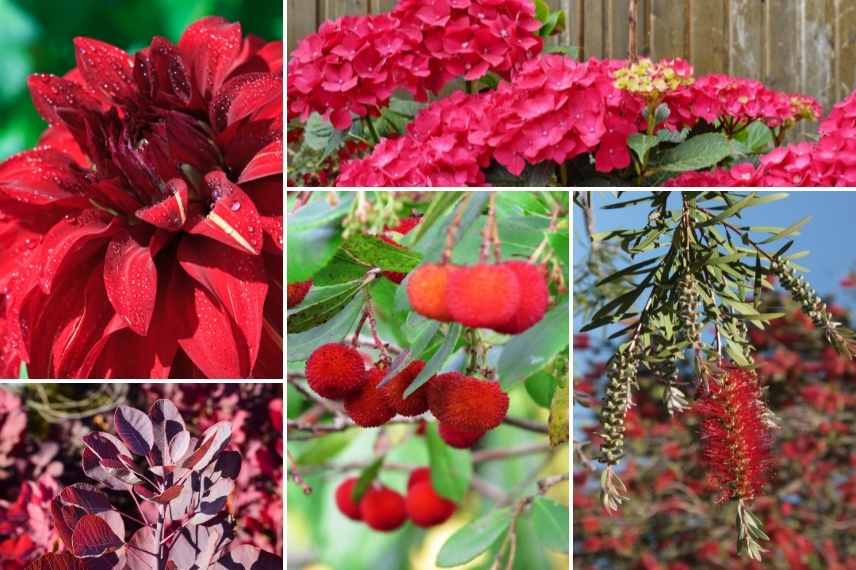
Red can be found in gardens, in flowers, but also in foliage and fruits: Dahlia, Cotinus, hydrangea, strawberry tree, and Callistemon
Read also
Pairing red or purple flowersFor what style of garden?
If there is a strong bias, the red garden actually adapts to radically opposing environments, as this colour is universal and iconic. It can be found in spaces of great classicism or, conversely, in lush places like exotic or English gardens.
An exotic garden
This is the easiest option to bring a mass of red colour to the garden. Exotic flowers are often scarlet red, and there are very beautiful red-flowering trees, unfortunately not very suitable for our climate due to their low hardiness, but which Mediterranean gardens will eagerly add to their list (see below in our selection).
In addition to these radiant beauties, we will gladly adopt the most spectacular flowerings for a complete exotic effect in the mildest regions (Atlantic coast and southern France): several Proteas like Telopea, Leucadendron ‘Safari Sunset’ or Leucospermum, and a dark red Bougainvillea reaching great heights. To complement a lush atmosphere primarily composed of broad foliage like banana plants, Colocasias, Tetrapanax and other palms, we can plant the reddest campsis, Callistemons and Grevillea, Brazilian guavas with protection, and a multitude of perennials or bulbous plants: Cannas, Kniphofias, Day lilies and red Crocosmias. We will insert some orange varieties among these characterful plants for even more warmth. In most gardens, common Rose mallow and a sculptural Aeonium arboreum will be possible in pots to be stored away. The key in an exotic jungle-type garden is to multiply the plants with broad leaves.
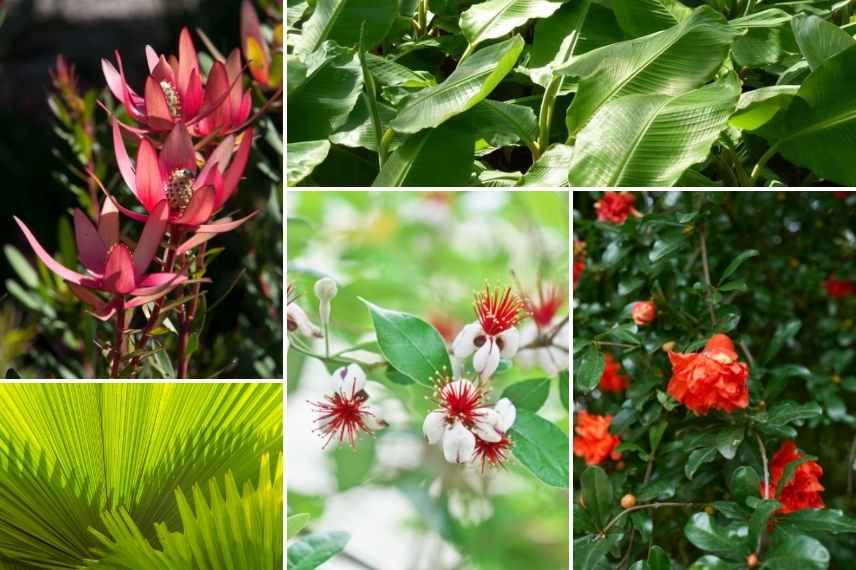
Pink to orange flowers are enhanced in an exotic garden: Protea, Feijoa and Pomegranate coexist here with banana plants and palmate-leaved palms.
A Japanese garden
Japanese scenes are magnified by the incandescent foliage of Acers in autumn, but not only! Many emblematic shrubs of this Zen garden have striking red flowers, including the essential Japanese azaleas and some rhododendrons. They will be the centrepieces of spring, preceded by a Japanese quince in the brightest tones (‘Texas Scarlett’ or ‘Red Joy’). Integrate one or two Pieris whose foliage evolves into sublime reddened tones, a Fatsia polycarpa, a few Japanese maples (one green turning red and one purple), and a mass of ferns, Farfugiums and other shade plants. Some very soft pink or white flowers will calm the fire and often fill the gaps in the off-seasons (Magnolia, Japanese anemones, Tricyrtis, Prunus, etc).
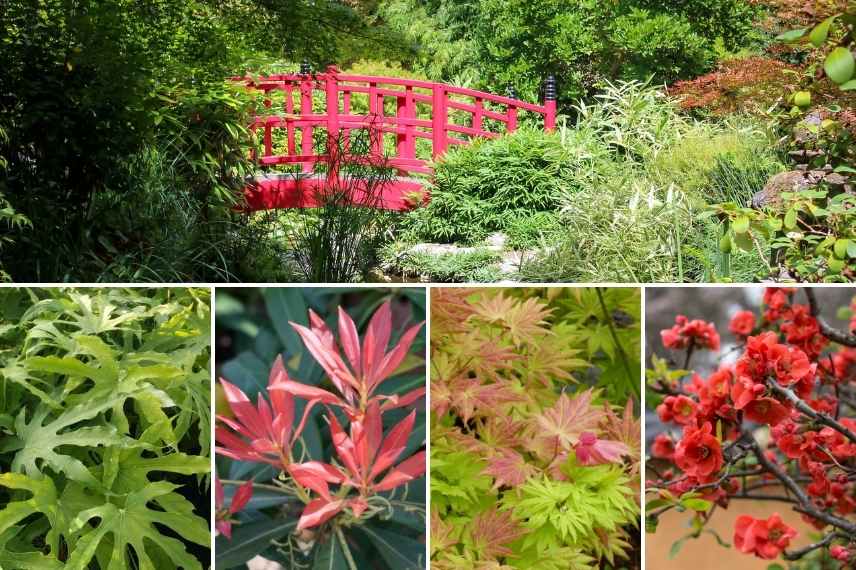
A Japanese scene with the iconic red bridge (which can be replaced by a simple railing), and graceful shrubs: Fatsia polycarpa, Pieris ‘Winter Flame’, Acer palmatum shirasawarum ‘Aureum’ and Japanese quince
A contemporary garden
The “design” garden with deliberately reduced colours, often in neutral tones and combining white or the straw colour of grasses, highlights green to bluish to black foliage, graphic and structured shapes. This is an ideal garden to invite red in touches in a pattern spirit, with carefully selected flowers and foliage to provide enough intensity, but also in a single accessory (chair, bench, pot, structure, statue) that will enhance the decidedly modern scene. Choose sculptural or atypical plants: Sumac, Amaranth, Melianthus major, Purple Phormium, mixed with round-shaped shrubs, topiaries or vertical forms (Pittosporum tobira, Hebe like the white Hebe rakaiensis, Lonicera nitida, Helianthus salicifolius and horsetail or black bamboos…) and some soft grasses.
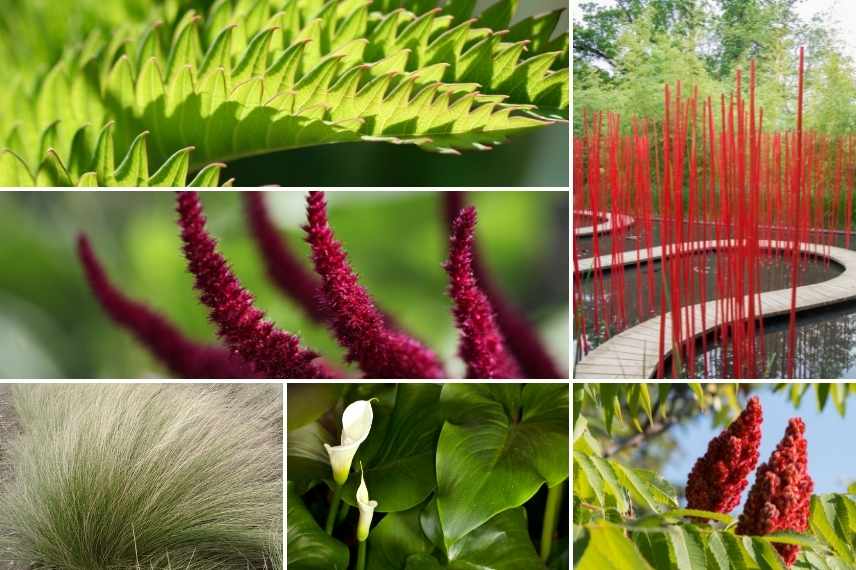
Melianthus major, amaranth, stipa tenuissima, Zantedeschia aethiopica and Virginia Sumac. A strong visual completes the scene
A classic French garden
A monochrome red garden is also very coherent in a French garden, enamoured with red, white and green. This configuration can be found in large properties, châteaux and manors when one wishes to maintain the idea of a formal garden. Here, the possibilities are numerous, often around boxwood embroidery surrounding the flowers and composing geometric figures, but also within rose gardens. Red annuals and purple foliage are preferred to renew the scenes as much as possible from one year to the next, all enhanced by topiaries and neatly trimmed shrubs.
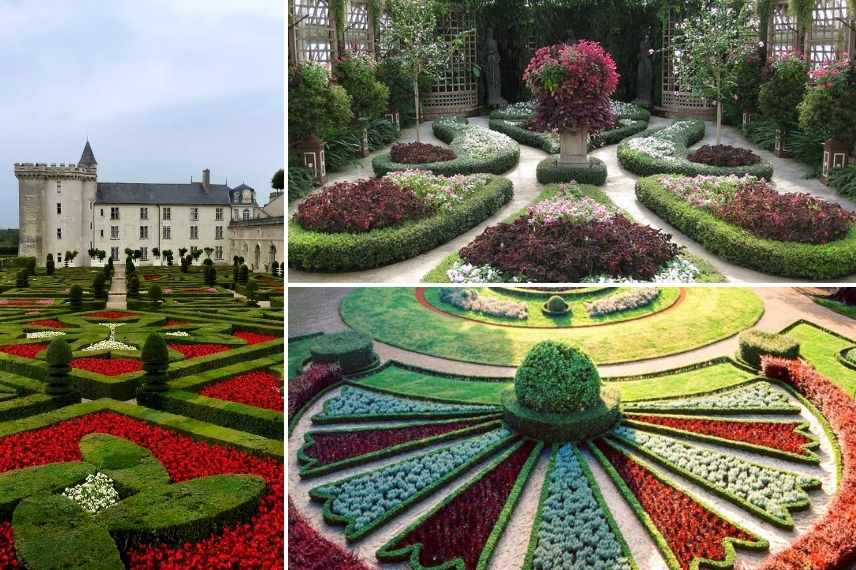
Villandry gardens on the left and detail of the flowerbeds of the Château d’Angers. At the top right, another arrangement formed of boxwood embroidery and red and purple plantings (© daveynin-Flickr)
The English garden
As we will see later in this article, the English garden and its mixed borders favour warm colours, and red is one of the essentials in lush gardens during summer. In this case, compositions are made with red harmonies, where flowers will compete in brilliance in yellow-orange tones. Purple and golden foliage from certain shrubs, annuals and grasses will also serve as a binding element.
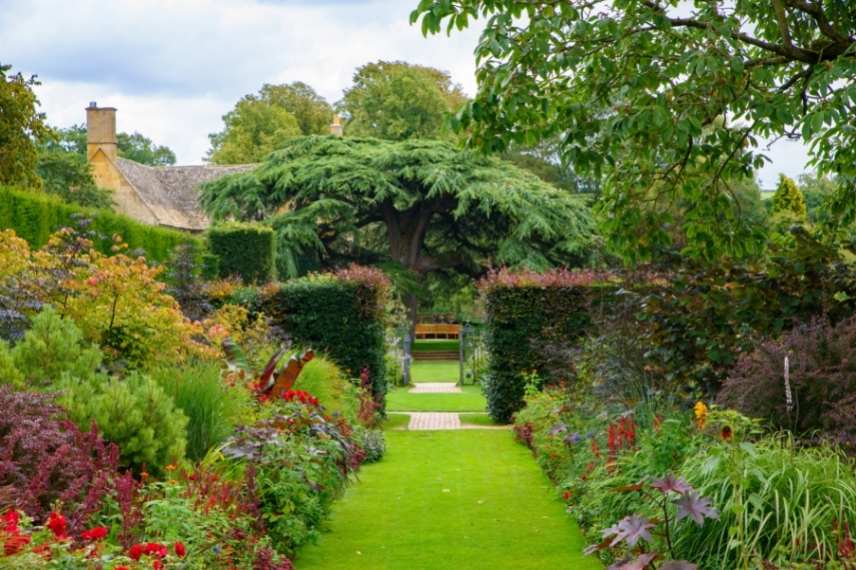
The English garden and its mixed borders: here the famous “Red border” at Hidcote chooses a combination of red, purple and green
A countryside garden
One can envision a red garden in the countryside, provided that the rosy and purple red flowers are diluted with plenty of foliage, grasses, and some neutral white flowers. The vivid impression of red is then attenuated, which is suitable for this rustic garden. Integrate the most rustic flowers, such as monardas, as well as red poppies, hollyhocks, integrating for example Gypsophila, wormwoods, large white daisies (Leucanthemum), not forgetting some light grasses like the delicate but sublime Pennisetum setaceum ‘Rubrum’ or ‘Fireworks’ and Miscanthus. Elder and physocarpus are beautiful shrubs to plant for their purple to black foliage and graceful white or very pale pink flowers that will not clash at the end of spring. Some simple-flowered clematis like Clematis ‘Rouge Cardinal’ will beautify this garden all summer, a golden hop will bring much light, and a virgin vine (Partenocissus) will close the season in a fairy-like blaze.
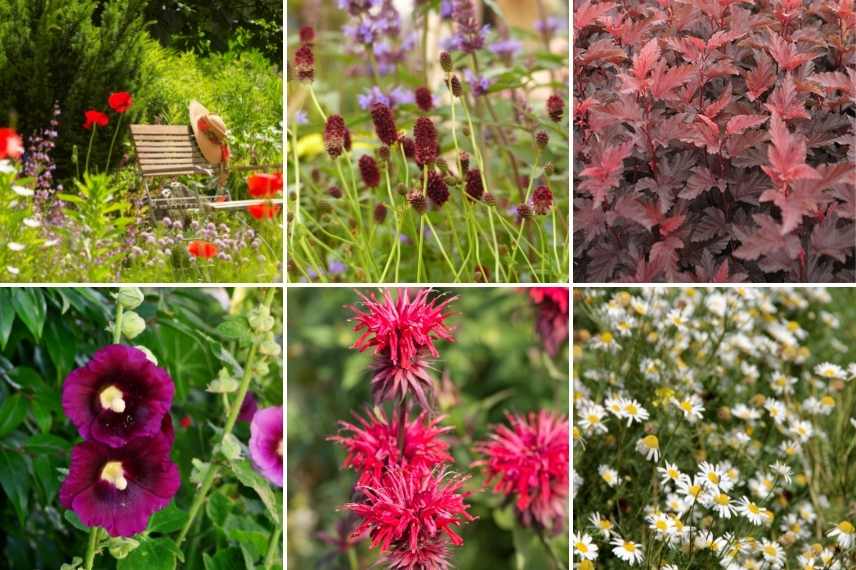 Dare to use red in a countryside garden: dark and scarlet reds mixed with rich reds and white: poppies, sanguisorba, physocarpus, hollyhocks, monarda and large daisy (Leucanthemum)
→ See also our article Pairing red or purple flowers.
Be mindful of overheating and associations!
Wanting to compose solely with red flowers or foliage is a mistake even more pronounced in the red garden than in other monochrome gardens. A garden that would consist solely of a compilation of red flowerings and purple foliage would indeed be uncomfortable to the eye, as the attraction of red on the eye eclipses surrounding plants.
Red must therefore be enveloped by an essential other colour: green! Bright greens to highlight dark reds or purples, greyed greens for more pinkish reds. Green in all its shades, up to purple, but always generously.
Purple, often brought by sumptuous foliage, is essential in the red garden, but it too will require careful dosing: in lighter shades, it calms the ardour of red, but in shades approaching black, it becomes gloomy and should then be surrounded by orange-red or bicoloured flowers.
Red will be tempered in the garden when associated with white, straw, or cream which soothes the fire, or by choosing flowerings in closely related shades of red, a tone above or below (in gradient), or in monochrome (nuanced with nearby shades like pink or orange). Pair dark reds leaning towards burgundy with some mauves or pinks to brighten the whole.
For all these reasons, red remains difficult to handle. It is often advisable to consider a single subspace of the garden dedicated to this powerful colour, or even just one season (summer, autumn, or winter most often). This is a wise compromise for the boldest gardeners.
→ See also our article on the perception of colours and the effect of light on red.
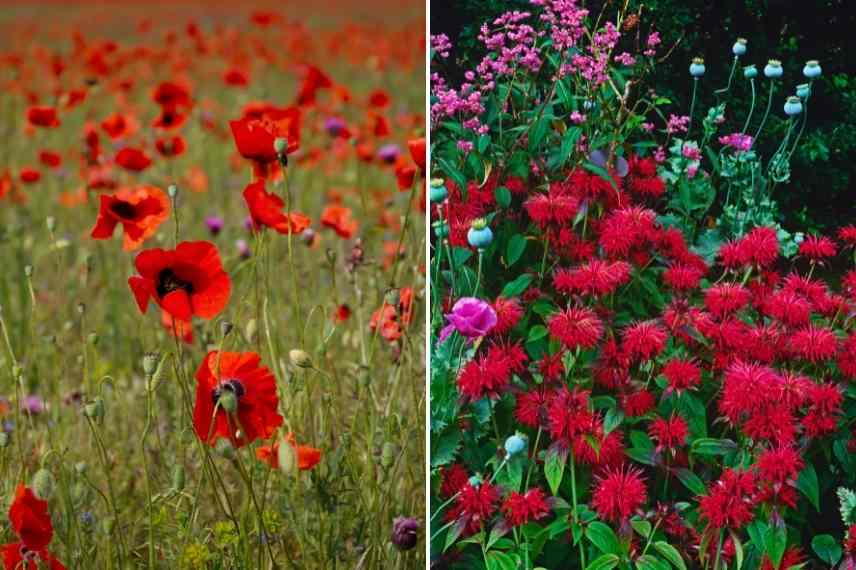
Scarlet red pairs well with light or bright greens like these poppies in a wild meadow. On the right, a scene that appears a bit too sad mixes reds and pinks with overly glaucous greens.
Compose with the most beautiful flowers, foliage, and red fruits
Some plants only bloom in red, and these are the ones we favour in the red garden. And then… there are all the other red to purple flowers that can also be found in other colours, such as Dahlias, to name just a few. But red is also a sought-after colour among foliage and fruits. So many possibilities! Here are some of the most beautiful references for creating a red garden:
- Red-flowering shrubs and undershrubs: Calycanthus, Lagerstroemia ‘Red Imperator’, Feijoa (Acca sellowiana) in red and pink, Japanese azaleas, Rhododendrons and Camellias, Japanese quince, the Pomegranate in orange-red, Weigela ‘All Summer Red’, Red Oleander ‘Single’, Melianthus major, bush sages, Escallonia rubra, Grevillea…
- Perennials and bulbous plants: Crocosmia ‘Lucifer’ and ‘Babylon‘, Dahlia and gladioli, some tulips and Lilies, Monardas, sages, Acanthus sennii, numerous roses, Russelia equisetiformis
- Climbers: Bougainvilleas and Trumpet vines in red, Gloriosa rotschildiana, Dipladenia ‘Cerise’ or ‘Jade Scarlet’
- Annuals: Amaranth, Zinnia, Cosmos atrosanguineus ‘Chocolate’ and impatiens
- Red to purple foliage: some Loropetalum, Physocarpus, and Cotinus, Albizia julibrissin ‘Summer Chocolate’, Purple-leaved Heucheras, Phormium tenax ‘Purpureum’, Cordyline ‘Charly Boy’ and other cultivars in these two genera, Dodonaea, Berberis, Euphorbia amygdaloides ‘Purpurea’, Persicaria ‘Red Dragon’, Lophomyrtus, Filipendula ‘Hjordis’, Actaea simplex ‘Brunette’. Also read 7 red-leaved grasses!
- Red autumn foliage: Virginia creeper (Parthenocissus), Euonymus alatus (winged spindle), Liquidambar, Nyssa sylvatica, and many Japanese maples
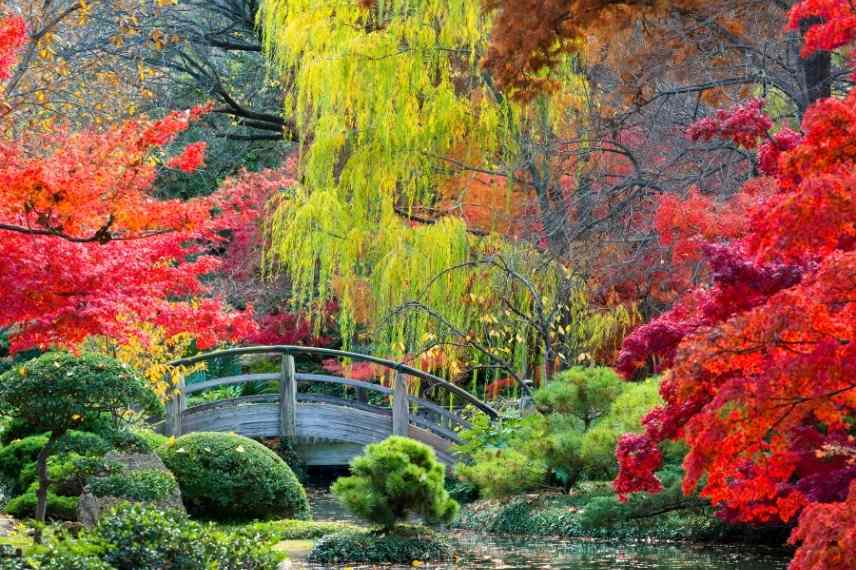 The red garden can also be designed with its striking autumn colours alongside bright greens
- Red berries and fruits: castor oil plant, Cotoneaster, Pyracantha, Malus evereste, Myrica rubra, strawberry tree, holly…
- Grasses: Uncinia rubra, Miscanthus sinensis ‘Ferner Osten’ and ‘Ghana’, some Panicum virgatum including ‘Kulsenmoor’, Imperata cylindrica ‘Red Baron’…
- The most exotic… but tender plants: among them are trees like the Japanese Tulip Tree (Spathodea campanulata), the flamboyant (Delonix regia), Metrosideros, Brachychiton acerifolius, the fire tree (Embothrium coccineum), and shrubs like Erythrina (also known as coral tree), Telopea, Abutilon, lobster claw (Clianthus puniceus)…
- Red and bicoloured blooms/foliage: they are variegated with a bouquet of stamens, a border or a contrasting heart often white, pink or purple: camellias like Camellia japonica ‘Lipstick’, fuchsia, Caladium, Primula vialii, some roses like Feijoa, or with a white throat like Penstemon ‘Le Phare’, some Kalmia like ‘Minuet’…
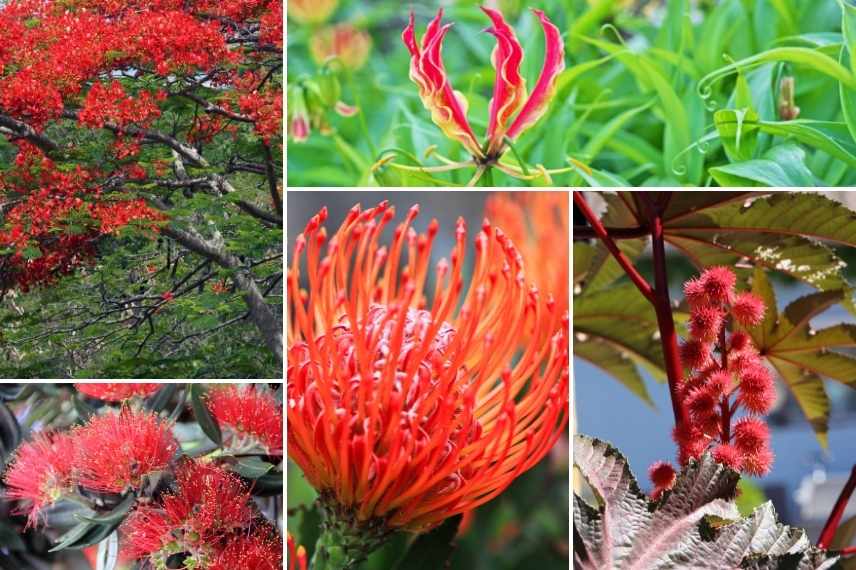 Gabon Tulip Tree, Metrosideros, Gloriosa, Leucadendron and castor oil plant: spectacular plants reserved for the least tender gardens!
Install a hot border
Red is a magical colour in summer and autumn… It is the standout colour that the English have chosen, along with orange and yellow, to create a summer version in warm tones of their legendary mixed-border, an opulent bed formed of flowers that enhance each other.
To achieve the most vibrant effect in this seasonal bed, select a mix of perennials in warm tones. You can even add some purple blooms (asters, daisies…), resulting in a more spectacular display at the end of summer, ideally ensuring a spreading of the flowering: in a large border, lobelias, dahlias, cannas, and red alstroemerias, gladioli, Crocosmia ‘Lucifer’, monardas, or kniphofias thrive, mingled with bright yellows and sunny oranges: heleniums, coreopsis, yarrow, and solidago. Physalis and grasses maintain this spectacle until the frosts: Chinese fountain grass, Uncinia rubra, Stipas, Miscanthus. Integrate some purple foliage (Phormium, as well as those of dahlias, lobelias, and cannas), or light, tender green like that of Helianthus salicifolius or fennel.
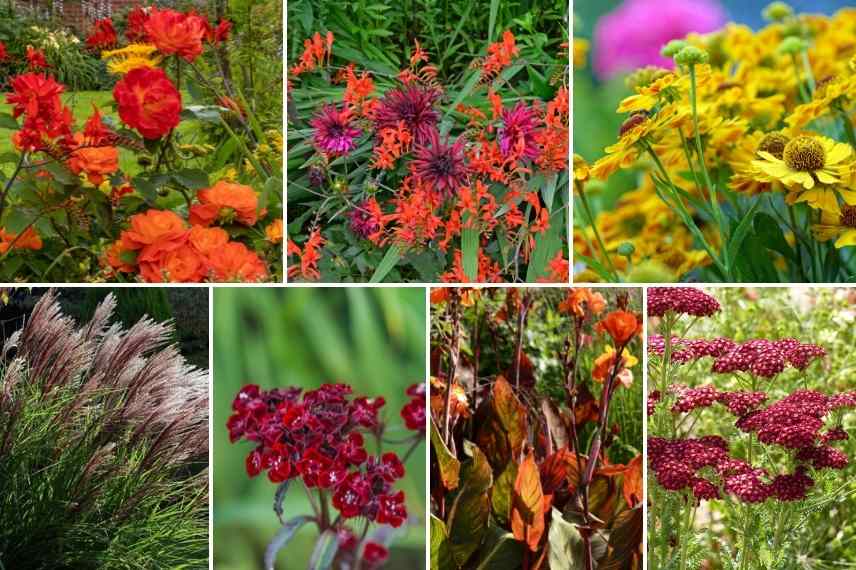
A profusion of warm shades, from reddish-orange to burgundy: roses, Crocosmias, dahlias, heleniums, Miscanthus sinensis, Dianthus barbatus, cannas, and Achillea millefolium ‘Red Velvet’ for the creation of a “hot border”
Don't forget the winter garden
One often lacks the boldness to design an entire outdoor space as a monochrome red garden, an option that can be quite radical. However, specific areas can invite red as the guest star! This is typically the case for the winter garden, which plays with the warmest colours during the cold season. This garden has become a beautiful trend in recent years. It combines shrubs with attractive fruit, interesting barks, and some sumptuous winter blooms, thus awakening the dormant garden.
In the heart of winter, you can create a large shrub mass where reddened barks and woods will emerge from the garden amidst perennials and conifers. You can even play with the garnet berries and fruits of certain shrubs like the ornamental apple or holly. The garden literally ignites under the effect of carefully chosen plants, which will succeed one another until the first signs of spring.
Here are some of the most beautiful reds for a successful winter garden: Cornus alba ‘Sibirica’ with its bright red upright stems, Dodonea viscosa ‘Purpurea’, Malus ‘Red Obelisk’ with its small decorative red apples, Prunus rufa with its amber-brown bark, Prunus maackii, Acer palmatum ‘Winter Flame’, Bergenia ‘Bressingham Ruby’, etc. They will complement a very soft plant palette, composed of heathers, birches, blue conifers, and more.
Learn more about the winter garden in our article!
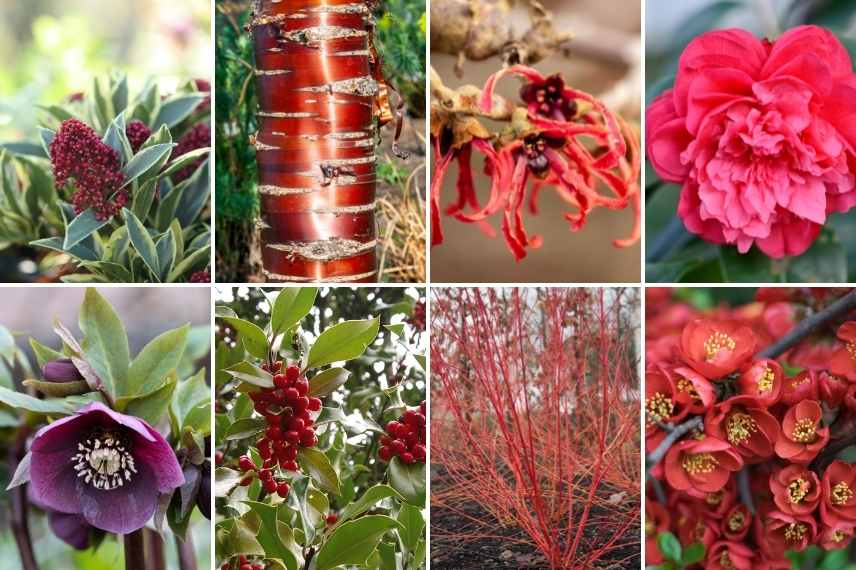
Skimmia japonica, Prunus serrula, Hamamelis, Camellia, Oriental Hellebore, holly, Cornus alba ‘Sibirica’, and Japanese quince.
... nor the shaded garden
Certainly, red flowers thrive much better in sunlight than in shade… but a small number of them do enjoy it. This allows for the possibility of utilising shaded and semi-shaded areas in a planned red garden. In such locations, you can find a lovely variety of foliage ranging from red to purple. This little ensemble should be accompanied by some light, white inflorescences (like those of heucheras, for example) and certain variegated or fresh green foliage to lighten the overall effect and especially bring more brightness (ferns, hostas, epimediums, polygonatums, etc.).
Prioritise red flowers variegated with white or cream, as well as scarlet red and red leaning towards orange, which are less cold. A few powdery pink or very pale notes will harmonise well in the darkest areas to further illuminate the scene.
→ Among the beautiful options for a red shade garden: scarlet azaleas or rhododendrons like Rhododendron ‘Melville’, some hydrangeas in the most beautiful red shades like Hydrangea macrophylla ‘Julisa, crimson red, Hydrangea ‘Leuchtfeuer’ or, less commonly, the bicolour ‘Green Shadow’®, astilbes (which can be paired with a light pink variety), the lovely Primula vialii in red and mauve, and Loropetalum with purple foliage. Also consider Nandina domestica, which will offer reddened foliage in winter if they receive enough sunlight, along with bright red berries.
Dare to integrate into a large exotic-themed bed Tricyrtis hirta ‘Raspberry Mousse’, Arisema speciosum, striated with purple and acid green, some Roscoea purpurea ‘Rubra’ which are also stunning, and a Caladium white veined with red like ‘White Queen’.
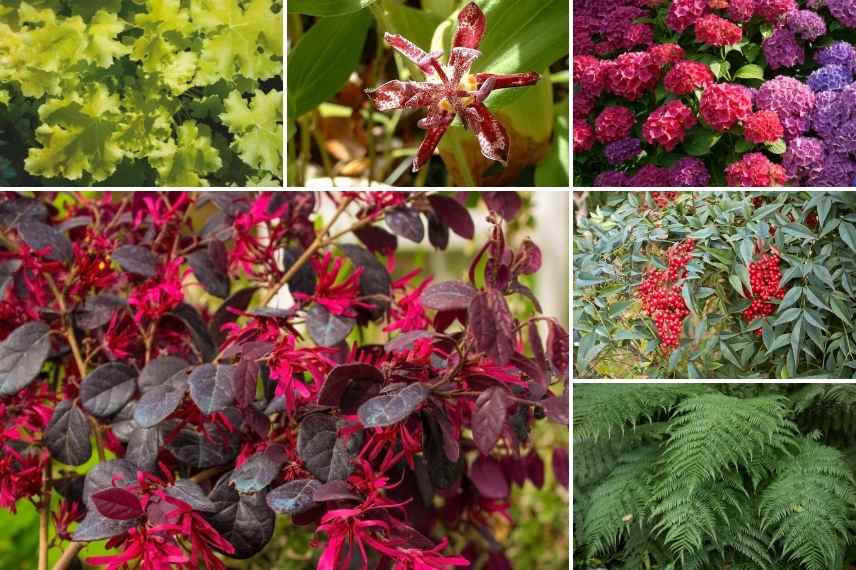
An anise green foliage is useful to soften the bright foliage: Here Heuchera ‘Lime Ricket’, alongside Tricyrtis hirta ‘Raspberry Mousse’, red and pink Hydrangea macrophylla, a flowering Loropetalum (in winter), heavenly bamboo, and a fern.
Refine with furniture and materials
The vitality of red should be considered when finalising the layout of a red garden.
Given the importance placed on this colour in a monochrome garden, even if red is attenuated by green and a few white touches, it is best not to overdo it, especially with furniture. Thus, a bulky garden lounge should be chosen in neutral and muted shades (anthracite grey, white, cream) or in natural materials (wicker, wood). The shapes can be straight, with a design look, or conversely round, depending on whether one is creating a contemporary garden or an English garden.
However, one can consider inserting, even in a small garden, a red bench or two small chairs as a reminder of the plant palette. Chilean chairs in “bayadère” fabric, striped with red and other colours, are a lovely alternative to subtly bring in red without overdoing it in a country garden, for example.
Pots and containers on the terrace or in the garden can also draw the eye to a beautiful object such as Albi pottery, known for its beautiful glazed reds. But again, be sparing: it is better to have one original object than several scattered throughout the red garden, as it would lose its finesse. Matte and raw terracotta provides a subtle marriage with red (terracotta pots, paving), blending into the surrounding green. All synthetic materials (resin, fibreglass with a concrete look…) in dark or very light colours will be perfect in a modern setting.
Finally, in a region like the Basque Country or Brittany, where oxblood red is part of the landscape and architecture (doors, shutters, gates), stay within the tone, but avoid overloading with accessories.
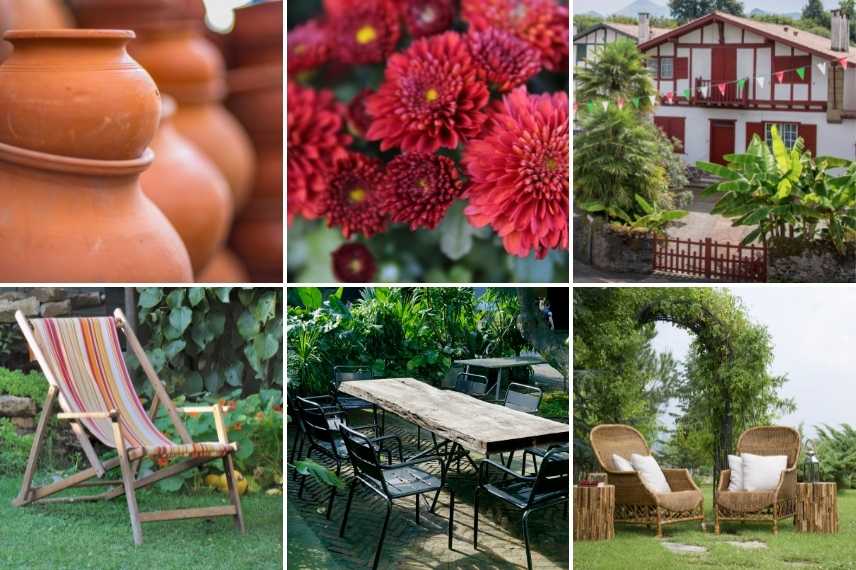
Pots, chairs, garden lounge and relaxation area: always keep in mind not to compete with the strength and omnipresence of red in the garden.
- Subscribe!
- Contents
![[plantes couleur="rouge"]](https://www.promessedefleurs.ie/blogwp/wp-content/uploads/2022/08/8-conseils-de-paysagiste-pour-amenager-un-jardin-rouge.jpg "8 landscaping tips for creating a red garden")
Comments